Framework:
Burdens
This topic should be judged on the basis of utilitarianism. This holds that an action that would otherwise be immoral becomes justified if it leads to a net benefit for the greater good.
Existence of Threshold
Many actions, such as driving a car, owning a knife, or drinking alcohol, are justified despite posing some risk to innocent people. We know that the court system will convict some innocent people, but it’s necessary for the common good. Furthermore, actions that would sometimes be unjustified, such as speeding, become justified in extreme situations. Speeding poses risks to innocent people, but if you’ve been stabbed and need to get to the hospital quickly, that risk is acceptable. The government infringes on liberties all the time and goes to war despite knowing that there will be civilian casualties, but these sacrifices are necessary. Most US soldiers in WW2 were drafted, but this was necessary to end the Holocaust and put a stop to Hitler’s expansion. As evidenced by these examples, a harmful action is justified so long as it is necessary to prevent greater harm.
Objections to Utilitarianism Debunked
Objections to soft utilitarianism usually take the form of convoluted thought experiments that don’t actually represent the framework well. For example, Judith Jarvis Thomson argues that forcibly taking one person’s organs to save five people would be unjustified, despite being a net benefit. But such an action would not be a net benefit, because when this action was discovered, it would inevitably lead to distrust of doctors and the medical system and therefore less people being treated.
A much simpler scenario would be asking someone “would you press a button to save five people even if it killed one person?” And when we take practicality into account, the correct answer is of course yes—one person’s death, while tragic, is not as bad as five people dying.
Hence, if hypothetical scenarios become too convoluted, they are not a good representation of soft utilitarianism or of Light Yagami’s actions, which led to a net benefit.
Moral Duties
We must also take into account moral duties. For example, if I see a child drowning in a pond and don’t save them, I clearly bear responsibility for their death. Morally speaking, it would not be different from killing them—saving and killing are both making a choice about whether someone will live or die. Killing 1 person to save a greater number of people involves a conflict between the duty to save and the duty not to kill, but these are really both part of our duty to keep others alive when given the choice. Thus, sacrificing the smaller number of people is the logical thing to do, since it prevents a greater amount of death.
My Case
I will use the following modus ponens to affirm the resolution:
1. Justifications for the Death Note:
Criminals vs. Innocent
Light Yagami targets criminals, making up the vast majority of his killings. Infringing on the liberties of convicted criminals to protect the innocent is clearly justified, even if you don’t accept utilitarianism—otherwise prisons are no different from kidnapping innocent people.
New World
In E2, Light Yagami states his motivations clearly: “I protect the innocent and those who fear evil.” Even if Light Yagami had only killed innocent people to achieve his goal, it would be justified by net benefit.
2. Death Note Net Effect:
Crime Rates
Due to Light Yagami’s actions, violent crime rates were reduced by over 70%. This dramatic effect was first observed when his killings first began. Given approximately 475,000 homicides annually, this means that Light saved approximately 332,500 people per year.
War Deaths
Light Yagami was active for 6 years and ended all wars during his reign. Since Light was operational from 2006-2011, this means that Light averted the deaths of an approximate 209481 people. This brings the average lives saved per year to 367,413.
Saved vs. Killed
According to one analysis, Light Yagami directly or indirectly killed about 46,500 per year [1], a mere fraction of the 367,413 people he saved every year. That’s not even counting all the other crimes he prevented, and we should also note that many of the people he killed were going to be executed anyway, since Light targeted criminals. Therefore, Light Yagami’s actions resulted in a net benefit.
Effect on Innocent people
Some studies suggest that about 5% of convicted criminals are actually innocent. This is probably a high estimate, since the Innocent Project is not a neutral source, but I will accept it for the sake of argument. Again, practicality demands that convicted criminals still be punished to protect the innocent, even if 5% of convictions are false.
To put this in perspective, I have graphed the number of innocent people Light killed alongside the number of innocent people he saved:
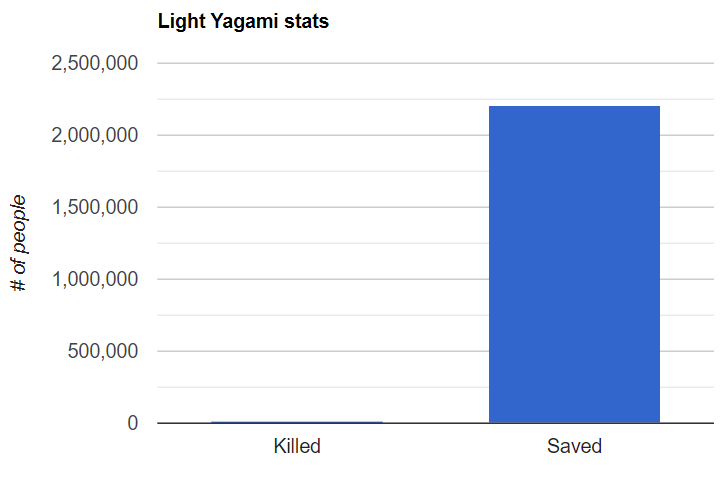
For the sake of argument, I included L, Rey Penber, and Naomi Misora with the kill count even though they were not innocent—they wanted to stop Light, which would have resulted in the deaths of many innocent people. The bar on the right is the number of innocent people that Light saved. The bar on the left that you can barely see is the number that he killed. The term for that is “statistically insignificant.”
No counter-arguments have been posted yet.
