Introduction
I affirm the resolution: on balance, the benefits of genetically modified foods outweigh the harms. In this debate, I will prove that GMOs have been beneficial in three specific areas: health, economic, and ecological.
Observation 1: Everything is a GMO
The first thing I want to point out is that everything we eat is genetically modified. This is simply how evolution works. For thousands of years, humans have been artificially breeding animals and plants to select the traits that they want to improve and pass down. Let's take a look at the banana, for example:
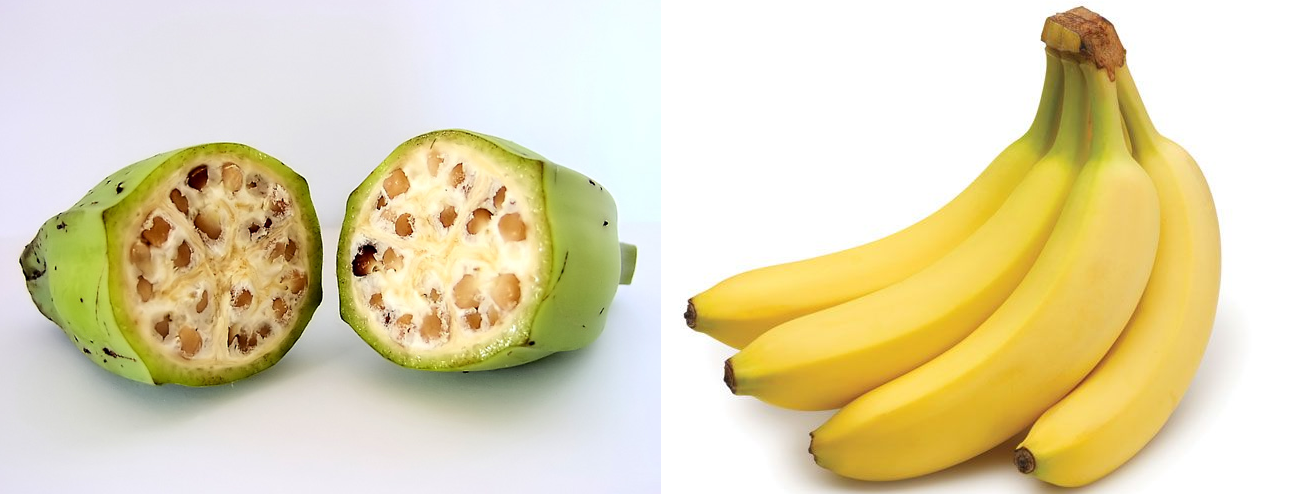
If you enjoy fresh bananas, then you can thank genetic modification via artificial selection.
Genetic modification works the same way except that we can make the traits we want much faster. Let's now look at the three areas which GMOs have improved our lives.
Area 1: Health
A) GMOs are safe
The scientific evience overwhelmingly states that GMOs are safe to eat. More than 3,000 studies came to the same conclusion. GMOs do not negatively impact our health. In fact:
B) GMOs improve health
GMOs can help improve the nutritional value of foods. "An example is GMO soybeans with healthier oils that can be used to replace oils that contain trans fats." - Source.
Another example is golden rice which has signiifcantly increased the nutritional value. The PNAS writes: "The consumption of the genetically modified rice variety known as Golden Rice (GR) offers a potent and cost-effective strategy to combat VAD. But this innovation has been cast aside owing to fear or false accusations, resulting in numerous lives needlessly lost (1–3). With the recent exception of the Philippines, governments have not approved the cultivation of GR (5). We believe it should be broadly approved and given the opportunity to save and improve lives."
Area 2: Economic
Because GMOs can singiicantly increase the produciton yield this has translated to a signiciant economic benefit for farmers. PG Economics notes:
"Crop biotechnology helps farmers earn more secure incomes due mainly to improved control of pests and weeds. The net farm level economic benefit in 2014 was $17.7 billion, equal to an average increase in income of $101/hectare. For the 19 years (1996-2014), the global farm income gain has been $150.3 billion;
The total farm income benefit of $150.3 billion was divided almost equally between farmers in developing (51%) and developed countries (49%)..."
This has lead to a noticable reduciton in suicide among farmers. The genetic literacy project demolishes the false claim that GMOs have increased suicide rates:
We find that the suicide rate for male Indian farmers is slightly lower than the non-farmer rate. And Indian suicide rates as a whole are not notably high in a global context. The pattern of changes in suicide rates over the last 15 years is consistent with a beneficial effect of Bt cotton, albeit not in every cotton-growing state.
The Conversation noted:
the available data does not support the view that farmer suicides have increased following the introduction of Bt cotton. Taking all states together, there is evidence to support the hypothesis that the reverse is true: male farmer suicide rates have actually declined after 2005 having been increasing before then.
Finally, Stuart J Smyth noted:
Research examining the relationship between farm suicide and Bt cotton adoption revealed a plateauing of the suicide rate following the commercialization of Bt cotton (Gruère and Sengupta, 2011). Farmer suicides were trending upward from 15 000 per year, peaking in 2004, the year after Bt cotton was first commercialized in India. By 2007, the actual suicide rate was 25% below the extrapolated suicide rate. Cumulatively, the reduced rate of suicide associated with the adoption of Bt cotton represents the prevention of a minimum of 75 000 farmer suicides.
Area 3: Ecological
The final area I will look at is the ecological impact of GMOs. The FDA notes:
Overall, studies have shown GMOs can have positive environmental impacts and can be important tools for addressing the causes and effects of climate change...
When farmers grow Bt crop varieties, they can apply less insecticide while still preventing insect damage to their crops. This in turn allows for a higher diversity of beneficial insects. For example, insecticide application among U.S. corn and cotton farmers decreased by over 80% from 1996 to 2017
The GMO answer project noted:
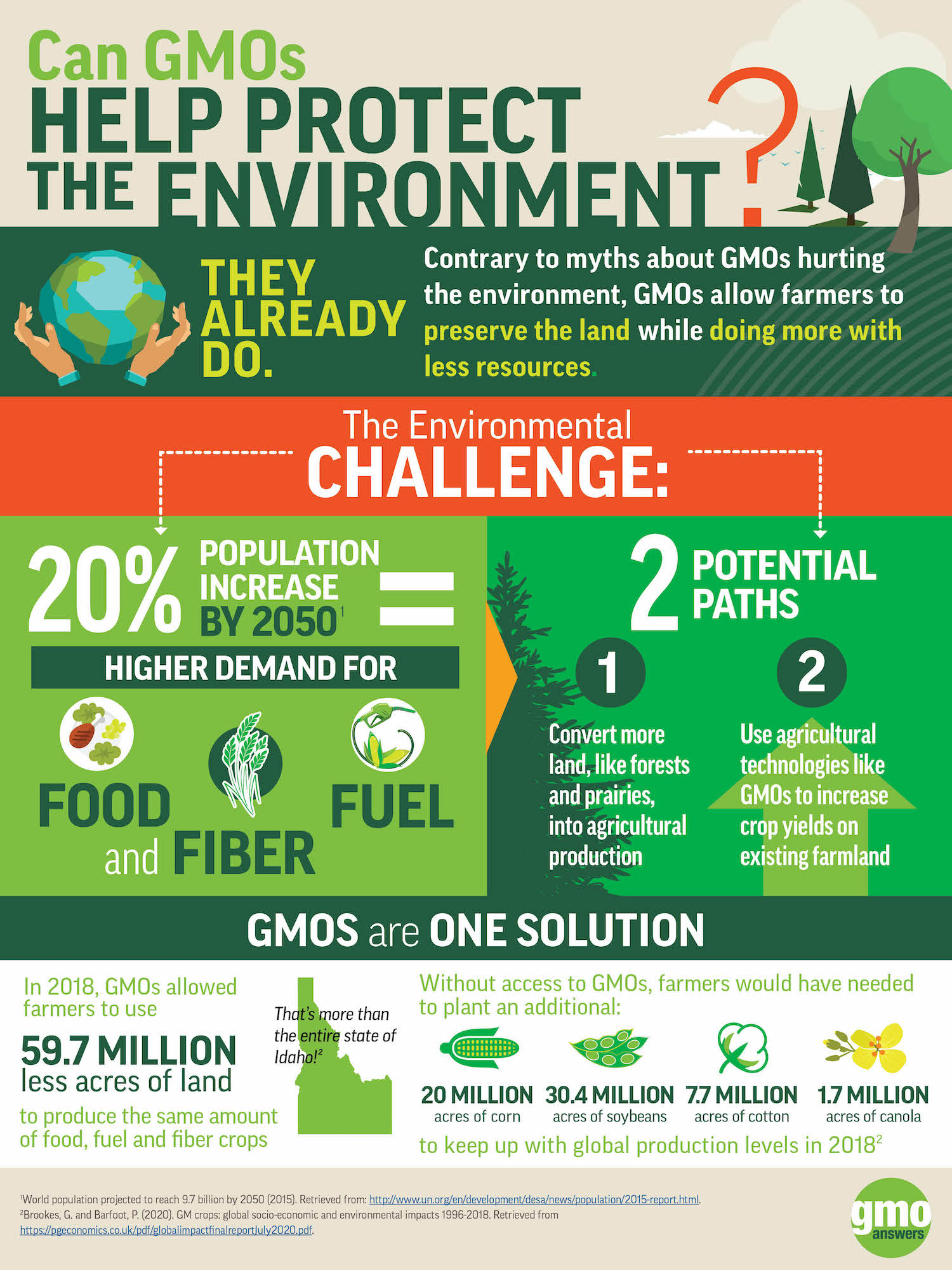
Herbicide-tolerant crops help farmers control weeds more effectively, and in turn farmers plow fields less frequently if at all, to manage weeds. Because the soil isn’t turned, the carbon naturally stored in soil stays there (soil carbon sequestration). Because machinery isn't used to plow fields, less gasoline is needed, resulting in fewer CO2 emissions from engines.
These benefits add up: In 2020 alone, the GM crop-related CO2 emission savings from reduced fuel use and additional soil carbon sequestration were equal to the removal of 15.6 million cars from the road3 - two million more than all the cars registered in California!4
Conclusion
GMOS have had significant benefits in multiple areas. The resolution is affirmed. Please vote PRO
I shall argue, on balance, the harms of genetically modified foods outweigh the benefits.
Shall argue the areas of health, economic, and ecological, while linking them to The People in weighing the harms and benefits of GMOs.
"The National Bioengineered Food Disclosure Standard defines bioengineered foods as those that contain detectable genetic material that has been modified through certain lab techniques and cannot be created through conventional breeding or found in nature."
https://www.fda.gov/food/agricultural-biotechnology/how-gmos-are-regulated-united-states
The debate description states,
"There are many countries in which GMO foods are allowed, and many where they are substantially regulated or even banned."
Countries are not banning foods which are naturally cultivated. But GMO lab foods.
One is not going to get a GloFish by standard breeding techniques.
It required the "adding a variant of the jellyfish gene."
https://en.wikipedia.org/wiki/GloFish
Little glowing fish, seems harmless enough.
But it's the implications see.
Ecosystems can be surprisingly delicate, when certain additions or subtractions are made.
We 'had food before GMOs,
Now, we 'still have food.
But what is worse, we have people able to 'quickly and near invisibly damage ecosystems.
There is 'much legislation on GMOs, in 'some countries.
There is much legislation on 'nukes, in 'some countries.
It's not necessarily 'great that nukes exist and it's constant apocalypse threat exists.
GMOs have exhibited and possess potential for a great deal of harm
Nutrition,
"most of the comparative analyses (275; 41.9%) showed no significant difference between organic and conventional foods. "
https://pmc.ncbi.nlm.nih.gov/articles/PMC10987935/
GMOs can contain nutrition, or they can not.
Pesticides, Safe? Unsafe?
Consider this, leaded water can safely be drunk once, maybe twice, but over months or years, deadly effects stack up.
GMOs are tightly under the grasp of corporations.
"Since the mid‑1990s, Monsanto has filed suit against 145 individual U.S. farmers for patent infringement and/or breach of contract in connection with its genetically engineered seed"
https://en.wikipedia.org/wiki/Monsanto_legal_cases
What do companies like?
Profit.
What do consumers eat? Whatever is available.
We 'already have nutrient rich foods that people could buy. But people are often drawn to what is cheap, tasty, or available.
https://news.yale.edu/2008/09/10/healthy-foods-scarce-poor-neighborhoods-yale-researchers-find
Is a lack of nutrition safe?
Not over time I'd say.
And that is something to fear of 'companies with monopolies.
"In the United States, monopolies and monopolistic behavior are highly criticized. Monopolies remove consumer choice, and often lead to higher prices for lower quality goods and services."
https://www.debatecraft.com/debates/d/9k/on-balance-the-benefits-of-genetically-modified-foods-outweigh-the-harms
Pesticides
"Mexico’s report presents dozens of studies from peer-reviewed scientific journals that link a wide range health effects to consumption of GM corn and exposure to glyphosate residues that often come with it – since 80% of U.S. corn is sprayed with glyphosate-based herbicides."
https://usrtk.org/gmo/new-scientific-analyses-mexicos-restrictions-on-gm-corn-glyphosate-health-risks/
Imagine the groundwater from all those pesticides.
Are 'farmers making money, or are corporations?
Recall the court cases earlier
Here is another from Australia.
https://www.farminstitute.org.au/getting-the-story-right-on-the-marsh-baxter-gm-case/
Much of a farmers livelihood was 'ruined by the wind, and a corporations 'patent on said wind blown seeds.
And frankly, the economic benefits are little to no benefit.
"The Top 10 Percent Own 70 Percent of U.S. Wealth"
https://www.statista.com/chart/19635/wealth-distribution-percentiles-in-the-us/?srsltid=AfmBOoom-ovCrtrxvLph-8OXxO9-_9MOJkgNOW3Y38xdzGL2O6EYfBQ-
The economic benefit to The People is little, yet the people are the majority.
What average farmer anywhere has a lab by which to Frankenstein GMO their crops?
What average farmer has the funds or lawyers to finance and copyright their crops to 'such a degree as large companies are?
Make America 10 times as rich, but if all the added bounty goes to the companies, and the rest of us are left serfs.
I ask you, what type of economic improvement is 'that?
Below I shall argue frequent examples of GMOs gone astray.
PESTS
"It is also possible that if insect-resistant plants cause increased death in one particular pest, it may decrease competition and invite minor pests to become a major problem. In addition, it could cause the pest population to shift to another plant population that was once unthreatened."
https://pmc.ncbi.nlm.nih.gov/articles/PMC3791249/
Here again we see the monopoly of companies, and the destruction of any who will not rent from them their seeds.
"These effects can branch out much further. A study of Bt crops showed that “beneficial insects, so named because they prey on crop pests, were also exposed to harmful quantities of Bt.” It was stated that it is possible for the effects to reach further up the food web to effect plants and animals consumed by humans"
https://pmc.ncbi.nlm.nih.gov/articles/PMC3791249/
Safe in the lab is one thing, safe deployed into various ecosystems, is another.
DAMAGES TO HUMANS
And what happens when crops are made so strongly pest resistant, other than diverting and killing bits of the ecosystem.
"Court documents filed by attorneys for Waimea homeowners who successfully sued DuPont for pesticide and dust impacts to their homes show the company sprayed ten times the mainland average, based on internal pesticide records obtained from DuPont."
https://theecologist.org/2015/nov/04/hawaii-anger-rises-over-health-impacts-pesticides-used-gmo-crops
Can apply less pesticides, does not mean that is standard practice.
Not to mention the insecticide 'corn some companies grow.
"engineered to resist weedkillers and produce its own insecticide."
https://www.nongmoproject.org/blog/the-gmo-high-risk-list-corn/
Healthy?
ESCAPES
"For years, some farmers in central and eastern Oregon have been battling an unexpected new pest: a genetically modified strain of the soft, lush grass you’d commonly see on a golf course.
In 2003, a botched experiment by agribusiness giants Scotts Miracle-Gro and Monsanto unleashed a mutant strain of creeping bent grass across the state."
https://www.opb.org/news/article/gmo-grass-oregon-creeping-bent-scotts-monsanto/
We also might worry of
https://en.wikipedia.org/wiki/Horizontal_gene_transfer
"Imagine a pest resistance gene jumping to a native plant that is the main food source for an ecologically important caterpillar."
- Some Guy Off Reddit
Pesticide
"In 1999, a paper stated that, in a laboratory environment, pollen from Bt maize dusted onto milkweed could harm the monarch butterfly.[293] A collaborative research exercise over the following two years by several groups of scientists in the US and Canada studied the effects of Bt pollen in both the field and the laboratory. The study resulted in a risk assessment concluding that any risk posed to butterfly populations was negligible.[294] A 2002 review of the scientific literature concluded that "the commercial large-scale cultivation of current Bt–maize hybrids did not pose a significant risk to the monarch population" and noted that despite large-scale planting of genetically modified crops, the butterfly's population was increasing.[295] However, the herbicide glyphosate used to grow GMOs kills milkweed, the only food source of monarch butterflies, and by 2015 about 90% of the U.S. population has declined."
https://en.wikipedia.org/wiki/Genetically_modified_food_controversies
"A 2010 study showed that about 83 percent of wild or weedy canola tested contained genetically modified herbicide resistance genes.[335][336][337] According to the researchers, the lack of reports in the United States suggested that oversight and monitoring were inadequate.[338] A 2010 report stated that the advent of glyphosate-resistant weeds could cause GM crops to lose their effectiveness unless farmers combined glyphosate with other weed-management strategies.[339][340]"
https://en.wikipedia.org/wiki/Genetically_modified_food_controversies
Consider Thomas Midgley Jr. and his creation unleashed upon the world.
"In 2011, researchers retroactively estimated the annual impact of tetraethyl lead worldwide to be 1.1 million excess deaths"
https://en.wikipedia.org/wiki/Tetraethyllead
People 'want and require the GMO sticker on foods, 'because they are worried.
A sticker that 'companies (No surprise) are eager to remove.
https://www.ewg.org/research/big-food-companies-spend-millions-defeat-gmo-labeling
My opponent is quick to notice 'lab safety, and controlled environment safety.
But they ignore the effects that GMOs can have when applied in the real world.
They ignore the soulless money grubbing companies whose first focus is 'not safety.
They ignore the wideness of the world, even 'if first world companies manage to rein in GMOs to be farmed a 'bit more safely (While often failing), what of the world at large?
What of third world farmers and sweatshops, what 'safety will be found there?
The US government could not force China to not kill all the sparrows,
And the US government cannot force China to follow US safety regulations on GMOs.
On balance, the benefits of genetically modified foods outweigh the harms.
Because we don't need 'more food, we need more infrastructure, planning, and safety nets for the people we have 'now.
We 'have the food and money, it just needs to be 'applied to the people.
There are little to no benefits, GMOs are rather additions of risks and downsides.
