
Resolved: The Moral Argument for God's Existence is Sound

Finished religion philosophy ethics
Like this debate? Score 0
···
X Facebook
Pro Instigator Opens first Winner
Instigator Avatar
3
Rating
1574
Debates
30
Win rate
66.67%
Con Contender
Contender Avatar
0
Rating
1492
Debates
2
Win rate
25.00%
Verdict Kohai wins · 3 points
Kohai Pro
3
avni Con
0

After 3 votes (0 ties) — 3 points ahead

Note: I would like to go up against a stronger debater who understands the topic. Please DM me before accepting this debate. Failure to do so may result in an auto loss


Introduction.


In this debate I will be arguing that the moral argument for God's existence is a sound argument. The moral argument goes like this:


  1. If God does not exist, objective moral values and duties do not exist.
  2. Objective moral values do exist
  3. Therefore, God exists


The burden of proof is shared. I must prove it is sound and my opponent must prove it is unsound.


Frameworks and Definitions


In order for the affirmative to win this debate I will need to prove two things: (1) objective moral values actually exist; (2) these values cannot exist unless God also exists. If my opponent disproves even one of these contentions then the argument falls flat and is thus unsound. I will begin by giving the following definitions


God: For the purposes of this debate, the term "God" will be defined broadly as to include the general 4'Os (omniscient, omnipresent, omnipotent, and omnibenevolent being) who is the source of creation.) That is to say, I am not referring to any specific deity. Hence religious texts and religious doctrines are irrelevant to the debate. .


Objective Morality / Moral Realism: The meta-ethical view which holds that there are objective moral facts and values that are independent of our beliefs, feelings, or other attitudes towards them. In this view, moral claims can be true or false in the same way scientific claims can be.


Moral anti-realism: The meta-ethical view that denies the existence of objective, mind-independent moral facts. It encompasses various positions that claim moral statements are expressions of emotion, cultural conventions, or subjective judgments rather than statements of objective truth.


Again: Please do not accept without DM'ing me

Round 1

1 of 4
avatar
Kohai Administrator
Pro #1

Thank you, avni, for accepting this debate and welcome to debatecraft.


Intro


An argument is sound if the argument is both valid and if the premises are true. In this case our syllogism states:


1. If God does not exist, objective moral values do not exist.

2. Objective moral values do exist.

3. Therefore, God exist


This syllogism is valid. If both premises are true then the conclusion necessarily follows.


Premise 2: Objective moral values exist


I’m actually going to begin my arguments by defending premise 2 before I defend premise 1. Premise 2 is where the bulk of this debate will probably be focused on. Why should we believe that moral facts are objective? Here are a few reasons:


(1) Moral progress 


Moral progress only makes sense in the framework of moral realism. Almost everyone can agree that slavery is wrong and that the abolition of slavery was an improvement on society. But why should we believe this is the case? If morality were merely subjective or based on culture, then who is to say that we actually made progress as a society? 


Consider the following statistics: In Yemen, under the oppressive forces of the Youthis, gay people are routinely imprisoned and sentenced to death [2], enslaves children [3], and restrict women’s freedom of movement [4]. Most people would rightly be repulsed by such behavior. But why should we be repulsed? If morality was merely subjective or based on culture, then who are we to say Yemen’s culture is worse than ours?


(2) The objective nature of morality allows for moral judgement 


Consider the above examples from Yemen. We are certainly repulsed at the notions of child slavery. But why? If morality is nothing more than one's mere opinion, then it makes no sense condemning or praising someone. Under moral anti-realism or subjectivism, stating “slavery is immoral” is like saying “wearing white after labor day is wrong.” But we intuitively know that there are things that are objectively right and wrong, like child slavery. 


(3) Argument from Epistemic Realism


Consider the following dialogue:


Kohai: What do you think of my argument for evolution?

avni: I think it's a sound argument -- your conclusion was well-argued, and I see no problems with it.

Kohai: So does that mean you'll reject young earth creationism now and accept the scientific facts of evolution?

avni: No

Kohai: Why not?

avni: Because I have no duty to embrace the truth. I reject reality and substitute it with my own. 


Such an exchange is rightfully absurd. If there are epistemic facts and duties, then why are there no moral facts and duties? In the context of this debate I am sure my opponent would have me be respectful of him, honestly engage with his arguments, and not commit logical fallacies. But why is that the case? We can summarize this as follows [5]:


P1. If moral facts do not exist, then epistemic facts do not exist.

P2: Epistemic facts do exist

C1: Moral facts do exist. 

P3: If moral facts do exist, then moral realism is true. 

C2: Moral realism is true


Consider the following principles and values which are foundational to the very possibility of rational discourse, all of which the moral anti-realists must deny:


1. It is good to believe the truth and avoid falsehood.

2. We ought to think rationally.

3. We ought to argue from an honest perspective.

4. We ought not misrepresent your opponent's arguments.

5. You must not commit logical fallacies.

6. We ought not to use AI to create our arguments for us


If relativism or nihilism about value entails such conclusions, then it can be rightly rejected as absurd. Given the ubiquity and centrality of rational discourse in everyday life, we have every reason to suppose that there are such things as objective moral facts.


Premise 1: If God does not exist, objective moral values do not exist 


Now that we have established moral realism, why should we accept the first premise? If moral realism is true, that means there is a mind-independent source of morality that transcends humanity and is morally perfect. This source also must be rational as moral judgements require the ability to think. The moral source also must be powerful and authoritative that can compel humanity to act in a certain manner. This entity is what we call God.


Objection: Euthyphro’s dilemma


There is a famous argument made by Euthyphro that attempts to undermine the divine origins of ethics. The argument states: “do the gods love good action because it is good, or is good action good because it is loved by the gods?” 


The problem is that this is a false dilemma. Morality is not good because God says it is good nor is it good because it is already good independent of God, but rather morality reflects the moral perfection of God’s nature.


Conclusion


Objective moral values and duties exist, as shown by progress, judgment, and epistemic realism. These require a personal, morally perfect God to ground ethics. The resolution is strongly affirmed. 


Sources

1.https://www.reasonablefaith.org/podcasts/defenders-podcast-series-1/s1-moral-argument/moral-argument-part-1 

2. https://www.barrons.com/news/13-sentenced-to-death-for-homosexuality-in-yemen-source-0f0dc729 

3. https://www.dol.gov/sites/dolgov/files/ILAB/child_labor_reports/tda2018/Yemen.pdf 

4. https://www.hrw.org/news/2024/03/04/yemen-warring-parties-restrict-womens-movement 

5. Michael Jones, "Moral Realism Defended." https://youtu.be/zjkgD4w9w1k?si=fgWg7NfYThtSr3PL&t=42 

avatar Con #2


Contention 1: Objective moral values do NOT need to exist

1. Moral progress does not prove objective morality

My opponent claims that slavery being abolished proves “moral progress” and therefore objective morality.

But moral progress can be explained without God:

  1. Humans became more educated
  2. Empathy increased
  3. Societies realized slavery causes suffering and instability

This is change in human values, not discovery of eternal moral truths.

If morality were objective and given by God:

  1. Why did religious societies support slavery for centuries?
  2. Why did people disagree so much about it?

Moral change looks like human learning, not moral facts written into the universe.


2. Feeling something is wrong does not make it objective

My opponent says we are “repulsed” by child slavery, so it must be objectively wrong.

But:

  1. Strong emotions ≠objective facts
  2. Humans evolved emotions like empathy and disgust to survive socially

Many people once felt slavery was acceptable.

If feelings decide morality, then morality clearly depends on humans, not God.


3. Moral disagreement weakens objectivity

If morality were objective like math:

  1. Everyone would eventually agree

But we don’t.

  1. Cultures disagree on abortion, punishment, gender roles, sexuality
  2. Even religions disagree on what God commands

This shows morality is social and cultural, not objective and universal.


Contention 2: Epistemic realism does NOT prove moral realism

My opponent argues:

If epistemic duties (truth, logic) exist, moral duties must exist too.

This is a category mistake.

  1. Epistemic rules are tools for reasoning
  2. They are conditional, not moral facts

Example:

“If you want truth, use logic.”

That does NOT mean logic is a moral law.

You can value truth without believing in objective morality or God.


Contention 3: God is NOT required to ground morality

1. False dilemma

My opponent assumes:

Either God grounds morality, or morality does not exist.

This ignores other explanations:

  1. Human well-being
  2. Reason and rational duty
  3. Social contracts
  4. Evolutionary ethics

God is not the only option.


2. God does not escape the Euthyphro dilemma

Saying:

“Morality comes from God’s nature”

does not solve the problem.

Either:

  1. God’s nature is good because it matches morality → morality exists independently
  2. OR
  3. God’s nature is good by definition → morality becomes arbitrary

Either way, God is not necessary for morality.


3. Authority does not equal morality

Power does not create goodness.

If God commanded cruelty:

  1. Would it become moral?

If yes → morality is arbitrary

If no → morality exists independently of God

Both options defeat the argument.


Contention 4: Even if objective morality exists, God does not follow

This is a logical leap.

From:

“Objective moral values exist”

It does NOT follow that:

  1. They are personal
  2. They are conscious
  3. They are a God

The conclusion goes far beyond the evidence.


Conclusion

  1. Objective moral values are not proven
  2. Moral behavior can be explained naturally
  3. God is not required to ground morality
  4. The Moral Argument fails to meet the standard of soundness

Therefore, the resolution:

“The Moral Argument for God’s Existence is Sound” must be REJECTED.


Round 2

2 of 4
avatar
Kohai Administrator
Pro #3

Rule Violations


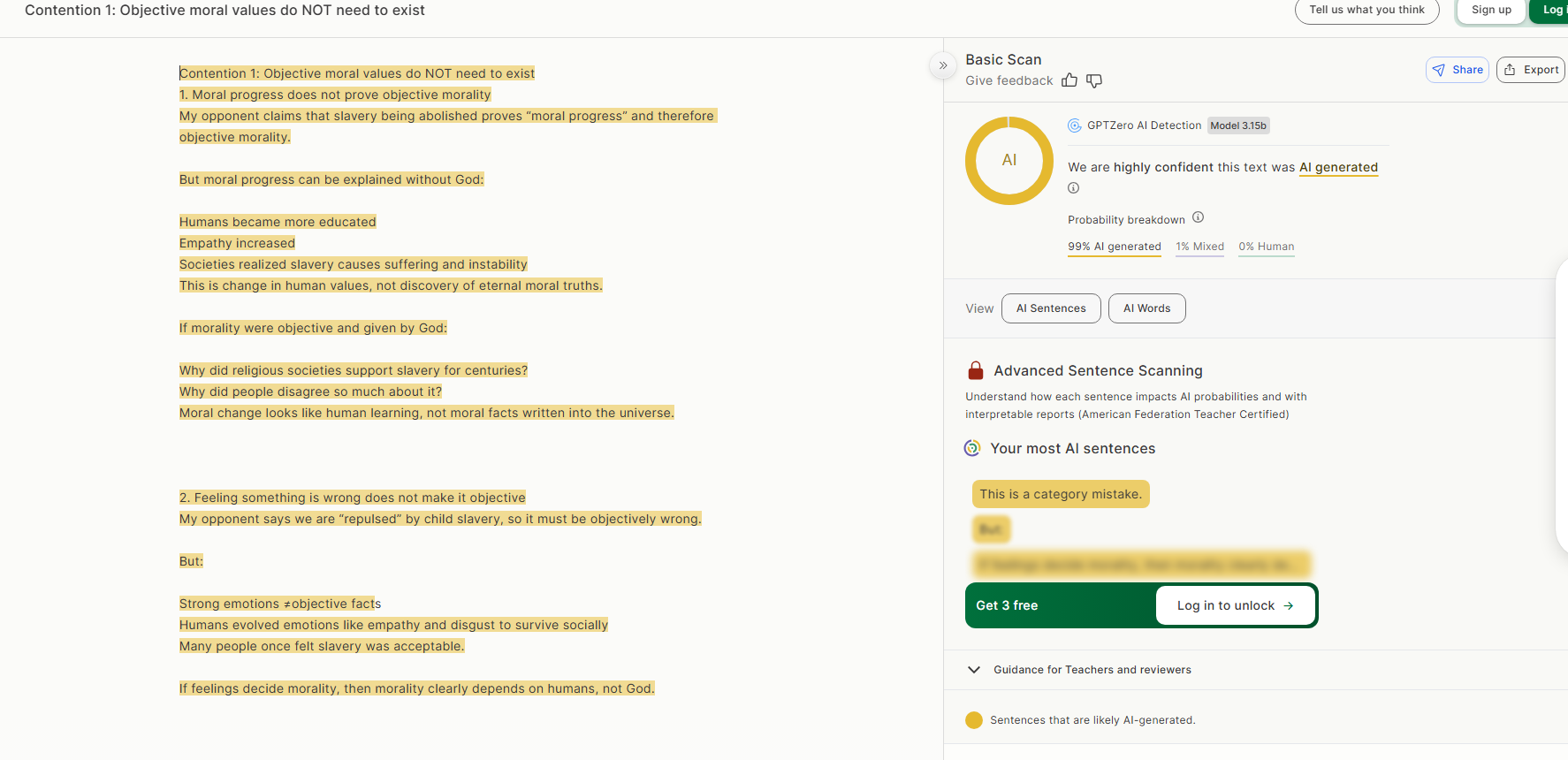
My opponent violated two major rules of the debate: (1) Failure to contact me before accepting this debate. He contacted me after I accepted this. I wouldn't really mind this rule violation except for (2) the argument was entirely AI generated.


AI Generated Proofs


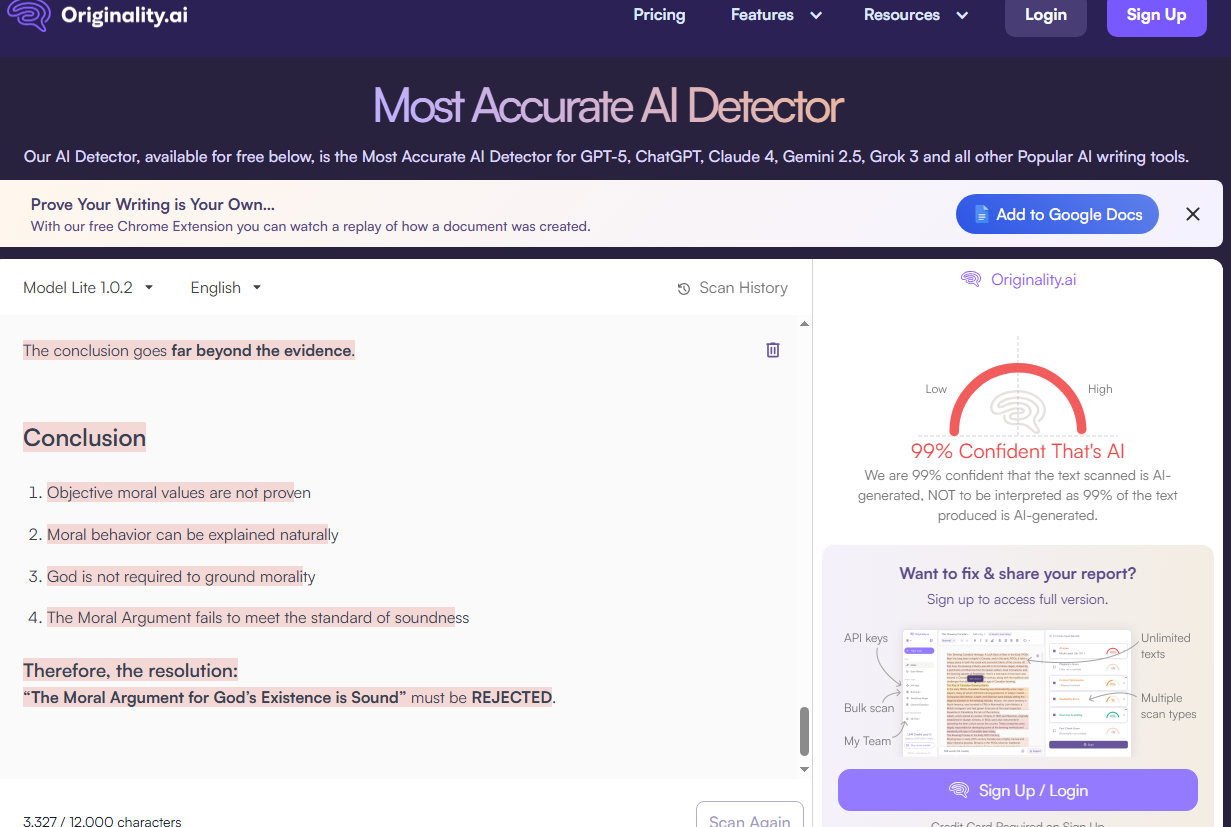
Looking clearly at my opponent's argument AI is quite blatant. Here are a few screenshots from AI detectors that prove this


In addition the text my opponent wrote has several hallmark AI signs:


  1. Even pace in sentences with all sentences being roughly the same length
  2. Randomized bolding
  3. Failure to refer to themselves in the first person
  4. Failure to engage in the dialogue I presented in the opening argument (classic AI skip).
  5. Completely ignored We ought not to use AI to create our arguments for us


Conclusion


Multiple AI tells exist in my opponent's writing. If I wanted to debate AI I would just open ChatGPT myself.

Round 3

3 of 4
avatar
Kohai Administrator
Pro #5

Extend all arguments

Round 4

4 of 4
avatar
Kohai Administrator
Pro #7

Extend

New comment

avatar
•••
#3
--> @Kohai

Copy pate from AI.

avatar
Kohai Administrator
•••
#2
--> @Makhdoom

Shows you they don’t know what they’re talking about

avatar
•••
#1

LOL, how some people are being that much lazy?

Criterion Pro Tie Con
Winner
Of course the other person's content was A.I generated so automatically the pro wins
Criterion Pro Tie Con
Winner
A complete forfeit and use of AI by con, pro automatically wins
Savant
Savant Administrator
#1
Criterion Pro Tie Con
Winner
Full forfeit plus plagiarism from Con