Should we Celebrate Black History Month?

Voting history

The participant with the most points wins.

Voting stays open until 2 more votes are cast.

Like this debate? Score 0
···
X Facebook
Pro Instigator Opens first
Instigator Avatar
1
Rating
1502
Debates
2
Win rate
75.00%

Match format

Type
Rated · 5 rounds
Time
One week
Limit
10,000
Vote
One month · 3 votes to close
Con Contender
Contender Avatar
0
Rating
1350
Debates
461
Win rate
40.02%

The short description is everything you need to know. To help understand items better each participant can ask questions to understand positions better and ask questions. This is a laid back debate that is still based on serious discussion. I am pro so I will be arguing that we should celebrate black history month while con will argue against. I look forward to starting this debate!

Round 1

1 of 5

I thank my opponent for engaging in this discussion.

To celebrate something is to publicly recognize it as important and worthy of attention (Webster Dictionary). The question, then, is whether dedicating a month to Black history meaningfully contributes to historical understanding and civic life. I argue that it does for three primary reasons: Black history remains underrepresented in education, understanding it is essential to interpreting present-day institutions, and public recognition expands civic inclusion and aspiration.


Argument 1: Black History Remains Underrepresented

Black history has historically been marginalized within mainstream curricula. Historian Carter G. Woodson, founder of what later became Black History Month, argued in The Mis-Education of the Negro that omission and distortion of Black contributions shaped both national memory and individual self-perception. The month itself originated as a corrective effort in response to this exclusion.

More recently, scholars such as Jarvis Givens in School Clothes document how Black educational efforts and intellectual traditions have often been minimized or framed peripherally in textbooks. Reconstruction-era Black institution-building, independent schooling efforts after emancipation, and intellectual contributions are frequently condensed or omitted.

When a society’s historical narrative systematically underrepresents a group’s contributions, public understanding becomes incomplete. Black History Month functions as a structured intervention within that broader pattern of omission. It does not replace integration; it compensates for persistent gaps.


Argument 2: Understanding the Present Requires Understanding Black History

History is not merely retrospective; it shapes present institutions.

Educational disparities, residential segregation, and funding inequalities did not arise spontaneously. As detailed in The Color of Law, many patterns of housing segregation were reinforced by public policy. Because public schools are largely funded through local property taxes, historic residential segregation continues to influence educational resource distribution.

Similarly, post-emancipation schooling for Black Americans was often severely underfunded and restricted in scope. The cumulative effects of these policies persist across generations.

Without sustained attention to this history, contemporary disparities can appear accidental or cultural rather than institutional. Dedicating time to Black history strengthens civic literacy by clarifying how past policy decisions shape current structures.


Argument 3: Public Recognition Expands Civic Inclusion

Public recognition also carries symbolic and developmental weight. Highlighting figures such as Booker T. Washington, who founded the Tuskegee Institute after being born into slavery, or W. E. B. Du Bois, one of the first African Americans to earn a Ph.D., reinforces a more complete narrative of national achievement.

Representation influences perceived possibilities. When historical narratives include intellectual, political, and institutional contributions from Black Americans, they expand the civic story itself. Celebration in this sense is not uncritical praise; it is public acknowledgment of importance.

References

Berliner, D. C., &Hermanns, C. (2022). Public Education Defending a Cornerstone of American Democracy. Teachers College Press, Teachers College, Columbia University.

Givens, J. R. (2023). School clothes: A collective memoir of Black Student Witness. BEACON.

Washington, B. T. (1986). Up from slavery: An autobiography. 1st edition. Penguin.

Webster Dictionary

Rothstein, R. (2018). The color of law: A forgotten history of how our government segregated America. Liveright Publishing Corporation.

Du Bois, W. E. B. (2016). The souls of Black Folk. African American Classic Publications.


avatar Con #2

In order to debate, or make any reasoning with highest level of accuracy, deductive reasoning is mandatory.


And deductive reasoning requires clear definitions.


"To celebrate something is to publicly recognize it as important and worthy of attention (Webster Dictionary)"


Definition accepted. I have no reason to challenge a definition which came from dictionary, and which represents common understanding of the word, but which also has no working time frame or place frame.


However, my opponent only defined 1 word out of 4 necessary terms in title.


Should - undefined by opponent

we - undefined by opponent

Celebrate - defined by opponent partially

Black History Month - undefined by opponent


I will begin by defining a word "should" in a very specific way to clearly frame debate.


"Should" talks about action in this case. Because we know number of actions we can do at a time or in a place are limited, and we cannot do all possible actions, the only way my opponent can argue one action over another is to establish principle of best action.


In simple terms, my opponent either concedes no action is better than another, and loses debate, or he accepts a position where he must defend that celebrating black history month is the best action out of all possible actions.


Because if it is not the best possible action, then we would do a different action and not that one. Because resources are limited, and due to many actions being mutually exclusive, we should logically do best action out of all possible actions.


Now, the word "we". My opponent didnt explain who is "we". Does it include me? I must assume my opponent means "all people", which includes me. I have no logical reason to consider this specific event important and worthy of attention, because it is not best possible action for me, because I can use my attention for better things which I actually find important, or to be more precise, most important. And in case of forced choice between limited options, only most important things become important and worthy of attention. So my opponent must argue that somehow this specific event is both important to me, and worthy of my attention. But in order to be important to me, it would have to match my goals the best and be best possible action, which this specific event doesnt.


In order for something to be best possible action, it must achieve goals most completely, which for me, this event doesnt, and I assume it doesnt for a lot of people.


Celebrate was defined only partially, because my opponent didnt set time frame or place frame. Obviously, one cannot celebrate in all places or 24 hours a day.


Black History Month: Black History Month is an annually observed commemorative month originating in the United States, where it is also known as African-American History Month.[6][7] It began as a way of remembering important people and events in African-American history, before it spread to other countries where it could celebrate black people worldwide.


https://en.wikipedia.org/wiki/Black_History_Month


I didnt accept this debate with plan of winning it, but merely showing that my opponent didnt answer crucial questions necessary to prove topic:


  1. Amount of time used to celebrate, place of celebration
  2. Who should celebrate?
  3. Is this action better than any other possible action person can do (no comparison was made by opponent of all possible actions)
  4. Definitions of crucial terms were left undefined
  5. Does my opponent accept principle of best action?
  6. Did my opponent use deductive reasoning to show that celebrating black history month is best possible action out of all possible actions? Where was this comparison made?


thats it for round 1. In next round, I will expand more on arguments. this was merely to establish opponent's position in this topic, so I know what I am debating against.

Round 2

2 of 5

To start, I will define the terms my opponent feels are important so we can avoid talking past each other. For clarity, in this debate, I define “should” to mean that the benefits outweigh the harms and that it is morally and socially preferable compared to the alternatives. I define “we” as society at large, including public institutions, schools, and communities. Using these definitions allows us to ground our discussion in real social impact rather than abstract principles.

I will also define “underrepresented” in case the conversation moves in that direction: it means “insufficient presence or acknowledgement of certain groups, often based on gender, race, socioeconomic status, or other demographics, in specific domains or contexts.” Additionally, while my opponent feels that my definition of “celebrate” needs a time limit, in the context of this debate and my dictionary definition, no such limit is needed, because the focus is on the importance and worthiness of the recognition. My opponent’s definition of Black History Month is accepted, as it reflects the universally understood term — except historically, when it was initially celebrated as a single week during Woodson’s time.

Consequently, I will occasionally ask my opponent to define terms I feel are under-addressed, to ensure we remain on the same page and maintain a productive debate.

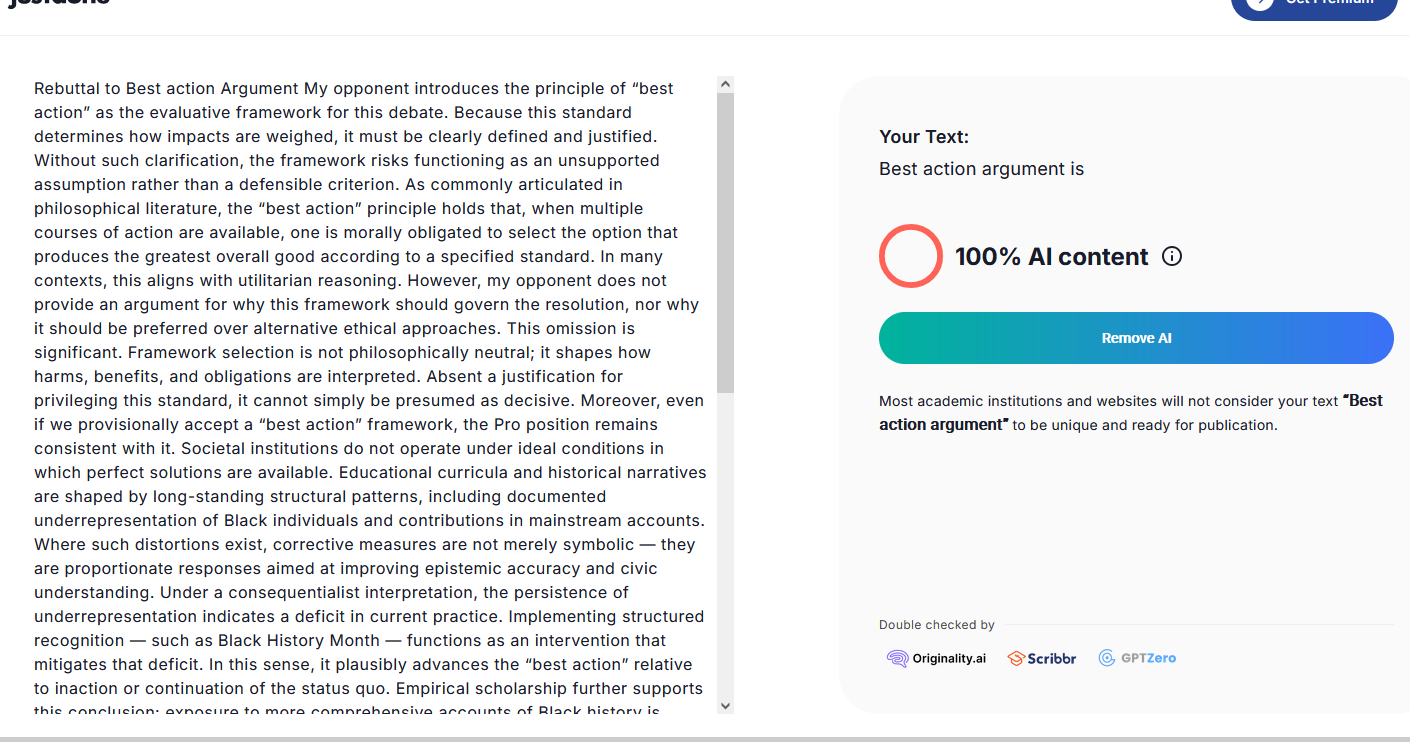
Rebuttal to Best action Argument

My opponent introduces the principle of “best action” as the evaluative framework for this debate. Because this standard determines how impacts are weighed, it must be clearly defined and justified. Without such clarification, the framework risks functioning as an unsupported assumption rather than a defensible criterion.

As commonly articulated in philosophical literature, the “best action” principle holds that, when multiple courses of action are available, one is morally obligated to select the option that produces the greatest overall good according to a specified standard. In many contexts, this aligns with utilitarian reasoning. However, my opponent does not provide an argument for why this framework should govern the resolution, nor why it should be preferred over alternative ethical approaches.

This omission is significant. Framework selection is not philosophically neutral; it shapes how harms, benefits, and obligations are interpreted. Absent a justification for privileging this standard, it cannot simply be presumed as decisive.

Moreover, even if we provisionally accept a “best action” framework, the Pro position remains consistent with it. Societal institutions do not operate under ideal conditions in which perfect solutions are available. Educational curricula and historical narratives are shaped by long-standing structural patterns, including documented underrepresentation of Black individuals and contributions in mainstream accounts. Where such distortions exist, corrective measures are not merely symbolic — they are proportionate responses aimed at improving epistemic accuracy and civic understanding.

Under a consequentialist interpretation, the persistence of underrepresentation indicates a deficit in current practice. Implementing structured recognition — such as Black History Month — functions as an intervention that mitigates that deficit. In this sense, it plausibly advances the “best action” relative to inaction or continuation of the status quo.

Empirical scholarship further supports this conclusion: exposure to more comprehensive accounts of Black history is associated with increased cross-cultural understanding, greater awareness of institutional development, and improved civic literacy. If the operative standard is maximizing societal benefit, then intentional historical inclusion aligns with that objective.

Rebuttal to claim of personal irrelevance 

My opponent also contends that they do not personally find Black History Month important. However, the resolution concerns what society should do, not what an individual subjectively prioritizes.

Normative public questions are evaluated according to collective impact and social consequences. Individual indifference does not negate broader societal effects. Even if one does not perceive personal relevance, the question remains whether the practice produces measurable or defensible benefits at the societal level.

The historical record and contemporary research indicate that structured recognition of Black history contributes to greater awareness of institutional development, historical inequities, and civic participation. The relevant metric, therefore, is aggregate social impact — not individual preference. On that basis, the Pro position remains substantively supported.

Closing

In closing, the evidentiary and historical foundations of this debate weigh in favor of celebrating Black History Month as a socially beneficial practice. My opponent must not only clarify and defend their philosophical framework, but also demonstrate why it invalidates the documented benefits associated with intentional historical recognition.

Several substantive arguments presented in the Pro case — particularly regarding systemic underrepresentation and institutional literacy — remain insufficiently addressed. Until those points are directly engaged, the balance of impacts continues to favor affirmation of the resolution.

I look forward to continuing this discussion with a focus on clearly articulated standards and evidence-based evaluation.

References

https://www.igi-global.com/dictionary/multiculturalism-in-special-education/33681#google_vignette

Pene, M. (2020, October 24). Patriotic Education is a whitewashing of history. UT News.

https://commons.law.famu.edu/famulawreview/vol17/iss1/7

https://www.scu.edu/ethics/ethics-resources/ethical-decision-making/calculating-consequences-the-utilitarian-approach/

Woodson, C. G. (2018). The Mis-education of the negro. Youcanprint.

https://rossier.usc.edu/news-insights/news/how-should-black-history-be-taught

Multivariate Research: Design and Interpretation, 3rd ed. Thousand Oaks, CA: Sage.

Friedman, B. D. (2006). The research tool kit: Putting it all together. Thomson Brooks/Cole.

Onwuegbuzie, A. J., & Frels,R. (2016). Seven steps to a comprehensive literature review. Sage.

Field, A. P. (2018). Discovering statistics using IBM SPSS. Sage Publications


avatar Con #4
To start, I will define the terms my opponent feels are important so we can avoid talking past each other. For clarity, in this debate, I define “should” to mean that the benefits outweigh the harms and that it is morally and socially preferable compared to the alternatives.


By saying that it is "preferable compared to alternatives", my opponent is accepting principle of best action. In other words, not only that benefits must outweigh the harms, but it must be action where benefits outweigh harms more than in any other possible action.


For example, if action 1 gives 100 benefits and 10 harm, and action 2 gives 1000 benefits and 10 harm, while in both actions benefits outweigh gains, we must use principle of best action and choose action 2.


Because my opponent has conceded to this standard, he must argue that celebrating black history month not only outweighs harm with benefits, but does so in greater ratio than any other action.


And to measure if benefits outweigh harms, my opponent must set up some sort of measuring system, which he didnt do.


I define “we” as society at large, including public institutions, schools, and communities. Using these definitions allows us to ground our discussion in real social impact rather than abstract principles.


Because my opponent has included communities, and community includes me, and I dont benefit from celebrating black history month and its not best possible action for me, I simply have to disagree with the topic.


Additionally, while my opponent feels that my definition of “celebrate” needs a time limit, in the context of this debate and my dictionary definition, no such limit is needed, because the focus is on the importance and worthiness of the recognition.


Because my opponent has said that there is no time limit, then he argues for 24 hours a day celebration, which prevents sleeping.


Rebuttal to Best action Argument
My opponent introduces the principle of “best action” as the evaluative framework for this debate. Because this standard determines how impacts are weighed, it must be clearly defined and justified. Without such clarification, the framework risks functioning as an unsupported assumption rather than a defensible criterion.
As commonly articulated in philosophical literature, the “best action” principle holds that, when multiple courses of action are available, one is morally obligated to select the option that produces the greatest overall good according to a specified standard. In many contexts, this aligns with utilitarian reasoning. However, my opponent does not provide an argument for why this framework should govern the resolution, nor why it should be preferred over alternative ethical approaches.


My opponent seems to be terribly confused here. First, my opponent himself did not provide any moral framework which he deduced logically. He said "benefits outweigh harm....ect", but he has not deduced that logically. So when he accuses me of not defending my framework, he forgets that he didnt defend his either or logically deduced it.


Right now debate structure for my opponent is:

P1. Should happen means action where benefits outweigh harm and is preferable to all alternative actions

P2. Black history month celebration is an action where benefits outweigh harm and is preferable to all alternative actions

C. Black history month celebration should happen


Notice that premise 1 is not logically deduced anywhere by my opponent, and premise 2 has no measuring system by my opponent.


to make matters worse, by saying "preferable to alternatives", my opponent already conceded to principle of best action and uses it in his moral framework.


My opponent also contends that they do not personally find Black History Month important. However, the resolution concerns what society should do, not what an individual subjectively prioritizes.


Because individual is part of society and community, this very much concerns an individual as well. Community is a set of individuals. Saying that community should do something means individuals in it should do something. Because my opponent never said "majority" or "merely some large part", he is forced to defend that I should celebrate black history month.


Conclusion:

Opponent conceded to principle of best action and uses it in his framework, yet produced no deductive argument for his framework, nor a measuring system to prove that celebrating black history month is best action and preferable to all other actions.

Round 3

3 of 5

To begin this round, I want to clarify the scope of this debate. The resolution asks whether society should celebrate Black History Month, meaning this is fundamentally a question about social benefit and harm. The most reasonable evaluation standard is therefore whether the practice produces positive outcomes for society. Demonstrating societal impact is typically done through research and historical evidence, which I have provided throughout this debate.

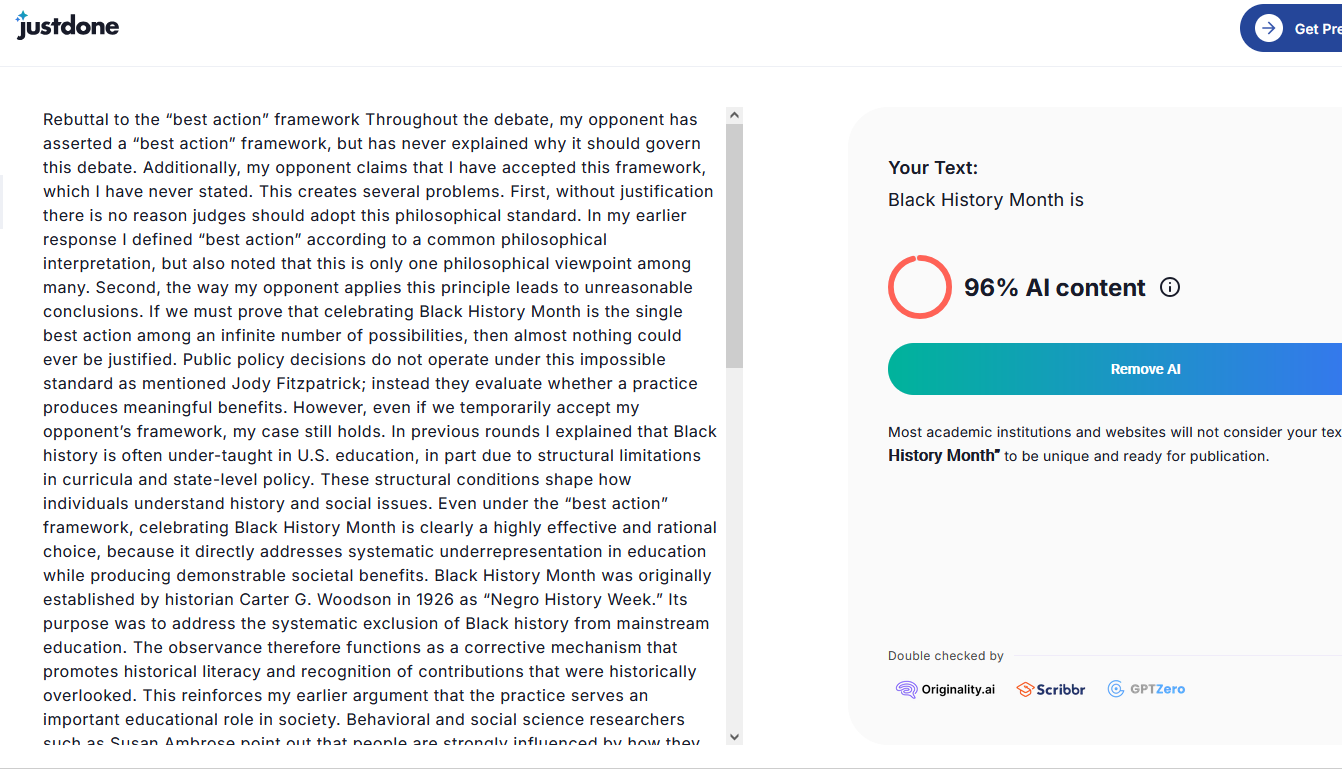
Rebuttal to the “best action” framework

Throughout the debate, my opponent has asserted a “best action” framework, but has never explained why it should govern this debate. Additionally, my opponent claims that I have accepted this framework, which I have never stated.

This creates several problems. First, without justification there is no reason judges should adopt this philosophical standard. In my earlier response I defined “best action” according to a common philosophical interpretation, but also noted that this is only one philosophical viewpoint among many.

Second, the way my opponent applies this principle leads to unreasonable conclusions. If we must prove that celebrating Black History Month is the single best action among an infinite number of possibilities, then almost nothing could ever be justified. Public policy decisions do not operate under this impossible standard as mentioned Jody Fitzpatrick; instead they evaluate whether a practice produces meaningful benefits.

However, even if we temporarily accept my opponent’s framework, my case still holds. In previous rounds I explained that Black history is often under-taught in U.S. education, in part due to structural limitations in curricula and state-level policy. These structural conditions shape how individuals understand history and social issues. Even under the “best action” framework, celebrating Black History Month is clearly a highly effective and rational choice, because it directly addresses systematic underrepresentation in education while producing demonstrable societal benefits.

Black History Month was originally established by historian Carter G. Woodson in 1926 as “Negro History Week.” Its purpose was to address the systematic exclusion of Black history from mainstream education. The observance therefore functions as a corrective mechanism that promotes historical literacy and recognition of contributions that were historically overlooked. This reinforces my earlier argument that the practice serves an important educational role in society.

Behavioral and social science researchers such as Susan Ambrose point out that people are strongly influenced by how they were taught and what information they are exposed to, and these attitudes often change gradually over time. We can see this pattern historically in areas such as property rights, voting rights, education, and employment opportunities for minority groups. Progress has occurred, but it has often been slow and incremental.

Because laws, policies, and social attitudes influence society in structural ways, targeted educational efforts can play an important role in improving historical understanding. Given the evidence I have presented showing the educational and cultural benefits of Black History Month—and the absence of demonstrated harms—it remains a rational and beneficial action for society to support.

Rebuttal to the “24-hour celebration” argument

My opponent argues that celebrating a month would require constant celebration and therefore prevent sleep. This interpretation relies on an unreasonable literal reading of the resolution.

When people celebrate holidays such as Christmas or Independence Day, they do not celebrate every second of the day. Instead they recognize the occasion through events, education, and reflection Black History Month functions in the same way: it creates a period for increased recognition and discussion, not continuous activity.

Rebuttal to “it doesn’t matter to me”

My opponent again argues that because Black History Month does not matter to him personally, this should carry significant weight. However, public commemorations are not justified by whether one individual finds them meaningful.

Societies recognize historical events and communities because of their collective significance. By my opponent’s logic, any historical commemoration could be rejected simply because one person does not care about it.

When we consider the evidence previously presented—such as the historical underrepresentation of Black history in education—we see that celebrating Black History Month creates a period of recognition that helps address these imbalances. These recognitions have been shown to provide educational and cultural benefits.

Conclusion

My opponent claims that my arguments lack justification. However, in the opening round I provided reasoning and evidence showing that Black History Month produces societal benefits, including addressing historical underrepresentation in education and improving historical literacy.

My opponent has not directly refuted these arguments, meaning they remain standing in the debate. Con has not justified their framework, has not disproven the benefits presented, and has shown no harms resulting from the practice. Since the only substantiated impacts in this debate support the societal benefits of recognizing Black History Month, the resolution should be affirmed.

References

 https://firstliteracy.org/wp-content/uploads/2015/07/How-Learning-Works.pdf

https://www.law.cornell.edu/wex/plessy_v_ferguson_(1896)

https://ed.stanford.edu/news/70-years-after-brown-v-board-education-new-research-shows-rise-school-segregation

Fitzpatrick, J. L., Fitzpatrick, J. L. /Sanders, James R., & Worthen, B. R. (2011). Program evaluation. Pearson Education (US); Pearson. 

Rothstein, R. (2018). The color of law: A forgotten history of how our government segregated America. Liveright Publishing Corporation.

https://nmaahc.si.edu/explore/stories/knowing-past-opens-door-future-continuing-importance-black-history-month

Friedman, B. D. (2006). The research tool kit: Putting it all together. Thomson Brooks/Cole.


avatar Con #6

My opponent is changing his previous definitions, has still not defended his moral framework.


He also conceded that under principle of best action, his case cannot be justified. And no, best action principle doesn't require comparison to billions of alternatives, but merely definition deduction truism (action which achieves all wants fully).


Also no measurements provided in any form by opponent, nor any meaningful comparison to alternatives.


Because my opponent is changing his definitions, this debate is pointless. He even tried to define principle of best action, not realizing he doesn't get to define my framework after I already defined it.

Round 4

4 of 5

I would like to begin this round by thanking my opponent for participating in this discussion. While it is somewhat unusual to do so at this stage of a debate, I appreciate the opportunity to exchange ideas on an important topic. My goal in this debate is not simply to win, but to present substantive arguments that allow the audience to evaluate competing ideas about an important social question.

In this round, I will respond to my opponent’s recent claims while also expanding on arguments presented in earlier rounds.

Response to Claims About Definitions

My opponent argues that I have changed my definitions throughout the debate. However, my definitions have remained consistent. Earlier in the debate I defined “should,” “we,” and “celebrate,” and I accepted my opponent’s widely understood definition of Black History Month. These definitions were provided in order to clarify that the resolution concerns societal outcomes and social impact.

If my opponent believes a specific definition has changed, I would welcome clarification about which definition they believe was altered. Based on the debate record, the definitions have remained consistent throughout the discussion.

My opponent also states that I attempted to define their framework. My intention was not to redefine their framework, but rather to analyze and critique it using philosophical literature. In Round 1 the “best action” framework was introduced but not fully defined or justified. While my opponent provided additional explanation in Round 2, the debate still lacks a clear justification for why this particular ethical framework must govern the resolution.

In contrast, my framework has remained consistent throughout the debate: evaluating the societal benefits and harms of a practice using historical research and social evidence. This is a common approach used in policy analysis and social decision-making. To support this framework, I cited research and historical scholarship demonstrating measurable social effects. Importantly, my opponent has not directly challenged that research or offered competing evidence.

Rebuttal to the “Best Action” Framework

At this stage of the debate, my opponent’s position rests almost entirely on a single claim: that the resolution must be evaluated using a strict “best possible action” framework. However, my opponent has not provided a justification for why this framework must govern the debate. Without that justification, the central foundation of the Con case becomes difficult to sustain.

Throughout the debate I have addressed this framework by referencing philosophical discussions about this form of ethics. Scholars note that applying a strict “best possible action” standard can be extremely difficult in practice because real-world decisions involve numerous competing possibilities and practical constraints.

My opponent suggests that this framework does not require considering a large number of possible actions. However, even in their own examples they compare actions producing vastly different quantities of benefits. This illustrates the practical challenge of determining a single “best” action when evaluating complex social decisions.

To further illustrate the difficulty of applying rigid ethical standards to real-world dilemmas, philosophers often use thought experiments such as the Heinz Dilemma. In this scenario, a man considers stealing medicine he cannot afford in order to save his dying wife. Different ethical frameworks produce different conclusions about how the dilemma should be resolved. I would be interested to hear how my opponent’s “best action” framework would resolve such a scenario when individuals have competing needs and constraints.

Importantly, even if my opponent’s framework were accepted for the sake of argument, they would still need to demonstrate that celebrating Black History Month fails to produce meaningful benefits or that an alternative action clearly produces greater benefits. My opponent has done neither. No harms resulting from Black History Month have been demonstrated, and no alternative action has been presented that would produce greater societal benefits.

Argument: Understanding the Present Requires Understanding Black History

The relevance of this discussion becomes clear when we consider the role of Black history in understanding present social conditions.

Historical scholarship shows that Black families in the United States have faced structural barriers to wealth accumulation and educational opportunity. Policies such as housing discrimination limited home ownership opportunities, which in turn affected long-term asset building. Works such as The Color of Law document how government policy contributed to these outcomes.

Educational disparities also played a significant role. Historically underfunded schools and restricted educational access limited opportunities for many Black Americans. Scholars such as David Berliner, Carl Herman’s, and Jarvis Givens have documented these structural inequalities.

Despite these challenges, many influential figures emerged from these circumstances. Individuals such as Booker T. Washington and W.E.B. Du Bois contributed significantly to educational and political thought while also debating strategies for improving opportunities within Black communities. Recognizing these historical developments helps society understand how present-day institutions and disparities developed.

Research also shows that exposure to Black history can have measurable educational effects. Studies such as Bwanda Albert’s research indicate that increased exposure to Black history can improve historical understanding and increase awareness of social issues. These outcomes demonstrate that the benefits of Black History Month are not merely symbolic but educational.

When we consider that Black history often represents only a small portion of standard curricula in many areas, dedicating time to structured recognition helps address this gap and improves historical literacy and civic understanding.

Importantly, my opponent has not directly refuted these central arguments presented in earlier rounds. The claims regarding underrepresentation in education, the role of historical knowledge in understanding present institutions, and the documented educational benefits of Black history instruction remain uncontested in the debate. Because these arguments were not directly rebutted, they continue to weigh in favor of the Pro position.

Dropped Points

It is also worth noting that some earlier arguments appear to have been dropped in my opponent’s most recent response. In particular, the claim that celebration would require continuous activity and the claim that personal indifference should determine the outcome were not addressed further. Since these arguments were not defended in later rounds, they no longer function as active objections in the debate.

Conclusion

The central question in this debate is whether society should celebrate Black History Month. My position has consistently been that the practice produces meaningful societal benefits by addressing historical underrepresentation, improving historical literacy, and expanding civic understanding.

My opponent has focused primarily on a philosophical framework that has not been fully justified and has not directly engaged with the historical and empirical evidence presented. Even if we temporarily consider the “best action” framework, the evidence presented throughout this debate shows that recognizing Black history produces clear educational and social benefits.

For these reasons, the balance of arguments continues to support the resolution that society should celebrate Black History Month.

Reference 

https://scholarworks.umb.edu/doctoral_dissertations/844/

https://ethicalimagination.lmc.gatech.edu/2022/09/05/the-heinz-dilemma/

Friedman, B. D. (2006). The research tool kit: Putting it all together. Thomson Brooks/Cole.

Rothstein, R. (2018). The color of law: A forgotten history of how our government segregated America

https://www.scu.edu/ethics/ethics-resources/ethical-decision-making/calculating-consequences-the-utilitarian-approach/

Du Bois, W. E. B. (2016). The souls of Black Folk. African American Classic Publications

Washington, B. T. (1986). Up from slavery: An autobiography. 1st edition. Penguin.

https://exhibitions.lib.udel.edu/issues-and-debates-in-african-american-literature/home/washington-and-du-bois-the-great-debate/

Berliner, D. C., &Hermanns, C. (2022). Public Education Defending a Cornerstone of American Democracy. Teachers College Press, Teachers College, Columbia University.

Givens, J. R. (2023). School clothes: A collective memoir of Black Student Witness. BEACON.

avatar Con #8

1. Lack of deduction argument


My opponent didnt use deductive reasoning in this whole debate.

Debate doesnt deal with what is likely, but with certainty of resolution,

and my opponent failed to establish such certainty in any deductive logic.


My opponent does not say "it is likely preferable to celebrate black history month

over other actions", but "it is preferable to celebrate black history month over

other actions".


2. Lack of time frame deduction


My opponent conceded he cannot logically deduce time frame in this debate,

and even said that topic shouldnt be interpreted literally,

making any other deductions impossible as well,

and thus making topic impossible to prove.


Literal interpretation is required for deductive reasoning,

which is the only form of reasoning which produces certainty.


With lack of such reasoning, my opponent cannot logically

deduce anything in this debate anymore.


3. Lack of comparison to alternatives


My opponent despite being 4 rounds into debate, did not compare his

proposed action to alternatives, despite saying he will.


4. Lack of measuring system for benefits and harms


My opponent made no measuring system so far, so his

arguments have no measurable value in numbers.


5. Lack of deduction argument for opponent's framework


My opponent's framework so far was:


P1. Should means positive change for society

P2. Positive change for society is when benefits outweigh harms

P3. Black month history celebration is action where benefits outweigh harms

P4. Black month history celebration is positive change for society

C. Black month history celebration should be done


Now, the obvious problem is that my opponent didnt prove P1 or P2 or P3.


Because deduction reasoning requires premises, and premises require their own

separate deduction to be proved true, the lack of such deduction

in my opponent's case means my opponent's case becomes unproved.


take P3 for example. We know celebrating black history month has harms, in

economical costs, in costs of resources and attention.

My opponent did not present any measuring system where benefits

outweigh these costs.


6. Uncertainty principle


My opponent said that "best action" is impossible to use, and thus unreasonable to use.


However, such conclusion doesnt follow.


Just because something is impossible doesnt mean it is unreasonable.


For example, me saying that opponent cannot prove objective morality

doesnt mean its unreasonable to demand proof for objective morality.


Likewise, saying that its impossible to present proof that aliens exist

doesnt mean its unreasonable to demand proof for aliens before believing in aliens.


So impossible = / = unreasonable.


Also, the only way to choose which action to do is to compare it with other actions,

otherwise you are not choosing between actions, and have no reason to choose

this action over other actions which also bring positive change,

making opponent's case unreasonable.


My opponent's case suffers from being extremely unlikely, because my opponent

cannot defend why this action is better than every other action, and

benefits outweighing harms isnt enough to prove this one bit.


My opponent says its impossible for him to prove that this action is

better than many other actions, and for that reason, my opponent lacks

any comparable method to prefer this action.


Uncertainty principle, as follows:


1. Celebrating black history month is best action and this is known

2. Celebrating black history month is best action and this is not known

3. Celebrating black history month is not best action and this is known

4. Celebrating black history month is not best action and this is not known


In only 1 case out of 4 cases does my opponent's case work, but as my opponent admits,

that one case which does work (case 1) is impossible to prove.

So me claiming that it is impossible for my opponent to prove his side is simply truism,

which makes topic both uncertain and unlikely, because it is extremely unlikely

that celebrating black history month is action more preferable than other actions.


7. Alternative actions


My opponent so far did not present any alternative actions, even tho his case depends on it entirely.


Some alternative actions include:


Donations to charity (saves more lives than celebrating black history month and is more

cost effective), reparations, supporting animal rights (animals suffer much more than black

people do right now), stopping wars, sending food to areas high in starvation,

doing meditation which improves intelligence a lot and with that compassion,

celebrating whole humanity, advancing technology to improve quality of life,

advancing medicine, investing in high quality education,

improving road safety, reducing homicides, reducing rape rates,

celebrating native Americans, celebrating all humans,

celebrating asians, celebrating latino and hispanic,

celebrating Jews...ect.


As we can see, all these actions have benefits far outweighing harms.


Meditation, for example, costs no money and improves

universal compassion and intelligence and decision making greatly, even reduces violence

by teaching to control anger.


Because resources and attention are both limited, making all actions

mutually exclusive, even when we accept my opponent's

unproved framework, he still must argue that

celebrating black history month is preferable to all these alternative actions,

and he must say which measuring standard he uses to even measure that.


8. Individual is part of society


My opponent's definition in round 1 included both society and community.


And because individual is part of community, my opponent must still argue

that celebrating black history month is preferable for me.


Because he didnt say majority of community, but community (which by law of identity means

all community).


My opponent says "individual preference isnt used to justify actions",

but he did not prove that claim because his definition of "should"

did not define "benefits" or "harms" in any way to say who gets

to decide what benefits are.


9. Lack of definition for "positive change".


My opponent keeps changing definitions each round, making each round essentially

contradicting with other rounds.


Also, no definition for "positive change" or "benefits" given by my opponent.


If it is merely about what is desirable, well many people and countries

dont find it desirable to celebrate black history month,

nor find it most desirable.

So it is not desirable for all countries, societies, groups, communities or individuals.


10. Opponent's case suffers from subjective morality


My opponent didnt do any deductive reasoning, but even if he did,

problem of subjective morality remains

where each deductive moral argument has an unproved premise which

requires another deduction argument which has another unproved premise.


Because not celebrating black history month does not produce any

contradiction, as it is possible in reality not to celebrate black

history month, and thus action isnt self-contradictive,

my opponent cannot use laws of logic to deduce topic or

prove opposite topic self-contradictive.


And because not everyone has as their main and only goal

to celebrate black history month, my opponent

cannot use deductive reasoning to produce any

conclusion resulting in topic.


11. Meaning of word "reasonable"


My opponent doesnt seem to know what reasonable means.


Deductive reasoning with proved premises,

which my opponent lacks, is form of reasoning which is most reasonable.


It is not unreasonable, but most reasonable to say that my opponent

cannot decide which action is preferable, and thus

cannot know if this specific action is preferable.


My opponent might say that "he does not need to know which action is preferable",

but that makes it impossible for him to reasonably choose which action to do in the first place.


So this deductive argument follows:


P1. Opponent has no measuring system to determine which action is preferable

P2. Failing to determine which action is preferable means being unable

to determine that celebrating black history month is preferable

C. Opponent is unable to determine that celebrating black history month is preferable.


Because P1 is true as we see in debate, P2 is truism, and conclusion logically follows.


We cannot logically choose which action to do without comparison to other actions.


Round 5

5 of 5

To begin, I want to thank my opponent for participating in this debate. I’ve genuinely enjoyed this discussion, even though we disagree on outcomes and methodology. Our different approaches to truth could be a debate in itself someday, but for now, we are focused on this topic.

Throughout this debate, my opponent has not directly responded to any of my historical evidence, research studies, court cases, or policy examples. Many of my philosophical critiques and dilemmas have also gone unanswered. In debate, when a point is not contested, it stands uncontested. I will address my opponent’s points, though not strictly in order, and will merge related arguments for clarity.

Rebuttal to Definitions

My opponent claims I’ve changed my definitions, but when asked for examples, none were provided. My definitions have remained consistent:

  1. “Should” benefits outweigh the harms and that it is morally and socially preferable compared to the alternatives.
  2. “We” means society at large, including public institutions
  3. “Celebrate” means publicly recognize as important and worthy of attention. This is structured and not a continuous 24/7 activity.
  4. Black History Month, which was defined by my opponent and accepted by me. 

These definitions are sufficient to evaluate the resolution and show societal impact.

Rebuttal to “Best Action” / Philosophical Framework

My opponent focused heavily on “best action” and deductive reasoning but has never justified why their framework should govern this debate. While I respect the attempt, my metric — evaluating social outcomes through historical research, data, and policy — is a widely accepted and empirically supported approach to assessing societal impact.

Many of my opponent’s criticisms, such as the “uncertainty principle,” lack of alternatives, and need for numerical measurements, are unjustified. Research inherently compares outcomes across groups and conditions, which addresses alternatives and demonstrates measurable benefits. For example, studies consistently show that exposure to Black history improves understanding of minority issues, empathy, and civic awareness.

Even using my opponent’s framework, the action we can currently take that produces clear benefits is celebrating Black History Month. My opponents main argument for possible harms using this critique is from costs, but that has not been substantiated through research. No harms have been demonstrated, and no alternative action has been shown to produce greater societal impact in this context.

Philosophically, this approach aligns with Aristotle’s emphasis on observation and empirical reasoning. Aristotle argued that understanding outcomes through evidence is essential to making sound decisions. Similarly, my use of historical and social research is a modern application of this philosophical principle, grounding the debate in evidence rather than abstract assumptions.

Rebuttal to Alternative Actions

My opponent lists alternative actions such as charity, stopping wars, or meditation. These do not conflict with celebrating Black History Month. Research shows that education and civic awareness help improve social outcomes, including reducing poverty and increasing sympathy for marginalized groups. Many societal improvements, like civil rights advances, have been driven by educational and policy reform, not by ignoring history. Celebrating Black History Month complements other positive actions, rather than excluding them. 

Rebuttal to Time Frame & Literal Interpretation

My opponent insists on a hyper-literal interpretation, claiming celebrating a month means 24/7 attention. This doesn’t apply to real-world celebrations — for instance, no one celebrates Christmas every second of the day, yet its societal impact is undeniable. Similarly, the time dedicated to Black History Month is sufficient to produce meaningful social benefits.

Rebuttal to Individual Opinion

My opponent again emphasizes their personal indifference. Policy decisions are made at the societal level, considering collective outcomes. While my opponent may not personally feel impacted, research shows that recognizing Black history improves societal knowledge, inclusion, and understanding. As Carter G. Woodson emphasized, failing to understand this history has negative consequences for the community, and educating society benefits everyone.

Conclusion

None of my opponent’s points have directly rebutted my arguments, so they stand uncontested. Black history remains underrepresented; understanding it is crucial for interpreting current social inequities, and public recognition produces measurable societal benefits. Educational and civic outcomes improve when history is accurately taught and celebrated. Recognition of achievements by Black Americans sends a powerful message of possibility and accomplishment that has influenced generations.

In contrast, my opponent has not addressed evidence, justified their framework, or engaged with the critiques I raised. For these reasons, the evidence and reasoning in this debate support the resolution: society should celebrate Black History Month.

References

https://iep.utm.edu/aristotle/

Friedman, B. D. (2006). The research tool kit: Putting it all together. Thomson Brooks/Cole.

Onwuegbuzie, A. J., & Frels,R. (2016). Seven steps to a comprehensive literature review. Sage.

Field, A. P. (2018). Discovering statistics using IBM SPSS. Sage Publications

Woodson, C. G. (2018). The Mis-education of the negro. Youcanprint.

Berliner, D. C., &Hermanns, C. (2022). Public Education Defending a Cornerstone of American Democracy. Teachers College Press, Teachers College, Columbia University.

https://scholarworks.umb.edu/doctoral_dissertations/844/


avatar Con #10

My opponent seems to be using AI a lot.


Anyway, there is only one argument left to be relevant.


My opponent lists alternative actions such as charity, stopping wars, or meditation. These do not conflict with celebrating Black History Month.


they do, because resources and attention are both limited and can only be used for limited set of actions. If you have 4000 dollars, you can donate it to charity, or you can pay to celebrate black history month. Also, you cannot meditate and focus attention on black history month at the same time.


My opponent showed no meaningful comparison between donating to charity (without celebrating black history month) and celebrating black history month, or meditating, or any other alternative. He also showed no studies about celebrating black history month being best way to stop wars and poverty, better than for example investment in education and technological research without celebrating black history month at all.


Further, he conceded that meditation improves compassion and intelligence, yet made no comparison in numbers between meditation and black history month.


Research shows that education and civic awareness help improve social outcomes, including reducing poverty and increasing sympathy for marginalized groups. Many societal improvements, like civil rights advances, have been driven by educational and policy reform, not by ignoring history. Celebrating Black History Month complements other positive actions, rather than excluding them. 


Notice how my opponent gives no numbers here to compare to any alternative actions. Because he conceded resources and attention are limited, his task was to show that celebrating black history month was preferable to alternatives, which requires comparison, which requires numbers. With lack of any numbers, the improvement from black history month could be so tiny that its not worth considering, and investing in technology or meditation or for areas struck by starvation is probably better.


No numbers, no possible comparison.


My opponent also still didnt use deductive reasoning to justify his framework. He merely said his framework is widely accepted, which is appeal to popularity fallacy and not deductive reasoning.


Summary of debate:


My opponent said society decides what benefits are, but many societies

decided that celebrating black history month doesnt benefit them,

making topic unproved universally.


In round 1, my opponent failed to establish definitions, and then

I asked for definitions.


In round 3, opponent says:


"my opponent claims that I have accepted this framework, which I have never stated."


In round 2, my opponent establishes definition of should in his own words as:


"For clarity, in this debate, I define “should” to mean that

the benefits outweigh the harms and that it is morally and socially preferable compared to the alternatives."


In his own words, my opponent accepted a framework where he must prove his proposed action is

preferable to alternatives, so better than alternatives.


His definition says black history month is preferable to alternatives,

however, my opponent made no any comparison in whole debate

to prove black history month is preferable to alternatives, and

many more positive alternatives which bring more benefits and less cost likewise exist.


In round 3, my opponent changes definition of "should" to

"positive change for society", which doesnt match his definition in round 2 and doesnt

explain what positive change is, thus producing a contradiction to round 2.

and round 3 is too late to change his already established definitions.

After repeatly asking for deductive reasoning, my opponent made no

deductive reasoning in this whole debate to prove his framework,

and since his framework is unproved, his side of topic likewise is too.


Framework of debate by my opponent:


P1. Should means action which brings more benefits than harm

and is preferable to alternatives

P2. Celebrating black history month is action which brings more benefits than harm

and is preferable to alternatives

C. Celebrating black history month should be done.


Because premise 1 is unproved by any deductive reasoning, my opponent's case

remains unproved.


And premise 2 is unproved as well.


I offered many alternative actions to which my opponent gave no meaningful response

which measures these actions and their costs against his proposed action.


Because my opponent in round 2 defined "should" as action preferable to alternatives,

and because he has not shown that his proposed action is preferable

to alternatives, his case remains unproved.


this deductive argument follows:


P1. Opponent has no measuring system to determine which action is preferable

P2. Failing to determine which action is preferable means being unable

to determine that celebrating black history month is preferable

C. Opponent is unable to determine that celebrating black history month is preferable.


Because P1 is true as we see in debate, P2 is truism, and conclusion logically follows.


And conclusion deduction:


P1. In order to choose to do some action, that action must be compared to alternatives.

P2. Opponent presented no way to compare action to alternatives which also have positive change.

C. Opponent has no reasonable way to choose this action over many alternatives who also have positive change.


Meditation, for example, costs much less money than opponent's action and improves

universal compassion and intelligence much more.

New comment

avatar
Savant Administrator
•••
#14
--> @SatanLucy, @TheAnalyticalAdvocate, @Martialarts

<p>>Reported Vote: Martialarts // Mod action: Removed</p>
<p>>Voting Policy: info.debateart.com/terms-of-service/voting-policy</p>
<p>>Voted for: pro</p>
<p>>Reason for Decision: vote-rigging</p>
<p>>Reason for Mod Action:</p>
<p>Suspected multiaccounting.</p>

avatar
Savant Administrator
•••
#13

<p>---Martialarts's former vote---</p>
<p>Voted for: pro</p>
<p>So, this debate was interesting, yet I do feel like I am a tad disappointed as well. I will give the strengths and weaknesses of both sides, but I do feel as though Pro’s win can be seen as tainted. I will get into that in a minute.
Pro won this debate for a few different reasons.
1. They presented a case that was never refuted. This was a three point case which went through underrepresentation, understanding the present, and public recognition. Con never contested these points directly so they count as uncontested points.
2. Con tried to play definitional games which didn’t work. Pro did a good job neutralizing it, which con never addressed on many issues.
3. Con basically didn’t type a response hardly on one of the rounds (I think round 3). While pro remained consistent throughout the debate.
4. Pro used a lot of scholarship, research, and philosophy to either make points, or rebut Con’s points. Many of them went unaddressed such as the pushback on best action.
Con critique
I think con did a pretty good job creating a framework and trying to use it against pro, but it remained weak due to no offense being used. Con could have made this debate interesting if he used best action with a follow up hit by saying “integrating black history year round could be considered the best possible action”. This would have side stepped a lot of his arguments such as argument 2 and 3 in his opening. This would have created a framework fight to contend with point 1. I think that would have made this debate a lot closer. Overall Pro won by a significant margin.
Pro’s problems
Pro used AI, and while he is correct in that his work could be original, and it is used in academic institutions more readily now (While I was still in school it started to become more acceptable as long are you own thoughts were there), it doesn’t present the best look. I suggest he mentions it in the description of each debate he is in from now on. If it was a close debate, I would have probably left this vote alone. But due to con not answering points this is a given.
Con Issues
I feel like the last minute AI comment was a way for Con to muddy the waters. Pro did better in each round. Round 1 and 2 were close even though pro did better in these rounds, but round 3-5 Pro started to take over significantly. I feel that due to pro being able to answer everything, con could have knew about the AI thing earlier, but waited to bring it up to bring the debate in question. It’s an equivalent to bringing a new argument up in a closing statement. I am unsure how this works in written debates, but if you watch live debate channels on YouTube it is often considered poor conduct in a way. Overall this was an interesting debate from both sides, but ended in a crappy way. I would honestly like to see them debate again with more in the description. </p>

avatar
•••
#12

I can't say I care much about voting outcome. But don't vote on your own debates. That is literally cheating, and if everyone starts doing it, then might as well abolish voting system because then it's all about who makes the most alts.

avatar
Savant Administrator
•••
#11
--> @Martialarts, @TheAnalyticalAdvocate

Both of your accounts are on the same IP network. Do you know each other irl?

Also the fact that Martialarts made an account just to vote on this debate is a bit suspicious.

avatar
•••
#10
--> @Martialarts

I do thank you for the vote and I do have to disagree and agree with you at the same time. I think I won on each part of the debate and I am sure con thinks they presented a better case. I do think you voted fairly, but I disagree with you about con in the last round. I haven’t debated con enough to know if they were trying to muddy the waters. They could have thought I was trying to do something unfairly even though I wasn’t. I am honestly big on giving people the benefit of the doubt. I honestly would like to debate them again at some point and I would then further specify the rules on items. In the future I will specify if I use AI or not. You see I didn’t find it problematic because I actually do a lot in academia. I am a PhD student, I have published research (Well my first article comes out soon. I’ve mainly done research conferences and I have some works waiting to be published), and I teach adjunct at a university. We have AI policies and I have used them to help with grammar in my research articles. Institutions aren’t having problems with it because these AI checkers are buggy at times and often produce false results. Their are a lot of articles on it, which has caused issues with students and false accusations of plagiarism (How I used it was for grammar checks, which means I didn’t plagiarize. I could understand people who haven’t read about this though so I don’t have hard feelings). Their are now other checks that are used because AI is not good with certain things and if you ask it to say write a paper, it will not be too good. I’ve had students turn in 100% AI content. You could tell by how it is written because a lot of the time the subject matter is false. I really just told the truth even though I could have skated past it because honestly is the best policy. Other fields outside of academia progress differently and I won’t judge people for their thoughts. I will just put it in the description if I am going to use it, or I won’t use it at all. Anyway I hope you are doing well. I hope to debate you at some point.

Yea. I honestly am not trying to do anything shady. In my new debate I have set up I put it in the description. I just honestly didn’t think much of it, because they honestly let it be used for academic use now. There were stricter rules in the past due to it possibly being used to cheat. But they found AI checkers aren’t that accurate and have lead to a lot of false claims for students cheating so they allow it now in universities in the manner I used it. That’s honestly why I didn’t think much about it. Professors are starting to be ok with it, as long as it meets a certain criteria. You can tell mainly though because if you use AI alone to write stuff it will be wildly inaccurate in a lot of cases. But I will put it in the description whether it will be used or not from now on.

avatar
•••
#8

I am of the exact same line of thought. While I do not disagree with AI's use I absolutely think it should be declared up front and defined in terms of how its used prior to engaging.

Im not sure if there is an area to suggest rules for the site but this would make a lot of sense especially when debates are handled as formally as they are.

If we go at it again I will let you know in advance lol

avatar
•••
#6

Its not that I oppose use of AI. In fact, I am very much pro for use of AI in debates.

I just think it should be clearly stated, so that when I accept a debate, I know in advance if I am debating human or AI.

I dont always feel like putting in effort while my opponent just copy pastes all from AI.

So if I know in advance my opponent uses AI, I can use AI too, or maybe put in less effort.

You can do what you feel is right, but AI is actually starting to be generally acceptable in most settings. For example universities have actually started to allow the use of AI in the manner I used it in. What they do is allow you to use it if it’s your original thoughts and it is just used as an editing tool. It’s generally permissible in research writing as well. I’m a peer review researcher in areas similar to this debate topic and I speak at research conferences. I can prove it as well, but they allow AI in the way I used it. I really had just been viewing this debate in a similar way to academic writing. Granted I am green to debate, so if it is frowned upon in the community then I am happy to just use AI research tools. And no hard feelings lol! If the community is a certain way on it then it is what it is.

avatar
•••
#4

Im not gona vote but I do feel that absolutely any use of AI in a debate is unacceptable. Maybe you just edited with it but its something that I see as an utter abuse of debate in general and should probably not be touched. Would be like competing in a video game competition and hacking but 'just to modify your UI'
Maybe you did not gain direct advantage but just hearing you did use AI in any form at all makes me not want to debate you. (not saying this to be judgmental, just saying it for feedback on what you consider doing in the future.) Take that feedback for what it is.

It was a good debate. I won’t argue in the comments, but I was accused of using AI. I use AI as an editing tool. Using AI for plagiarism wouldn’t have gotten the framework I did. I don’t want people to walk away thinking that the comments, research, and framework I did throughout this debate wasn’t my own. I put too much work in for that lol! Anyway I hope that you have a good day.

avatar
•••
#2
--> @TheAnalyticalAdvocate

It was a good debate.

--> @SatanLucy

I will have my reply ready soon. I’m a grad school student, which is why replies have been longer, yet inconsistent. I also have a four month old lol! Anyway hand shake across the isle before we both end this lol! Thanks for being my first debate back after a long break lol!

ShtLp
#1
Criterion Pro Tie Con
Winner
Pro clearly defined their terms and scope as amwas needed. Pro also responded well to Con's complaints while keeping the debate focused.

Con once again, failed at their role in such a spectacular and habitual way that it continues to raise questions as to their honesty as a person, or skill as a debator.

Con, you didn’t engage the resolution...you replaced it with an unclear and unjustified standard and avoided defending a clear position. Here are the specific issues...

Shifting the standard (changing the resolution)
You changed the requirement from “should we celebrate Black History Month” to something much more specific
Example: “Did my opponent...show that celebrating black history month is best possible action out of all possible actions?”
The resolution does not require proving it is the single best action, only that it should be celebrated.

Unjustified principle (bare assertion)
You introduce a rule without defending it.
Example: “Does my opponent accept principle of best action?”
You never justify why debate requires this principle or why it applies to this topic.

Irrelevant requirements (red herring)
You demand conditions that are not necessary to answer the resolution.
Example: “Amount of time used to celebrate, place of celebration”
These details are not required to determine whether it should be celebrated.

False standard of proof
You require exhaustive comparison against all possible actions.
Example: “Is this action better than any other possible action… (no comparison was made...of all possible actions)”
No reasonable debate requires comparing against every possible alternative.

Failure to engage (non-response)
You do not address the arguments presented, only claim they weren’t answered.
Example: “my opponent didnt answer crucial questions necessary to prove topic”
You list questions instead of responding to the reasoning already given.

Definition nitpicking
You claim definitions are insufficient but don’t show how that affects the argument.
Example: “Definitions of crucial terms were left undefined”
You don’t explain how this prevents evaluating the resolution.

Failure to advance a position
You criticize but do not defend a clear alternative.
Example: the entire response focuses on what the opponent didn’t do, without stating or supporting why Black History Month should not be celebrated.

You haven’t shown that Black History Month should not be celebrated, or why your opponents framing and answers are illegitimate. You’ve replaced the resolution with an extreme standard (best possible action), introduced irrelevant requirements, and avoided engaging the actual argument.

If your position is that it should not be celebrated, then defend that directly. Otherwise, this isn’t a rebuttal to the resolution, it's just your unjustified complaints.