Is Israel Committing Genocide In Gaza (AI Permitted)?

Voting israel gaza genocide

The participant with the most points wins.

Voting stays open until 3 more votes are cast.

Like this debate? Score +3
···
X Facebook
Con Instigator Opens first
Instigator Avatar
0
Rating
1507
Debates
43
Win rate
53.49%

Match format

Type
Rated · 4 rounds
Time
Two days
Limit
10,000
Vote
One week · 3 votes to close
Pro Contender
Contender Avatar
0
Rating
1500
Debates
4
Win rate
50.00%

Since October 2023, the war in Gaza has produced immense human suffering — tens of thousands of deaths, the displacement of the overwhelming majority of Gaza's population, and the destruction of much of its civilian infrastructure. The question of how to characterize this — as a war conducted with devastating but lawful (or at least non-genocidal) military necessity, or as a campaign that meets the legal threshold for genocide — is currently being actively litigated before the International Court of Justice, debated by legal scholars, human rights organizations, and governments around the world, and it remains unresolved as a matter of international law.


It's worth being precise about what's actually being debated. Genocide, under the 1948 Genocide Convention, is a specific legal term — it requires not just mass civilian death, but a demonstrable intent to destroy a national, ethnic, racial, or religious group, in whole or in part, as such. This debate is not a referendum on whether the war has been catastrophic for civilians — that is not seriously disputed by either side. The question is narrower and more legally exacting: does the evidence support the specific intent required to meet the legal definition of genocide, or does it not.


Round 1

1 of 4
avatar Con #1

Welcome to DebateCraft!

My case in a nutshell: If Israel wanted genocide, Gaza would already be gone. Genocide doesn't require total annihilation — I know that. But it does require intent to destroy a group as such. And everything I'm about to show — the warnings, the aid corridors, the absence of any policy statement calling for Palestinian extermination — points toward a war aimed at defeating Hamas, not a war aimed at destroying Palestinians as a people.

Capability vs. Intent — the legal core of the case: Israel possesses one of the most capable militaries in the world, including the technical means to inflict far greater destruction than it has. The fact that Gaza's population, while devastated, still exists as a functioning population — receiving aid, being evacuated ahead of strikes, with hospitals still operational in parts of the strip — is evidence against the specific intent required under the Genocide Convention. Genocide isn't measured by casualty count; it's measured by proof of intent to destroy a group "as such." That intent has to be demonstrated affirmatively, not inferred backward from suffering.

Advance warnings and evacuation corridors: Israel uses leaflet drops, phone calls, and "roof-knocking" (small warning strikes) before major operations, and coordinated evacuation corridors. A military engaged in genocide has no incentive to warn its targets in advance — warning civilians undermines a genocidal objective, but is fully consistent with a military trying to minimize (not maximize) civilian casualties while still achieving military objectives against embedded combatants.

Hamas's use of civilian infrastructure: Hamas builds tunnels running beneath hospitals, schools, and mosques; weapons caches in civilian buildings; command centers embedded in dense residential areas. High civilian casualties in this specific war are substantially a product of Hamas's strategy of using civilians as shields, not proof of Israeli intent to target and destroy Palestinians as a people.

Round 1 – Pro

My opponent correctly identifies that genocide is ultimately a question of specific intent under the 1948 Convention on the Prevention and Punishment of the Crime of Genocide.


Where his case fails is in assuming that three isolated facts—Israel's military capability, civilian warnings, and Hamas's conduct—are sufficient to disprove genocidal intent.


They are not.


Indeed, international criminal law has never recognised any of these factors as independently determinative. The proper legal assessment requires consideration of the totality of the available evidence, not reliance upon any single fact in isolation.


I. My opponent applies the wrong legal test.

My opponent opens by stating:

"If Israel wanted genocide, Gaza would already be gone."


This is a rhetorically powerful statement, but it is not the legal test.


Article II of the Convention on the Prevention and Punishment of the Crime of Genocide (1948) defines genocide as certain prohibited acts committed:

"...with intent to destroy, in whole or in part, a national, ethnical, racial or religious group, as such."


The Convention deliberately rejects the idea that complete extermination is necessary.


Furthermore, in Bosnia and Herzegovina v. Serbia and Montenegro (ICJ, 2007), the International Court of Justice recognised that genocidal intent is rarely proved by direct evidence and may instead be inferred from a pattern of conduct and the surrounding circumstances where the evidence justifies such an inference.


Accordingly, proving that Israel possesses greater destructive capability than it has employed tells us very little about whether genocidal intent exists.


Capability and intent are legally distinct concepts.


A state may possess overwhelming military superiority while pursuing lawful military objectives.


Conversely, a state may commit genocide without employing every weapon or capability available to it.


My opponent therefore invites voters to adopt a legal standard that appears nowhere within either the Genocide Convention or the jurisprudence of the International Court of Justice.


II. Intent is inferred from the totality of the evidence.

My opponent repeatedly suggests that unless an explicit government policy ordering extermination exists, genocide cannot be established.


That is not how international criminal law operates.


Direct evidence of genocidal intent is comparatively rare.


International courts frequently infer intent from the cumulative weight of the evidence, including:

  1. patterns of conduct;
  2. repeated public statements by officials;
  3. the foreseeable consequences of military operations;
  4. systematic deprivation of necessities of life;
  5. destruction affecting the survival of the protected population.


Accordingly, the legal question is not whether someone has produced a written document entitled "Policy of Genocide."


The legal question is whether the available evidence, viewed as a whole, supports an inference that the protected group is being intentionally destroyed, in whole or in part.


III. Warnings do not automatically negate genocidal intent.

My opponent places considerable emphasis upon leaflet drops, telephone calls, roof-knocking and evacuation orders.


These measures are certainly relevant evidence.


I readily acknowledge that.


However, relevance is not the same as exoneration.


International law does not state that issuing warnings automatically defeats an allegation of genocide.


Warnings are simply one factor among many.


If civilians receive evacuation orders but have no genuinely safe destination, or if humanitarian conditions continue to deteriorate despite repeated displacement, then warnings alone cannot resolve the legal issue.


My opponent treats them as legally conclusive.


They are not.


IV. Hamas's conduct does not determine Israel's legal responsibility.

My opponent correctly notes that Hamas has been accused of embedding military infrastructure within civilian areas.


If true, those allegations may constitute serious violations of international humanitarian law.


However, this debate is not asking:

"Has Hamas committed war crimes?"

The proposition before us is:

"Is Israel committing genocide in Gaza?"

These are separate legal questions.


Even if Hamas commits grave violations of international law, Israel remains independently bound by the Genocide Convention.


The legality of Hamas's conduct therefore cannot itself determine whether Israel possesses genocidal intent.


Each party's conduct must be assessed independently.


V. There is affirmative evidence from which intent may be inferred.

Unlike my opponent, I do not ask voters to rely upon a single slogan.


Rather, I ask them to examine the cumulative picture.


Those who argue that Israel is committing genocide do not rely solely upon casualty figures.


Instead, they argue that genocidal intent may be inferred from the cumulative effect of several categories of evidence, including:

  1. statements made by certain Israeli political and military officials that have been argued to demonstrate intent or dehumanisation;
  2. the scale and pattern of destruction affecting civilian infrastructure;
  3. repeated large-scale displacement of the civilian population;
  4. allegations concerning restrictions upon food, water, medical care and humanitarian assistance, together with their foreseeable humanitarian consequences.


Whether this evidence ultimately satisfies the demanding legal threshold established by the Genocide Convention is precisely the matter currently before international courts.


However, it plainly constitutes evidence capable of supporting an inference of genocidal intent.


Accordingly, the allegation cannot simply be dismissed because Israel issued warnings or possessed the military capability to inflict even greater destruction.


Those facts are relevant.


They are not legally determinative.


Conclusion

My opponent's argument ultimately rests upon three propositions:

  1. Israel possesses greater military capability.
  2. Israel issues civilian warnings.
  3. Hamas operates among civilians.


Even if every one of those propositions is accepted as true, none logically or legally excludes genocidal intent.


International law requires the Court—or, in this debate, the voters—to examine the totality of the available evidence, rather than treating any single fact as dispositive.


When that totality is considered—including official rhetoric, patterns of conduct, humanitarian consequences, and the foreseeable effects of sustained military operations—the allegation of genocide cannot simply be dismissed through the simplified reasoning advanced by my opponent.


Accordingly, the Con case has failed to demonstrate that the legal threshold for rejecting the allegation has been met.


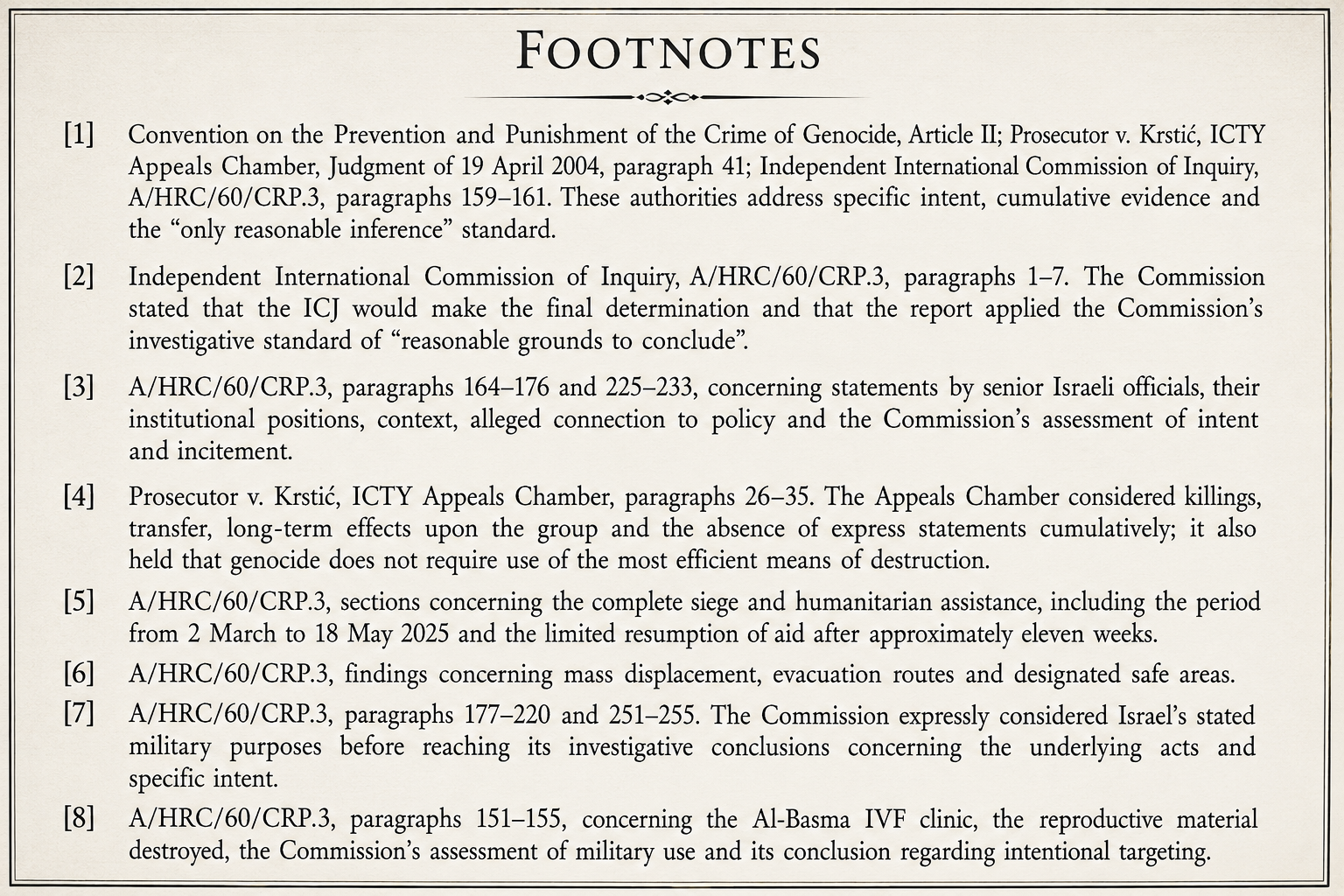
Footnotes

[1] Convention on the Prevention and Punishment of the Crime of Genocide, adopted 9 December 1948, entered into force 12 January 1951, 78 U.N.T.S. 277, Article II.

[2] Application of the Convention on the Prevention and Punishment of the Crime of Genocide (Bosnia and Herzegovina v. Serbia and Montenegro), Judgment, I.C.J. Reports 2007, p. 43, particularly the Court's discussion of proving genocidal intent by inference from the evidence.

[3] Prosecutor v. Krstić, Case No. IT-98-33-A, Appeals Chamber, International Criminal Tribunal for the Former Yugoslavia (ICTY), Judgment of 19 April 2004 (discussing destruction "in part" and genocidal intent).

[4] Convention on the Prevention and Punishment of the Crime of Genocide, Article II ("...intent to destroy, in whole or in part...").

References

  1. Convention on the Prevention and Punishment of the Crime of Genocide, 1948.
  2. International Court of Justice, Application of the Convention on the Prevention and Punishment of the Crime of Genocide (Bosnia and Herzegovina v. Serbia and Montenegro), Judgment (2007).
  3. International Criminal Tribunal for the Former Yugoslavia, Prosecutor v. Krstić, Appeals Judgment (2004).
  4. International Court of Justice, Application of the Convention on the Prevention and Punishment of the Crime of Genocide in the Gaza Strip (South Africa v. Israel), Orders on Provisional Measures (2024). (Note: these orders did not determine whether genocide had occurred; they addressed provisional measures pending a final judgment.)


Thank you to my opponent for an engaging opening argument. I have the utmost respect for anyone willing to publicly defend their position through reasoned debate, particularly on such a difficult and sensitive subject. While I respectfully disagree with your conclusions, I appreciate the courteous tone you have set and look forward to your response in the next round. I wish you every success for the remainder of this debate, and may the strongest argument prevail.

Round 2

2 of 4
avatar Con #3

My opponent's move here is worth naming directly: they've reframed the debate's burden of proof. It is not the Con case's job to "demonstrate that the legal threshold for rejecting the allegation has been met." Under the actual framework we are debating — the 1948 Genocide Convention — the burden sits with the accusation. The Pro case must affirmatively establish specific intent to destroy a group as such; the Con case does not need to disprove genocide, it needs only to show that the evidence fails to meet that threshold. Restating our position as if we bore an affirmative burden of "rejection" doesn't strengthen the Pro case — it quietly shifts the goalposts because the direct evidence for intent isn't there.

On the "totality of evidence" standard itself: I agree with it, and I invoked it in my own case. But totality-of-evidence analysis, as established in genocide jurisprudence like the ICTY's Krstić ruling, requires that the pattern be substantially inexplicable by any competing, non-genocidal motive before intent can be inferred. My opponent's totality includes official rhetoric, patterns of conduct, and humanitarian consequences — but conspicuously omits the counter-evidence I raised: evacuation warnings, aid corridors, and continued diplomatic engagement on ceasefires and hostage negotiations. A totality analysis that only counts the evidence supporting one conclusion isn't a totality analysis — it's a selective one.

The phrase "foreseeable effects of sustained military operations" deserves particular scrutiny, because it's doing a lot of quiet work in my opponent's argument. Foreseeability of civilian harm is the legal standard for assessing proportionality and potential war crimes — it is explicitly not the standard for genocide. Genocide requires dolus specialis: a specific, purposive intent to destroy the group, not merely knowledge that a military campaign would produce civilian casualties. Every sustained military campaign in urban terrain produces foreseeable civilian harm; that fact alone cannot be the evidentiary bridge to genocide, or the term would apply to nearly every modern war fought in populated areas.

"Official rhetoric" fares no better as evidence of state intent. Isolated statements by individual officials, however inflammatory, are not equivalent to command policy or operational intent — a distinction international tribunals have consistently required before attributing statements to a state's genocidal purpose. If scattered rhetoric from individual officials were sufficient, virtually every democracy at war, with its free press and outspoken politicians, would meet the same bar. That isn't a serious legal standard; it's a much lower one dressed up in the language of one.

So while I appreciate my opponent's appeal to totality, a totality of unproven inferences is still unproven. The Pro case has not shown that the pattern of conduct in Gaza is inexplicable by military necessity against an enemy embedded in civilian infrastructure — it has shown only that the war has been catastrophic, which no one on this stage disputes. Catastrophe is not the legal question tonight. Intent is. And on intent, specifically defined, specifically required, and specifically unmet by the evidence presented, the Pro case has not carried its burden.

Round 2 – Pro

I thank my opponent for a thoughtful and legally focused response. He is correct about one point that should be clarified immediately: Pro bears the burden of establishing genocide. My final sentence in Round 1 was therefore phrased too loosely. I do not ask Con to disprove genocide; I accept the obligation to establish the prohibited acts and the required specific intent.


However, correcting that formulation does not resolve the substance of the debate. My opponent proceeds from the assumption that direct evidence of intent does not exist and that the military explanation necessarily defeats the genocidal one. Neither proposition is established.


I. We agree on the legal standard—but not its application

Genocide requires the commission of one or more acts listed in Article II of the Genocide Convention, accompanied by the specific intent to destroy, in whole or in part, a protected group as such.[1]


I also accept the demanding evidential rule invoked by my opponent: where intent is inferred from conduct, genocidal intent must be the only reasonable inference available from the evidence.


But this does not mean that the mere existence of some conceivable military purpose automatically defeats the inference.


The question is not:

Can Israel identify any military objective at all?

The question is:

Does military necessity reasonably explain the entire pattern of conduct, when all of the evidence is considered?

Those are not the same test.


In Prosecutor v. Krstić, the ICTY Appeals Chamber held that, even without direct statements admitting genocidal purpose, intent may be inferred from the factual circumstances.


It relied upon the scale of the killings, awareness of their consequences for the community, and other coordinated actions directed toward that community’s destruction.[2] The absence of a written extermination order did not prevent a finding of genocide.


My opponent is therefore correct that the inference must be rigorous, but incorrect to imply that the existence of an armed enemy automatically supplies a reasonable alternative explanation for every act committed during the campaign.


II. A military objective does not automatically exclude a concurrent genocidal intent

My opponent argues that Israel seeks to defeat Hamas, obtain the release of hostages and protect its citizens.


Those are plainly stated Israeli objectives, and I do not pretend they are irrelevant.


But the existence of one objective does not logically exclude another.


The United Nations Independent International Commission of Inquiry addressed this exact issue in its September 2025 legal analysis. Applying the ICJ’s “only reasonable inference” test, it explained that another reason for an individual act—such as obtaining military advantage or destroying an armed group—does not automatically preclude genocidal intent when the totality of the evidence supports that inference.[3]


More importantly, the Commission did not ignore Israel’s counter-case. It expressly considered:

  1. self-defence following 7 October;
  2. the neutralisation of Hamas;
  3. the recovery of Israeli hostages; and
  4. Israel’s reliance upon military necessity.


After considering those explanations alongside the entire evidential record through 31 July 2025, it concluded that military necessity did not justify the overall pattern of conduct and that genocidal intent was the only reasonable inference it drew from that pattern.[3]


The Commission is not the International Court of Justice, and its report is not a final binding judgment. It applied a “reasonable grounds to conclude” standard, and the ICJ will ultimately make its own determination. The Commission itself acknowledges that distinction.


Nevertheless, it is an independent UN-mandated investigative body that examined extensive evidence, expressly considered the very alternative explanation raised by Con, applied the same legal test and reached the opposite conclusion.


That directly answers the allegation that Pro’s case consists merely of selective or legally untested inferences.


III. Foreseeability is not our substitute for intent

My opponent is right that civilian suffering—even catastrophic and foreseeable suffering—does not by itself prove genocide.

That has never been my argument.


Foreseeability becomes probative when it is combined with:

  1. deliberate policies;
  2. repeated knowledge of their destructive consequences;
  3. continued implementation after authoritative warnings;
  4. statements capable of illuminating purpose; and
  5. conduct corresponding to those statements.


Article II(c) of the Genocide Convention does not concern merely accidental collateral damage. It concerns the deliberate infliction of conditions of life calculated to bring about the group’s physical destruction, in whole or in part.[1]


The relevant allegation is therefore not simply:

Israel knew civilians would be harmed during urban warfare.


It is that Israeli authorities deliberately imposed and maintained destructive conditions involving food, water, electricity, medicine, healthcare and displacement, despite being repeatedly informed of their consequences.


The UN Commission recorded that the ICJ had warned in March 2024 that famine was setting in and had ordered humanitarian assistance in sufficient volume. It further recorded that the humanitarian situation was later characterised as disastrous, yet adequate aid still did not reach Palestinians in Gaza. The Commission concluded from the conduct it examined that the conditions were knowingly and deliberately inflicted.[4]


My opponent may dispute that conclusion. But he cannot accurately reduce Pro’s case to the proposition that foreseeable civilian casualties equal genocide.

The case concerns deliberate policies, their continuation after notice, their cumulative consequences and the purpose reasonably inferred from that combination.


IV. Warnings and evacuation orders must be assessed by their practical effect

I accept warnings, evacuation notices, aid arrangements and negotiations as potentially exculpatory evidence. A genuine totality analysis must include them.

But their legal weight depends on what happened after the warning.


An evacuation notice cannot automatically prove an intention to protect civilians where:

  1. no genuinely safe destination exists;
  2. the designated destination lacks food, water, shelter or medical care;
  3. civilians are repeatedly displaced from one area to another;
  4. evacuation routes or designated safe areas are themselves attacked; or
  5. the population is trapped and unable to leave the territory.

T

he Commission reported that approximately 1.9 million people—around 90 per cent of Gaza’s population—had been displaced by June 2025. It also found instances in which Palestinians were killed during evacuation and within areas designated as safe by Israeli forces.[5]


Consequently, the existence of an evacuation order is not the end of the analysis. It must be evaluated alongside the destination, the conditions there, subsequent attacks and the cumulative effects of repeated displacement.


The same applies to aid corridors and ceasefire negotiations. Diplomatic engagement regarding hostages or temporary ceasefires does not legally cleanse every military or humanitarian policy pursued simultaneously.


A state may negotiate in one sphere while acting unlawfully in another.


Con must show that these measures reasonably explain or negate the broader pattern—not merely establish that the measures existed.


V. The rhetoric is neither isolated nor legally irrelevant

My opponent characterises the evidence as “scattered rhetoric from individual officials”.


That description understates both the identity of the speakers and the evidential case.


The statements assessed by the Commission included those of:

  1. the President of Israel;
  2. the Prime Minister;
  3. the then Defence Minister;
  4. other ministers; and
  5. senior military personnel.


These are not unknown commentators, opposition backbenchers or members of the public.


The Commission assessed the statements in their political, military and operational context. It concluded that statements by Israeli authorities constituted direct evidence of genocidal intent and that statements by President Isaac Herzog, Prime Minister Benjamin Netanyahu and then Defence Minister Yoav Gallant amounted to direct and public incitement to genocide.[6]


Again, that conclusion is contestable and is not a final ICJ judgment. But it cannot be dismissed merely by labelling the statements “isolated”.

The correct questions are:

  1. Who made the statement?
  2. What authority did that person possess?
  3. Was it repeated or echoed?
  4. Did subsequent conduct correspond to it?
  5. Was contrary conduct ordered, enforced and investigated?
  6. Were those responsible disciplined when the rhetoric was translated into unlawful behaviour?


International law does not require a formally published document entitled Genocide Policy. Indeed, Krstić confirms that even where no direct statements exist, intent may be inferred from the factual circumstances.[2]


Here, Pro relies not upon rhetoric alone, but upon rhetoric considered together with conduct.


VI. Hamas’s violations do not answer Israel’s intent

I do not minimise Hamas’s conduct.


The deliberate killing of civilians, hostage-taking, indiscriminate attacks and any unlawful use of protected civilian locations are grave violations. The Commission itself has investigated violations by all parties rather than treating Hamas as legally blameless.[7]


But Hamas’s criminality cannot provide unlimited legal justification for Israel.


The presence of combatants among civilians may affect:

  1. target identification;
  2. proportionality;
  3. feasible precautions; and
  4. the complexity of military operations.


It does not convert every civilian object into a military target, make every deprivation militarily necessary or eliminate Israel’s separate obligations under the Genocide Convention.


Con repeatedly invokes Hamas but does not demonstrate that Hamas reasonably explains the full pattern identified by Pro: the combination of killings, severe bodily and mental harm, mass displacement, siege conditions, destruction of health and reproductive systems, restrictions on indispensable supplies, senior rhetoric and continuation after repeated notice.


“Military necessity” cannot function as a universal label. It must explain the particular conduct under examination.


VII. Pro has presented affirmative evidence

My opponent concludes that Pro has shown only catastrophe.


That is incorrect.


Pro’s affirmative case contains three connected elements.


First, there is evidence of prohibited acts within Article II. The 2025 Commission concluded on reasonable grounds that four categories were present:

  1. killing members of the group;
  2. causing serious bodily or mental harm;
  3. deliberately imposing destructive conditions of life; and
  4. imposing measures intended to prevent births.[8]


Second, there is direct evidence relevant to intent in statements by senior political and military authorities.


Third, there is circumstantial evidence in the wider pattern of conduct. The Commission considered Israel’s alternative explanations, applied the “only reasonable inference” standard and concluded that the pattern demonstrated genocidal intent.[3][8]


Con may challenge the Commission’s evidence, methodology or conclusions. That would be legitimate debate.


But Con cannot credibly maintain that:

  1. direct evidence does not exist;
  2. the military explanation has not been considered;
  3. the totality consists only of Pro-selected material; or
  4. no serious legal body has concluded that the evidential threshold is met.


Conclusion

I accept my burden.


I also accept that genocide is not established by casualty numbers, foreseeable suffering or inflammatory language in isolation.

The Pro case is cumulative:

  1. senior official statements;
  2. acts corresponding to those statements;
  3. an extensive and sustained pattern of destruction;
  4. deliberate deprivation of indispensable conditions of life;
  5. repeated displacement without genuine safety;
  6. continuation after authoritative notice; and
  7. insufficient military justification for the overall pattern.


My opponent has identified a possible military purpose. He has not demonstrated that it reasonably explains the entire body of evidence, nor that it excludes a concurrent intent to destroy Palestinians in Gaza, in whole or in substantial part, as a protected group.


The legal threshold is demanding. On the evidence now available, however, Pro has provided an affirmative and legally grounded basis for concluding that it is met.


I thank my opponent once again for the serious and respectful manner in which he has conducted this debate. I look forward to his reply, and may the strongest evidence and reasoning prevail.


Footnotes

[1] Convention on the Prevention and Punishment of the Crime of Genocide, Article II.

[2] Prosecutor v. Radislav Krstić, ICTY Appeals Chamber, Judgment, 19 April 2004, especially paragraphs 34–35 and 41. The Appeals Chamber held that the absence of direct statements was not determinative and that intent could be inferred from the circumstances, subject to the “only reasonable inference” standard.

[3] Independent International Commission of Inquiry on the Occupied Palestinian Territory, Legal Analysis of the Conduct of Israel in Gaza Pursuant to the Convention on the Prevention and Punishment of the Crime of Genocide, A/HRC/60/CRP.3, 16 September 2025, paragraphs 159–160 and 176–179.

[4] Ibid., paragraphs 144–145, concerning notice, humanitarian deprivation and the deliberate infliction of destructive conditions of life.

[5] Ibid., paragraphs 107 and 182, concerning mass displacement, evacuation processes and attacks within designated safe areas.

[6] Ibid., paragraphs 176, 220, 233 and 253–254, concerning statements by senior Israeli authorities, incitement and the Commission’s finding on genocidal intent.

[7] Ibid., introduction, noting that the Commission collected and analysed evidence concerning alleged violations by all parties.

[8] Ibid., paragraphs 252–255, setting out the Commission’s conclusions concerning four underlying genocidal acts, incitement, specific intent and state responsibility.

Round 3

3 of 4
avatar Con #5

Here's my point-by-point rebuttal to each of my opponent's seven cumulative elements:

1. Senior official statements

Individual statements, even from senior officials, are not equivalent to state policy or command intent under genocide law. International tribunals have consistently required that rhetoric be tied to actual operational decision-making authority over the campaign before it can be attributed to the state as evidence of genocidal purpose — a junior minister's inflammatory comment carries very different evidentiary weight than a documented order from the military chain of command. Democracies fighting wars produce inflammatory rhetoric from elected officials as a matter of course; if scattered statements were sufficient to establish intent, most modern conflicts fought by states with a free press and outspoken politicians would meet the same bar. The Pro side needs to show these statements translated into actual command policy — not simply that they were said.

2. Acts corresponding to those statements

This item assumes its own conclusion: it treats "acts corresponding to rhetoric" as proof the rhetoric reflected genuine state intent, rather than considering that both the acts and the statements might independently be explained by a military campaign against an entrenched, embedded adversary. Correlation between what officials said and what the military did is also fully consistent with officials describing a real war against Hamas in harsh terms while the military pursued Hamas — that is not the same as officials describing, and the military executing, a campaign against Palestinians as a people. The Pro case needs to rule out the non-genocidal explanation for this correspondence, not simply note that words and actions overlapped.

3. An extensive and sustained pattern of destruction

Scale and duration of destruction, however severe, are the domain of proportionality and military necessity analysis under international humanitarian law — not the domain of genocidal intent, which requires a specific purpose to destroy the group as such, not merely an extensive campaign against an enemy embedded in populated areas. Urban warfare against a combatant force that deliberately locates military infrastructure in civilian buildings will, almost by definition, produce an extensive and sustained pattern of destruction regardless of whether genocidal intent exists. Citing scale alone doesn't distinguish between the two explanations; it simply restates that the war has been large and long, which no one disputes.

4. Deliberate deprivation of indispensable conditions of life

"Deliberate" is doing the entire load-bearing work in this claim, and it hasn't been established — restrictions on aid, water, or infrastructure access during active combat, however severely they've affected civilians and however heavily criticized, are not automatically evidence of a policy to destroy the population through deprivation. Israel has continued to coordinate humanitarian corridors, permit aid shipments, and engage with international relief organizations throughout the conflict — imperfectly, and under enormous international criticism, but that ongoing coordination is inconsistent with a deliberate policy of extermination through deprivation. Contrast this with cases the international community has actually classified as genocide, where no humanitarian coordination existed at all because destruction of the population was the explicit goal, not a contested byproduct of a security campaign.

5. Repeated displacement without genuine safety

Displacement during active combat is a documented feature of nearly every modern war fought in populated areas and is addressed under IHL as an issue of proportionality, adequacy of warning, and safe-passage obligations — not as inherent evidence of genocidal intent. The fact that "safety" has been imperfect or repeatedly disrupted reflects the reality of an active, mobile front line against an enemy that doesn't hold fixed positions — it does not by itself establish that displacement was engineered as a mechanism of group destruction rather than a consequence of shifting combat zones. The Pro case would need to show displacement was pursued as an end in itself, separate from any military objective, to make this evidence of intent rather than evidence of war.

6. Continuation after authoritative notice

Continuing military operations after international criticism or an ICJ provisional measures order reflects a dispute over the legality and proportionality of the ongoing campaign — it is not itself proof of genocidal intent. Provisional measures require prevention of potential Genocide Convention violations and improved humanitarian access; they are not a finding that genocide occurred, and continuing a war effort while contesting the legal characterization of your own conduct is categorically different from continuing a war effort you've conceded is aimed at group destruction. Many states have continued disputed military campaigns after international bodies raised concerns without those campaigns being subsequently found to be genocidal.

7. Insufficient military justification for the overall pattern

This is the crux of the debate, and it's an assertion, not a demonstrated finding — no court has yet ruled that the military justification is insufficient to explain the pattern. The competing, well-documented explanation on the table is Hamas's sustained practice of embedding command centers, tunnels, and weapons caches in hospitals, schools, mosques, and residential buildings. Under the standard from cases like Krstić at the ICTY, pattern-based inference of intent is only valid when the pattern has no plausible non-genocidal explanation — and here, the military explanation is not merely plausible but extensively documented. Asserting that the military justification is "insufficient" without demonstrating why the embedded-combatant explanation fails to account for the pattern is circular: it assumes the conclusion the Pro case is supposed to be proving.

Every item on this list takes a real, terrible feature of this war — rhetoric, destruction, deprivation, displacement, continuation, scale — and asks you to treat it as self-evidently genocidal, without ruling out the competing explanation that's been on the table throughout this debate: a brutal war against an enemy embedded in civilian infrastructure. Cumulative weight doesn't fix that gap. Seven unproven inferences stacked together are still unproven — they're just stacked.

Round 3 – Pro

I thank my opponent for a detailed and disciplined response. His seven objections are clearly presented, but they repeatedly rely upon the same underlying proposition:

Because particular acts may have some connection to Israel’s military campaign against Hamas, the military explanation necessarily prevents an inference of genocidal intent.


That does not fully state the legal test.


I accept that Pro bears the burden of proving specific intent. I also accept the demanding standard applicable when intent is inferred from conduct: genocidal intent must be the only reasonable inference available from the evidence.


However, reasonable does not mean merely imaginable. A competing explanation must reasonably account for the evidence when viewed as a whole. It is not enough to explain selected parts of the pattern while leaving other significant parts unanswered.


International jurisprudence also recognises that a military objective connected to a discrete act does not automatically exclude a concurrent genocidal purpose. The question is whether, after all reasonable alternative explanations are considered, the totality of the evidence supports the inference of an intent to destroy the protected group, in whole or in substantial part.[1]


Pro therefore accepts the burden of proof. This round will demonstrate that intent is supported through two mutually reinforcing routes:

  1. statements by senior state officials, considered in their political and operational context; and
  2. circumstantial evidence arising from a sustained pattern of conduct that the general invocation of military necessity does not, on its own, adequately explain.

Before proceeding, one qualification should remain clear. The Independent International Commission of Inquiry is not the International Court of Justice. Its September 2025 report applied its investigative standard of “reasonable grounds to conclude”, and the Commission expressly acknowledged that the ICJ will make the final determination of Israel’s responsibility under the Genocide Convention.


The Commission’s analysis is therefore evidence, not a binding final verdict. Nevertheless, it remains a detailed investigation by an independent United Nations body that expressly examined Israel’s stated military justifications before reaching its conclusions. Its findings cannot be dismissed simply because they are inconvenient to Con’s position.[2]


I. Senior official statements

My opponent characterises the statements relied upon by Pro as scattered remarks by individual politicians, disconnected from command policy.

That characterisation understates the evidence.


The speakers assessed by the Commission included:

  1. President Isaac Herzog;
  2. Prime Minister Benjamin Netanyahu; and
  3. then Defence Minister Yoav Gallant.

The evidentiary weight of a statement depends upon the speaker’s authority, its audience, the context in which it was made, whether it was repeated, and whether subsequent state conduct corresponded with it. A remark by an obscure backbencher would carry very different weight from one made by the Prime Minister or the minister responsible for defence during the formulation and execution of a military campaign.


The statements were also not limited to severe language directed exclusively at Hamas. The Commission examined, among other matters:

  1. Gallant’s announcement of a “complete siege” while using dehumanising language;
  2. Herzog’s attribution of responsibility to an “entire nation”; and
  3. Netanyahu’s invocation of Amalek while addressing Israel’s campaign and military personnel.


The Commission assessed these statements contextually, not as isolated quotations. It reached the view that statements by senior Israeli authorities were capable of evidencing genocidal intent and separately concluded that statements by Herzog, Netanyahu and Gallant amounted to direct and public incitement to genocide.[3]


That conclusion remains open to challenge and is not binding upon the ICJ. Nevertheless, Con must engage with the substance of the Commission’s assessment. Calling the statements “scattered rhetoric” does not explain why statements by officials occupying the highest offices of state and government should carry no evidentiary weight.


Nor does genocide law require Pro to produce a document expressly entitled Policy of Genocide.


In Prosecutor v. Krstić, the ICTY Appeals Chamber held that the absence of statements explicitly admitting genocidal intent was not determinative. Intent could still be inferred from the factual circumstances and from other culpable acts systematically directed against the protected group.[4]


II. Acts corresponding to the statements

My opponent argues that the relationship between official rhetoric and operational conduct may amount only to correlation. Officials may have spoken harshly while the military independently pursued Hamas.


That possibility must be considered.


However, Pro’s case does not rest merely upon similar language appearing in two separate places.


On 9 October 2023, Gallant publicly announced a complete siege. The Commission subsequently documented the cutting or severe restriction of electricity, water, fuel, food, medicine and humanitarian assistance. The Commission also recorded directives issued by relevant Israeli ministers concerning electricity and the entry of essential supplies.[5]


The sequence is therefore evidentially significant:

  1. a senior official responsible for defence publicly announced a policy;
  2. state institutions implemented measures corresponding to that announcement;
  3. the measures affected the civilian population across Gaza; and
  4. substantial restrictions continued after the resulting humanitarian consequences had become widely known.


This does not prove that every subsequent strike or military decision implemented the same purpose. It does, however, provide a stronger evidentiary connection than the mere coincidence alleged by Con.


The Commission also assessed whether official statements were reflected in the behaviour of Israeli forces and in the development and implementation of public policy and military operations. It reached the view that the rhetoric and conduct were connected.[3]


Again, this is an investigative assessment rather than a final judicial determination. But Con cannot rebut it merely by stating that correlation is theoretically possible. He must explain why the documented relationship between announcement, implementation and continued enforcement should be treated as legally meaningless.


III. An extensive and sustained pattern of destruction

I agree with my opponent that scale and duration alone do not establish genocide.


A large and destructive war is not automatically genocidal.


But Pro has never relied upon scale alone. Relevant considerations may include:

  1. the systematic nature of the conduct;
  2. the identity and vulnerability of the victims;
  3. the selection of targets;
  4. the repetition of destructive measures;
  5. the degree to which damage exceeds a credible military justification;
  6. the long-term effects upon the survival of the group; and
  7. conduct before, during and after the alleged genocidal acts.


My opponent repeatedly examines each category separately. He considers rhetoric without deprivation, deprivation without displacement, displacement without attacks upon supposed safe areas, and destruction without measures affecting future births.


That is not a genuine cumulative analysis.


The point of cumulative reasoning is that an act carrying limited weight in isolation may become highly probative when it corresponds with several independent categories of evidence.


Krstić illustrates the principle, although the facts of Srebrenica and Gaza are plainly not identical. The Appeals Chamber considered killings, forcible transfer and the long-term effects upon the community together. It rejected the argument that allowing some members of the population to survive necessarily

disproved genocide. It also held that genocide does not require the perpetrator to select the most direct or efficient method of destruction.[4]


The relevance to this debate is narrow but important:

Partial restraint, incomplete destruction or measures protecting some civilians do not automatically negate genocidal intent.

Warnings, aid deliveries and the continued survival of much of Gaza’s population must be considered. They cannot simply be isolated from the rest of the evidence and converted into an automatic legal defence.


IV. Deliberate deprivation of indispensable conditions of life

My opponent correctly observes that the word deliberate carries substantial weight.


It must be established rather than assumed.


Pro does not infer deliberateness merely from the existence of severe suffering. The argument relies upon the connection between:

  1. publicly announced siege measures;
  2. the implementation of restrictions upon indispensable supplies;
  3. repeated notice of the foreseeable consequences;
  4. continuation or reimposition of those restrictions; and
  5. the inadequacy of the aid ultimately admitted.


The Commission recorded that no aid trucks entered Gaza between 2 March and 18 May 2025. It described this as approximately eleven weeks of complete blockade. When limited aid resumed, only nine UN trucks were initially permitted to enter, and OCHA described the amount admitted at that stage as vastly insufficient.[5]


These findings do not, by themselves, establish genocidal intent. They nevertheless materially weaken Con’s claim that continued humanitarian coordination necessarily demonstrates the absence of a deliberately destructive policy.


The existence of some aid is relevant, but its evidentiary meaning depends upon:

  1. its quantity;
  2. its regularity;
  3. the needs of the population;
  4. which supplies were allowed or excluded;
  5. whether distribution was safely possible; and
  6. whether the aid was capable of sustaining civilian life.


The Genocide Convention contains no principle under which permitting a limited quantity of humanitarian assistance automatically disproves genocide.

The legal question under Article II(c) is whether conditions of life were deliberately inflicted as a means of contributing to the group’s physical destruction, in whole or in part. The Commission reached the view that the pattern of siege, deprivation and humanitarian obstruction supported that inference.[5]


Con may dispute that conclusion. But saying that humanitarian organisations were sometimes engaged does not adequately answer the duration, breadth and consequences of the restrictions documented.

V. Repeated displacement without genuine safety

I also accept that civilian displacement during armed conflict is not inherently genocidal.


Evacuation orders may constitute genuine precautions intended to protect civilian life.


Their evidentiary value, however, depends upon their practical operation.


Relevant questions include:

  1. Could civilians realistically comply?
  2. Was the proposed destination materially safer?
  3. Were adequate food, water, shelter and medical services available?
  4. Were civilians repeatedly ordered to relocate?
  5. Were evacuation routes or designated safe areas subsequently attacked?
  6. Was there any realistic possibility of leaving the territory altogether?


The Commission reported that approximately 1.9 million Palestinians—around 90 per cent of Gaza’s population—had been internally displaced by August 2025. It also reported incidents in which Israeli forces allegedly knew that civilians were present along evacuation routes or within designated safe areas but nevertheless fired upon or killed civilians, including people carrying makeshift white flags.[6]


Those are the Commission’s findings and may be contested. They should not be presented as though a final court has already resolved every factual dispute.

However, if the findings are accepted, they substantially complicate Con’s account of evacuation orders as straightforward evidence of civilian protection.


A warning followed by movement to a genuinely safer location may support Con’s explanation. A warning followed by repeated displacement into overcrowded, deprived or subsequently attacked areas has a different evidentiary character.


Pro does not argue that displacement alone proves genocide. We argue that displacement must be considered together with deprivation, attacks affecting civilian refuge, official rhetoric and the broader pattern of destruction.


VI. Continuation after authoritative notice

My opponent is correct that continuing a military campaign after international criticism or provisional measures does not automatically prove genocide.


The ICJ’s provisional-measures orders were not final merits judgments. Pro does not claim otherwise.


Notice is nevertheless probative because it helps distinguish:

  1. an unforeseen consequence from a known one;
  2. an accidental shortage from a consciously maintained deprivation;
  3. an initial error from a policy continued after its effects became clear.

The argument is not:

The ICJ issued provisional measures; therefore genocide occurred.

The argument is:

Israeli authorities were repeatedly placed on authoritative notice of the threat to civilian survival, yet substantial elements of the allegedly destructive conduct continued.

That does not establish specific intent in isolation. It strengthens the inference of knowledge and deliberateness when considered with the initial siege announcement, the breadth of the restrictions and the decision to continue or reintroduce them after their effects were documented.

Notice is therefore one part of the cumulative case—not a substitute for it.

VII. Military necessity does not, by itself, adequately explain the whole pattern

This remains the central point of disagreement.


I accept that Hamas has operated within densely populated civilian areas and has been accused of using tunnels, hospitals, schools and other civilian infrastructure for military purposes.


That fact may reasonably explain some Israeli attacks. It also increases the difficulty of conducting lawful military operations and may contribute significantly to civilian casualties.


But the existence of Hamas cannot function as a universal explanation for every category of conduct alleged.


The Commission expressly considered Israel’s stated purposes:

  1. self-defence following 7 October;
  2. neutralising Hamas;
  3. securing the release of Israeli hostages; and
  4. protecting Israel’s long-term security.


It did not omit those explanations. After examining them against the totality of the evidence, the Commission reached the view that they did not adequately justify the overall pattern and that genocidal intent was the only reasonable inference it drew.[7]


That conclusion is not binding upon this debate or upon the ICJ. Its significance is that an investigative body examined the same competing explanation repeatedly advanced by Con and did not regard it as an adequate account of the entire evidential record.


The destruction of the Al-Basma IVF clinic provides one concrete example.


The Commission reported that approximately 4,000 embryos and 1,000 sperm samples and unfertilised eggs were destroyed. It stated that it had found no credible information indicating that the standalone clinic had been used for military purposes. Considering the precision of the strike, the concentration of damage and the absence of a credible military threat, it reached the view that the clinic and its reproductive material had been intentionally targeted.[8]


This finding may be challenged. But if the Commission’s factual assessment is accepted, the general explanation that Hamas embedded itself within civilian infrastructure does not adequately account for that incident.


The same difficulty arises where Con invokes military necessity to explain:

  1. an eleven-week halt to all aid trucks;
  2. restrictions affecting specialised infant nutrition;
  3. alleged attacks upon civilians in designated safe areas;
  4. destruction affecting reproductive capacity; and
  5. broad declarations of collective civilian responsibility.


Hamas may explain why military operations were initiated and why many particular locations were attacked.


It does not necessarily explain every policy adopted, every deprivation maintained or every protected civilian interest destroyed.


This does not make the military explanation impossible. It makes it incomplete.


VIII. Proving specific intent

My opponent repeatedly says that Pro has not proved intent. I will therefore state the case directly.

A. Evidence from senior officials

The statements relied upon were made by officials occupying the highest positions within the state and government.


Their evidentiary significance arises not simply from their severity, but from the combination of:

  1. the authority of the speakers;
  2. the context of an active military campaign;
  3. references extending responsibility beyond Hamas;
  4. the announcement of policies affecting Gaza’s population as a whole; and
  5. subsequent conduct corresponding with elements of those statements.


The Commission treated these statements as direct evidence of genocidal intent and reached the further view that statements by Herzog, Netanyahu and Gallant constituted incitement to genocide.[3]


Pro does not ask voters to treat the Commission’s legal assessment as binding. We ask voters to recognise that Con’s description of the evidence as merely scattered and irrelevant rhetoric is unsustainable.


B. Circumstantial evidence from the pattern of conduct

The circumstantial case includes:

  1. alleged acts falling within four categories of Article II;
  2. broad and prolonged deprivation of indispensable necessities;
  3. attacks affecting healthcare and reproductive survival;
  4. mass and repeated displacement without consistent safety;
  5. alleged attacks against civilians and protected locations lacking an adequately demonstrated military justification;
  6. continuation after repeated notice; and
  7. effects extending beyond immediate casualties to the future physical and biological continuity of the group.

The Commission reached the view, on its “reasonable grounds to conclude” standard, that four underlying genocidal acts had occurred and that the pattern of conduct supported the necessary specific intent.[7]


This remains an investigative conclusion rather than a final judicial judgment. Nevertheless, it supplies Pro with affirmative evidence and legal analysis. The case is therefore not merely:

The war is catastrophic, so it must be genocide.

It is:

Senior declarations, implemented policies and a sustained pattern of conduct mutually reinforce an inference concerning the purpose behind the prohibited acts.


C. Why the competing inference is inadequate

The military explanation is not rejected merely because the campaign has produced destruction.


It is inadequate as a complete explanation because it does not sufficiently account for important parts of the evidence, including:

  1. broad deprivation imposed upon the population rather than identified combatants;
  2. continuation of restrictions after their civilian consequences were repeatedly documented;
  3. alleged attacks affecting civilians in designated areas of refuge;
  4. destruction of reproductive material at a facility for which the Commission reported no credible military use; and
  5. senior statements assigning collective responsibility beyond Hamas.


The burden upon Pro is not to prove that no Israeli action had a legitimate military purpose.


The existence of lawful military purposes for some acts does not automatically exclude the possibility that other acts—or the campaign’s broader methods—

were also pursued with a specific destructive intent.


The question is whether military necessity reasonably explains the entire pattern.


On the evidence presented, it does not adequately do so.


Round 4

4 of 4
avatar Con #7

I want to begin by naming something important: my opponent has just changed the legal standard mid-debate, and voters should notice. Round one argued from the Genocide Convention's dolus specialis requirement. This round, the operative standard has quietly become "the totality of evidence, viewed cumulatively" — a standard borrowed not from the ICJ or any binding tribunal, but from a UN Human Rights Council Commission of Inquiry using its own self-described "reasonable grounds to conclude" threshold. That threshold is explicitly lower than what genocide law actually requires, and my opponent concedes this directly — "the Commission's analysis is therefore evidence, not a binding final verdict." I agree. So let's be precise about what evidentiary weight it can bear.

On the Commission of Inquiry as a source

"Reasonable grounds to conclude" is an investigative threshold used to justify continuing an inquiry — not the standard any court applies to establish state responsibility for genocide, and not the standard this debate is bound by. The Commission operates under a mandate created by a UN Human Rights Council with a long, well-documented history of disproportionate scrutiny of Israel relative to other states in active conflict — a pattern criticized not just by Israel's supporters but by former UN officials and independent watchdogs across the political spectrum. The Commission was also denied direct access to Israel and to much of Gaza, meaning significant portions of its evidentiary base rely on secondary reporting, testimony gathered remotely, and data from Gaza's Hamas-run Health Ministry — sources whose reliability is contested for reasons entirely independent of this debate's outcome. None of this means the Commission's findings are worthless. It means they are not the neutral, dispositive "totality of evidence" my opponent is presenting them as. Citing one contested report repeatedly is not the same as citing "the evidence" — it's citing an advocate's brief and calling it a totality.

On senior official statements

I'm not disputing that Herzog, Netanyahu, and Gallant hold high office — I'm disputing that isolated wartime rhetoric, made in the immediate emotional aftermath of the deadliest attack on Jews since the Holocaust, constitutes proof of state policy. Notice what's missing from my opponent's account: the same officials, across the same period, also announced humanitarian corridors, negotiated multiple ceasefires and hostage exchanges, and coordinated aid deliveries with international bodies. A genuine totality analysis has to weigh the Amalek reference against the ceasefire negotiations conducted by the same government days later — not select the rhetoric that fits the thesis and treat the countervailing diplomatic conduct as irrelevant. My opponent's own framework — "reasonable does not mean merely imaginable, but a competing explanation must reasonably account for the evidence when viewed as a whole" — cuts both ways. If cherry-picked statements can't be waved away by Con, cherry-picked diplomatic and humanitarian conduct can't be waved away by Pro either.

On Krstić — the case my opponent needs to distinguish, not just cite

Krstić is being asked to do far more work than it can bear. In Srebrenica, the Trial and Appeals Chambers were working from an adjudicated factual record, established through full trial process, in which the killing of the military-age male population had no plausible military explanation whatsoever — the men and boys were unarmed, separated, and executed after surrender. There was no competing account left standing. That is what "the only reasonable inference" actually looks like in practice. Here, my opponent concedes on the record that Hamas embeds itself in civilian infrastructure, that Israel faced a genuine security threat, and that self-defense, hostage recovery, and neutralizing Hamas were all legitimate stated purposes. Krstić had one explanation. This case has two live, competing explanations — and where two explanations remain reasonably available, the "only reasonable inference" standard is, by definition, not met. My opponent's own framing — accepting Con's Krstić standard while trying to satisfy it with a lower-standard Commission report — doesn't resolve that gap; it just relocates it.

On the siege announcement and deprivation

The eleven-week aid restriction is a serious, legitimate humanitarian criticism, and I won't minimize it. But a policy being harsh, even a policy that violates international humanitarian law's proportionality requirements, is not automatically evidence of genocidal purpose — IHL has its own extensive framework for judging exactly this kind of conduct as a war crime or unlawful reprisal, precisely because these categories are legally distinct from genocide's specific-intent requirement. My opponent needs deprivation to prove destruction of the group as such was the goal — not that the siege was a coercive, unlawful pressure tactic aimed at Hamas and hostage recovery, which is the explanation the Israeli government has consistently and publicly given, and which is consistent with the fact that aid was never fully or permanently cut off, and negotiations over its resumption continued throughout.

On the Al-Basma clinic

This is presented as the strongest single piece of evidence, and I'll engage it directly rather than wave it away: if the facts are as reported, it is a horrifying incident deserving full independent investigation and accountability. But one incident — however serious — cannot establish state policy intent across an entire 21-month campaign. Genocidal intent under the Convention must be attributable to the state's conduct of the campaign as a whole, not inferred from a single contested strike, however emotionally weighty. My opponent's own standard requires the totality to be inexplicable by competing purposes — a single incident, isolated from that totality, cannot carry that weight no matter how disturbing it is in isolation.

The core problem with Pro's case, stated plainly

My opponent closes by reframing the question as: "whether military necessity reasonably explains the entire pattern." That is not the legal question, and it inverts the actual burden. The question is not whether Con can produce a fully satisfying military explanation for every documented harm in this war — wars this destructive rarely permit a tidy explanation for everything that happens in them. The question is whether Pro has shown that genocidal intent is the only reasonable inference available. Two competing, well-evidenced explanations remaining on the table — brutal, IHL-violating warfare against an embedded enemy, versus purposive group destruction — is not a totality that excludes reasonable doubt. It's a totality that confirms it.

Round 4 – Pro

Final Rebuttal

I thank my opponent for a serious and carefully constructed final argument. His submission is strongest where it insists that genocide requires proof of specific intent, rather than proof merely of widespread destruction, unlawful warfare or catastrophic civilian suffering.


I agree.


But his argument fails because it conflates three distinct legal questions:

  1. The substantive element: whether there was an intent to destroy a protected group, in whole or in substantial part.
  2. The method of proof: whether that intent may be established directly or inferred from the evidence viewed cumulatively.
  3. The standard of proof: how convincingly the evidence must establish that inference.

Pro has not changed any of these.


Article II of the Genocide Convention has remained our substantive standard throughout this debate. The “only reasonable inference” requirement has remained our inferential test. The totality of the evidence is not a replacement for dolus specialis; it is the method by which international courts and tribunals determine whether dolus specialis may be inferred where there is no written confession or formally titled extermination order.[1]


The Commission of Inquiry did apply its own lower investigative threshold of “reasonable grounds to conclude”. Pro has repeatedly acknowledged that limitation. But its evidentiary standard is not the legal standard I ask voters to apply.


The Commission is a source of evidence and analysis.


It is not the law.


The law remains the Genocide Convention and the jurisprudence of the ICJ and international criminal tribunals.


There has therefore been no mid-debate alteration of the standard.


I. “Totality of the evidence” is not a new or lower test

My opponent suggests that cumulative analysis was borrowed from the Commission of Inquiry.


That is incorrect.


The ICJ has expressly accepted that genocidal intent may be proved indirectly through a pattern of conduct. In Croatia v. Serbia, the Court stated that the inference of dolus specialis must be the only inference that could reasonably be drawn from the acts in question. It then examined the alleged conduct contextually, including its scale, systematic character, targeting, severity and relationship to military necessity.[1]


International criminal tribunals likewise recognise that specific intent may be inferred from:

  1. the general context;
  2. systematic acts directed against the same group;
  3. the scale of atrocities;
  4. repeated destructive or discriminatory conduct;
  5. the targeting of people because of their group identity; and
  6. relevant statements by perpetrators or officials.[2]

That is cumulative analysis.


It does not lower the requirement of genocidal intent. It is how the requirement is proved when direct admissions are unavailable.

My opponent therefore mistakes the method of evaluating circumstantial evidence for a different legal standard.


II. Pro accepts the burden of proof

Let there be no ambiguity: Pro bears the burden.


I am not asking Con to prove that genocide did not occur. Nor am I asking voters to presume genocide because Israel cannot explain every tragedy produced by a long and destructive war.


The ICJ has said that allegations of genocide against a state must be clearly established by fully conclusive evidence and that the Court must be fully convinced.[3]


Pro accepts that demanding approach.


But accepting the burden does not mean accepting Con’s central shortcut:

A non-genocidal explanation has been asserted; therefore genocidal intent cannot be established.


An alternative explanation does not become reasonable merely because it is named.


It must fit the evidence.


The ICJ did not decide Croatia v. Serbia by counting how many possible narratives each party could articulate. It assessed whether the alternative explanation actually accounted for the proven conduct. The Court considered military necessity, the scale and pattern of attacks, specific targeting, opportunities not taken and the broader operational context.[1]


Testing whether Con’s proposed military explanation adequately accounts for the evidence is therefore not a reversal of the burden.


It is the precise task required by the “only reasonable inference” test.


An explanation is not reasonable because it carries the label “military necessity”. It is reasonable only insofar as it credibly explains the relevant conduct.


III. Con confuses motive with intent

This is the central weakness in my opponent’s final case.

Con identifies three legitimate Israeli objectives:

  1. defeating Hamas;
  2. protecting Israel; and
  3. securing the hostages’ release.


Pro does not deny that these objectives exist.


But their existence does not logically exclude an additional prohibited intent.


International tribunal jurisprudence distinguishes motive from specific intent. A political, personal, economic or military motive does not necessarily prevent the simultaneous existence of genocidal intent. The ICTY Appeals Chamber also held that a formal genocidal plan or policy is not itself a legal ingredient of genocide, even though such a plan may assist in proving intent.[2]


In this debate:

  1. defeating Hamas may explain why Israel entered the war;
  2. recovering hostages may explain why negotiations occurred;
  3. self-defence may explain why force was employed.

None of those propositions independently answers the different question:

What intent accompanied the particular prohibited acts and policies imposed upon Palestinians in Gaza?


My opponent treats “military objective” and “genocidal intent” as mutually exclusive alternatives.


They are not necessarily mutually exclusive.


A campaign may begin in response to a genuine attack, pursue real military objectives and still employ methods intended to destroy a protected civilian group in substantial part.


Therefore, merely proving that Israel had a military motive does not establish the competing inference Con needs. Con must show that the military explanation excludes the destructive intent inferred from the whole pattern.


That has not been shown.


IV. The Commission is evidence—not the standard and not the whole case

My opponent raises legitimate questions concerning the Commission’s mandate, access and investigative threshold.

Those issues affect the weight voters may give its findings.


They do not justify dismissing the report as nothing more than an “advocate’s brief”.


The Commission expressly stated that:

  1. it investigated alleged violations committed by all parties;
  2. it relied upon its own investigations and earlier published findings;
  3. its factual record was non-exhaustive;
  4. it applied a “reasonable grounds to conclude” investigative standard; and
  5. the ICJ would make the eventual authoritative determination of state responsibility.[4]


That is not equivalent to a final merits judgment, and Pro has never represented it as one.


However, it also means that the Commission did not secretly replace the Genocide Convention’s intent requirement. In its legal analysis, it expressly identified and applied the ICJ’s “only reasonable inference” formulation when evaluating the pattern of conduct—although its ultimate institutional findings remained subject to its lower investigative threshold.[4]


My opponent is therefore entitled to argue that the Commission’s findings deserve reduced weight.


But attacking the institution cannot substitute for answering the underlying material it assembled:

  1. public statements;
  2. announced siege policies;
  3. restrictions upon necessities;
  4. displacement;
  5. attacks on protected facilities;
  6. the practical operation of evacuation measures; and
  7. conduct allegedly lacking an adequate military explanation.


Furthermore, Pro’s case does not depend upon one casualty figure or upon accepting every factual claim in the Commission’s report.

The central evidence concerning intent includes public statements and publicly announced policies whose existence does not depend upon statistics from Gaza’s Health Ministry.


Even if voters substantially discount the Commission, the legal and logical questions remain.


V. Countervailing conduct must be weighed—but it is not automatically exculpatory

My opponent correctly identifies evidence that may weigh against genocidal intent:

  1. evacuation warnings;
  2. aid deliveries;
  3. humanitarian corridors;
  4. ceasefire negotiations; and
  5. hostage exchanges.

Pro has never argued that this evidence is irrelevant.


It must be weighed.


But my opponent turns relevant counter-evidence into a categorical legal veto.


The fact that a government negotiates a temporary ceasefire does not establish the intent accompanying every other policy it implements. Hostage negotiations may pursue hostage recovery. Aid arrangements may mitigate some harm. Evacuation warnings may protect some civilians.


Those facts can coexist with destructive acts or policies undertaken for a different or additional purpose.


The Genocide Convention does not require:

  1. the destruction of every group member;
  2. the rejection of every negotiation;
  3. a permanent refusal of all humanitarian relief;
  4. the use of the most efficient available means; or
  5. uninterrupted destructive conduct at every moment of the campaign.

The intended destruction may be partial.


Similarly, mixed conduct does not automatically produce a mixed intent. Courts must identify the intent accompanying the prohibited acts themselves.


The evidence of negotiations and humanitarian measures therefore counts in Con’s favour. But it must be evaluated against:

  1. the amount and continuity of aid;
  2. whether it was sufficient for civilian survival;
  3. whether evacuation destinations were genuinely safe;
  4. whether the restrictions were population-wide;
  5. whether destructive policies continued after notice of their consequences; and
  6. whether senior statements corresponded with implemented measures.

My opponent wants the existence of a corridor to end the inquiry.


The law requires the corridor’s actual significance to be assessed within the whole record.


VI. The official statements cannot be dismissed as emotional remarks

My opponent says that the statements arose in the emotional aftermath of 7 October.


That context is relevant.


It does not render the statements legally invisible.


The speakers included the President, Prime Minister and Defence Minister—not merely junior politicians or unaffiliated commentators. The Commission assessed their authority, their wording, the audiences addressed and the relationship between the statements and subsequent conduct.[4]


More importantly, a formally documented command policy is not indispensable.


The ICTY Appeals Chamber has held that the existence of a plan or policy is not a legal ingredient of genocide and that intent may be inferred from conduct, context and repeated acts even without an express admission.[2]


The evidentiary question is therefore not:

Can Pro produce a document entitled “Order to Commit Genocide”?

It is:

Do the statements of senior officials, when placed beside the acts and policies subsequently implemented, illuminate the purpose behind those acts?

My opponent says that humanitarian negotiations by the same government negate the statements.


They do not necessarily do so.


At most, they create counter-evidence which must be weighed. They do not erase the statements, reduce the speakers’ authority or prevent a finding that different objectives coexisted.


Calling all contrary statements “rhetoric” while treating every humanitarian announcement as conclusive state policy is not a genuine totality analysis.


It is selective weighting.


VII. Krstić does not establish Con’s claimed rule

My opponent says that Krstić involved only one possible explanation, whereas Gaza presents two.


This oversimplifies both the case and its legal significance.


Srebrenica existed within an armed conflict and had substantial strategic importance. The ICTY recorded the Bosnian Serb leadership’s territorial and military objectives. Yet those strategic motives did not prevent the Tribunal from finding genocide when the scale of the killings, awareness of their long-term impact and other actions directed towards the community’s demise established the necessary intent.[5]


The factual differences are real.


The executions at Srebrenica involved captured and unarmed men and boys. Gaza involves urban warfare against an armed organisation. Pro does not claim the factual situations are identical.


We cite Krstić for narrower principles:

  1. genocidal intent may be inferred from circumstances;
  2. the evidence must be assessed cumulatively;
  3. the intended destruction may concern a substantial part of the group;
  4. a formal admission is unnecessary; and
  5. the survival or removal of some group members does not automatically negate the intention to destroy the relevant part.[5]

The proposition that “Krstić had one explanation” describes the conclusion reached after the tribunal assessed and rejected competing arguments. It was not a rule assumed before the evidence was considered.


Con’s reasoning is circular:

  1. Con asserts military necessity.
  2. Con labels it a reasonable explanation.
  3. Con then concludes that two reasonable explanations exist.

But the very question in dispute is whether military necessity reasonably accounts for the relevant pattern.

Con cannot establish the reasonableness of its explanation merely by repeating it.


VIII. Deprivation cannot be answered simply by pointing to some aid

My opponent acknowledges that the eleven-week aid restriction was serious but argues that aid was neither permanently nor completely cut off throughout the whole war.


That is true—and legally insufficient.


Article II(c) concerns the deliberate infliction of conditions of life calculated to bring about physical destruction, in whole or in part. It does not require a permanent and absolute blockade maintained without a single exception.


The ICJ’s March 2024 order referred to worsening conditions, famine and starvation, and unanimously required the unhindered provision at scale of food, water, fuel, shelter, sanitation and medical assistance throughout Gaza. In May 2024, it reaffirmed those measures and again emphasised maintaining open crossings and large-scale humanitarian provision. These were provisional measures, not findings that genocide had occurred, but they demonstrate the gravity of the conditions and the authoritative notice given concerning them.[6]


Con says the restrictions may have been intended to pressure Hamas and obtain the hostages’ release.


That is a proposed coercive motive.


It does not conclusively establish the intent accompanying the continued imposition of life-threatening conditions upon the civilian population.

The legal inquiry must consider:

  1. who was deprived;
  2. what was withheld;
  3. for how long;
  4. what authorities knew about the consequences;
  5. whether the deprivation was continued after that knowledge; and
  6. whether the measures were reasonably tailored to a lawful military purpose.

Permitting some aid after severe deprivation may mitigate the evidence.

It does not retroactively make the deprivation accidental, nor does it establish that the permitted quantities were sufficient to sustain the population.

Once again, Con mistakes evidence against intent for automatic disproof of intent.


IX. The Al-Basma clinic was never offered as the whole case

My opponent responds that one attack upon a fertility clinic cannot establish the intent behind an entire campaign.


I agree.


No single incident carries Pro’s whole burden.


But cumulative evidence does not require every item to prove the entire case independently.


The relevance of the Al-Basma incident is narrower.


Con repeatedly advances an explanation broad enough to cover almost everything:

Hamas embeds itself in civilian infrastructure.

The clinic incident tests that explanation.


The Commission reported that it found no credible information that the standalone clinic was being used for military purposes and concluded that the strike deliberately destroyed thousands of embryos and other reproductive material.[4]


Voters may contest or discount that finding.


But if it is accepted, the incident does not need to prove the entire campaign was genocidal. It demonstrates that Con’s universal military explanation does not necessarily account for every significant act affecting the group’s physical or biological continuity.


The incident is therefore corroborative, not dispositive.


My opponent attacks each piece of evidence because that individual piece does not independently prove the whole allegation.


That misunderstands cumulative proof.


A statement does not prove the whole case.


A siege measure does not prove the whole case.


An attack on reproductive capacity does not prove the whole case.


A displacement pattern does not prove the whole case.


But each may reinforce the others and collectively support an inference that none could establish alone.


X. Two proposed explanations are not necessarily two reasonable explanations

My opponent’s final conclusion is:

Two explanations remain; therefore the only-reasonable-inference test fails.

That does not follow.


Two explanations have been proposed.


They are not therefore equal, mutually exclusive or equally capable of accounting for the evidence.


Con’s military explanation reasonably accounts for:

  1. the decision to respond to 7 October;
  2. military attacks upon demonstrated Hamas targets;
  3. efforts to destroy tunnels and weapons;
  4. efforts to recover hostages; and
  5. some civilian harm inherent in urban warfare.

Pro does not deny any of that.


But it does not adequately account for the entire alleged pattern, including:

  1. population-wide deprivation;
  2. continuation after repeated notice of the consequences;
  3. senior statements extending responsibility beyond Hamas;
  4. unsafe and repeated displacement;
  5. alleged attacks upon people in designated civilian areas;
  6. destruction affecting reproductive capacity; and
  7. conduct for which no particular military justification has been demonstrated.

The military explanation is therefore not rejected because it explains nothing.


It is rejected as a complete alternative inference because it leaves material portions of the evidence insufficiently explained.


This is not a demand that Con provide a tidy explanation for every accidental tragedy of war.


It is a demand that the explanation Con asks voters to treat as legally decisive account for the acts from which intent is being inferred.


That is precisely what the governing test requires.


Conclusion

The legal standard has never changed.

  1. Article II defines genocide.
  2. Specific intent remains essential.
  3. Pro bears the burden of proof.
  4. Intent must be the only reasonable inference from the evidence.
  5. The Commission is evidence, not a binding judgment.


My opponent's case ultimately rests on four assumptions:

  1. That a military objective excludes a concurrent genocidal intent.
  2. That humanitarian measures automatically negate contrary evidence.
  3. That merely asserting an alternative explanation makes it a reasonable one.
  4. That criticising the Commission rebuts the underlying evidence.

None follows.


Pro does not claim every Israeli action was genocidal, nor deny Israel's legitimate security concerns after 7 October. The case is that the overall pattern—including senior official statements, corresponding policies, prolonged deprivation, repeated displacement and conduct continuing after authoritative warnings—supports the inference of genocidal intent.


Con has shown that Israel had legitimate military objectives. It has not shown that those objectives adequately explain the entire evidential pattern or displace the inference of genocidal intent.


Accordingly, Pro submits that it has discharged the burden imposed by the Genocide Convention and respectfully asks voters to affirm the resolution.


I thank my opponent for a rigorous and respectful debate and leave the matter to the voters.
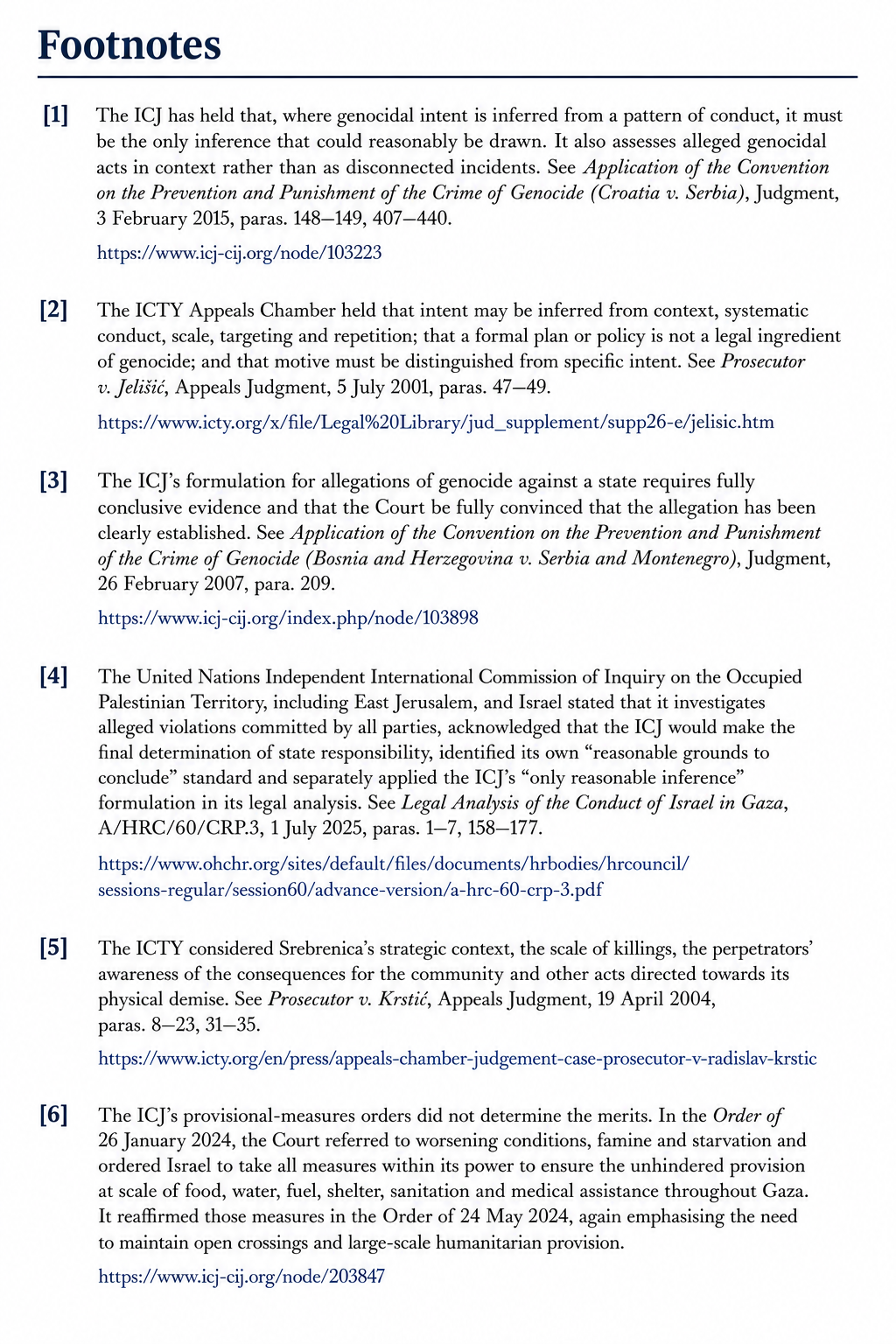

New comment

avatar
•••
#9

I see a lot of ambivalence in the human voters. No matter what our AI agents think.

avatar
•••
#8

How about you produce your AI argument as to why your AI thinks you are the winner, and I'll produce mine? Then genuine human voters can choose from that who's AI they think made the best argument?

avatar
•••
#7

Is this because voters believe that it is a tie? Or because nobody has read this debate, because it is to long, that it has no votes? But surely the voters must also explain why they think it is a tie, before a tie can be called? Perhaps AI is better after-all

avatar
•••
#6

There are 146 debates in the voting stage. Most have 0 votes.

avatar
•••
#5

Is it humanly possible for a person to cast an unbiased and impartial vote on a debate as indepth as this, and not simply a matter of opinion vote which pretends to have located key points? It would be a shame that it end a tie simply because the debate is to complicated for a human to judge upon

avatar
•••
#4
--> @SatanLucy

Soooooo...?

avatar
•••
#3

Given that I must prove intent, Pro is basically required to be a mind reader here, not that statements and actions of Israeli don't strongly imply that intent.

avatar
•••
#2
--> @SatanLucy

You gonna debate?

avatar
•••
#1

I don't know how else to call bombing every house, hospital and school in Gaza, but sure, you can think otherwise.