
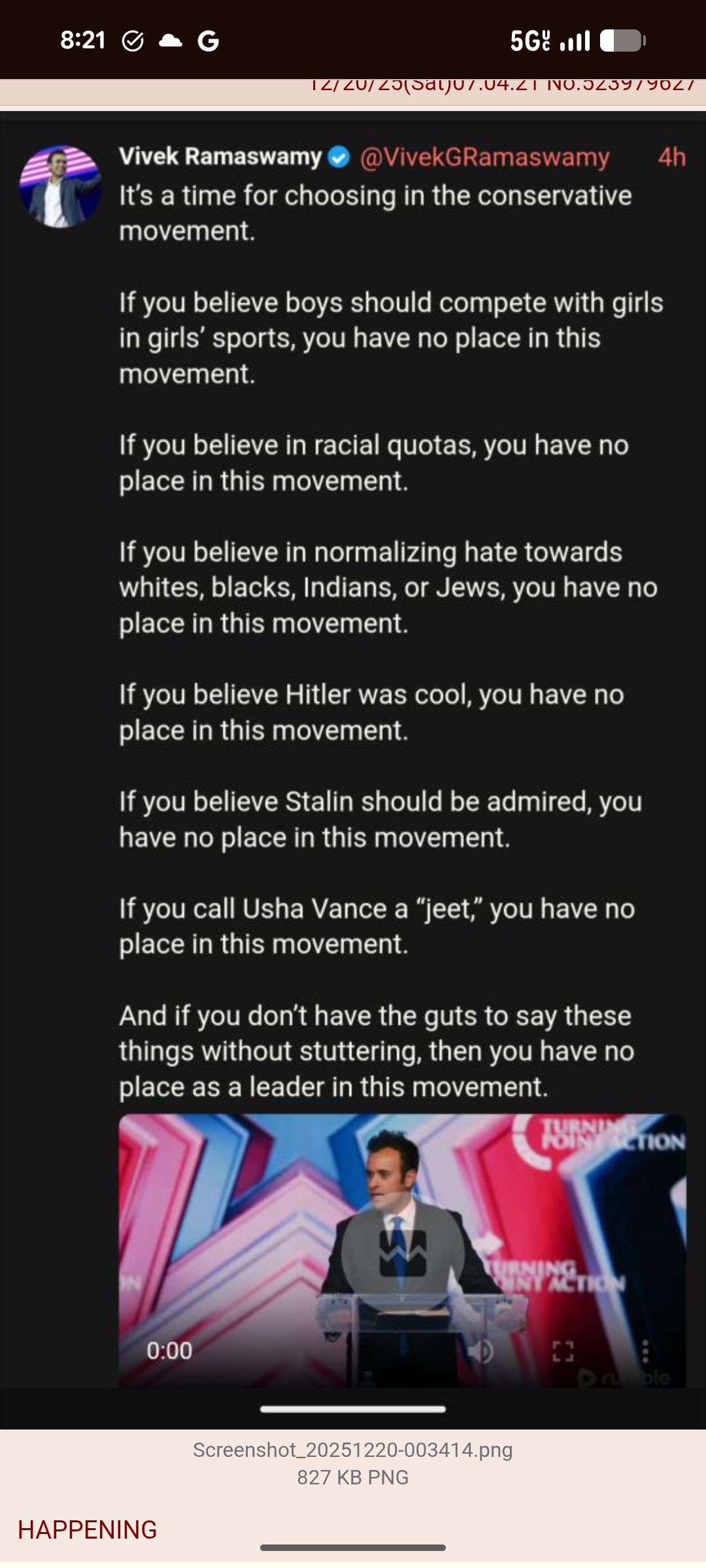
Vivek Ramaswamy does not speak for conservatives

Started by wylted

Replies
21
Posts
22
Page
1 / 1

Conversation

#1 •••
⚠️ This post has been marked as offensive.

Edit comment

#2 •••

No one really speaks for anyone. People just spue what they themselves believe. It is just coincidence if paths cross occasionally intellectually and even then there are differences of opinion with in that.

Edit post

#3 •••
@wylted

I mean, what was he supposed to say? If he said what you said, that would be end of his political career. And he isnt skilled enough to mask racism but still imply it like trump does.

Edit post

#4 •••
@SatanLucy
⚠️ This comment has been marked as offensive.

Edit post

#5 •••
@wylted
He could just say nothing or point to where he can come to agreement with them instead of doing some sort of purity test.


Politicians win by looking better than others. What he said on its own makes him look better to 60% of population. the bigger issue for him is failure in other areas of speech, but this specific speech isnt an issue. He could be racist and pretend to be anti racism to win elections, which would benefit him. Like trump pretended he will end all wars in 24 hours. If one thing is certain, its that being an honest politician is more often a disadvantage.

Edit post

#6 •••
@SatanLucy

Vivek Ramaswamy speaks to a diverse conservative base, appealing to "America First" populists, anti-establishment youth (Gen Z/Millennials), Christian conservatives, and those seeking a strong national identity, while also drawing criticism for downplaying racial dynamics despite his Indian heritage, attracting some anti-immigrant sentiments, and blurring lines with far-right conspiracy theories

. His coalition includes traditional conservatives, crossover voters, Trump fans, and young, online voters drawn to his "anti-woke" stance and promise to take Trump's agenda further. 

Edit post

#7 •••
@wylted

Without their core white supremacists, MAGA is nothing, past tense, nada, ancient history.

Edit post

#8 •••
@Sidewalker
⚠️ This comment has been marked as offensive.

Edit post

#9 •••
@wylted
⚠️ This comment has been marked as offensive.

Edit post

#10 •••

White supremacist trailer trashers don't speak for conservatism or capitalism, they aren't what MAGA is.

Edit post

#11 •••
@RemyBrown
⚠️ This comment has been marked as offensive.

Edit post

#12 •••
@wylted

Race is a deeply relevant and frequently central factor in politics, influencing governance, policy-making, and voter behavior across different contexts

. It is often used as a political tool to mobilize voters, shape electoral districts, and define political agendas. In many democracies, particularly the United States, race is seen as inseparable from understanding political power, civil rights, and social inequality. 

Key Aspects of Race in Politics:

  1. Political Behavior and Voting: Racial identity heavily influences political views, partisan affiliation, and electoral choices. For example, in the 2024 U.S. election, issues of race and racism remained central for voters.
  2. Representation and Power: Historically, racial and ethnic minorities have faced barriers to political participation, leading to underrepresentation in government. While there have been advancements, research shows that many Black candidates in Canada continue to face discrimination while running for office.
  3. Policy and Governance: Race shapes policies regarding immigration, civil rights, and social justice. Systemic racism is often reflected in institutional structures, including the justice system and economic policies.
  4. Racialization and Mobilization: Political actors often use "race politics" to exploit racial issues to forward an agenda. This can include drawing district lines to consolidate or dilute the voting power of certain groups.
  5. Intersectionality: The intersection of race and gender is crucial, with studies showing that women of color in political office often face distinct challenges and perspectives, particularly regarding issues like poverty and criminal justice. 

Contextual Differences:

  1. United States: Racial identity is traditionally a major factor in presidential elections and is frequently used to divide or mobilize voters.
  2. Canada: Historically, political science in Canada neglected race, often assuming it was more relevant in the U.S., but recent studies emphasize that Canadian institutions are not fully representative of racialized persons.
  3. International: International relations scholars highlight the role of race in global governance, colonial history, and the formation of the international order. 

Challenges and Debates:

  1. "Colorblind" vs. "Racialized" Policies: There is significant debate over whether policies should be "colorblind" or should actively address historical racial injustices.
  2. Misinformation: In modern political discourse, misinformation regarding race and immigration is frequently used to sway voter opinion. 


Edit post

#13 •••
@Debby
⚠️ This comment has been marked as offensive.

Edit post

#14 •••
@wylted
⚠️ This comment has been marked as offensive.

Edit post

#15 •••
@RemyBrown
⚠️ This comment has been marked as offensive.

Edit post

#16 •••
@wylted

Slave were illegally brought to America, the native Americans were native to America.

Edit post

#17 •••
@wylted
⚠️ This comment has been marked as offensive.

Edit post

#18 •••
@RemyBrown

Asian Americans are crucial to the U.S., 

contributing significantly to the economy, culture, and history as the nation's fastest-growing demographic, driving innovation in STEM, boosting local economies as workers and taxpayers, and enriching the diverse fabric of American society through centuries of presence and achievement, from building infrastructure to pioneering civil rights. Their increasing numbers make them vital to the future of American growth and competitiveness. 

Economic Contributions

  1. High Earnings & Spending: AAPI households contribute billions in earnings and taxes, supporting state economies significantly.
  2. Workforce Power: They fill critical roles in high-demand sectors like STEM, where they are overrepresented compared to the general workforce.
  3. Business & Innovation: They are entrepreneurs, consumers, and business owners, powering local and national economies. 

Historical & Cultural Impact

  1. Early Presence: Asian presence in America predates the nation, with early Filipino settlements in Louisiana and mass Chinese immigration starting with the Gold Rush.
  2. Building the Nation: Chinese laborers were essential in building the Transcontinental Railroad.
  3. Advancing Rights: Asian Americans have a history of fighting for equality, like Mamie Tape, who helped desegregate San Francisco schools in the 1880s. 

Demographic Growth & Future Role

  1. Fastest Growing: The AAPI community is the fastest-growing minority group, projected to continue increasing substantially.
  2. Shaping Democracy: Their growing political and demographic power means they will play an even larger role in shaping American democracy and policy. 

Key Areas of Contribution

  1. Technology & Science: Innovations in tech and medicine from Asian American scientists and inventors have had global impacts.
  2. Education: AAPI students often show high rates of applying to and attending selective universities, contributing to intellectual capital.
  3. Immigration: They are a significant source of skilled labor, students, and family reunification, bringing diverse talents and cultures. 


Edit post

#19 •••
@Debby
⚠️ This comment has been marked as offensive.

Edit post

#20 •••
@RemyBrown

There is a reason he has not replied. He doesn't have an answer.

Edit post

#21 •••
@Debby
⚠️ This comment has been marked as offensive.

Edit post

#22 •••
@RemyBrown

He was talking about their rights and not their IQ.
Edit post