Finite vs Infinite

Started by ebuc

Replies
16
Posts
17
Page
1 / 1

Conversation

#1 •••

We start with two primary kinds of space:


1} eternally existent, non-dynamic, macro-micro-infinite{ non-integral beyond whole } , truly non-occupied space outside/beyond/etc of the following,


2} the eternally existent, dynamic, macro-finite [ integral whole }, occupied space Universe @


Yes, we assume/presume integrity of finite whole, we identify as Universe. In that case ive yet to see any valid, illogical in the those two, complementary aspects of one scenario/story we identify as 1} and 2}. above.


Eternity complements finite, dynamic occupied space Universe, and


Eternity may appear as more of prerequisite for non-dynamic, truly infinite and truly macro-micro, non-occupied space, because, humans, observe and then count finite spaces to a finite total { integrity }.


Ergo, humans relate our counting of a finite{s} to that, of non-count-able, macro-micro infinite and truly non-occupied space { not countable total exist there. }.


Think of it way B Fuller used to say. We cannot get out of Universe. The pure act of seeming expansive increase of the the sum-total finite set of accounting, is a transformation of bits from volumetric { area in holography } from perhaps many location to allow any expansion outward of the dynamic, finite, occupied space Universe @


Sure, in a macro-micro infinite Universe we could also say the same above, --cant get outside of and infinite and that infinite is not expanding as I stated above, because, infinite, is beyond begin maxed out. Infinite is beyond finite limits as integral whole{s}.


Running out of words to express a clarity of the distinction between finite and infinite. How bout this. Infinite can not have and outer surface area, boundary geometry, whereas, a finite must have { dynamic { non-static } or non-dynamic i.e. static, *meta-space outer pattering* }.

Edit comment

#2 •••

The core distinction is that 

finite refers to anything that is limited, bounded, and countable, while infinite refers to that which is limitless, endless, and unbounded

This fundamental difference is applied across various fields, including mathematics, economics, and philosophy. 

In Mathematics (Set Theory)

In mathematics, the distinction primarily relates to sets and their elements. 

  1. Finite Sets have a definite, natural number of elements that can be counted completely, and the counting process comes to an end.
  2. Example: The set of months in a year: {January, February, ..., December}. It has 12 elements.
  3. Key Property: A finite set cannot be put into a one-to-one correspondence with a proper subset of itself.
  4. Infinite Sets have an endless, unlimited number of elements that cannot be counted to completion. They are typically represented using three dots (ellipsis, ...) to show they continue indefinitely.
  5. Example: The set of all natural numbers: {1, 2, 3, 4, ...}. No matter how high you count, there is always a larger number.
  6. Key Property: An infinite set can be put into a one-to-one correspondence with a proper subset of itself (e.g., the set of all natural numbers can be mapped to the set of all even natural numbers). 

In Economics

In microeconomics, the concepts are applied to resources, goods, and demand. 

  1. Finite Resources/Goods: These are limited in availability, leading to scarcity and influencing market prices and production decisions.
  2. Infinite Goods: These are theoretical concepts, often digital products (like an e-book), that can be reproduced endlessly without additional resource expenditure, eliminating scarcity. 

In Philosophy and General Concepts

The distinction is also used in broader, more abstract contexts: 

  1. Finite Games vs. Infinite Games: Philosopher James Carse described finite games as having fixed rules and a clear objective (winning), like a football match. Infinite games have changeable rules, both known and unknown players, and the purpose is to keep the game going indefinitely (like a relationship or a business).
  2. Humanity: In philosophy, humans are often considered finite due to their physical limitations and mortality, yet simultaneously, through thought and self-awareness, are considered to have an aspect of the infinite. 


Edit post

#3 •••
@ebuc

The proof is IN the pudding... the pudding, is in the crust.

Edit post

#4 •••
@linate

What about the custard?


The custard maketh the pudding.


Some might prefer cream though.

Edit post

#5 •••
@Debby, @ebuc

Infinite and finite are words that define concepts that we think are relevant to something.


Typically, my friend Ebuc likes to elaborate and my friend Debby likes to elaborate too.

Edit post

#6 •••
@linate
The proof is IN the pudding... the pudding, is in the crust


1} I offer no proofs,


2} pudding is only partially embraced by crust, whereas,


3} all of the Spirit-2 { Fermions and Bosons }, Spirit-3 and Spirit-4 { Dark Energy } and eternally existent, dynamic, finite, occupied space Universe @ is embraced by,


5} the Spirit-3, as the outer most surface of ultra-micro, non-quantized and non-quantified positive geodesic, Gravitational surface ( )


6} and outside of that, the eternally existent, non-dynamic, macro-micro-infinite, truly non-occupied space,


<---macro-micro-infinite...............................................@......................................................macro-micro-infinite--->

Edit post

#7 •••
@SergeantLynch
Infinite and finite are words that define concepts that we think are relevant to something.


Yes that is true, Sarge, that, those two words are relevant to each other.


They both co-exist as words, definning to specific kinds of primary space.


However, there does exist a third kind of space, called meta-space. Meta-space mind/intellect/concepts is concepts of Space:


concept of finite occupied space @


concept of infinite and truly non-occupied space <-----.................----->


concept of specific 3D { XYZ or as abc } dimensions of space


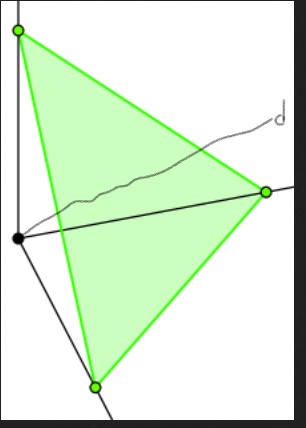
concept of specific abc-d dimensions of space, where d is the 45 degree, volumetrical diagonal from vertexial point/corner of cube we define as abc.


Edit post

#8 •••

"The proof is in the pudding, the pudding is in the crust" is a playful twist on the classic idiom, "The proof of the pudding is in the eating," meaning you can only judge something's quality by experiencing it directly, not by its appearance or promise, but the added line suggests the actual test (the crust) is hidden, emphasizing that you must get past the surface (the "crust") to find the real substance (the pudding) to truly judge it. It highlights that appearances can be deceiving, and the real value or success is found in the actual results or consumption. 

  1. Original Meaning: The original proverb means you must taste (eat) the pudding to know if it's good; you can't tell from looking at it.
  2. The Twist: Adding "the pudding is in the crust" implies the real test isn't even eating the whole thing, but seeing what's beneath the surface (the crust), making the point even stronger that appearances are misleading.
  3. Modern Usage: It's used to say that true worth or effectiveness is revealed only through action, results, or testing, not promises or looks. 


Edit post

#9 •••
@ebuc
truly non-occupied space,


Where is there "truly non-occupied space?" It's all occupied, or does "non-occupied space" = true, absolute vacuum? I think that is non-extant.

Edit post

We tell God what to do and then blame Him for our errors.

- Dr. Pet Dragon of Sorbonne University

#10 •••
@linate
The proof is IN the pudding... the pudding, is in the crust.


If the pudding is in the crust, is it pudding, wouldn't that make it pie?

Edit post

#11 •••
@ebuc
We start with two primary kinds of space:

1} eternally existent, non-dynamic, macro-micro-infinite{ non-integral beyond whole } , truly non-occupied space outside/beyond/etc of the following,


According to current cosmological theory, time came into being with the Big Bang.  


2} the eternally existent, dynamic, macro-finite [ integral whole }, occupied space Universe @


According to theory, space also came into being with the Big Bang, all we can know about the start of the Big Bang is that it came forth from a singularity, an infinitely hot, infinitely dense, dimensionless point, that necessarily transcended time and space.


Current cosmological theory tells us that this is the process by which the Big Bang occurred, and the dilemma is that a process needs to occur in time and space, so what you are referring to as “eternally existent time and space” is a realm that transcends time and space.


Yes, we assume/presume integrity of finite whole, we identify as Universe. In that case ive yet to see any valid, illogical in the those two, complementary aspects of one scenario/story we identify as 1} and 2}. above.

Eternity complements finite, dynamic occupied space Universe, and

Eternity may appear as more of prerequisite for non-dynamic, truly infinite and truly macro-micro, non-occupied space, because, humans, observe and then count finite spaces to a finite total { integrity }.


Eternity and infinity are conceptual; they only exist as semantic devices which define finite. They are words that do not have a physical referent.


Ergo, humans relate our counting of a finite{s} to that, of non-count-able, macro-micro infinite and truly non-occupied space { not countable total exist there. }.


It necessarily would transcend the concept of “counting” or anything that mathematics can apply to.


Think of it way B Fuller used to say. We cannot get out of Universe. The pure act of seeming expansive increase of the the sum-total finite set of accounting, is a transformation of bits from volumetric { area in holography } from perhaps many location to allow any expansion outward of the dynamic, finite, occupied space Universe @

Sure, in a macro-micro infinite Universe we could also say the same above, --cant get outside of and infinite and that infinite is not expanding as I stated above, because, infinite, is beyond begin maxed out. Infinite is beyond finite limits as integral whole{s}.

Running out of words to express a clarity of the distinction between finite and infinite. How bout this. Infinite can not have and outer surface area, boundary geometry, whereas, a finite must have { dynamic { non-static } or non-dynamic i.e. static, *meta-space outer pattering* }.


Again, according to current theory, space is curved, so there isn’t necessarily a “boundary”. Perhaps it doesn’t matter if it’s infinite or finite, conceptually it wraps around itself (like a sphere's surface), meaning you'd loop back if you traveled far enough, with no "outside", hence, no boundary.


While “We cannot get out of Universe” to “see” the entire universe, our observable universe does have a boundary, but that's just how far light has traveled to us, not an edge or boundary.


Edit post

#12 •••
@Sidewalker
According to current cosmological theory, time came into being with the Big Bang. 


I dont think so and at best, we perhaps can say, that occupied space of outer surface, ultra-micro { not quantised nor quantified } Gravity ( ) and its diametric opposite ultra-micro Dark Energy )( are not considered by me as occupied space, that,


is interna-to-tube of my specific, space and time, dual invaginated, horn { approximeted } tori as physical reality --aka observe{ quantised } time--.


So again at best we can say that perhaps for the briefest moment, physical reality as observed { quantised } time dissipates from the internal existence as reality, into outer Gravitaitonal surface and then via geodesic surface trajectories to inner surface of Dark Energy.


Then invagination into the internal occupied space as reality begins again. Then pops out follows geodesic around surface to Gravity and invaginates in then back out again. Ive posted in other thread topics here before how invagination may occur more on the inner surface of Dark Energy, accumulate enough that we have the alledged Dark Inflation period of expansion, and,


that internal that numerically triangulated sine-wave ---0, 3p 6, 9, 12, 15, 18 etc-- of internal reality begins its overall movement from innner surface interior to the Gravitational outer surface again, until the next Big WOW! happens again repeatedly eternally.


Naught { occupied space } is lost nor created { occupied space }, only transformed eternally. Aka a sum-total cosmic cost accounting that does not change, eternally. That is known as cosmic integrity of dynamic, eternally existent, finite, occupied space Universe @.


That is basis of my belief system about Universe, outer surface geodosics of Gravity, and inner surface geodesics of Dark Energy and internal triangulated ---18 combinatiorial aspects of quark and 18 anti combintorial kinds of quari, 3 generations of electron { muon and tau }, and 3 anti-generations of electron, 3 generations of neutrino{ muon and tau } and 3 generations of anti-neutrino-- sine-wave, as mentioned above.


According to theory, space also came into being with the Big Bang, all we can know about the start of the Big Bang is that it came forth from a singularity, an infinitely hot, infinitely dense, dimensionless point, that necessarily transcended time and space.


Believe in any theory you want. I direct you back to what I wrote above and elserwhere for months and years.


Current cosmological theory tells us that this is the process by which the Big Bang occurred, and the dilemma is that a process needs to occur in time and space, so what you are referring to as “eternally existent time and space” is a realm that transcends time and space.


Huh? False. No transcending time and space, as that is what the BB theory does i.e creates occupied space where before none ever existed. Illogical, lack of common sense critical thinking.


Eternity and infinity are conceptual; they only exist as semantic devices which define finite. They are words that do not have a physical referent.


False. Occupied space cannot be created nor destroyed, only transformed, eternally. Finite integral set of Universe. Simple no illogical transcending of time and space as you suggest.


It necessarily would transcend the concept of “counting” or anything that mathematics can apply to.


Huh? Reread all Ive stated above, and for many months if not years at Debate and old debate forum and other groups. BB is what attempts to transcend time and occupied space, not myself or my belief system based on observation by humans. Naught is lost nor destroyed, only transformed eternally. Simple and all else lacks even basic common sense.


Again, according to current theory, space is curved, so there isn’t necessarily a “boundary”. Perhaps it doesn’t matter if it’s infinite or finite, conceptually it wraps around itself (like a sphere's surface), meaning you'd loop back if you traveled far enough, with no "outside", hence, no boundary.'s


SW, reread what Ive stated above and/or continue to believe in BB theory that transcends time and occupied space. Good Luck!


While “We cannot get out of Universe” to “see” the entire universe, our observable universe does have a boundary, but that's just how far light has traveled to us, not an edge or boundary.


False. Finite = integrity ergo whole.


Infinite = lack of integrity { whole }.


We only observe a dynamic, eternally existent, finite, occupied space Universe @ and that is all that will ever be observed by any meta-space mind/intellect/concept accessing creatures of Universe. Good Luck with those illogical BB theorys!.
Edit post

#13 •••
@Sidewalker

Grok 4 AI predicts 7 frequency tological geometries to be found in vacuum of spacetime.


And the scientist identified 6 of them.

Go to 5:39 to get gist of this topological and geometric discovery coming out the vacuum.


It is not energy from where before there was none, is made clear by the narrator.

https://www.youtube.com/watch?v=5GrkkBYBgg4

Edit post

#14 •••
@Sidewalker

Oops! that Grok 4 scenario is False narrative hype for E Musk.


My bad for not researching it more. The key give away I should have noticed was, there was none of the MIT scientists being interviewed.


So Sorry to Sidewalker and all.

Edit post

#15 •••
wouldn't that make it pie?


It might be a planet.

Edit post

We tell God what to do and then blame Him for our errors.

- Dr. Pet Dragon of Sorbonne University

#16 •••
@linate, @SergeantLynch
The proof is IN the pudding... the pudding, is in the crust.


The pudding is not in the crust. I.e. the crust is distinctly seperate from the pudding.


The finite pudding is partially embraced by the finite crust.


1} The eternal, non-dynamic, macro-micro-infinite, truly non-occupied space, embraces the following,


2} the eternal, dynamic, finite, occupied space Universe @. Simple


(^ v ^) Hi, Im a finite { whole }, biological integrity ---structural and systemic whole-- that exists in constant transformation until it comes apart aka decay process with terminal ending as a biological integrity.


Edit post

#17 •••

This phrase describes a two-part metaphysical model of reality:

  1. The "Container" (Non-occupied Space): An infinite, eternal, non-dynamic (static) void that exists permanently. It is described as "macro-micro-infinite" (extending infinitely in both large and small scales) and "truly non-occupied," meaning it is pure space, un-filled by matter or energy.
  2. The "Content" (Occupied Space): A "dynamic, finite, occupied space Universe," often referred to as the material universe. This part is "dynamic" (constantly changing, expanding, moving), "finite" (having a definite, albeit huge, boundary of matter/energy), and "occupied" by matter, light, and energy, existing within the larger non-occupied space. 

In simpler terms, this view proposes an eternal, unchanging, and infinite "container" that contains a finite, changing, and moving "content" (the material universe). 


Edit post