
⚠️ This post has been marked as offensive.
I used to read Hitler's books, and I think he was corrupt before getting power.
I mean, he said a lot of things in his books which were clearly pro-genocide even before he got power.
He praised Sparta for killing children with disabilities, saying "they were doing those children a favor", and "it was more merciful than what countries do now".
And also, he said "I dont see why man shouldnt be as cruel as nature".
But people in 1933 werent smart and they thought he was making a joke when he said those things.
While Hitler often used extreme, violent rhetoric that some contemporaries might have initially dismissed as hyperbole or theater, his threats regarding the "annihilation" of Jews were not generally treated as a joke by the German public, but rather as a serious, escalating promise of state policy
. Historians argue that the public was aware of the anti-Semitic nature of the regime, and by the outbreak of war in 1939, these threats transitioned towards a clearly understood, violent, and eventually genocidal policy.
Key Details Regarding Public Perception:
Ultimately, the threats were part of a systematic campaign to desensitize the population to violence and gain compliance for the "Final Solution".
Well I'm not sure about that...But nonetheless they do seem to be a sub-species apart...Not sure it is all down to genetics or simply formative conditioning.
Despite what is done for them, they still harbour disrespect and contentment and tend to abuse any infrastructure put in for their benefit.
But hey, that's me and I consider myself to be a basic normal human being...But maybe I'm completely adrift with such theory...Who's to judge.
Tee hee hee, you are so clever, I bet no other troll ever thought of this one before...truly original.
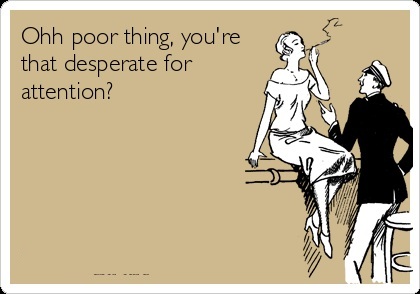
Are you really that desperate for attention?
I think that most Europeans nowadays think he was right about the gypsies at least.
No, almost no one in Europe thinks that except the nazi and racists, which are minority. Roma people are people like any other. Now, the fact that racist system was put in place to prevent them from getting education and wealth, same system put in place for poor white people and white women in past and today (making education either too expensive or legally inaccessible), this fact doesnt make Roma people bad, but the system put in place which would actually make any race, even white race, much poorer, if it was placed against them.
Wrong again.
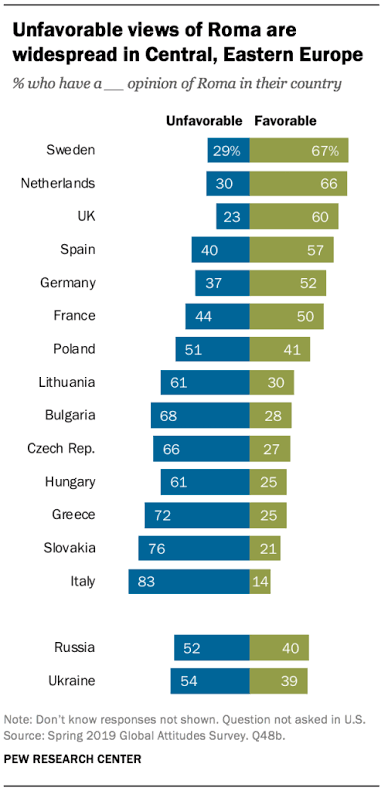
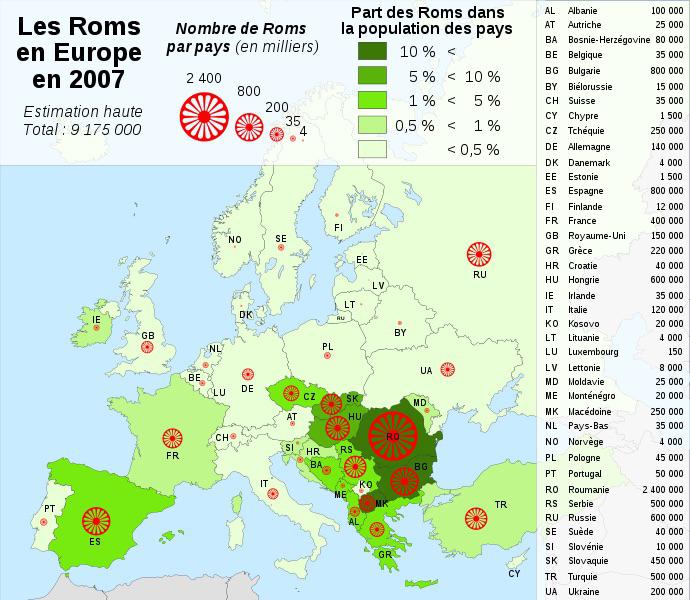
And would you look at that, the positive countries strongly correlate to low exposure to the people in question. Tale as old as time.
Wrong again.
Are you unable to do basic logic?
Saying someone has "not favorable views of Roma" isnt same as saying he wants them eradicated and him agreeing with Hitler in that regard.
You can dislike someone without wanting him to be eradicated. We dislike nazi, but we dont eradicate them.
Your claim was that they were people just like any other and that dislike of them was due entirely to situations outside their control and not specific to their particular ethnic group. Were that the case, exposure to said group would result in a decrease of animosity and prejudice, not an increase.
And when disapproval in a given region does crest, there is public support for physically removing these populations, with nationwide expulsion taking place in France in the 2010s. People were by and large happy with the results. Most Germans didn't know about the death camps, they were essentially happy with the same results that contemporary expulsion policies produce, while being unaware that their government was doing more than 'relocating' them.
Your claim was that they were people just like any other and that dislike of them was due entirely to situations outside their control
Yes, being born in poverty and much lower education is a situation outside of their control, as well as people being racist towards them.
But again, if you think majority of Europe wants Roma eradicated, you should provide evidence for that, because that would be a serious problem.
Were that the case, exposure to said group would result in a decrease of animosity and prejudice, not an increase.
this conclusion doesnt follow from previous statement, because it depends on idea most people are rational and good, which they arent.
Adolf Hitler's rise to power was not a direct result of a single event or action, but rather a combination of exploiting deep-seated national grievances, leveraging severe economic crises, and utilizing sophisticated propaganda and political manipulation
. He transformed the Nazi party from a fringe group into a mainstream political force by appealing to widespread dissatisfaction with the Weimar Republic's handling of post-WWI conditions.
Key factors in Hitler's rise included:
1. Exploiting Post-WWI Discontent (1918–1929)
2. Utilizing Economic and Political Crisis (1929–1933)
3. Propaganda and Charisma
4. Conservative Elite Support
5. Consolidation of Power (1933–1934)
exploiting deep-seated national grievances
Also, nobody else gave a crap about the German people. In the world of port-o-pottys, the man who gives a shit is king.
Germany is such a waste in 2025. Destroyed all their power plants, forcing them to either freeze to death or buy oil from Russia. Can't talk about anything glorifying Germany in any way whatsoever. Demographic collapse. Cultural collapse. Bureaucratic rule. No energy to support industry. What's there to love anymore besides Oktoberfest?
Germany is widely considered the largest and most influential economy in Europe, but whether it is the "richest" or "most successful" depends on the metrics used, as it faces significant economic headwinds in the mid-2020s.
Economic Standing
"Success" and Recent Challenges
While historically strong, Germany has faced significant economic troubles in the 2020s, including:
Comparison with Other European Powers
In summary, Germany is the largest economic enginein Europe, but other nations are wealthier per capita or currently show more growth stability.
Germany isn't a sovereign country anymore. It was literally raped by the USSR, then turned into a proxy battleground during the Cold War, then absorbed under the Nato security umbrella. Being an American vassal means not even being able to utter a peep after we bombed the gas pipeline that they were relying on, sending their manufacturing economy into a death spiral. You saw the same thing with Japan and the Plaza Accord decades earlier. That's what it means to have a suzerain. Vae victis. They brought this upon themselves by not fighting to the death against foreign control.
Germany is a fully sovereign country, officially the Federal Republic of Germany, recognized globally as an independent state and a member of the UN, having regained full sovereignty after its reunification in 1990, though its post-WWII path to sovereignty was gradual, marked by its joining NATO and the EU.
Key Points:
In summary: Germany is an independent, sovereign country, though it participates in international alliances like NATO and the EU, which is a choice made by its sovereign government.
Sad to see an entire country give up.
with its own democratically elected leaders making national decisions.
no.
Yes, liberal nimby's love these folk as long as they're in someone else's back yard.
Otherwise I don't think you will find a whole lot of reciprocal love exists elsewhere.
Don't get me wrong, some are reasonable and make an effort to be sociable, but nonetheless their base allegiances lie with their own community.
Never trust a G*p*o is the watch word...And yes, as far as British society goes and despite liberal pandering, these people always have been a non-integrated and separate sub-group.
Yes, liberal nimby's love these folk as long as they're in someone else's back yard.
Actually, when I was in prison, there was a lot of Roma people there too. Many of them are good people. Literally, just give them few things occasionally and you are their best friend. But same is true for everyone. I made a lot of friends in prison merely by being charitable.
LOL, they saw you as a mark because you would give them stuff for free. If I ran around in the city giving stuff away I'd suddenly have a bunch of homeless 'friends' as well. Once I stopped giving out free stuff I'm sure our 'friend' status would evaporate and half of them would cus me out and move on to a juicier target.
You misunderstood. I dont give to others because I expect reward or friendship or anything. No, rewards and friendships are just a nice bonus which comes when you are being charitable and useful.
true reward is worship service to Vaheguru, the universal all-pervading master.
I believe in true Communism, because I know we all exist thanks to Communism and charity of Gods, so being charitable is merely being a vessel of divine will.
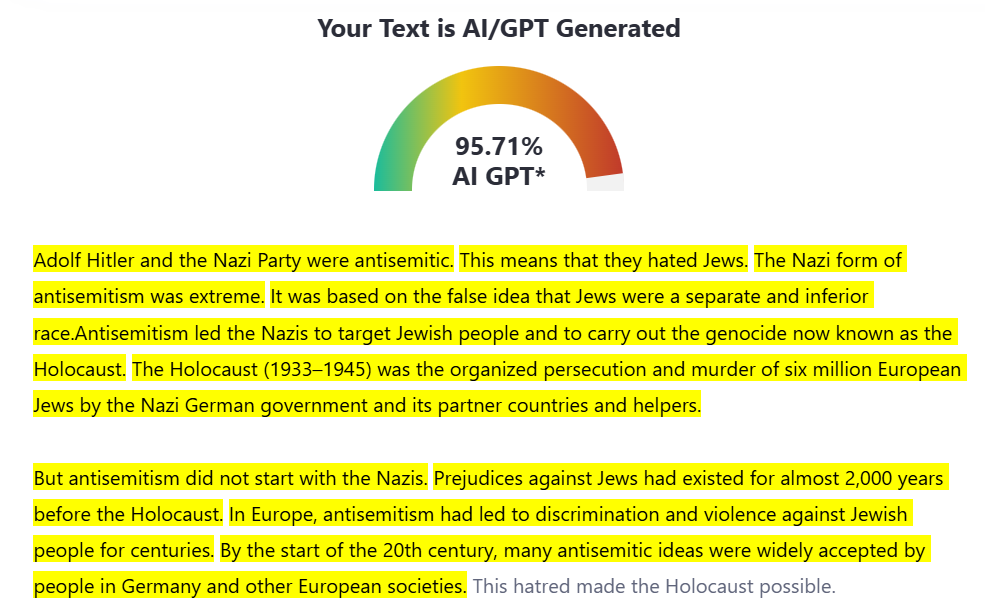
Adolf Hitler and the Nazi Party were antisemitic. This means that they hated Jews. The Nazi form of antisemitism was extreme. It was based on the false idea that Jews were a separate and inferior race.Antisemitism led the Nazis to target Jewish people and to carry out the genocide now known as the Holocaust. The Holocaust (1933–1945) was the organized persecution and murder of six million European Jews by the Nazi German government and its partner countries and helpers.
But antisemitism did not start with the Nazis. Prejudices against Jews had existed for almost 2,000 years before the Holocaust. In Europe, antisemitism had led to discrimination and violence against Jewish people for centuries. By the start of the 20th century, many antisemitic ideas were widely accepted by people in Germany and other European societies. This hatred made the Holocaust possible.

I think Hitler has become the mascot of evil itself. He got unlucky and was picked to be the complete representation of evil. There were likely plenty of evil men who no one ever knew about because they killed the people who found out what they did. Hitler killed people's ancestors who are still alive today. In the future, there will unfortunately be new Hitler (God forbid tho) who everyone will hate even more.
What stand out in the post is.
“But antisemitism did not start with the Nazis. Prejudices against Jews had existed for almost 2,000 years before the Holocaust. “