Rape

Started by RemyBrown

Replies
24
Posts
25
Page
1 / 1

Conversation

#1 •••
⚠️ This post has been marked as offensive.

Edit comment

#2 •••

no

Edit post

#3 •••
@RemyBrown

Rape is risky because if you try to rape a woman, she has many ways to hurt you. Women with long nails could easily poke your eye out if you get close.


It makes more sense to pay a prostitute to get sex, because she probably wont try to poke your eye out.


So rape makes no logical sense if goal is sex.

Edit post

#4 •••
@Shoresy
⚠️ This comment has been marked as offensive.

Edit post

#5 •••
@SatanLucy
⚠️ This comment has been marked as offensive.

Edit post

#6 •••
@RemyBrown
Do you think we should legalize rape?


I dont see what goal would be achieved by rape being legal. Most women dont bother to even report sexual assault or sexual harassment, but still, the extreme cases get reported and dealed with. So keeping it illegal still serves a purpose to prevent a serial rapist from raping again, as well as creating incentive not to commit rape.

Edit post

#7 •••
@RemyBrown

Legalizing rape would actually be bad for rapist, because it would mean rapist can get legally endlessly raped (by private individuals, or by government).

Edit post

#8 •••

I mean if someone wants to live in a world where rape is legalized they can just move to India. It isn't very nice.

Edit post

#9 •••
@RexFavilla

You are right.

Rape in 

India is a significant and persistent social and legal challenge. As of January 2026, the issue remains at the forefront of national discourse following several high-profile incidents and ongoing debates regarding legal reforms. 

Current Statistics and Trends (2025–2026)

  1. Reported Cases: In 2022, approximately 31,516 rape cases were reported, averaging roughly 86 cases per day.
  2. Perpetrators: A vast majority of reported rapes—nearly 89%—are committed by individuals known to the victim, such as relatives, friends, or neighbors.
  3. Underreporting: Experts emphasize that reported figures represent only a fraction of actual occurrences due to social stigma, fear of retaliation, and systemic barriers.
  4. Conviction Rates: The conviction rate for rape remains low, recorded at approximately 27% in 2022, with many cases ending in acquittal due to factors like poor investigations or witnesses turning hostile. 

Recent High-Profile Incidents

  1. Kolkata Doctor Case (2024): The brutal rape and murder of a trainee doctor at a government hospital sparked nationwide protests and a major strike by medical professionals, highlighting safety failures in workplaces.
  2. January 2026 Incidents: Recent reports include a 25-year-old woman gang-raped in an ambulance in Faridabad (January 4, 2026) and the gang-rape of a 13-year-old girl by three minors in Karnataka (January 3, 2026).
  3. Nainital Case (2025): A significant child sexual assault case in Nainital made headlines in early 2025, further fueling demands for better protection of minors. 

Legal Framework and Ongoing Debates

  1. New Criminal Laws: On July 1, 2024, the Bharatiya Nyaya Sanhita (BNS) replaced the Indian Penal Code (IPC). While it retains harsh punishments (10 years to life/death), it has been criticized for removing "unnatural offences" (formerly Section 377), which critics argue leaves adult men and transgender individuals with inadequate protection against sexual assault.
  2. Marital Rape Exception: India still maintains a legal exception that protects husbands from being charged with raping their wives if the wife is over 18 (formerly 15). The Supreme Court is currently hearing challenges to this exception, while the government has argued that criminalizing it could "disturb the institution of marriage".
  3. Death Penalty: Following the Kolkata incident, there have been renewed calls for the death penalty in "rarest of rare" cases, though human rights groups argue systemic reforms are more effective than capital punishment. 

Systemic Challenges

  1. Institutional Failures: Victims often face secondary victimization at police stations and hospitals. Investigations are frequently marred by delays, and the judicial process can take decades to resolve.
  2. Social Barriers: Marginalized communities, particularly Dalit women, face even higher barriers to justice due to caste-based discrimination and social apathy.
  3. Infrastructure: Despite the "Nirbhaya Fund" established in 2013 to improve women's safety, reports indicate that less than 50% of the allocated funds have been effectively utilized for initiatives like CCTV and safer public transport. 


Edit post

#10 •••
@SatanLucy

Disable them first.


Not that I'm and expert you understand.


Just seems like a sensible modus.

Edit post

#11 •••

Rap me, me friend. Rape me, again.

Edit post

#12 •••
@SatanLucy
⚠️ This comment has been marked as offensive.

Edit post

#13 •••
@SatanLucy
⚠️ This comment has been marked as offensive.

Edit post

#14 •••
@RemyBrown

Why would a castrated rapist be more attractive to you?

Edit post

#15 •••
@RemyBrown

As I said, there is a certain "lex talionis" principle in law where even if something was legal, it would only be worse or equally bad for people who do it because it would enable same being done to them.


Lets say that rape was legal. this basically means government can choose to capture any rapist and endlessly rape him forever, maybe using machines.


Same is true with murder. If murder was legal, government would have legal right to murder murderers.


this is why certain actions, even if legalized, actually only end up being self-defeating.


Such actions are rape, murder, theft, and similar.


Legalizing them does basically nothing except enable government to punish those who do them with same.


this is why principle of lex talionis is crucial in law, because it sets a principle which shows that law is not merely something made up in someone's mind, but some actions cannot be legally unpunished logically, because even if they were legal, there would still be legal punishment for person who does them in form of those very same actions.

Edit post

#16 •••
@Debby
⚠️ This comment has been marked as offensive.

Edit post

#17 •••
@SatanLucy
⚠️ This comment has been marked as offensive.

Edit post

#18 •••
@RemyBrown

Desperate for attention.


"Look at me everybody, look at me" - RemyBrown


Edit post

#19 •••
@RemyBrown
Basically eye for an eye?


Yes, lex talionis starts with premise that certain action is already legal, and thus when person does an action, same action can be done to him.


For some actions, it doesnt matter if they are legal or not, by lex talionis. If rape is legal, rapist can also legally be punished with rape.


It is "eye for an eye", but as principle it works irrelevant of if action is legal or illegal.


If action X is illegal, person gets punished when doing action X to others.


If action X is legal, person gets punished by same action X after doing action X to others.


It is one principle which holds true even when law doesnt exist.


So government who has power to enforce punishments, can use lex talionis principle where it doesnt matter if rape is legal or not, rapist gets legally punished either way.

Edit post

#20 •••

Lex talionis is basically a more simple and understandable version of Kant's categorical imperative, which is based on morality where we see what happens when some action is universally allowed. (Not to be confused with universally done, which aims to produce a contradiction where certain action cannot be universal because when being done by one person, other person cannot do it. "universally done" is a weaker version of categorial imperative, where "universally allowed" is much more improved and understandable version, originally called Lex talionis, and Kant trying to re invent something what already existed.).

Edit post

#21 •••

Edit post

#22 •••
@Sidewalker
⚠️ This comment has been marked as offensive.

Edit post

#23 •••
@RemyBrown

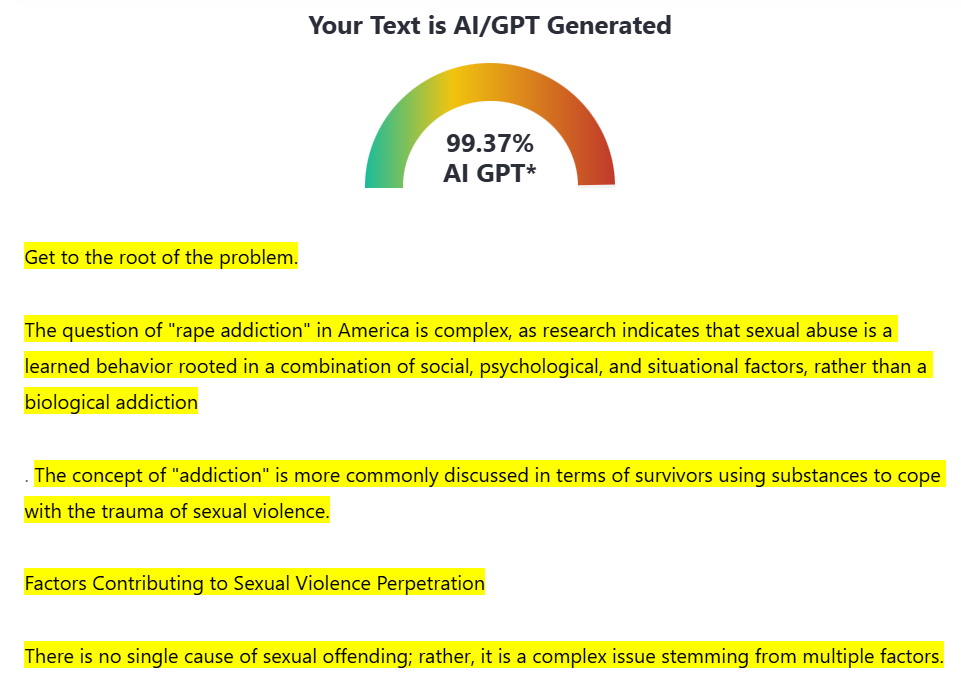
Get to the root of the problem.

The question of "rape addiction" in America is complex, as research indicates that sexual abuse is a learned behavior rooted in a combination of social, psychological, and situational factors, rather than a biological addiction

. The concept of "addiction" is more commonly discussed in terms of survivors using substances to cope with the trauma of sexual violence. 

Factors Contributing to Sexual Violence Perpetration

There is no single cause of sexual offending; rather, it is a complex issue stemming from multiple factors. 

  1. Learned Behavior and Early Development: Sexual abuse is often a learned behavior, and negative experiences or adverse conditions during early development, particularly poor relationships with caregivers, can contribute to offending behaviors.
  2. Cognitive Distortions: Perpetrators often hold distorted thought processes and beliefs about sexual assault (e.g., that the victim wants it, or no harm is done) that help maintain their deviant behavior.
  3. Lack of Empathy and Social Skills: Many sex offenders have poor social skills, difficulty with intimacy, and low empathy, making them more likely to act on harmful desires.
  4. Sense of Entitlement: A perpetrator's sense of entitlement to sex with a woman is significantly associated with a higher likelihood of coercive sexual behaviors.
  5. Substance Use: Alcohol and drug use are significant risk factors. Perpetrators who have been drinking are more likely to commit sexual assault, as substance use can lower inhibitions and impair judgment.
  6. Rape Culture: Broader cultural issues, sometimes referred to as "rape culture," which include minimizing the severity of sexual assault and shifting blame to the victim, can influence the frequency of such incidents and public perception. 

Link Between Sexual Trauma and Substance Addiction

The term "rape addiction" more accurately reflects the high rate at which survivors of sexual assault develop substance use disorders as a coping mechanism for their trauma. 

  1. Coping Mechanism: Victims often turn to drugs and alcohol to numb the emotional and physical pain, mask symptoms of mental illness (like PTSD, depression, or anxiety), and temporarily stop thinking about the trauma.
  2. Increased Risk: Survivors of sexual trauma are at a significantly higher risk for developing substance use disorders later in life.
  3. Revictimization: Substance use, which can impair judgment and the ability to resist, can put survivors at a higher risk of being victimized again, sometimes creating a cycle of trauma and substance abuse. 

Resources for Help

If you or someone you know has been affected by sexual assault or is struggling with addiction related to trauma, help is available.

  1. RAINN (Rape, Abuse & Incest National Network): Offers a national sexual assault hotline at 800-656-HOPE or via their website RAINN.org for support and resources.
  2. SAMHSA (Substance Abuse and Mental Health Services Administration): Provides a national helpline for individuals and families facing mental and/or substance use disorders at 1-800-662-HELP(4357).
  3. Safe Horizon: Offers support for victims of violence and abuse through their website safehorizon.org


Edit post

#24 •••

Edit post

#25 •••

That is the root of the problem and not AI.

Edit post