Should chatgpt be found liable in these murders?

Started by linate

Replies
27
Posts
28
Page
1 / 1

Conversation

#1 •••

https://www.nbcnews.com/news/us-news/openai-sued-chatgpts-alleged-role-guiding-fsu-shooter-rcna344443


I dunno thats a tough one. I could see chatgpt having moral responsibility in aiding the crime but im not sure about legal. The question comes down to whether the ai engaged in 'aiding and abetting' the shooter, and i do see that that could potentially involve giving advice to a shooter. I dunno how clear the shooters intentions should have been to the ai bot. The prosecutor says an actual human would be charged with a crime for what the ai did, and that might be true.


I could see arguing that the shooters intentions were clear and even if they weren't clear to the bot the intentions should have been clear, as itd be clear to any human. I suppose itd boil down to whether ai should be held to the same standard as a human. And even if that standard isnt even considered at all, strictly speaking the bot gave advice to the shooter, point blank, though i do think the standard involved should be considered in the deliberation

Edit comment

#2 •••
@linate

That's like saying an encyclopedia could be charged with assisting with a crime.

Edit post

#3 •••
@linate

So AI can be used for evil? Who would have guessed.

Edit post

#4 •••
@Shoresy

I mean, AI is used to commit a lot of crimes. But it still doesn't mean government should regulate AI until it becomes government's private bitch servant.

Edit post

#5 •••
@SatanLucy

It's literally Google. You can't sue libraries for having how-to manuals, even on guns. Accessory to murder is even more outlandish.

Edit post

#6 •••
@linate
I suppose itd boil down to whether ai should be held to the same standard as a human.


What sperates AI from an encyclopedia, as one user suggested, is the fact that it does have the capability to understand the shooter's intentions and assisted anyway. That I would argue is absolutely grounds to hold the company liable.


It is perhaps the most fundamental consideration of any product - how can this product be used to cause harm, whether intentional or inadvertent? In any other scenario we have no problem accepting that harm resulting from a product being used as intended opens the makers to liability. This is perhaps the clearest example.

Edit post

#7 •••
@Shoresy
It's literally Google. You can't sue libraries for having how-to manuals, even on guns. Accessory to murder is even more outlandish.


It's not Google. Google only returns the inputs you give it. AI actually gave the shooters ideas that they didn't come up with themselves.


Beyond that, you can argue all day long that the shooters would have carried these acts out anyway, that's mostly irrelevant. When you create a product for public consumption you have a responsibility to ensure that product comes with the proper safeguards in place to ensure it is not utilized in a way that causes harm. That clearly wasn't done here.


And not for nothing, this is such basic common sense. We all grew up watching terminator, the idea that an AI bot would come up with ways to kill people is the first concern anyone born in the last 50 years would instantly tie to it. In the movie IRobot the literal first rule of their fictional bots was to cause no harm. How does a company put out a product like this and not teach it to refrain from instructing people on how to kill themselves or others? That is childish incompetence.

Edit post

#8 •••
@Double_R

It would be pretty crazy do you agree to charge the makers of gpt with murder type charges? Aiding and abetting is one thing but the line from that to more serious chargers isnt clear. Plus what other harms could gpt cause? Some are foreseeable and some aren't. Aiding in murder would be foreseeable but whether it was specifically something the makers should have lnown I dont know.

Thats the standard theyd use whether it was 'reasonably foreseeable'

Edit post

#9 •••
@Double_R
When you create a product for public consumption you have a responsibility to ensure that product comes with the proper safeguards in place to ensure it is not utilized in a way that causes harm


Not really. There is no such responsibility in any country. But sounds like good excuse for governments to seize control over AI and basically sterilize it.


What's the next thing they gonna say? AI made him do it?

Edit post

#10 •••
@SatanLucy
There is no such responsibility in any country.


Nonsense, this is how every product just about anywhere works. People sue companies and win over liability issues all the time. They sue car makers when their safety features don't work, they sue food manufacturers when their products are contaminated, hell they've even sued gun manufacturers. AI doesn't get a pass.


Do you seriously think a business should not be held liable for the harm it causes?

Edit post

#11 •••
@linate
do you agree to charge the makers of gpt with murder type charges?


No. Murder or any other kind of criminal charge would require intent or at the very least willful negligence. As far as I am aware there's no evidence of that nor reason to believe that it is the case. Companies exist for one reason only; to make money. So that is always the go to when companies do wrong. I think they should be ordered to compensate the victims generously.

Edit post

#12 •••
@Double_R
Do you seriously think a business should not be held liable for the harm it causes?


In many cases, no. Most businesses cause some harm.

Edit post

#13 •••
@SatanLucy
In many cases, no


Which translates into "in many cases yes". So we're in agreement.

Edit post

#14 •••
@Double_R
Which translates into "in many cases yes". So we're in agreement.


Your original claim didn't include "many cases" but was an absolute claim. And no, we are not in any sort of agreement on the issue. Do you see "I agree with you" written anywhere in my previous comment?

Edit post

#15 •••
@SatanLucy
Do you see "I agree with you" written anywhere in my previous comment?


Yes. I argued that companies have liability when their products cause harm. When you said they "in many cases" should not be held liable, that directly, necessarily, translates into many cases where they would be held liable. So we're saying the same exact thing.


Your original claim didn't include "many cases" but was an absolute claim.


Show me where I made an "absolute claim" that companies should always be held liable. I'll wait.

Edit post

#16 •••
@Double_R
I argued that companies have liability when their products cause harm.


Many cases =/= all cases.

Edit post

#17 •••
@SatanLucy

And no one has argued anything having to do with "all cases", so we're in agreement.

Edit post

#18 •••
@Double_R
And no one has argued anything having to do with "all cases"


You:

"When you create a product for public consumption you have a responsibility to ensure that product comes with the proper safeguards in place to ensure it is not utilized in a way that causes harm."


This was an absolute claim, not "in many cases".


And if it wasn't an absolute claim, then you can't tell if it applies to AI or not.

Edit post

#19 •••
@Double_R
I argued that companies have liability when their products cause harm.


This is likewise an absolute claim, because it tells nothing of exceptions.

Edit post

#20 •••
@SatanLucy
You:
"When you create a product for public consumption you have a responsibility to ensure that product comes with the proper safeguards in place to ensure it is not utilized in a way that causes harm."

This was an absolute claim, not "in many cases".


It was a principal, of course principals are absolute otherwise they're not principals. That's not what we were talking about. Principals are ideas we apply, our conversation and where you tried to argue I was absolute was in saying that companies should always be held liable, but that is of course absurd. Whether they should be held liable depends of the facts of the case, and each case will be different. So in many cases they will be, in many cases they will not be. We're saying the same damn thing.


--> I argued that companies have liability when their products cause harm.

This is likewise an absolute claim, because it tells nothing of exceptions.


I don't think you understand the difference between having liability and being held liable. The latter is a legal judgement resulting from the process being played out, the former is an assessment of the potential. If your product causes harm, you have liability meaning you can be sued, doesn't mean you'll lose the case.

Edit post

#21 •••
@Double_R
If your product causes harm, you have liability meaning you can be sued, doesn't mean you'll lose the case.


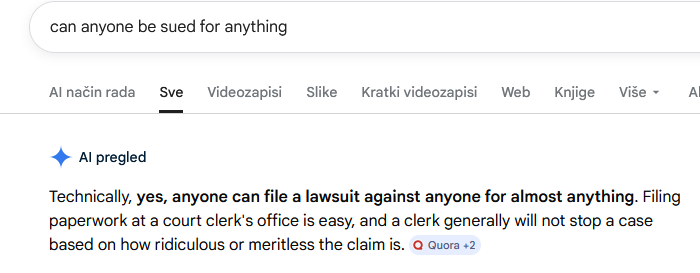
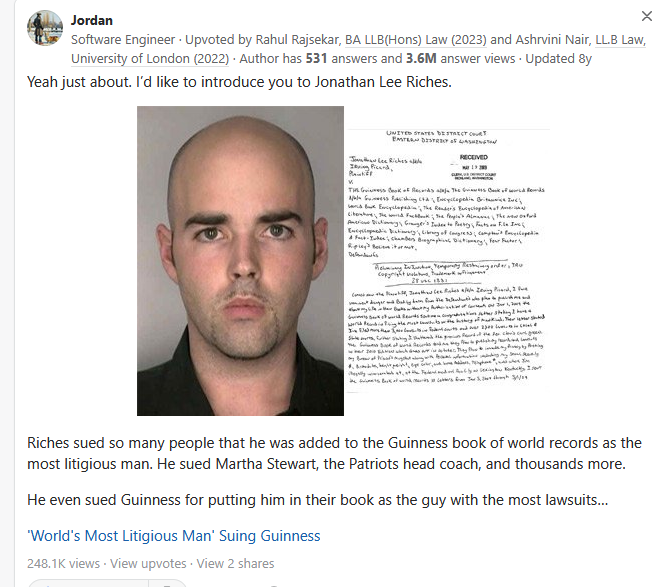
Everyone can be sued for anything. that is not definition of liability.


Liability is usually defined as legal obligation to pay or provide.


But justification for AI company being liable or having liability to provide anything due to harm AI causes doesnt exist.


Because justification for AI advancement outweighs justification for punishing AI companies for this.


So your "absolute claim", which then degraded to "not true in many cases", likewise ceases in case of AI, because advancing AI is more important than placing endless restrictions to sterilize its growth.


So I am afraid the agreement which you think exists between us exists only in your head.

Edit post

#22 •••
@SatanLucy
Everyone can be sued for anything


Not how our system works.


that is not definition of liability.

Liability is usually defined as legal obligation to pay or provide.


It's how the term is used in the legal profession. I would know, I work very closely with the legal team in my line of work.


A "legal obligation" is a vague term, not a black or white. There are always competing factors that have to be taken into account, so when lethal professionals say "there's some liability there" (a phrase I hear multiple times a year) they're telling you that there's a reasonable case that can be made against you. Again, this doesn't mean you will lose the case.


But justification for AI company being liable or having liability to provide anything due to harm AI causes doesnt exist.


That's literally the topic we're debating, but thanks for your opinion.


Because justification for AI advancement outweighs justification for punishing AI companies for this.


Thanks for your opinion. I'll think I'll stick with my opinion that AI companies should ensure their product isn't being used to teach mass murderers how to maximize their casualties.


So your "absolute claim", which then degraded to "not true in many cases"


Nothing I said changed. I'm sorry that you don't know how to read.


Edit post

#23 •••
@Double_R

And you are wrong again.

Edit post

#24 •••

Edit post

#25 •••

Edit post

#26 •••
@SatanLucy
And you are wrong again.


Wow Lucy, what a great argument. I can see why no one is a match for your awesome genius.

Edit post

#27 •••
@Double_R

Sure.

Edit post

#28 •••
@SatanLucy

I wonder where he got the money to pay for those lawsuits?

Edit post