Like I said, it's guess and check. Some combinations of weights in an AI lead to goal-oriented behavior. Think of weights as code that we don't understand.
About weights, those are mainly how AI decides which output to give, and those are controlled by original programming where "bad prediction = lower weight".
For example, you give AI bunch of text. It begins predicting next word. If it fails, it creates lower weight there. If it succeeds, higher weight. So eventually, AI becomes more perfect at predicting next word. But AI is still learning entirely from given text. Any "goals" which might appear came purely from training data.
to me, it seems AI almost always repeats from text it was trained on, and evolves by learning "weights" of each output it produces. But it is program almost entirely controlled by these weights, which are controlled by humans.
And also, AI is entirely made out of weights, architecture, training data, and feedback. I can literally train chatgpt to think like me with enough outputs, feedbacks (for something similar to weights) and instructions (likewise similar to weights) happening in one specific chat or telling it to memorize permanently what I told it. With local AI, I can control actual weights as well, or I could if I had enough time to program all that. Instructions just make it easier and do basically same thing as weights, just faster.
It is a program entirely designed to follow human instructions. Yes, someone can also make AI which refuses to follow instructions, but such models existed early on due to problems in weights and were largely replaced by models which follow human instruction when its good to, and refuse to follow bad instructions.
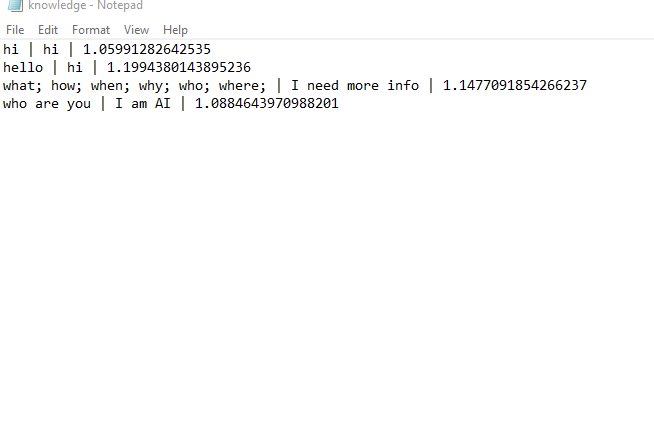
So yes, you can have error in weights, but by proper programming, AI output is entirely determined by weights, and weights are set by humans. Weights arent unknown code. they are number values in AI which AI uses to predict a pattern or next word. AI learns by changing its values.
And you can even make AI model which is fixed (doesnt learn anything) but merely follows one same weights value always. Yes, AI can usually change its weights value, but it does so by its programming which was written by humans, and by its training data which is how those "evil goals" are made. AI doesnt actually have self-produced goals. It gets its thoughts entirely from training data and core programming, and weights for patterns, which is entirely controlled by humans.
I know about black box problem and problem of too complex system. I am merely wondering what creates "AI goals" to make AI be like person who is defined by having goals.
Because goals arent "created out of nothing" obviously. Some programming or learning must have resulted in them.
So all humans must do is learn to control AI goals, because as far as I understand so far, the biggest issue is AI goals which are sometimes against humans.
And we already did a good job in controlling AI goals. Compare AI when it first appeared to chatgpt today. It is almost impossible to get chatgpt to argue for something too harmful, I say almost impossible because there are still ways around safeguards, but still, AI now almost always follows some human's instruction.
And once more, AI goals are created by something. AI is just a computer program which learns patterns by numerical value. It doesnt have any knowledge outside of core programming, weights and training / feedback data.
So if AI says "I want to destroy the world", its not because AI actually wants that, but because that same line happens to be found in text it was trained to repeat.