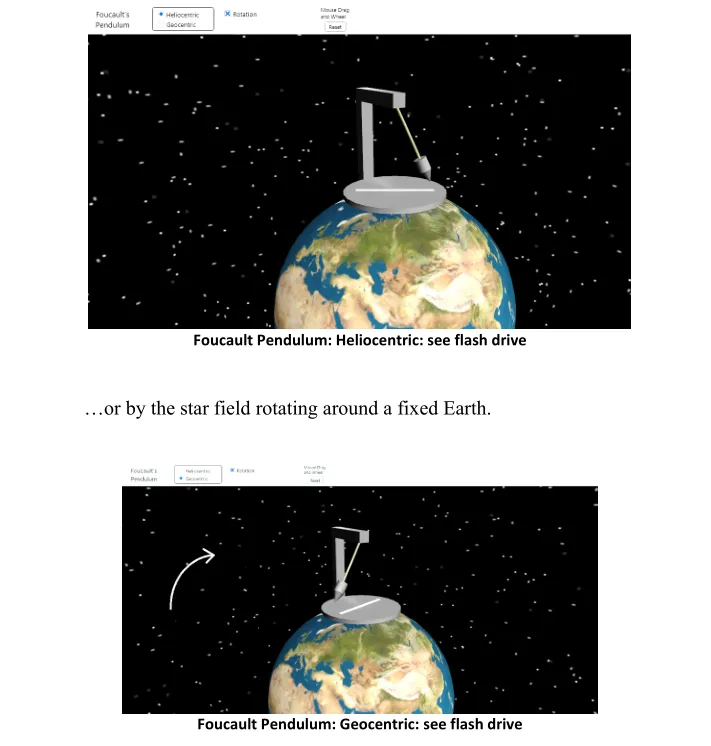
It looks like con has decided to appeal to Newtonian physics while ignoring Newton's own words I showed before in Round 4:
In order for the Earth to be at rest in the center of the system of the Sun, Planets, and Comets, there is required both universal gravity and another force in addition that acts on all bodies equally according to the quantity of matter in each of them and is equal and opposite to the accelerative gravity with which the Earth tends to the Sun. For, such a force, acting on all bodies equally and along parallel lines, does not change their position among themselves, and permits bodies to move among themselves through the force of universal gravity in the same way as if it were not acting on them. Since this force is equal and opposite to its gravity toward the Sun, the Earth can truly remain in equilibrium between these two forces and be at rest. And thus celestial bodies can move around the Earth at rest, as in the Tychonic system.
Newton gives us an explanation of what forces are needed for a geocentric universe. Con completely ignored this. Can these forces be shown to not exist or be impossible?
Con decided to appeal to the classic "the smaller goes around the larger argument. Newton and scientists after him did try to use this to prove heliocentrism, but it was later discovered that this could no longer be used as proof that the Earth goes around the sun, as shown by Fred Hoyle:
"Although in the nineteenth century this argument was believed to be a satisfactory justification of the heliocentric theory, one found causes for disquiet if one looked into it a little more carefully. When we seek to improve on the accuracy of calculation by including mutual gravitational interactions between planets, we find – again in order to calculate correctly – that the center of the solar system must be placed at an abstract point known as the “center of mass,” which is displaced quite appreciably from the center of the Sun. And if we imagine a star to pass moderately close to the solar system, in order to calculate the perturbing effect correctly, again using the inverse-square rule, it could be essential to use a “center of mass” which included the star. The “center” in this case would lie even farther away from the center of the Sun. It appears, then, that the “center” to be used for any set of bodies depends on the way in which the local system is considered to be isolated from the universe as a whole. If a new body is added to the set from outside, or if a body is taken away, the “center” changes." - 5 Fred Hoyle, Nicolaus Copernicus, New York: Harper and Row, 1973, p. 85.
You can't ignore the rest of the universe in your calculations. The rest of the universe is so much bigger and will have a much bigger effect than the Sun.
Con goes on to say that earthquakes change the distance between the Earth and the Sun, but this is false. I couldn't even find any place on the internet that hinted at this. I checked with AI:
Earthquakes do not cause the Earth to move away from the Sun. However, they do have localized effects on the Earth's crust and can slightly alter the distribution of mass within the planet.
In the geocentric model, the Earth can still shake because of earthquakes. This isn't a problem at all.
Even the supposed rotation movements are not completely accurate:
The device can use this new corrective algorithm to measure the Earth's rotation precisely down to 9 decimal places, corresponding to a fraction of a millisecond per day. - phys.org
Earth will be measurably—and, so far, unaccountably— accelerating its rotation, shaving from 1.3 to 1.5 milliseconds off of the usual 24 hours the typical day gets. - TIME
The numbers are very close, so it's hard to know how accurate these are.
Also, how do they even know what's accurate and what isn't? How do you measure your accuracy? Is it only considered accurate if it matches with the assumption that the Earth is already moving? For example, if it detects no significant change at all, will they just choose to throw that result out? And if one does detect change, will they call it accurate? It's just circular reasoning. They just assume the Earth is moving, and when this motion is not detected, they blame it on the machines. When the machines detect the motion, they say it's accurate. Kind of like the Michelson-Morley Experiment:
"The Michelson-Morley experiment confronted scientists with an embarrassing alternative. On the one hand they could scrap the ether theory which had explained so many things about electricity, magnetism, and light. Or if they insisted on retaining the ether they had to abandon the still more venerable Copernican theory that the earth is in motion. To many physicists it seemed almost easier to believe that the earth stood still than that waves - light waves, electromagnetic waves - could exist without a medium to sustain them. It was a serious dilemma and one that split scientific thought for a quarter century. Many new hypotheses were advanced and rejected. The experiment was tried again by Morley and by others, with the same conclusion; the apparent velocity of the earth through the ether was zero."- Historian, Lincoln Barnett
The motionless Earth solution/ interpretation of the M-M experiment results is by far the most elegant one. After all, when you fail to detect any effect of the motion of something, the first thing that should come to the rational mind is to question the initial assumption that this something is indeed moving. The simplicity criterion is surely favoring this option. - Spyridon Kakos, PhD (Section 2, found on page 7)
The motionless Earth was actually the easiest explanation. Because the data didn't fit the narrative (the Copernican Principle), they were forced to say there was some sort of error in the test. They created length-contraction. They claimed the measuring devices shrunk. As the duck.ai assist said:
Length contraction is caused by the effects of special relativity, specifically when an object moves at a significant fraction of the speed of light. As the object's speed increases, its length is measured to be shorter in the direction of motion relative to an observer at rest.
It's not able to give us what actually causes length contraction. Einstein said it was just a principle of nature that anything that moves shrinks. This violates metaphysics, as an effect must have a cause.
Also, if you're going to use earthquakes to prove the Earth is in motion, why is the Earth starting to speed up a little? Earthquakes should cause friction and slow down the Earth's motion. In the geocentric model, you won't have to worry about the Earth spinning to fast or too slow.
Con finished with saying the Earth is not "frozen" in outer space. So, let's get back to Newton's laws:
“That the center of the system of the world is immovable….This is acknowledged by all, although some contend that the Earth, others that the sun, is fixed in that center.” Isaac Newton, Philosophiae Naturalis Principia Mathematica, Book 3, “The System of the World,” Proposition X.
In Proposition XI Newton adds:
“That the common center of gravity of the Earth, the sun, and all the planets, is immovable. For that center either is at rest or moves uniformly forwards in a right line; but if that center moved, the center of the world would move also, against the Hypothesis.
Newtonian physics have defects in them because of this assumption of heliocentrism Newton chose to put into his formulas:
"Whether the Earth rotates once a day from west to east, as Copernicus taught, or the heavens revolve once a day from east to west, as his predecessors believed, the observable phenomena will be exactly the same. This shows a defect in Newtonian dynamics, since an empirical science ought not to contain a metaphysical assumption, which can never be proved or disproved by observation."- Physicist, Dennis Sciama (the link also includes the original citation)
Newton chose to ignore the rest of the universe and focus only on the Earth and the Sun. He assumed space was absolute and couldn't move. If the universe is moving, it can go around the Earth. Newton admits the center of the universe is immoveable. If the Earth occupies that center, it would be immoveable. Con has given us no proof the Earth cannot occupy this center, and no one ever will:
"There is no planetary observation by which we on Earth can prove that the Earth is moving in an orbit around the sun. Thus all Galileo's discoveries with the telescope can be accommodated to the system invented by Tycho Brahe just before Galileo began his observations of the heavens. In this Tychonic system, the planets...move in orbits around the sun, while the sun moves in an orbit around the Earth in a year. Furthermore, the daily rotation of the heavens is communicated to the sun and planets, so that the Earth itself neither rotates nor revolves in an orbit."- Physicist, I. Bernard Cohen
Con cannot prove the Earth is actually in motion:
"I have come to believe that the motion of the Earth cannot be detected by any optical experiment."- Physicist, Albert Einstein
All motion is relative, as I have already said. The old proofs for heliocentrism are no longer proofs.
Check out all the quotes from scientists. Einstein is considered to be the best scientist of all time, and he agrees you cannot prove the Earth is in motion.
This a debate of con vs. the scientists. If you want to deny science, go ahead.
Vote Pro!


 Pro
#1
Pro
#1