Is it possible that the Earth doesn’t move?

Voting 2025 science geocentrism motion

The participant with the most points wins.

Voting stays open until 3 more votes are cast.

Like this debate? Score 0
···
X Facebook
Pro Instigator Opens first
Instigator Avatar
0
Rating
1502
Debates
27
Win rate
51.85%

Match format

Type
Rated · 5 rounds
Time
One week
Limit
10,000
Vote
Two months · 3 votes to close
Con Contender
Contender Avatar
0
Rating
1485
Debates
11
Win rate
59.09%

Pro argues that our modern knowledge and scientific data allow for the Earth to be fixed in the center of the universe.


Con argues that geocentrism has been disproved with modern science and that it is impossible for the Earth to be fixed.

Round 1

1 of 5

I mean there’s no way you can say that it’s impossible for the Earth to be motionless.


Sorry, but the scientists are on my side this time.


"...to the question whether or not the motion of the Earth in space can be made perceptible in terrestrial experiments. We have already remarked...that all attempts of this nature led to a negative result. Before the theory of relativity was put forward, it was difficult to become reconciled to this negative result."- Physicist, Albert Einstein


"We can't feel our motion through space, nor has any physical experiment ever proved that the Earth actually is in motion."- Historian, Lincoln Barnett


"Thus, even now, three and a half centuries after Galileo...it is still remarkably difficult to say categorically whether the earth moves..."- Physicist, Julian B. Barbour


"There is no planetary observation by which we on Earth can prove that the Earth is moving in an orbit around the sun."- Physicist, I. Bernard Cohen


"So which is real, the Ptolemaic or Copernican system? Although it is not uncommon for people to say that Copernicus proved Ptolemy wrong, that is not true...one can use either picture as a model of the universe, for our observations of the heavens can be explained by assuming either the earth or the sun to be at rest."- Physicist, Stephen Hawking


"...we can take either the Earth or the Sun, or any other point for that matter, as the center of the solar system. This is certainly so for the purely kinematical problem of describing the planetary motions. It is also possible to take any point as the center even in dynamics, although recognition of this freedom of choice had to await the present century."- Astronomer, Fred Hoyle


"It is possible to describe the entire universe using any chosen point as the unmoving center - the Earth will do very well - and no one can prove that choice is wrong....Scientists today prefer to picture everything in motion and nothing as being the center. If you haven't given much thought to the implications of twentieth-century science, you may be chagrined...to realize that because of the concept of relative motion, no one can prove that the Earth moves."- Kitty Ferguson, Science Writer


"...Thus we may return to Ptolemy's point of view of a 'motionless Earth' This would mean that we use a system of reference rigidly fixed to the Earth in which all stars are performing a rotational motion with the same angular velocity around the Earth's axis...one has to show that the transformed metric can be regarded as produced according to Einstein's field equations, by distant rotating masses. This has been done by Thirring. He calculated a field due to a rotating, hollow, thick-walled sphere and proved that inside the cavity it behaved as though there were centrifugal and other inertial forces usually attributed to absolute space. Thus from Einstein's point of view, Ptolemy and Copernicus are equally right. What point of view is chosen is a matter of expediency."- Physicist, Max Born


"I can construct for you a spherically symmetrical universe with Earth at its center, and you cannot disprove it based on observationsYou can only exclude it on philosophical grounds. In my view there is absolutely nothing wrong in that. What I want to bring into the open is the fact that we are using philosophical criteria in choosing our models. A lot of cosmology tries to hide that."- Physicist, George F. R. Ellis


All motion is relative. How are you going to show geocentrism is impossible?

The geocentric model makes one big assumption that is contradicted by modern science. This assumption being that the earth is fixed at the universe's center. Given that the universe is in the process of rapid expansion, this center location would be impossible to maintain even if we were to assume it was true.

We also know from retrograde motion that the planets outside the earth sometimes seem to move backward, and this observation cannot be explained by anything within the geocentric model.

The obvious explanation is that the earth and planets orbit around the sun.


How do we know the Universe is expanding? – Euclid Consortium


"All planets in our solar system orbit in the same direction. Almost all planets rotate counterclockwise, except for Venus, which rotates clockwise, and Uranus, which rotates on its side."

What Is Retrograde Motion?

Round 2

2 of 5

You claim that the Earth cannot be in the center of the universe because there is no center of the universe. Why do you say there is no center? Because the universe is expanding equally and everywhere.


Well, where does the expanding universe theory even come from? I'll quote directly from the article you gave me:

The realization that the Universe is expanding emerged from the revolutionary discoveries of Edwin Hubble in the 1920s. Hubble’s discovery was based on the measurement of a phenomenon known as redshift. When light from a distant object moves away from us, its wavelength stretches and shifts towards the red end of the electromagnetic spectrum. This is similar to how the pitch of an ambulance siren changes as it moves away from you. The extent of this redshift is directly related to the object’s distance and its rate of recession.

I think it would be best to get Hubble's own words about what he saw:

Such a condition would imply that we occupy a unique position in the universe, analogous, in a sense, to the ancient conception of a central earth. The hypothesis cannot be disproved but it is unwelcome and would be accepted only as a last resort in order to save the phenomena. Therefore, we disregard this possibility and consider the alternative, namely, a distribution which thins out with distance...But the unwelcome supposition of a favoured location must be avoided at all costs. Therefore, we accept the uniform distribution, and assume that space is sensibly transparent.

Now let's also get what Stephen Hawking commented on matter in his book, A Brief History of Time (found on the last two paragraphs of page 57 if you want to check):

At first sight, all this evidence that the universe appears the same whichever direction we look in might seem to suggest there is something distinctive about our place in the universe. In particular, it might seem that if we observe all other galaxies to be moving away from us, then we must be at the center of the universe. There is, however, an alternative explanation: the universe might look the same in every direction as seen from any other galaxy too. This, as we have seen, was Friedmann’s second assumption. We have no scientific evidence for or against that second assumption. Centuries ago, the church would have considered the assumption heresy, since church doctrine stated that we do occupy a special place at the center of the universe. But today we believe Friedmann’s assumption for almost the opposite reason, a kind of modesty: we feel it would be most remarkable if the universe looked the same in every direction around us but not around other points in the universe!

Notice how neither Hubble nor Hawking actually choose explanations based on the actual data but instead base it on their own philosophical views. Hubble admits the central Earth "cannot be disproved but it is unwelcome and would be accepted only as a last resort in order to save the phenomena." Hawking admits the non-central Earth explanation has "no scientific evidence for or against" it. He merely prefers it for "modesty" purposes. This is not how science should work. Science is supposed to be unbiased. He compares it to back it Galileo's day when it was heresy to say the Earth was not the center because a central Earth makes more sense for God to make since we are special. In our day, it is heresy to say the Earth is the center because that would imply there is a God, forcing all the top scientists to repent of their sins, which they desperately are trying to avoid at all costs:

"Where has God gone?" he cried. "I shall tell you. We have killed him - you and I. We are his murderers. But how have we done this? How were we able to drink up the sea? Who gave us the sponge to wipe away the entire horizon? What did we do when we unchained the Earth from its sun? Whither is it moving now? Whither are we moving now? Away from all suns? Are we not perpetually falling? Backward, sideward, forward, in all directions? Is there any up or down left? Are we not straying as through an infinite nothing? Do we not feel the breath of empty space? Has it not become colder? Is it not more and more night coming on all the time? Must not lanterns be lit in the morning? Do we not hear anything yet of the noise of the gravediggers who are burying God? Do we not smell anything yet of God's decomposition? Gods, too, decompose. God is dead. God remains dead. And we have killed him. How shall we, murderers of all murderers, console ourselves?" - Philosopher, Friedrich Nietzsche

You tried to use an expanding universe to disprove geocentrism. The expanding universe theory is based on the assumption that the Earth is not the center. They knew the geocentric explanation "could not be disproven" but was "unwelcome." They instead chose a more complicated answer that had "no evidence for or against" it.


Now let's get to the retrograde motion, which you claim proves heliocentrism:

There is no planetary observation by which we on Earth can prove that the Earth is moving in an orbit around the sun. Thus all Galileo's discoveries with the telescope can be accommodated to the system invented by Tycho Brahe just before Galileo began his observations of the heavens. In this Tychonic system, the planets...move in orbits around the sun, while the sun moves in an orbit around the Earth in a year. Furthermore, the daily rotation of the heavens is communicated to the sun and planets, so that the Earth itself neither rotates nor revolves in an orbit. - Physicist, I. Bernard Cohen

Still don't believe me? Check out this experiment done to prove it:

The Eames machine ran continually without default for something like sixth months. As the circles turned, the rods, representing the observed line of sight to Mars, always remained parallel. Each time Mars came on the inner side of the epicycle, the combined counterclockwise motions of the deferent and epicycle caused the geocentric rod to briefly swing clockwise, the so-called retrograde motion. Whenever that happened, in the heliocentric model the faster-moving Earth was always nearest Mars and bypassing it, so the heliocentric rod remained in perfect tandem with the geocentric rod. It was a brilliant demonstration of the equivalence of the two systems, and what worked for Mars would work for each of the other planets. - Owen Gingerich, The Book that Nobody Read, pp. 44-45.


The geocentric and heliocentric models are geometrically the same. There's no way around it.

Round 3

3 of 5

7 days and no response from my opponent. What happened in those 7 days? Did the Earth rotate fully 7 times, or did the heavens revolve around the Earth 7 times? Let’s see:

“Whether the Earth rotates once a day from west to east, as Copernicus taught, or the heavens revolve once a day from east to west, as his predecessors believed, the observable phenomena will be exactly the same. This shows a defect in Newtonian dynamics, since an empirical science ought not to contain a metaphysical assumption, which can never be proved or disproved by observation.” - Physicist, Dennis Sciama

All my opponent did in round 1 was use circular reasoning and ignore that the geometry in the heliocentric and geocentric models is exactly the same.


I’ll let my opponent try to rebut my previous arguments if possible.

“The Earth rotates on its axis… Its rotation relative to ‘fixed’ stars (sidereal time) is 3 minutes 56.55 seconds shorter than the mean solar day.” — NASA.

https://science.nasa.gov/learn/basics-of-space-flight/chapter2-1/


“When Gaia measured the distances to stars, it observes the combined effect of parallax motion and proper motion. Since parallax motion repeats every year, while … the proper motion does not, the parallax is caused by the orbit of Earth around the Sun.” — European Space Agency (Gaia).

https://www.esa.int/Science_Exploration/Space_Science/Gaia/Parallax?


Crucial Points


  1. The Foucault pendulum is a laboratory experiment that was conducted to observe the rotation of the earth, which ended up demonstrating this as true. It literally shows that the earth rotates.
https://www.britannica.com/science/Foucault-pendulum?


NASA uses a combination of tools and resources including satellites and lasers to measure the earth's shape, orientation, and rotation. This is physical proof. It allows it to keep track of its rotation rate, and any changes in the spin axis.

https://www.earthdata.nasa.gov/data/space-geodesy-techniques?

Round 4

4 of 5

But NASA Said So


Con gave us an article from NASA but failed to point out an important part of it:

The Earth rotates on its axis… Its rotation relative to ‘fixed’ stars (sidereal time) is 3 minutes 56.55 seconds shorter than the mean solar day. (emphasis added)

This article talks about relative rotation. You can rework the system to show the exact same thing with a geocentric model, as I will show later. What does Einstein say about detecting the Earth's motion?

I have come to believe that the motion of the Earth cannot be detected by any optical experiment. - "How I Created the Theory of Relativity" (This can be found on the second page of the PDF in paragraph 4.)

And in another quote:

...to the question whether or not the motion of the Earth in space can be made perceptible in terrestrial experiments. We have already remarked...that all attempts of this nature led to a negative result. Before the theory of relativity was put forward, it was difficult to become reconciled to this negative result. - (Here in paragraph 7)


Stellar Parallax


Con also claims that stellar parallax proves heliocentrism, but it doesn't. You see, con already brought up retrograde motion in a previous round to try to prove heliocentrism. Retrograde motion only proved that Ptolemy's cosmology needed to be improved. Instead of all heavenly bodies simply going around the Earth, Tycho Brahe created a new system in which the planets in our solar system go around the Sun while the Sun goes around a fixed Earth. Stellar parallax does a similar thing. It just proved Tycho's cosmology needed to be updated. In his system the stars were fixed. To show show stellar parallax, all one needs to do is have the stars centered on the Sun:

It is often said that Tycho's model implies the absence of parallax, and that Copernicus' requires parallax. Yet it would not be a major conceptual change for Tycho to have the stars orbit the Sun (like the planets do), which would give the same yearly shifts in their apparent positions as parallax gives. So if parallax were observed, a flexible Tychonean could adjust the theory to account for it, without undue complexity...If different stars were to show different amounts of parallax, that would rule out the possibility of them all being on one sphere, but still not really decide between Tycho and Copernicus...If we don't worry about the distant stars, these two models describe identical relative motions of all the objects in the solar system. So the role of observation is not as direct as you might have guessed. No bare observation can distinguish whether Tycho (taken broadly) or Copernicus (taken broadly) is right. This statement would NOT apply to the Ptolemy/Copernicus dispute. So beware generalizations about how scientific issues are resolved. - University of Illinois Physics, found on pages 4 and 6


Foucault Pendulum


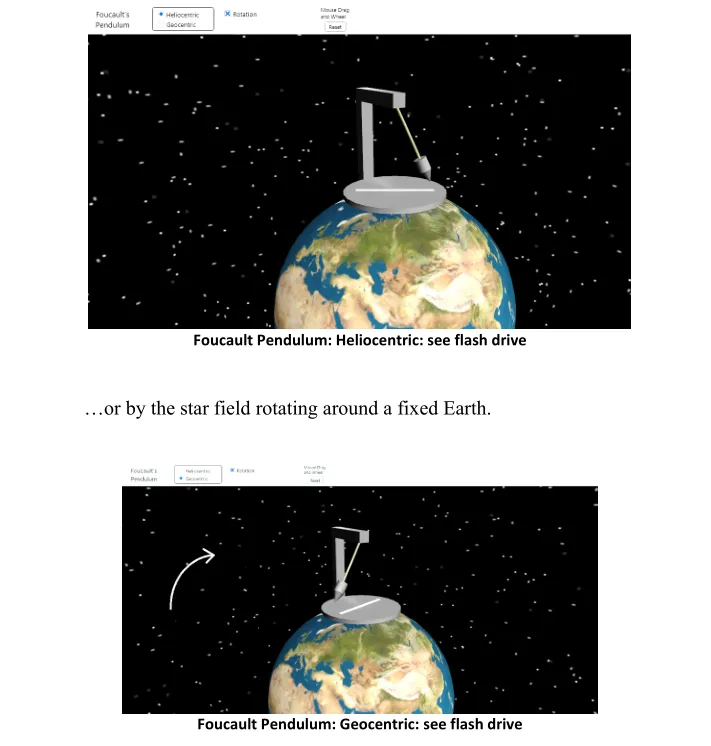
Con also claim that the Foucault pendulum proves the Earth is in motion, but this is false. We know that there is relative motion between the Earth and space with the pendulum, but we can't prove that one of them is the one that is in motion. Ernst Mach shows why this is the case:

Obviously it matters little if we think of the earth as turning about on its axis, or if we view it at rest while the fixed stars revolve around it. Geometrically these are exactly the same case of a relative rotation of the earth and the fixed stars with respect to one another.

What force even causes the Foucault Pendulum to do what it does?

The precession of the plane of oscillation of a pendulum, due to the Coriolis force... - University of Texas at Austin (last paragraph)

What is the Coriolis force? Wikipedia says:

In physics, the Coriolis force is a pseudo force that acts on objects in motion within a frame of reference that rotates with respect to an inertial frame.

So a fictitious force is causing the pendulum to move? This just doesn't even make sense. What does Newton say?

In order for the Earth to be at rest in the center of the system of the Sun, Planets, and Comets, there is required both universal gravity and another force in addition that acts on all bodies equally according to the quantity of matter in each of them and is equal and opposite to the accelerative gravity with which the Earth tends to the Sun. For, such a force, acting on all bodies equally and along parallel lines, does not change their position among themselves, and permits bodies to move among themselves through the force of universal gravity in the same way as if it were not acting on them. Since this force is equal and opposite to its gravity toward the Sun, the Earth can truly remain in equilibrium between these two forces and be at rest. And thus celestial bodies can move around the Earth at rest, as in the Tychonic system.

Thus in the geocentric system, the Coriolis force isn't a fictious force but a real force. This force is what causes the Foucault pendulum to do what it does. Also, for some reason this was left out of Newton's Principia. You can find the original page here and the translation can be found here.


The Foucault pendulum does not prove the Earth is rotating:


The motion is relative:

If Einstein rode past me on his bicycle, I could only say that he is moving from my perspective. From his perspective, he could rightly claim that he was fixed still and that I was the one in motion. - Universe Today


More NASA


Let's move on to the final point con made:

NASA uses a combination of tools and resources including satellites and lasers to measure the earth's shape, orientation, and rotation. This is physical proof. It allows it to keep track of its rotation rate, and any changes in the spin axis.

About Earth's shape, I do not believe in a flat Earth. I accept the shape of the Earth that NASA says. Not sure how NASA is supposed to prove the Earth moves. All motion is relative. If you see the Earth's "rotation" in space, it could really just be the universe rotating around the Earth to make it look like there is a rotation.


Also, Earth was supposedly spinning faster this summer. This should not be happening if there is actually a rotation. The friction of earthquakes and waves would slow down the Earth, but there should be no speeding up. For example, spinning a fidget spinner makes it spin, but it will eventually slow down. This is because of friction and outside forces. If there were no friction, it would just spin forever because of Newton's first law. One cannot claim that the Earth is simply overall slowing down but may speed up slightly. What is causing the Earth to speed up slightly? A fidget spinner can only slow down from there, unless you apply another force on it.


Con has still been unable to show it is impossible that the Earth is motionless.

Then let's talk size gaps and gravity.


The earth is very small compared to the sun, being so insignificant that it lacks the force to command the gravitational frequency that would pull the sun and everything else in its orbit. But the earth is trapped a safe distance away from the sun but cannot escape its orbit because of its massive size.

As I have pointed out in the last round. NASA physically observes the earth's rotation axis being affected whenever there is an earthquake or hiccup which disrupts the distance between the earth and the sun, creating a wider distance gap.


If the earth itself didn't move, then these earthquakes shouldn't have the capacity to affect the distance between the earth and the sun. As these earthquakes are not an external source.

This proves that the earth does move and is not frozen in outer space.


Extend.

Round 5

5 of 5

It looks like con has decided to appeal to Newtonian physics while ignoring Newton's own words I showed before in Round 4:

In order for the Earth to be at rest in the center of the system of the Sun, Planets, and Comets, there is required both universal gravity and another force in addition that acts on all bodies equally according to the quantity of matter in each of them and is equal and opposite to the accelerative gravity with which the Earth tends to the Sun. For, such a force, acting on all bodies equally and along parallel lines, does not change their position among themselves, and permits bodies to move among themselves through the force of universal gravity in the same way as if it were not acting on them. Since this force is equal and opposite to its gravity toward the Sun, the Earth can truly remain in equilibrium between these two forces and be at rest. And thus celestial bodies can move around the Earth at rest, as in the Tychonic system.

Newton gives us an explanation of what forces are needed for a geocentric universe. Con completely ignored this. Can these forces be shown to not exist or be impossible?


Con decided to appeal to the classic "the smaller goes around the larger argument. Newton and scientists after him did try to use this to prove heliocentrism, but it was later discovered that this could no longer be used as proof that the Earth goes around the sun, as shown by Fred Hoyle:

"Although in the nineteenth century this argument was believed to be a satisfactory justification of the heliocentric theory, one found causes for disquiet if one looked into it a little more carefully. When we seek to improve on the accuracy of calculation by including mutual gravitational interactions between planets, we find – again in order to calculate correctly – that the center of the solar system must be placed at an abstract point known as the “center of mass,” which is displaced quite appreciably from the center of the Sun. And if we imagine a star to pass moderately close to the solar system, in order to calculate the perturbing effect correctly, again using the inverse-square rule, it could be essential to use a “center of mass” which included the star. The “center” in this case would lie even farther away from the center of the Sun. It appears, then, that the “center” to be used for any set of bodies depends on the way in which the local system is considered to be isolated from the universe as a whole. If a new body is added to the set from outside, or if a body is taken away, the “center” changes." - 5 Fred Hoyle, Nicolaus Copernicus, New York: Harper and Row, 1973, p. 85.

You can't ignore the rest of the universe in your calculations. The rest of the universe is so much bigger and will have a much bigger effect than the Sun.


Con goes on to say that earthquakes change the distance between the Earth and the Sun, but this is false. I couldn't even find any place on the internet that hinted at this. I checked with AI:

Earthquakes do not cause the Earth to move away from the Sun. However, they do have localized effects on the Earth's crust and can slightly alter the distribution of mass within the planet.

In the geocentric model, the Earth can still shake because of earthquakes. This isn't a problem at all.


Even the supposed rotation movements are not completely accurate:

The device can use this new corrective algorithm to measure the Earth's rotation precisely down to 9 decimal places, corresponding to a fraction of a millisecond per day. - phys.org
Earth will be measurably—and, so far, unaccountably— accelerating its rotation, shaving from 1.3 to 1.5 milliseconds off of the usual 24 hours the typical day gets. - TIME

The numbers are very close, so it's hard to know how accurate these are.


Also, how do they even know what's accurate and what isn't? How do you measure your accuracy? Is it only considered accurate if it matches with the assumption that the Earth is already moving? For example, if it detects no significant change at all, will they just choose to throw that result out? And if one does detect change, will they call it accurate? It's just circular reasoning. They just assume the Earth is moving, and when this motion is not detected, they blame it on the machines. When the machines detect the motion, they say it's accurate. Kind of like the Michelson-Morley Experiment:

"The Michelson-Morley experiment confronted scientists with an embarrassing alternative. On the one hand they could scrap the ether theory which had explained so many things about electricity, magnetism, and light. Or if they insisted on retaining the ether they had to abandon the still more venerable Copernican theory that the earth is in motion. To many physicists it seemed almost easier to believe that the earth stood still than that waves - light waves, electromagnetic waves - could exist without a medium to sustain them. It was a serious dilemma and one that split scientific thought for a quarter century. Many new hypotheses were advanced and rejected. The experiment was tried again by Morley and by others, with the same conclusion; the apparent velocity of the earth through the ether was zero."- Historian, Lincoln Barnett
The motionless Earth solution/ interpretation of the M-M experiment results is by far the most elegant one. After all, when you fail to detect any effect of the motion of something, the first thing that should come to the rational mind is to question the initial assumption that this something is indeed moving. The simplicity criterion is surely favoring this option. - Spyridon Kakos, PhD (Section 2, found on page 7)

The motionless Earth was actually the easiest explanation. Because the data didn't fit the narrative (the Copernican Principle), they were forced to say there was some sort of error in the test. They created length-contraction. They claimed the measuring devices shrunk. As the duck.ai assist said:

Length contraction is caused by the effects of special relativity, specifically when an object moves at a significant fraction of the speed of light. As the object's speed increases, its length is measured to be shorter in the direction of motion relative to an observer at rest.

It's not able to give us what actually causes length contraction. Einstein said it was just a principle of nature that anything that moves shrinks. This violates metaphysics, as an effect must have a cause.


Also, if you're going to use earthquakes to prove the Earth is in motion, why is the Earth starting to speed up a little? Earthquakes should cause friction and slow down the Earth's motion. In the geocentric model, you won't have to worry about the Earth spinning to fast or too slow.


Con finished with saying the Earth is not "frozen" in outer space. So, let's get back to Newton's laws:

“That the center of the system of the world is immovable….This is acknowledged by all, although some contend that the Earth, others that the sun, is fixed in that center.” Isaac Newton, Philosophiae Naturalis Principia Mathematica, Book 3, “The System of the World,” Proposition X.

In Proposition XI Newton adds:

“That the common center of gravity of the Earth, the sun, and all the planets, is immovable. For that center either is at rest or moves uniformly forwards in a right line; but if that center moved, the center of the world would move also, against the Hypothesis.

Newtonian physics have defects in them because of this assumption of heliocentrism Newton chose to put into his formulas:

"Whether the Earth rotates once a day from west to east, as Copernicus taught, or the heavens revolve once a day from east to west, as his predecessors believed, the observable phenomena will be exactly the same. This shows a defect in Newtonian dynamics, since an empirical science ought not to contain a metaphysical assumption, which can never be proved or disproved by observation."- Physicist, Dennis Sciama (the link also includes the original citation)

Newton chose to ignore the rest of the universe and focus only on the Earth and the Sun. He assumed space was absolute and couldn't move. If the universe is moving, it can go around the Earth. Newton admits the center of the universe is immoveable. If the Earth occupies that center, it would be immoveable. Con has given us no proof the Earth cannot occupy this center, and no one ever will:

"There is no planetary observation by which we on Earth can prove that the Earth is moving in an orbit around the sun. Thus all Galileo's discoveries with the telescope can be accommodated to the system invented by Tycho Brahe just before Galileo began his observations of the heavens. In this Tychonic system, the planets...move in orbits around the sun, while the sun moves in an orbit around the Earth in a year. Furthermore, the daily rotation of the heavens is communicated to the sun and planets, so that the Earth itself neither rotates nor revolves in an orbit."- Physicist, I. Bernard Cohen

Con cannot prove the Earth is actually in motion:

"I have come to believe that the motion of the Earth cannot be detected by any optical experiment."- Physicist, Albert Einstein

All motion is relative, as I have already said. The old proofs for heliocentrism are no longer proofs.


Check out all the quotes from scientists. Einstein is considered to be the best scientist of all time, and he agrees you cannot prove the Earth is in motion.


This a debate of con vs. the scientists. If you want to deny science, go ahead.


Vote Pro!

Pro is right in correcting me on a very important detail that I was wrong about.


The fact that I did not verify or double-check before publishing is a significant failure on my part.

My error is what I believed to be the cause of the altering distance between the earth and the sun.

After double-checking, I have to come to realize that the cause is not earthquakes as I have originally believed.


To avoid further embarrassment and taking hits to my credibility, it therefore makes sense to quote the source directly and clarify certain crucial points. But first thing's first.:


  1. Science has already established that there is a fluctuating & changing distance between the earth and the sun which is observable at different seasons.
  2. This has already demonstrated, even if I am wrong about the cause.
  3. The Sun has the most mass, so it commands the center of orbit through stronger gravity.
  4. Which means it pulls the earth into its orbit. The Sun is not in earth's orbit.

It is not too late to bring this up, as I am not making any new arguments this round. I am simply repeating the argument I brought up the previous round and correcting myself.


The point at which the earth comes to the closest to the sun is known as perihelion.

Because despite what many non-space enthusiasts believe about the earth's orbit, it is not circular. But elliptical.

"In about 1604, Johannes Kepler fitted an ellipse model of Mars' orbit to observations of Mars," Bloomer told Space.com. "He came up with the first law of planetary motion that states that planets orbit the sun on an ellipse with the sun being the focus on this ellipse."


Aphelion is the name at the point in which the earth is the furthest from the sun.

Space.com/Perihelion


Pro certainly worked harder and did a better job at establishing their case.

But according to science, these models of planets and earth orbiting the sun have already been demonstrated and observed. No amount of misquoting Einstein or other physicists can change this.

New comment

avatar
•••
#12
--> @melcharaz

I looked back and saw the translations vary between whether it is future or present. The “movement” of the Earth in this case is just from earthquakes and God’s judgment, not a rotation or revolution around the sun.

avatar
•••
#11

So you admit then that the earth does move.

Thanks for affirming scripture.

avatar
•••
#10
--> @melcharaz

This verse is talking about end times and God’s judgment on the world. It says what will happen not what does happen. You need to read the verse.

avatar
•••
#9
--> @GreatfulGoy

Prove it then.

avatar
•••
#8

Isaiah 24:20

avatar
•••
#7
--> @SomeDebatePerson

You are lying that the Church didnt believe in a flat earth btw.

avatar
•••
#6
--> @GreatfulGoy

Science got many things wrong that it corrected later.

Vatican II doesn't really give any new doctrines or dogmas, it just takes different approaches.

avatar
•••
#5
--> @SomeDebatePerson

Well, it is.

The Church got many things wrong that it corrected later. Vatican II vs I vs prior and all.

It is about as 'infallible', as a banana is yellow. Overall sure, but not always.

avatar
•••
#4
--> @GreatfulGoy

I don't believe the Earth is flat, I believe it is in the center of the universe, motionless.

The Church never taught the Earth was flat.

avatar
•••
#3
--> @melcharaz

Can you cite the verse you're talking about? The Bible only says the Earth moves at the end of the world.

All scientists agree geocentrism is possible, they just don't prefer it.

avatar
•••
#2

It is rare to meet a fellow Cath-thinking flat earther.

Usually they are Protestants, Muslims or Pagans.

avatar
•••
#1

Even bible says the earth reels to and fro like a drunkard.

What science are you using to suggest the earth doesnt move?