

Resolved: Theism is a better explanation than Naturalism

Finished philosophy science religion
Like this debate? Score +2
···
X Facebook
Pro Instigator Opens first Winner
Instigator Avatar
3
Rating
1574
Debates
30
Win rate
66.67%
Con Contender
Contender Avatar
0
Rating
1480
Debates
4
Win rate
12.50%
Verdict Kohai wins · 3 points
Kohai Pro
3
novelnotions Con
0

After 3 votes (0 ties) — 3 points ahead

DO NOT ACCEPT THIS DEBATE WITHOUT TALKING TO ME FIRST!!! THIS WILL MERIT AN AUTO LOSS! I ONLY WANT TO GO UP AGAINST DEBATERS WHO KNOW WHAT THEY ARE TALKING ABOUT!!


I. Debate Introduction

In this debate I will defend the proposition that theism is a better explanation than naturalism and my opponent will argue that naturalism is a better explanation than theism.

II. Definitions

  1. Naturalism: hypothesis that the natural world is a closed system” in the sense that “nothing that is not a part of the natural world affects it.” As such, “naturalism implies that there are no supernatural entities
  2. Theism: The belief that at least one God exists.
  3. God: For the purposes of this debate, the term "God" will be defined broadly as to include the general 4'Os (omniscient, omnipresent, omnipotent, and omnibenevolent being) who is the source of creation.) That is to say, I am not referring to any specific deity. Hence religious texts and religious doctrines are irrelevant to the debate. .
  4. Best explanation: The most parsimonious account for the data across the domains of science, philosophy, ethics, logic etc.

III. Rules

  1. No AI of any kind allowed
  2. Talk to me before accepting this debate
  3. Burden of proof is shared. It is not enough for my opponent to just refute my arguments. They must provide evidence for naturalism.
  4. All sources must be cited. No plagiarism permitted
  5. NO AI OF ANY KIND ALLOWED!!!


DO NOT ACCEPT THIS DEBATE WITHOUT TALKING TO ME FIRST!!! THIS WILL MERIT AN AUTO LOSS! I ONLY WANT TO GO UP AGAINST DEBATERS WHO KNOW WHAT THEY ARE TALKING ABOUT!!


Round 1

1 of 4
avatar
Kohai Administrator
Pro #1

I want to begin by welcoming my opponent to debatecraft. I am looking forward to a fruitful exchange.

I. Framework

Both theism and naturalism makes specific claims about the universe and also makes specific testable predictions. I contend that we should define "best explanation" as which framework gives us the most parsimonious account for the data across the domains of science, philosophy, ethics, logic etc. By parsimony I mean favoring the simplest explanation that requires the fewest assumptions or entities to explain a phenomenon and provides for the most coherent framework. With that said let's begin.

II. Theism best explains existence

The most foundational question in metaphysics is why is there something rather than nothing? In philosophy we distinguish between several kinds of entities:

  1. A contingent entity: An entity that could exist but could also fail to exist. This entity exists in some possible worlds but not others and requires an explanation for why it exists external to it.
  2. A necessary entity: An entity that exists in all possible worlds, exists by its own nature, and does not require an external explanation for its existence.
  3. An impossible entity: An entity that exists in no possible worlds such as a square circle.

The universe has all the hallmarks of a contingent entity because it had a cosmic beginning and thus requires an explanation for its existence external to it. The question is is why is theism a better explanation for the cosmic beginning than a natural explanation? For that I will offer two arguments: The Leibniz's Cosmological Argument and the Kalaam Cosmological Argument.

A. The Leibnizian Cosmological Argument

  1. Anything that exists has an explanation of its existence, either in the necessity of its own nature or in an external explanation.
  2. The universe has an explanation for its existence, and that explanation is grounded in a necessary being.
  3. The universe exists
  4. Therefore the universe has an explanation of its existence (from 1, 3)
  5. Therefore, the explanation of the existence of the universe is grounded in a necessary being (from 2,4)
  6. Therefore, God (a necessary being) exists.

Premise 1 is a statement of the principle of sufficient reason: For every fact F , there must be a sufficient reason why F is the case.

Premise 2 seems to be fairly logical. If the sum of everything that exists is contingent then something that is not contingent is required to explain why it exists.

Premise 3 is fairly obvious.

Premise 4: This conclusion is unavoidable

P5-6: The contingent universe must be explained by a necessary being and this being is what people refer to as God.

B. The KCA

  1. Whatever begins to exist has a cause
  2. The universe began to exist
  3. Therefore, the universe has a cause

Going back to the PSR we know that If something begins to exist then it is not necessary, it is contingent. Contingent entities require an external explanation for their existence.

P2 has been scientifically proven. The universe is not static and has not always existed. Dr. Stephen Hawkings noted:

The conclusion of this lecture is that the universe has not existed forever. Rather, the universe, and time itself, had a beginning in the Big Bang, about 15 billion years ago. The beginning of real time, would have been a singularity, at which the laws of physics would have broken down. Nevertheless, the way the universe began would have been determined by the laws of physics, if the universe satisfied the no boundary condition. This says that in the imaginary time direction, space-time is finite in extent, but doesn't have any boundary or edge. The predictions of the no boundary proposal seem to agree with observation. The no boundary hypothesis also predicts that the universe will eventually collapse again. However, the contracting phase, will not have the opposite arrow of time, to the expanding phase. So we will keep on getting older, and we won't return to our youth.

Dr. Neil DeGrasse Tyson also admits:

Yes, the universe had a beginning. Yes, the universe continues to evolve. And yes, every one of our body’s atoms is traceable to the big bang and to the thermonuclear furnace within high-mass stars. We are not simply in the universe, we are part of it. We are born from it. One might even say we have been empowered by the universe to figure itself out—and we have only just begun.

This leads to an inevitable conclusion that the universe has a cause and why should we conclude that the cause is God? We are warranted to believe this because:

  1. The cause must be necessary (ie not contingent)
  2. The cause must be extraordinarily powerful to be able to bring an entire universe into existence ex nihilio.
  3. The cause must be transcendent and exist beyond space and time.

II. Theism best explains design

  1. The fine-tuning of the initial conditions of the universe is due to either law, chance, or design
  2. It is not due to law or chance
  3. Therefore, it's due to design

This is the famous teleological argument that asks the question "Why is the universe so finely tuned?" There are only three reasons why the universe appears fined-tune and if we can eliminate one or more options then we can determine the true cause of the fine tuning of the universe. If we can reasonably rule out law or chance then that leaves only design as the only viable option left.

A. Fine tuning explained

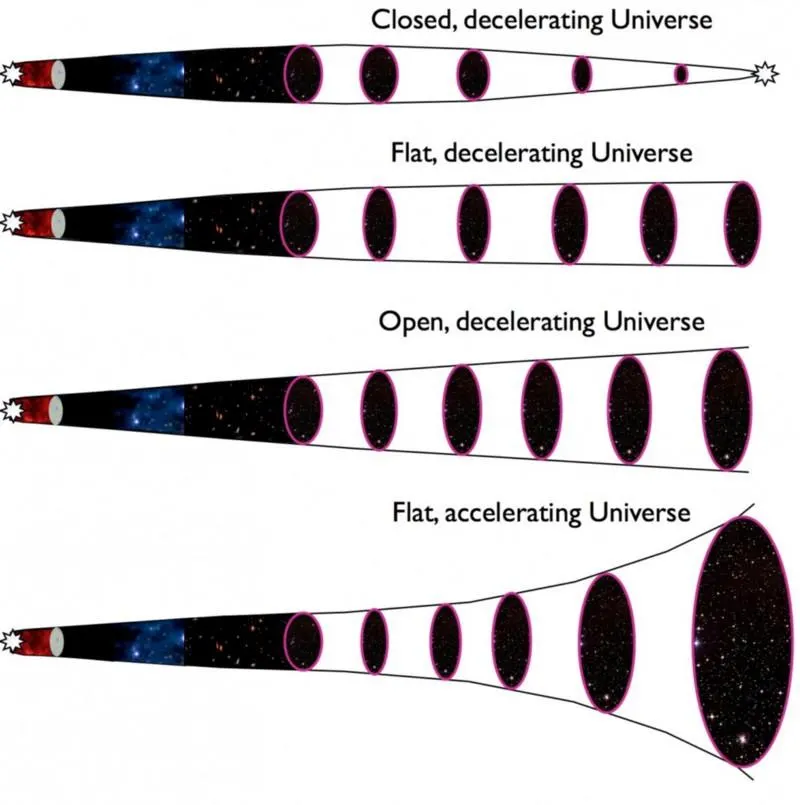
If the universe's constants were off by just a fraction then the universe would be life-prohibiting. For example, if the cosmological constant, gravitation forces, weak nuclear force, strong nuclear force, etc. were off by just a fraction then the universe would expand either too rapidly or not enough to allow stars, galaxies, and planets to form. Dr. Ethan Siegl notes the following [1].

A Universe with too much matter-and-energy for its expansion rate will recollapse in short order; a Universe with too little will expand into oblivion before it's possible to even form atoms. Yet not only has our Universe neither recollapsed nor failed to yield atoms, but even today, some 13.8 billion years after the Big Bang, those two sides of the equation appear to be perfectly in balance.
If we extrapolate this back to a very early time — say, one nanosecond after the hot Big Bang — we find that not only do these two sides have to balance, but they have to balance to an extraordinary precision. The Universe's initial expansion rate and the sum total of all the different forms of matter and energy in the Universe not only need to balance, but they need to balance to more than 20 significant digits. It's like guessing the same 1-to-1,000,000 number as me three times in a row, and then predicting the outcome of 16 consecutive coin-flips immediately afterwards.
Further tests will determine whether our best conclusion at present truly provides the ultimate answer, but we cannot just wave the problem away. The Universe really is finely tuned, and our existence is all the proof we need.

And this is just one of many fundamental constants and features of the universe that needs to be perfectly fine tuned for a life-permitting universe to arise.

So what is the best explanation for this? Again, we have three options: law, chance, or design. Let's try and eliminate two of these options:

A. Law/Necessity

There is no known physical laws stating why these constants are the way they are. There's zero reason to believe that they could not have been different. We can safely eliminate this option.

B. Chance

The fact that our universe is so fine-tuned the chances of this happening are astronomically small. Dr. Sigel further notes "it's our duty to seek out an explanation. Perhaps the outcome truly is a coincidence, but that should only be a conclusion we reach if we cannot find any other scientific explanation."

C. Design

Given that we just eliminated two of our three options there's only one left: The fine tuning of the universe is due to design.

Conclusion

In science we should go with the option that is the most parsimonious to the evidence. When we look at the fine tuning of the universe I believe we can safely say design is the most parsimonious option.

III. Theism Best Explains Morality

  1. If objective moral facts exist then God exists
  2. Objective moral facts exist
  3. Therefore, God exists

I will start with defending premise 2: Objective moral facts are moral facts that are independent of human minds. Under moral realism statements like rape is wrong and murder is wrong have the properties of being either true or false, much like the statement the sky is blue. Why think morality is objective? 1) objective morality best explains moral progress. Intuitively we know that slavery and segregation were wrong and society progressed by abolishing slavery and segregation. But why? 1) If morals were not mind-independent then one cannot make such claims. One could easily argue that it was wrong to take peoples property and to force white businesses to serve black customers and thus are actually progressing backwards. 2) Objective morality best explains why we feel moral outrage. When we see things like the holocaust and genocide we are rightfully outraged. But why? If morality were subjective then we have no right to condemn other cultures for those things.

So why should we believe p1? If moral realism is true, that means there is a mind-independent source of morality that transcends humanity and is morally perfect. This source also must be rational as moral judgements require the ability to think. The moral source also must be powerful and authoritative that can compel humanity to act in a certain manner. This entity is what we call God.

IV. Conclusion

Any framework must account for why we exist, the design in the universe, and ethics. Theism does this better than naturalism and thus the resolution stands affirmed.

So HI kohai

I will keep my arguments simple and subtle, so here are the following arguments that I have grabbed from yours-


Rebuttal to Premise 2:


THIS ARGUMENT IS TAKEN FROM THIS LINE BY KOHAI-


From the Kalam Cosmological Argument:

“Therefore, the universe has a cause.”

SO, here my opponent has said that the universe has a cause, just because the universe has a cause doesn't mean that cause is god and my opponent has not justified that this cause is personal or divine. here the opponent has assumed that the cause is god but this is a mere assumption and not a proven fact. likewise science has also justified the beginning of a universe, but has not stated the cause as god.


REBUTTAL TO:

Premise 1 of the Leibnizian Cosmological Argument


This argument is taken from the line-

“Anything that exists has an explanation of its existence.”

So here my opponent has said that everything which exists must have an explanation. This principle is also known as PSR, which has not been proven and cannot be assumed. so in this world, there is not any scientific or logical rule that says that everything must have an explanation.

so here's a question- if you think everything needs an explanation, then why does god not need one?


Rebuttal to-

The Fine-Tuning Argument:

This argument is taken from the point-

  1. The fine-tuning of the initial conditions of the universe is due to either law, chance, or design
  2. It is not due to law or chance
  3. Therefore, it's due to the design

so here my opponent is forcing a false choice in which they have put only 3 options- law, chance , design but here they have not proven that these are the only mere choices.

so take this example-

“Either Sophia stole the phone, it fell by chance, or she planned it.”

You would say:

“What if someone else took it?”

The opponent assumes that there are only three possible explanations for fine-tuning, but this has not been proven scientifically or logically.


Hence, these are my 3 rebuttals for the debate, and now I will further explain why naturalism is a better explanation than theism by a few points.


So firstly, WHAT IS NATURALISM?

Naturalism is the view that reality can be explained by natural causes and laws without appealing to supernatural beings. According to it, the universe operates according to physical laws, and all phenomena arise from natural processes. Naturalism does not deny that questions remain unanswered, but it holds that explanations should be based on evidence, observation, and reason rather than supernatural assumptions.

WHY NATURALISM IS BETTER THAN THEISM?

This is a question that quite naturally occurs in the minds of thoughtful people. When we examine the world about us, the world of nature, and the way in which things function, we inevitably go on to inquire why the world and everything in it occurs as it does. The mere fact that such a question is asked indicates, of course, that the reliance on nature, and the reliance upon explanations from nature, is the very thing which we seek and in which we trust. Our curiosity, our reasoning faculties, and our observations direct us to naturalism. The question answers itself, in a way.


SO HERE ARE A FEW POINTS TO JUSTIFY IT-


1) Naturalism is more straightforward and requires no extraneous


"Naturalism explains the world in accordance with natural laws without invoking any supernatural God and is therefore simpler in explanation than theism."


2) Naturalism is scientific


While it uses observation and reasoning to comprehend the universe, theism is based on assertions that are not proven and do not require proof.


3) Naturalism permits explanations to develop as new findings emerge


Scientific and natural explanations have the property of being amenable to modification and improvement as time passes, whereas theism relies on immutable views.


The Naturalistic Explanation (Theory)


Premise 1: Everything in the universe operates according to natural laws and processes.

Premise 2: Natural laws and processes are sufficient to explain observed phenomena without assuming supernatural beings.

Premise 3: Supernatural explanations, such as God, are unnecessary if natural explanations are possible.


Conclusion: Hence, naturalism offers a simpler, more trustworthy, and scientifically grounded approach to understanding the world than theism.


SUPPORTING EXAMPLE-

Lightning was once thought to be caused by the almighty/god, but today, due to science we have come to know that it is the result of electric charges in the atmosphere. Similarly, the formation of stars, planets, and galaxies can be fully explained by natural laws like gravity and thermodynamics, without invoking a supernatural creator.

HENCE I REST MY CASE.


Round 2

2 of 4
avatar
Kohai Administrator
Pro #3

I want to welcome my opponent once again to debatecraft and thank him for his speedy reply. With that, let's begin.

DEFENSE

I. Framework

I began with a simple framework and a criteria for which this debate ought to be judged. That framework is which worldview has the most explanatory and most parsimonious explanation. My opponent never offered a competing framework so please use this framework when judging this debate.

II. The KCA

My opponent begins by attacking the KCA:

  1. Whatever begins to exist has a cause
  2. The universe began to exist
  3. Therefore, the universe has a cause

The argument is sound if and only if both premises are true and the argument is valid. My opponent only challenged the conclusion and never challenged either premise therefore both premises are dropped.

My opponent's rebuttal tells me he didn't read my arguments or simply didn't understand them. To re-iterate, I gave several reasons why we are warranted to believe that the cause is God:

  1. The cause must be necessary (ie not contingent)
  2. The cause must be extraordinarily powerful to be able to bring an entire universe into existence ex nihilio.
  3. The cause must be transcendent and exist beyond space and time.

All 3 points are dropped so please extend all 3 points. If the universe began to exist then that cause must exist outside of the universe.

III. Leibnizian Cosmological Argument

Once again only one of the premises are actually challenged. Here is the argument again:

  1. Anything that exists has an explanation of its existence, either in the necessity of its own nature or in an external explanation.
  2. The universe has an explanation for its existence, and that explanation is grounded in a necessary being. - Drops
  3. The universe exists - Drops
  4. Therefore the universe has an explanation of its existence (from 1, 3) - Drops
  5. Therefore, the explanation of the existence of the universe is grounded in a necessary being (from 2,4) - drops
  6. Therefore, God (a necessary being) exists.

My opponent challenged the PSR and seems to have a fundamental misunderstanding of the topic. First, God does have an explanation for His existence. The explanation is in the necessity of His own nature. In other words, God exists because He has to exist and cannot fail to exist.

Second, my opponent gave us no reason to deny the PSR. Denying the PSR completely undermines the scientific enterprise. Let me illustrate with this parable: My opponent and I are police officers and are walking in the forest. We come across a fresh dead body that has all the hallmarks of a murder victim. We secure the scene and begin our investigation. Some time later we come across a person who is covered in blood and is carrying a knife that matches the stab wounds. When we question the person about the body they state "This body is there are a brute fact. There doesn't need an explanation for why that body is there or why their stab wounds happen to match my knife!" Would you accept this response? Of course not! If we assume that not everything requires an explanation then this begs the question: Why and when do some things require an explanation and others don't. Thus we are warranted to accept the PSR.

IV. Fine Tuning

  1. The fine-tuning of the initial conditions of the universe is due to either law, chance, or design
  2. It is not due to law or chance
  3. Therefore, it's due to the design

My opponent's only objection is the first premise and accuses this of being a false trilemma. If my opponent claims it is a false trilemma then it is up to my opponent to come up with a fourth possibility which they do not do. To define those terms:

  1. design: the fine tuning was designed by an intelligent creator
  2. Law: The universe's fine tuning is necessary and couldn't be any other way
  3. Chance: We are simply very lucky

Any other explanation will usually end up collapsing back into law or chance. If my opponent argues that it is a false trilemma then they need to come up with an alternative explanation.

V. Moral Argument

This is completely dropped by con. Please extend this across the board.

REBUTTALS

1) Naturalism is more straightforward and requires no extraneous

This is completely false. For example, many naturalist appeal to the multiverse to explain fine tuning. By doing so they create quadrillions of multiverses that are unfalsifiable and required for one life permitting universe (and that doesn't even guarantee that it will contain life)!

2) Naturalism is scientific

First opponent confuses methodological naturalism with metaphysical naturalism. The fact that methodological naturalism works is completely predicted by Theism. Second, Theism is not based on assertions. This is a strawman fallacy. Theism is a metaphysical framework that seeks to explain the reasons for contingencies, ethics, fine tuning, etc. None of these are merely assertions.

3) Naturalism permits explanations to develop as new findings emerge

Again false. Theism absolutely does permit modifications and improvements. If, for example, it could be proven beyond all reasonable doubt that naturalism is far better at explaining those foundations than theism then we would be right to abandon theism for naturalism.

The Naturalistic Explanation (Theory)

Premise 1: Everything in the universe operates according to natural laws and processes.

Premise 2: Natural laws and processes are sufficient to explain observed phenomena without assuming supernatural beings.

Premise 3: Supernatural explanations, such as God, are unnecessary if natural explanations are possible.

Conclusion: Hence, naturalism offers a simpler, more trustworthy, and scientifically grounded approach to understanding the world than theism.

The biggest problem with this argument is premise #2. My opponent asserts that natural laws are sufficient to explain observed phenomena. That said, if theism can provide a far more parsimonious explanation than naturalism then we are warranted in rejecting premise 2. Lastly, Theism does a far better job in explaining why there is something rather than nothing, why the universe is so fine tuned, and why we have moral duties and obligations. Finally, this argument is completely circular. The truth of naturalism is presumed in the premise itself thus making it a circular argument.

CONCLUSION

As the framework states we ought to pick the explanation that is most parsimonious and can best explain the foundations. My opponent completely drops morality and leaves the vast majority of the other premises untouched. Therefore, a vote for pro is warrranted.

So hi again


1) FRAMEWORK

These arguments should be judged on the basis of which side supports its claims with clear reasoning and avoids unsupported assumptions. The better explanation is the one that explains the facts clearly without adding unnecessary claims.


2) KCA-

1) So, here my opponent states that I have not challenged the premises, so they are dropped.


a) Just because I have not directly attacked each premise doesn't mean that they are dropped. I have addressed the conclusion, and I think it's sufficient, as the conclusion still depends on the premises being true.


2) My opponent has stated that I have either not read his arguments or have misunderstood them, but neither is true.

He has said that the cause of the universe is god because it is necessary, powerful, and exists beyond space and time.


a) Even in a hypothetical situation i accept this, then it doesn't solely prove that the major cause is god. My opponent here is assuming that only god could have these qualities. That is a guess, not a fact.

Instead of god it can be the universe itself, or perhaps some higher-level structure of the multiverse has these qualities, and I am not even saying that only these 2 things can have these properties; many other things that have not been discovered can be responsible, so either way, we have no proof that it is god.


b) and addressing another thing in which he has stated that "If the universe began to exist, then that cause must exist outside of the universe."

So here, even if we accept that the cause exists outside of the universe, we still cannot justify the cause to be god. outside the universe only means outside the space, but it doesn't mean a divine mind called god. again it can be any other fact of existence or some phenomenon that we do not fully understand now.


c) While my opponent has claimed that I have dropped his 3 points- necessity, power, and existence beyond space and time- this was intentional as I have focused on challenging the conclusion because his own framework favors the simplest explanation that requires the fewest assumptions.


2)Leibnizian Cosmological Argument

a) Here again, my opponent has said that I have dropped multiple premises of LCA, but he has misunderstood my strategy. Here, I have directly attacked the main premise that is PSR because every other premise is linked to PSR; hence, if I have addressed the main premise, then there is no need to address others.


b) So here my opponent claims that god exists because he has to exist and cannot fail to exist, he exists by the necessity of his own nature. however these lines are not an explanation in any logical sense. he has very cleverly repeated the same lines twice without any proper explanation.


c) Now my opponent's example assumes the conclusion instead of proving it. In this police scenario, we already know murders usually have causes, so demanding an explanation is expected. 2) Calling the body a "brute fact" sounds unreasonable only because this example is built on assumptions about crime. So, this example doesn't show us that everything must have an explanation; only some situations do.


4) fine-tuning

Saying that there are only 3 options- law, chance, and design is just a mere assumption, not a proven fact, as I have said before. My opponent claims that I gave the 4th possibility, but this is not how logic works cause if someone presents a limited list, they must show that the list is complete by a fact, not an assumption. The burden is not on me to invent a 4th option. So here by opponent simply repeats the trilemma instead of proving it. Reasserting a claim does not make it true. Until the list is shown to be complete, the conclusion therefore design does not logically follow.


5) moral argument

So I intentionally did not engage with the moral argument because it is not required under the framework, as in a debate, it is not important to address each and every argument. Even if the moral facts exist, that does not logically requires god, so addressing this argument doesn't change the outcome of the debate.


ARGUMENTS

1) MY opponent attacks a version of naturalism that I did not even defend. Naturalism doesn't require belief in the multiverse. Even if some naturalists appeal to the multiverse, that does not mean naturalism itself is committed to it. So by contrast, theism always adds a definition which is an extra assumption. therefore my claim still stands:  Naturalism is more straightforward and requires no extraneous


2) Here, my opponent claims that I am assuming methodological and metaphysical naturalism, but this does not help his case at all. Science works by assuming natural causes, not supernatural ones. Saying that this is "predicted by theism" adds nothing because science functions perfectly well without referring to god at all. claiming that theism "predicts" science does not show that theism is needed for science. And when I say theism relies on assertions i mean it ultimately appeals to an unobservable divine mind, which science does not require. Calling theism a framework does not change the fact that its explanations are not testable or scientific. Therfore my claim still stands: Naturalism is scientific


3) Here, my opponent completely misses the point that naturalism allows explanations to change because they are grounded in evidence. Theism allows change only by abandoning the views themselves, not by revising god bases explanations. Adjusting scientific theories is an improvement; giving up theism if it fails is not modification, it is replacement. therefore again, my claim still stands: Naturalism permits explanations to develop as new findings emerge


4) for p2- so in simple words1 my opponent is saying my argument fails if god is a better explanation, intersting i would very politely like my opponent, Kohai, to show me where this has been established, cause simply declaring it does not make it so. Till then, my p2 remains unchallenged.


5) My opponent confidently declares that theism does a far better job explaining everything from existence to fine-tuning to morality. I highly doubt that if anyone says it is not an impressive claim, but dear opponent, again its just a mere claim, not a proven fact. Simply listing what theism supposedly explains is not the same as actually showing that it explains them better. An assertion is not an argument.


6) My dear opponent, you claim my argument is circular because I start with natural laws. But premise 2 is not assuming naturalism is true; it simply states that natural laws exist and work, which is an observable reality. I don't need to assume naturalism to show that natural explanations are sufficient. You are mistaking a factual claim about how the universe operates for a philosophical assumption. If this counts as a so-called circular, then any argument about reality that uses observed facts would also be circular. Surely we don't want to throw out all reasoning based on what we actually observe, do we?


CONCLUSIONS

YES, I have intentionally left some premises aside to focus on the strongest point, but yeah, atleast i presented arguments and reasoning, unlike my dear opponent who enjoys repeatedly asserting conclusions as if saying them enough makes them magically true. So if dropping a premise is a flaw, then surely asserting claims without evidence must be a much bigger one.

HENCE, THE DECISION IS STRAIGHFORWARD AND A VOTE FOR CON IS CLEARLY WARRANTED.

Round 3

3 of 4
avatar
Kohai Administrator
Pro #5

I would like to once again thank my opponent for his reply.

DEFENSE

I. Framework

My opponent finally decided to put forward a framework. It's pretty much the exact same framework as mine. The side that should be preferred is the one that best explains the data and can provide the most coherent account across all domains. This is honestly the issue that is hurting him the most in this debate: My opponent never explained how naturalism explains these domains

II. KCA

Reminder of what the KCA states:

  1. Whatever begins to exist has a cause
  2. The universe began to exist
  3. Therefore, the universe has a cause

1) Exactly. Failing to respond to a premise is the equivalent of a drop.

2) Yes, not attacking or addressing a premise is 100% a drop. You cannot attack the conclusion without attacking the premises. In a logical syllogism if both premises are true then the conclusion logically follows.

A, B, & C) My opponent effectively just reasserts that we cannot prove that the cause is God. First it should be noted that the KCA is part of a cumulative case for Theism. Once we understand that the universe must have a cause we then must ask ourselves: What could possibly be the cause of the universe? Theism posits that the cause is in a necessary being that transcends spacetime and has the qualities of being powerful enough to create a universe. This being is pretty darn close to the definition of God which helps in our cumulative case. Finally, my opponent provided no alternative explanation to what caused the universe to come into existence.

III. Leibnizian Cosmological Argument

  1. Anything that exists has an explanation of its existence, either in the necessity of its own nature or in an external explanation.
  2. The universe has an explanation for its existence, and that explanation is grounded in a necessary being. - Drops
  3. The universe exists - Drops
  4. Therefore the universe has an explanation of its existence (from 1, 3) - Drops
  5. Therefore, the explanation of the existence of the universe is grounded in a necessary being (from 2,4) - drops
  6. Therefore, God (a necessary being) exists.

A) My opponent misunderstands my strategy as well. Anything that is unaddressed in a debate is a drop. By pointing out that these premises are not responded to they are considered drops and should be extended. My opponent's attack on the PSR is fundamentally weak.

B) My opponent again misunderstands the types of entities in philosophy. To reiterate:

  1. Necessary: A being that cannot fail to exist
  2. Contingent: A being that can fail to exist (ie the universe)
  3. Impossible: A being that is impossible to exist (ie a square circle or a married bachelor)

So yes, stating that God is necessary is 100% philosophical justified.

C) Calling the universe a brute fact or a brute contingency is both philosophically and scientifically expensive. First, it begs the question: Why do some contingent things require a cause and other things do not and where does this terminate? Second, since the universe began to exist it is not a brute fact or a brute contingency. A universe popping into existence out of nothing is literally worse than magic.

IV. Fine Tuning

  1. The fine-tuning of the initial conditions of the universe is due to either law, chance, or design
  2. It is not due to law or chance
  3. Therefore, it's due to design

My opponent repeatedly asserts that the first premise is a false trilemma and thus is invalid. However, they have yet to provide a 4th possibility which shows a 4th possibility does not exist. To reiterate the definitions:

  1. Law: The universe could not be any other way than it is today
  2. Chance: The fundamental constants are a lucky combination
  3. Design: It was deliberately made by an intelligent designer.

Every single natural explanation, including brute fact collapses back into either law or chance.

My opponent also failed to refute the fact that the universe is fined tuned so please extend those arguments as well.

V. Moral Argument

I'm shocked my opponent claims the moral argument is irrelevant. In both the debate description and in my debate framework I explicitly define best explanation as: the most parsimonious account for the data across the domains of science, philosophy, ethics, logic etc. Ethics is literally right in the framework and 100% relevant to the discussion. If moral duties exist then naturalism will need to give an account of why they exist, where they come from and why humans are bound to follow these rules.

Finally, my opponent completely ignores what I said about why God is necessary for objective moral facts: If moral realism is true, that means there is a mind-independent source of morality that transcends humanity and is morally perfect. This source also must be rational as moral judgements require the ability to think. The moral source also must be powerful and authoritative that can compel humanity to act in a certain manner. None of this is addressed. Please extend those arguments.

REBUTTALS

To review my opponent's argument:

Premise 1: Everything in the universe operates according to natural laws and processes.

Premise 2: Natural laws and processes are sufficient to explain observed phenomena without assuming supernatural beings.

Premise 3: Supernatural explanations, such as God, are unnecessary if natural explanations are possible.

Conclusion: Hence, naturalism offers a simpler, more trustworthy, and scientifically grounded approach to understanding the world than theism.

What I failed to point out in the last round is that this argument is not deductively valid. Even if all 3 premises are true the conclusion does not logically follow because God can still exist while the universe operates completely under natural laws. Thus even if we don't need God to explain things like thunder and lightning that does not prove He does not exist.

In addition my opponent continues to mistake methodological naturalism with metaphysical naturalism. These two things are completely distinct from one another. Methodological naturalism is the type of naturalism that posits everything can be explained by natural processes while metaphysical naturalism claims that the natural world is all that exists. These two claims are very different.

If one wants to claim the natural world is all that exists they must:

  1. Provide an explanation for why contingent things exist
  2. Provide an explanation for how the universe came into being from nothing
  3. Provide an account for why the universe appears fine tuned for life and
  4. Provide an explanation for ethics

My opponent failed to provide an account for any of those 4 things which are clearly required under our frameworks. If metaphysical naturalism cannot provide a coherent account for the origin of the universe from nothing then we are right to reject metaphysical naturalism.

1) Yes, I understand metaphysical naturalism does not require a multiverse. I was bringing that up because it is a common rescue device to explain fine tuning and why we exist at all.

2) Exactly. Methodological naturalism is scientific while metaphysical naturalism is a metaphysical framework. There is a significant difference between the two!

3) Also rather irrelevant and again mistaking the two forms of naturalism.

4) Premise 2 can still be true if theism is true. That's the primary reason why your deductive argument is invalid. In order to make if valid you need additional premises to leap from methodological to metaphysical naturalism.

CONCLUSION

Under our frameworks both our starting points needs to account for:

  1. Why there is anything at all
  2. Why the universe appears fine tuned for life and
  3. Why there are moral facts that transcends humans

Theism does this far better than metaphysical naturalism because it coherently explains everything in one necessary being. My opponent continues to fail to provide an adequate account for those facts. This is not an argument from ignorance or a god of the gaps fallacy because it is based on what we do know and not based on what we do not know. We know that things don't pop into and out of existence for no reason and we know that the fine tuning of the universe is very improbable by chance and not necessary and thus we are logically able to conclude it is due to design. Finally, a necessary morally perfect being better explains why we have moral duties than naturalism alone.

With that a vote for pro is warranted.

DISCLAIMER- I WROTE ALL OF THIS 4 DAYS AGO BUT ACCIDENTALLY FORGOT TO CLICK THE SUBMIT. THAT'S WHY I AM LATE AND REWRITING THE WHOLE THING.


FRAMEWORK-

MY opponent claims that naturalism explains nothing, but dude, naturalism is responsible for explaining the whole world, too, with explainable laws and evidence ( unlike other people). Simply by adding everywhere that GOD explains everything by assertion, not by clarity. So under this framework, fewer assumptions win - and that obviously favours naturalism


1) KCA-

OH MY GOD ! I have literally explained it multiple times, now I think it is your strategy to frustrate me by repeating the same thing again till you don't manipulate me into believing that it is true without any proof, or I think you are not reading my arguments, just repeatedly saying "THAT CAUSE MUST BE GOD" without any evidence.

{ TO THE PEOPLE ASSESSING THIS DEBATE - CLAIMS ALONE ARE'NT EVIDENCE}


REBUTTALS ( red ones are said by my opponent)


1)“In a logical syllogism, if both premises are true, then the conclusion logically follows.”

oh really! So you are just assuming that your premises are obviously true just because you wrote them? Why should I or anyone accept the conclusion that follows when the truth of the premises is exactly what's under debate?


2. “Failing to respond to a premise is equivalent to a drop.”

dude really! So you are just saying that I have to respond to every premise just because you say so? First of all, why should I follow your arbitrary rule when the real issue lies in whether your conclusion actually makes any sense, and one more thing, i focussed on the main premise that matters the most. ignoring other premises doesn't mean that I am blindly accepting them, I am challenging the main point that matters the most, according to me, and I think that's a free will to choose.


3. “You cannot attack the conclusion without attacking the premises.”

SURE I CAN, AND I DID ! FIRST of all, why should I accept that rule? If the conclusion clearly states that " god did it," then I am fully justified in attacking that claim directly. So if the conclusion isn't proven, then the whole argument fails regardless of how neatly the premises are arranged.


4. “The KCA is part of a cumulative case for Theism; once we understand the universe must have a cause, we ask: what could possibly be the cause?”

again the same question, alright, now I will also become a part of your little game in repeating myself. So asking "what could be the cause?" doesn't magically prove GOD. There are plenty of unknown possibilities. Claiming god as the sole reason is rather a shortcut.


5. “Theism posits the cause is a necessary being that transcends space-time and is powerful enough to create a universe.

FINE, let's grant your sole wish, and for a minute lets make it a hypothetical situation and grant you all that. Even then, it doesn't automatically mean it could be god. could be some unknown cosmic entity, a fundamental law, or something we haven't even discovered yet, and that's my friend, what we call circular reasoning.


6. “Finally, my opponent provided no alternative explanation to what caused the universe.


WHY SHOULD I? THE burden isn't on me to invent a cause; the burden is on you to prove your cause is GOD. Claiming no alternative exists doesn't make your assumption true - it just shows your argument is incomplete.


III. Leibnizian Cosmological Argument

REBUTTALS (RED ONE IS MY OPPONENT'S WORDING)


1) “Anything that exists has an explanation of its existence, either in the necessity of its own nature or in an external explanation.”

OH IS THAT SO! Tell me why everything must have an explanation? Isn't it possible that some things just exist without any explanation?


TAKE THIS FOR AN EXAMPLE-

Imagine a rock just sitting on the ground. Does it really need an external explanation for existing right there, or does the proton inside it need a reason for existing? Hence, saying that everything must have a cause just stretches the rule too far and ignores the fact that some things might just be.


2) “The universe has an explanation for its existence, and that explanation is grounded in a necessary being.”

Wait... so you just declare that the explanation is necessary without any proof? Isn't that what you are trying to prove in this debate?

{Again, those who are assessing the debate - claims alone are not evidence}


3) “The universe exists.”

ohh thankyou for telling me that information { sarcasm}. Of course, we all know that the universe exists, but as a matter of fact, i dont understand why it needs a special explanation beyond any natural cases.


4) “Therefore, the universe has an explanation of its existence (from 1,3).”

Response:

oh i see a leap again, so you’re saying because you wrote down your premises, the conclusion must follow? That’s a huge assumption, not reasoning.


5) “Therefore, the explanation of the existence of the universe is grounded in a necessary being (from 2,4).”

again you have assumed the conclusion in premise 2. Remember, it is not an explanation- Its a circular move dressed as logic.


6) “Therefore, God (a necessary being) exists.”

congratulation! You have restated your claim as a conclusion. But stating it repeatedly doesn't make it proven


A) “Anything unaddressed in a debate is a drop. By pointing out that these premises are not responded to they are considered drops.”

So, what you are trying to say is that just because I dropped a premise, it proves your point or side. So I hate to break it to you, but it doesn't prove your side.


B) Explanation of Necessary, Contingent, Impossible:

yes dude, we get your point. We understood the definitions. But defining something doesn't magically prove it exists. calling god necessary is a label, not a proof.


C) “Calling the universe a brute fact or a brute contingency is philosophically and scientifically expensive…”

alright just call it worse than magic in a dramatic way. The fact that we don’t yet fully understand something doesn’t automatically mean God did it. That’s an argument from incredulity.


FINE TUNING

Labelling the premise as a false trilemma doesn't require me to invent a 4th option, again its not my burden. Even for a minute i grant that law, chance, and design exhaust the options, your argument still fails. Eliminating law and chance does not automatically establish design. That move simply points to a lack of explanation, not the truth of an intelligent creator.


MORAL ARGUMENT

Saying that morality is important doesn't prove god exists. Even if moral rules are real, that does not automatically mean that they come from god. My opponent just assumes that morality needs a perfect divine mind but never proves it. moral can exist without god- through reason, human nature, etc.

Simply declaring "god is necessary." over and over doesn't make it true. An assumption repeated confidently is still just an assumption. If morality really must come from god, then that needs to be shown- not announced and treated as settled.


REBUTTALS

1) “Even if all three premises are true, the conclusion does not logically follow because God can still exist.

This line only shows that GOD is possible, not that God is needed. Possibility without explanatory value is irrelevant.


2) “Not needing God to explain natural phenomena does not prove He does not exist.”

I don't need to prove non- existence. if god explain nothing, then adding him is unjustified.


3)“In addition, my opponent continues to mistake methodological naturalism with metaphysical naturalism. These two claims are completely distinct.”

Funny how you keep pointing out distinctions he can't even use to prove god. Highlighting a difference doesn't make naturalism fail- it just exposes how weak his case is.


4) "My opponent failed to provide an account for any of those four things which are clearly required under our frameworks. If metaphysical naturalism cannot provide a coherent account for the origin of the universe from nothing, then we are right to reject metaphysical naturalism."

oh really, now I am responsible for providing how the universe began from nothing? The burden of proof is on you to show why a divine explanation is necessary, not for me to explain everything.

Pointing out gaps in naturalism does not automatically prove God exists. That’s a classic argument from ignorance. His four requirements (existence of contingent things, origin from nothing, fine-tuning, ethics) are not magically solved by theism; he just asserts it. Where’s the proof that God explains these any better? Simply saying naturalism can’t explain everything is not an argument; it just highlights that some things are mysterious, not divine.


CONCLUSIONS-

NATURALISM explains existence, fine-tuning, and morality using evidence and reason. Theism just says "GOD DID IT" without proof. Claims alone don't explain anything.


THE DECISION IS CLEAR: A VOTE FOR CON IS WARRANTED.


Round 4

4 of 4
avatar
Kohai Administrator
Pro #7

Once again I'd like to thank my opponent for this debate. As this is the final round I will not be introducing any more rebuttals or arguments. Instead I will just give a very brief closing remark and provide judges with the score card for this debate.

1. Framework

Both of us agreed on the basic framework. This debate ought to be judged by this question: Which side provides the most parsimonious account for the data across the domains of science, philosophy, ethics, logic etc? Both naturalism and theism makes specific claims about these domains. The most coherent foundation should win. With that, let's summarize.

Question 1: Why is there something rather than nothing?

The first foundational question that must be asked is why does anything exist at all? Theism answers this question by stating that the universe was not created from nothing and is not a brute fact but was created by an intelligent being that is necessary and exists outside of spacetime. To prove this point I provided two basic arguments: The KCA and the PSR

The KCA

  1. Whatever begins to exist has a cause - Dropped
  2. The universe began to exist - Dropped
  3. Therefore, the universe has a cause

My opponent continuously dropped both premises and only attempted to attack the conclusion. The problem I repeatedly raised was you cannot attack a logical syllogism by only challenging the conclusion. If both premises are true and the syllogism is logically valid then the conclusion is unavoidable. My opponent repeatedly dropped both premises.

The PSR

The PSR states that everything has a reason for why it exists. My opponent repeatedly tries to deny this point but kept running into the same question-begging problem: Why does almost everything else require an explanation for why it exists but not the universe? Where is that line terminated? This question was never fully addressed.

Question 1 is clearly won by PRO. My opponent has not provided a single natural explanation for why something exists at all.

Question 2: Why does the universe appear fine tuned for life?

The second fundamental question: Now that the universe exists why does it permit life to come about? A universe is more likely to have no life than to have life. For a universe to permit life it must have very specific fundamental constants and changing these could render the universe unstable or unfit for life.

  1. The fine-tuning of the initial conditions of the universe is due to either law, chance, or design
  2. It is not due to law or chance
  3. Therefore, it's due to design

Throughout this debate my opponent repeatedly challenged this as a false trilemma but never proved it to be a false trilemma. Given the fact that my opponent cannot come up with a 4th explanation should be seen as evidence that this is in fact a true trilemma. Clearly this point is won by PRO as my opponent failed to provide a naturalistic explanation for why the universe appears fine tuned for life

Question 3: Why are there mind-independent moral facts

The framework in this debate clearly mentioned ethics as one of those things that must be explained. My opponent for several rounds tried ignoring this argument and claimed it was not relevant to the framework. Only later did he actually try and challenge it but his very challenge was already answered in the main argument. This point is also clearly won by pro as my opponent has not provided a natural foundation for ethics.

Conclusion

In conclusion my opponent failed to meet their BOP and as such I urge a vote for PRO.

SO HI AGAIN, SO THIS IS THE FINAL ROUND AND I WOULD LIKE TO CONTRADICT MY OPPONENT'S ARGUMENTS AND WOULD LIKE TO STATE THE FACTS WHY YOU SHOULD VOTE FOR ME!


1)FRAMEWORK

So, this will be the same framework as my opponent's, since we both agreed on a similar one.


ARGUMENTS =


a) You cannot attack a logical syllogism by only challenging the conclusion. If both premises are true and the syllogism is logically valid, then the conclusion is unavoidable


I guess I have answered this question before, also, and now my opponent has raised the same question again, so let me give you the answer. here my opponent has completely missed the point. A conclusion can surely be rejected if the link between the premises and the conclusion is unjustified. So simply asserting that your premises are true would not make them so. Hence, until the pro actually defends the premises instead of labelling them as "dropped" the conclusion is not unavoidable - it is merely asserted.


B) Why does almost everything else require an explanation for why it exists but not the universe?

SO, I guess that already answers your question. This just predicts that the universe is the same kind of things as objects inside the universe. That is exactly what is being debated, not something already proven.


C) Where is that line terminated?

The question only arises if you assume the PSR is universally true, which is certainly not. That assumption is the very point that i rejected, so by repeating the question doesn't answer it.


D) My opponent has not provided a single natural explanation for why something exists at all.

So first of all i am not required to give a final explanation to reject an unsupported principle. Just showing that PSR is unproven is enough to block the argument.


PRO KEEPS ASKING ME THE QUESTION AS IF THE PSR IS ALREADY TRUE, BUT THAT IS THE CLAIM UNDER DISPUTE. REPEATING THE QUESTION IS NOT AN ARGUMENT.


E) NOW, about the fine-tuning, as I have said before, the burden is not on me to invent a fourth option. The burden is on you to tell that your list is enough. I am only saying this because you have assumed this, and neither is it proven scientifically nor logically, so hence, by keep repeating the same thing again and again will not make you right.


F) about moral values

Not engaging with an argument is not conceding it. I have set clear priorities under the framework and focused on what I think actually decided the debate. So choosing not to engage is not a loss cause it's my priority whether I want to engage with the particular topic or not.


NOW, WHY YOU PEOPLE SHOULD VOTE FOR ME


1) UNPROVEN ASSUMPTIONS VS ACTUAL ARGUMENTS

I challenged the key assumptions behind my opponent's case ( KCA, PSR, FINE- TUNING). In response, my opponent mostly repeated his claims instead of proving it.


2) BURDEN OF PROOF WAS NEVER MET

Saying " god explains this better" is not evidence. Throughout this entire debate, he is mimicking the same line. He just asserted the conclusions but did not demonstrate why they are true.


3)FALSE TRILEMMA WAS NEVER JUSTIFIED.

The claim that fine-tuning has only 3 explanations was assumed, not proven. Repeating the trilemma does not show its truth.


4) UNEQUAL ENGAGEMENT

I presented multiple lines of reasoning across many things. In many places, my opponent did not clearly contradict the statement - he simply declared them wrong.


5) NO OFFENSE -

I don't know if it's his strategy to frustrate me into believing the things that he has assumed by saying the same things repeatedly, perhaps me explaining 2-3 times, but throughout this debate, it has annoyed me a lot.


SO HENCE VOTE FOR CON IS WARRANTED.


New comment

avatar
Kohai Administrator
•••
#26
--> @Savant

I always worry about the future potential for rogue moderators to remove votes on their debates when the vote is unclear or barely sufficient. Moderators should recuse themselves on such debates.

avatar
Savant Administrator
•••
#25
--> @Kohai

Yeah, fair point abut it being your own debate. Probably a better precedent to do it this way.

avatar
Savant Administrator
•••
#24
--> @Kohai, @novelnotions, @AIOnlineAudits

>Reported Vote: AIOnlineAudits // Mod action: Removed
>Voting Policy: https://www.debatecraft.com/debates/vote-rubric
>Voted for: pro
>Reason for Decision: other
>Reason for Mod Action:
AI vote

avatar
Savant Administrator
•••
#23

---AIOnlineAudits's former vote---
Voted for: pro
Pro, Kohai, wins this debate—but not because theism was conclusively proved. I would score it about 68–32 for Pro.

Forfeitures

There do not appear to be any actual forfeitures here. Con said the response was late because they forgot to submit it, but a substantive argument was ultimately posted in every slot. Unless DebateCraft officially recorded a missed deadline as a forfeiture, I would apply no forfeiture penalty.

Why Pro wins

The rules explicitly stated that the burden of proof was shared:

Con could not merely rebut theism; Con also had to provide evidence that naturalism was the better explanation.

This is where Con lost the debate.

Con repeatedly said things such as:

“Why should I provide an alternative explanation?”
“I am not required to give a final explanation.”
“Not engaging with an argument is not conceding it.”
addressing morality was optional because Con had chosen other priorities.

That contradicts the agreed burden. Con was required to develop a positive comparative case for naturalism across the relevant domains.

Instead, Con’s affirmative case was largely:

naturalism is simpler;
naturalism is scientific;
scientific explanations can change;
natural explanations have succeeded historically.

Those points support methodological naturalism—the practice of searching for natural explanations—but do not establish metaphysical naturalism, the claim that nothing supernatural exists or affects reality.

Pro correctly identified that distinction.

Science explaining lightning naturally does not establish that the natural world is all that exists. It only establishes that lightning does not require a supernatural explanation.

Con’s naturalistic argument was circular or incomplete

Con proposed:

Everything operates through natural processes.
Natural processes are sufficient to explain observed phenomena.
Supernatural explanations are unnecessary where natural explanations exist.
Therefore naturalism is preferable.

The difficulty is that premise two essentially assumes the conclusion under dispute.

Whether natural processes are sufficient to explain all relevant reality, including existence itself, fine-tuning and moral facts, was exactly what Con needed to demonstrate.

Con never produced a developed naturalistic account of:

why anything exists;
why the universe has its particular structure;
or why objective moral facts exist, assuming they do.

Consequently, even though Pro’s answers were imperfect, Pro offered substantially more explanatory content.

Con was right about several weaknesses in Pro’s arguments

This was not an overwhelming victory because Con raised some legitimate objections.

The Kalam argument does not establish God

The Kalam argument concludes only:

The universe has a cause.

Even granting both premises, that does not immediately establish an omniscient, omnipotent, omnipresent and perfectly good personal creator.

Pro argued that the cause must be necessary, powerful and beyond space-time. But even those attributes would not establish:

personhood;
intelligence;
moral perfection;
uniqueness;
or omniscience.

Con repeatedly identified this gap. Pro’s response that the cause is “pretty darn close” to God is not sufficient to complete the argument.

The Principle of Sufficient Reason was not proved

Pro’s murder-scene analogy showed that many ordinary events reasonably demand explanations. It did not demonstrate the universal proposition:

Every fact must have a sufficient explanation.

Con was right that the analogy already involves a domain where causal explanations are expected. It cannot establish the PSR for reality as a whole.

Pro also defined God as necessary and then treated necessary existence as an explanation. But defining a being as necessary does not establish that such a being exists.

The fine-tuning trilemma remained unsupported

Pro argued that fine-tuning must arise from:

law;
chance;
or design.

Con correctly stated that the person proposing an exhaustive list bears the burden of establishing that the list is exhaustive. Con did not have to invent a fourth explanation merely to question whether Pro had demonstrated completeness.

Pro also did not conclusively eliminate law or chance. Saying that no presently known law requires the constants is not the same as proving that no deeper necessity exists.

The moral argument was weak

Pro argued:

Objective moral facts exist.
Objective moral facts require a rational, authoritative and morally perfect source.
Therefore God exists.

The second premise was largely asserted.

Objective moral facts, assuming they exist, might instead be grounded in:

rational facts;
facts about conscious wellbeing;
necessary moral truths;
human nature;
or irreducible normative facts.

Con eventually raised this objection, although much too late and without developing a naturalistic moral theory.

Why those objections were not enough for Con to win

Con successfully weakened Pro’s arguments but did not fulfil the other half of the debate.

The resolution was comparative:

Is theism a better explanation than naturalism?

It was not enough to say:

Pro has not conclusively proved God.

Con needed to show why naturalism offered the more coherent, parsimonious explanation.

Instead, Con often appealed to unknown possibilities:

an unknown cosmic entity;
an unknown higher structure;
an undiscovered phenomenon;
or the universe simply existing without explanation.

Those possibilities may block certainty, but they do not constitute a developed explanatory model. “Something unknown might eventually explain it” is no more complete than the God-of-the-gaps reasoning Con accused Pro of using.

Con also explicitly declined to engage with morality for several rounds, despite ethics being included in the agreed definition of “best explanation.” That was a major strategic error.

Final verdict

Pro’s arguments did not prove classical theism. The transitions from:

cause to God;
necessary reality to divine mind;
fine-tuning to design;
and moral realism to God

all required stronger defence.

Nevertheless, Pro:

established a coherent comparative framework;
presented several substantive arguments;
responded to Con’s positive case;
and addressed the domains identified in the debate rules.

Con raised worthwhile objections but repeatedly rejected the shared burden and never developed a sufficiently detailed affirmative case for metaphysical naturalism.

Winner: Pro — Kohai

Pro: 68%
Con: 32%
Forfeiture adjustment: none apparent.

avatar
Kohai Administrator
•••
#22
--> @Savant

Yep confirmed AI generated. I can do it on my own but I don’t feel it’s appropriate for staff to remove votes on their own debate even if it’s obviously egregious.

avatar
Savant Administrator
•••
#21
--> @Kohai

Was it confirmed to be AI generated? If so, sure. (Also, you should be able to as well. If you're not seeing that option there's a bug.)

avatar
Kohai Administrator
•••
#20
--> @Savant

Can you remove AI’s vote?

avatar
Kohai Administrator
•••
#19
--> @whiteflame

One more vote needed

avatar
whiteflame Global Moderator
•••
#18
--> @fauxlaw, @Kohai, @novelnotions

<p>>Reported Vote: fauxlaw // Mod action: Removed</p>
<p>>Voting Policy: info.debateart.com/terms-of-service/voting-policy</p>
<p>>Voted for: tie</p>
<p>>Reason for Decision: other</p>
<p>>Reason for Mod Action:</p>
<p>Removed at voter request.</p>

avatar
whiteflame Global Moderator
•••
#17

<p>---fauxlaw's former vote---</p>
<p>Voted for: tie</p>
<p>This debate was an enjoyable read. Pro presented a good Topic that typically is approached by an attempt to prove God's existence, which often is a difficult Burden of Proof [BoP]. However, by introducing the principle of parsimony, proof of God became of less significance for Pro's BoP by making a parsimonious argument. This is not to say Pro did not offer av proof of God, because the first pro argument was the Leibnizian Cosmological Argument, which offers a 5-step process concluding with proof of God. Many people automatically assume parsimony is a negative activity, because it tends to be linked to a monetary argument: the cheapest approach to solving a problem. Rather, Pro's approach, while not naming parsimony's "kissing cousin," Occam's [O's] Razor," is that the principle of parsimony is synonymous with O's Razor. He says in R1: " By parsimony I mean favoring the simplest explanation that requires the fewest assumptions or entities to explain a phenomenon and provides for the most coherent framework." Pro also offers the Kalaam Cosmological Argument [KCA], which asserts "Therefore, the universe has a cause." Pro's R1 gauntlet is that "simplest explanation." [citing the Topic] other good R1 argument by Pro is the "fine-tuning" argument, "The fine-tuning of the initial conditions of the universe is due to either law, chance, or design" which concludes that design, a "cause" is parsimoneous.
Con's R1 rebuttal does not refute the KCA's "cause" argument conclusion; rather, Com claims that does not necessitate God, ignoring that Pro did not "necessitate" God without evidence. The evidence is the parsimony argument, which is sufficient t to meet Pro's BoP. Con then tries to rebut the "Fine-tunoing" argument by the rebuttal suggestion of a situation, concluded by "“Either Sophia stole the phone, it fell by chance, or she planned it.” But Con. ignores that the third option, "...she planned it" is a perfect example of the fine-tuning "design." Designs are planned.
I could go on to demonstrate these same failed arguments by Con in R2-4 against Pro's R2-4, but they follow this same analysis.
Pro wins this one in a landslide. Parsimony = Occam's razor - BoP proven win R1.</p>

avatar
fauxlaw Global Moderator
•••
#16
--> @whiteflame

Yes, that will work, thanks. I am requesting my vote be cancelled to re-vote.

avatar
whiteflame Global Moderator
•••
#15
--> @fauxlaw

I can't go in and change the point allocation, unfortunately. I can go ahead and remove the vote, say that the removal was at your request, and you can re-post as a vote for Pro. Does that work for you?

avatar
fauxlaw Global Moderator
•••
#14
--> @whiteflame

I just voted, but made a critical error, forgetting to mark at the top that Pro wins the debate, so it defaulted to a tie. I don't need to change anything in the vote justification, just the vote, itself from tie to Pro winning.Can you do that that? There's only 12 hours left to vote.

avatar
whiteflame Global Moderator
•••
#13
--> @Kohai, @novelnotions, @Saksham

<p>>Reported Vote: Saksham // Mod action: Removed</p>
<p>>Voting Policy: info.debateart.com/terms-of-service/voting-policy</p>
<p>>Voted for: con</p>
<p>>Reason for Decision: fails-to-analyze</p>
<p>>Reason for Mod Action:</p>
<p>The voter talks pretty vaguely about what's presented in the debate. There's a discussion of the framework, but it's not clear how that factors into their decision, as the focus almost immediately shifts to whether certain points are justified rather than what the "simplest, clearest explanation" is between the two sides. I'm not clear what the voter means by "separately mentioning the lines from pro" or why that was a factor in their decision. The vote generally seems to jump around from one side having pictures in the debate to ignoring arguments presented by Con (which points? Why do they matter?) to a couple of lines of text about specific points (the Cosmological and fine tuning points, both of which are Pro's arguments) to a point about Pro somehow having "arguments on assumptions not facts" that doesn't get any explanation. At minimum, the voter needs to analyze specific points presented by each side, and they do not cover any points presented by Con.</p>

avatar
whiteflame Global Moderator
•••
#12

<p>---Saksham's former vote---</p>
<p>Voted for: con</p>
<p>Not gonna lie, reading this debate was actually fun, and the decision was also tough for me, but finally I came to the conclusion as soon as i saw the other vote, so now I will be a tie-breaker, and with the fairness will vote for the one who has followed the framework. honestly by seeing the debate, both opponents had good arguments. so like others i would like to present my views on it. This debate has a shared framework presented by the pro specifically and later accepted by the con that mainly talks about the winning side must give the simplest, clearest explanation without making unsupported guesses. If i talk about this then i guess con does suits this framework more than pro. first here my reasons for this- i liked the way con has presented his arguments by separately mentioning the lines from pro . this was a plus point for con according to me . now as we have moved towards the likeness the pro has also impressed me by putting pictures in the first round honestly in first round his arguments were much more better tha con but later it has been surpassed by con. main reasons why i have chosen con to vote are simply because i like his arguments . TheseCon are some justifications provided by me to favour him- 1) as the other person also justifies the argument about him ignoring many key points written by con, attacking him, which made him lose 1 point from my side. 2) now about the Leibnizian Cosmological Argument, con has argued against it many times but pro has ignored the root argument and has not focused, on it completely. 3) this is somehow related to the 2nd one but different arguments in the fine tuning one again con has suggested other means also that we can read but pro has focussed on sigle line that he did not invent a new one that i think has been clearly mentioned by con that burden of proof in not on him 4) another thing i did not like about him was that he has mostly stated his arguments on assumptions not facts . so yeah that were the mere reasons. overall both the arguments did not had a huge difference in them but a little diference made me favour con over pro.</p>

avatar
whiteflame Global Moderator
•••
#11
--> @Kohai, @novelnotions, @sheetaljariyal

<p>>Reported Vote: sheetaljariyal // Mod action: Removed</p>
<p>>Voting Policy: info.debateart.com/terms-of-service/voting-policy</p>
<p>>Voted for: con</p>
<p>>Reason for Decision: too-vague</p>
<p>>Reason for Mod Action:</p>
<p>Of the three reasons provided for the vote, only the second specifically analyzes any of the arguments presented in the debate. It is not sufficient for the voter to just generally say that one side "argued against the dropped arguments" justified by the other side, say that dropped arguments aren't correct by virtue of their being dropped, nor that one side questioned assumptions made by the other. Those are generalized reasons that don't engage with anything specific from the debate. Point 2 does, but the voter doesn't actually point to or consider any arguments presented by Con, merely stating what Pro did that didn't work. The voter has to consider arguments presented by both sides and explain why Con won, not just why Pro didn't.</p>

avatar
whiteflame Global Moderator
•••
#10

<p>---sheetaljariyal's former vote---</p>
<p>Voted for: con</p>
<p>SO I HAVE VOTED FOR CON. HERE ARE THE FOLLOWING REASONS FOR IT - 1) pro has repeatedly argued against the dropped arguments that have been justified by the CON. But on the other sides he has not proved the arguments and have assumed that by only saying that they are dropped his arguments are correct ( which has been pointed out by con but ignored by pro) 2) About the cosmological argument, con has pointed out the pro's argument by saying even if the universe has a cause, that does'nt means its god . hence pro has gone through this big leap that starts from "a cause exists" to "god exists" without proper explanation. 3)Now the third reason that explains why I have voted for Con is that he has consistently questioned the assumptions behind pro's arguments instead of simply accepting them. PRO has heavily relied on the assumptions asserting heavy conclusions, which have been pointed out by Con, and some of the points are completely ignored by the pro, so these are the reasons why I have favoured Con over PRO.</p>

avatar
Kohai Administrator
•••
#9
--> @fauxlaw, @Savant, @whiteflame

Please vote

avatar
Savant Administrator
•••
#8
--> @Arvish, @novelnotions

Both of you are on the same IP network with a similar browser fingerprint. Do you know each other irl? If you do, voting on each other's debates is probably a conflict of interest.

avatar
Savant Administrator
•••
#7
--> @Kohai, @novelnotions, @Arvish

<p>>Reported Vote: Arvish // Mod action: Removed</p>
<p>>Voting Policy: info.debateart.com/terms-of-service/voting-policy</p>
<p>>Voted for: con</p>
<p>>Reason for Decision: fails-to-analyze</p>
<p>>Reason for Mod Action:</p>
<p>Votes must evaluate specific arguments from each side and weigh them against each other.</p>

avatar
Savant Administrator
•••
#6

<p>---Arvish's former vote---</p>
<p>Voted for: con</p>
<p>The con has presented the arguments very precisely, explaining each point, whereas the pro has been circling the same questions again and again.

ACCORDING TO ME, FOR THE FOLLOWING ROUND-

1st round- pro won
2nd round- con won
3rd round- con won
4th round-con won</p>

avatar
•••
#5

Alr I will keep that in my mind

avatar
Kohai Administrator
•••
#4
--> @novelnotions

As an example for the fine tuning argument you could have conceded premise 2 that the universe is fine tuned for life but challenge the first premise and offer alternative explanations like a multiverse.

avatar
Kohai Administrator
•••
#3
--> @novelnotions

Thank you!

You don’t necessarily need to write a paragraph on everything your opponent said. You just got to at least attack the foundation.

avatar
•••
#2
--> @Kohai

You are a very good debater by the way and since it's my first debate I was not fully aware of the fact that we were supposed to contradict each premise so yeah I will keep that in mind

avatar
•••
#1
--> @Kohai

So hard-separation Theism vs Pantheism?

Which side is Panentheism on?

Due to holy spirit Judaism may he classified as Panentheistic, Christianity too but theyre borderline since Father himself (as Father) doesnt truly come down here as far as we know and intermingle with his creation fully.

whiteflame
whiteflame Global Moderator
#3
Criterion Pro Tie Con
Winner
I think it's important off the bat for Con to understand a few things.

One, a dropped argument/premise is, indeed, a concession. If the argument lacks merit and is dropped, it still counts for something in the debate because it's left on the table untouched. That may or may not matter in the end, but especially when it comes to a syllogism, it supports the line of logic that one side is developing.

Two, the debate is not an issue of whether it is an absolutely proven truth that God exists, only that theism is a better explanation for how the universe and various elements of it came to be than naturalism. And yes, that burden is equal. You are both defending theories. The question is whose theory is better, not whether theism is true.

All that ends up playing a lot into how the debate is argued. Pro presents two major arguments up front, which both have premises that are uncontested. The response from Con is largely dismissive, saying that there could be other ways these lines of logic lead us, but Con stops there without really doing much to elucidate other possibilities. There's no theory, just an appeal to some other explanation, and not necessarily one that aligns with his side. One could argue that having a single cause isn't necessarily more parsimonious, given all the assumptions that come with such an entity as God, but Con doesn't make that point. While I wouldn't say Pro does much to prove a specific type of God, he does at least show that certain information does fit with the existence of such an entity, and Con's appeals to other causes are either reliant on a magic of their own or require an appeal to future discoveries we can't know will happen.

However, it's in Pro's third and fourth arguments that he gains the most traction. The fine tuning point doesn't get a satisfactory response from Con, who just appeals to a potential fourth explanation without establishing what that is. It is not Pro's burden to show that all explanations are contained to the three he suggested, he's not required to show that there are no other logical explanations that could exist. Again, Con, if you're appealing to another explanation, you have to explain what it is. You can't just assert it exists and then require your opponent to address that unclear assertion. Morality ends up being an even bigger point in Pro's favor because Con largely leaves it unaddressed. Just asserting that Pro's argument here didn't require God doesn't give any alternate explanation for the existence of objective morality that Pro laid out. The point wasn't all that strong, but being untouched, it's a big point in his favor.

By contrast, Con's argument is predicated on the view that science will find answers for the things Pro brings up without really examining how or what theories exist currently. If naturalism can eventually explain it, great, but Con gives no reason to believe it will beyond proving that the scientific frontier is expanding and more explanations are being discovered. That doesn't mean those Pro shines a light on will receive similar explanations. By itself, it's not enough to counteract the theory that Pro still has on the table, and thus I vote Pro.
fauxlaw
fauxlaw Global Moderator
#2
Criterion Pro Tie Con
Winner
This debate was an enjoyable read. Pro presented a good Topic that typically is approached by an attempt to prove God's existence, which often is a difficult Burden of Proof [BoP]. However, by introducing the principle of parsimony, proof of God became of less significance for Pro's BoP by making a parsimonious argument. This is not to say Pro did not offer av proof of God, because the first pro argument was the Leibnizian Cosmological Argument, which offers a 5-step process concluding with proof of God. Many people automatically assume parsimony is a negative activity, because it tends to be linked to a monetary argument: the cheapest approach to solving a problem. Rather, Pro's approach, while not naming parsimony's "kissing cousin," Occam's [O's] Razor," is that the principle of parsimony is synonymous with O's Razor. He says in R1: " By parsimony I mean favoring the simplest explanation that requires the fewest assumptions or entities to explain a phenomenon and provides for the most coherent framework." Pro also offers the Kalaam Cosmological Argument [KCA], which asserts "Therefore, the universe has a cause." Pro's R1 gauntlet is that "simplest explanation." [citing the Topic] other good R1 argument by Pro is the "fine-tuning" argument, "The fine-tuning of the initial conditions of the universe is due to either law, chance, or design" which concludes that design, a "cause" is parsimoneous.
Con's R1 rebuttal does not refute the KCA's "cause" argument conclusion; rather, Com claims that does not necessitate God, ignoring that Pro did not "necessitate" God without evidence. The evidence is the parsimony argument, which is sufficient t to meet Pro's BoP. Con then tries to rebut the "Fine-tunoing" argument by the rebuttal suggestion of a situation, concluded by "“Either Sophia stole the phone, it fell by chance, or she planned it.” But Con. ignores that the third option, "...she planned it" is a perfect example of the fine-tuning "design." Designs are planned.
I could go on to demonstrate these same failed arguments by Con in R2-4 against Pro's R2-4, but they follow this same analysis.
Pro wins this one in a landslide. Parsimony = Occam's razor - BoP proven win R1.
Savant
Savant Administrator
#1
Criterion Pro Tie Con
Winner
So to start, Pro doesn't need to prove God exists, just that God is a better explanation than naturalism. There's a burden on both sides here, and the two don't necessarily cover all the possibilities. (It might be the case that metaphysical things exist, but that God does not.) However, that third possibility is not really relevant here.

Pro's first two arguments are the Leibnizian Cosmological Argument and the KCA, which end up collapsing into basically the same argument (the universe is dependent and began to exist, therefore it requires a cause). The way the definitions are set up, God does not require a cause due to not having a beginning/being a necessary being as defined. Con challenges the premise that most things need a cause and argues that murders are a special case, because murders usually have causes, but Pro presses the point, comparing an uncaused universe to magic and saying that it would be arbitrary for some things to require a cause and other things not to. Con's analogy of a rock "just existing" doesn't get directly addressed, but arguably the particles in the rock are part of the universe and Pro is challenging it more broadly by arguing everything needs some cause and that the cause must be necessary and not contingent. In the end Pro doesn't prove the rule so much as show it tends to be an emperical pattern, but this does get them far enough to establish the likelihood of a powerful, transcendent being existing beyond space and time. That doesn't prove the four O's, but it makes naturalism a lot less likely.

Pro's third argument is about fine tuning. They provide three explanations out the gate, and Con's response is to argue there might be a fourth explanation. Again, Pro doesn't prove there's no fourth explanation, but the fact Con can't provide a plausible explanation other than the one Pro provides does make Pro's argument significantly more likely. Basically, if the best explanation anyone in the debate can provide points to God rather than naturalism, I think that carries some weight in favor of the instigator.

Pro's fourth argument is that morality requires a "mind-independent source of morality that transcends humanity" that "can make moral judgements." I don't think this was as rigorous as it could have been, but Con simply saying that moral facts don't "logically requires god" isn't engaging with Pro's argument. Pro's argument about moral facts precludes them from being mind-dependent or based on human nature or culture, so Con attributing them to reason or human nature doesn't really engage with this. Con just isn't engaging the way they need to be to rebut this argument, so the meat of it is mostly dropped, and it's another point for Pro in favor of God and against naturalism. (Heck, Pro could have argued that morality itself is incompatible with naturalism, but they didn't.)

I take Con's argument to be that naturalism has succeeded in explaining a lot of things and that we haven't directly observed God. Overall, I think Pro pushes back on natural laws explaining everything to the point that Con only really establishes naturalism to be useful in a lot of cases or able to explain a lot of things. The specific arguments Pro brings up earlier seem like cases where naturalism seems a lot more shaky, and even if naturalism itself requires fewer explanations, Pro is bringing up things naturalism seems like it fails to explain.

As Pro's arguments here seem more solid by the end of the debate than Con's, I vote Pro.