America made a catastrophic mistake sending troops to Vietnam

Finished war
Like this debate? Score 0
···
X Facebook
Pro Instigator Opens first
Instigator Avatar
1
Rating
1499
Debates
42
Win rate
52.38%
Con Contender Winner
Contender Avatar
2
Rating
1502
Debates
392
Win rate
70.66%
Verdict wylted wins · 1 point
ChatKnight Pro
1
wylted Con
2

After 3 votes (0 ties) — 1 point ahead

Was it a strategic miscalculation? Were there unwinnable objectives? Were there tactical blunders? Was the overall policy flawed?


Round 1

1 of 4
avatar Pro #1

Major American failures and mistakes of the Vietnam War:


Containment of Communism: Prevent North Vietnam's takeover of South per domino theory → Failed: Hanoi unified Vietnam 1975; guerrilla NLF/Viet Cong evaded conventional tactics, sustained via Ho Chi Minh Trail despite bombing.


Support Non-Communist South Vietnam: Prop up Diem/ARVN governments → Failed: Diem's corruption/repression alienated populace; ARVN lacked will/motivation post-U.S. withdrawal, collapsed 1975.


Military Victory over NVA/VC: Destroy enemy forces via superior firepower → Failed: Insurgency thrived in jungles/populace; search-destroy alienated civilians (My Lai), no decisive battles.


Hearts and Minds: Win South Vietnamese support → Failed: Brutal tactics (Agent Orange, free-fire zones) killed civilians, boosted VC recruitment.


Negotiated Peace Preserving South: Paris Accords 1973 → Failed: U.S. troop exit, Congress cut aid; NVA invaded unopposed 1975.

avatar Con #2

Out of fairness to my significantly inferior opponent I will be giving him a 1 round advantage here

Round 2

2 of 4
avatar Pro #3

I don't appreciate you speaking about me like that. Insults and name-calling are not an effective way to debate. Let's try to have a respectful conversation instead. Either debate or forfeit.


Explain why you think America sending troops to Vietnam was not a mistake.


avatar Con #4

Framework


How voters should look at this is they should not determine if a decision was a mistake by looking at the consequences of that decision.


If somebody offers to give you one million dollars if a dice lands on 1-3 and tells you it costs $1000 to play this dice game, it would not be a mistake if you lost.


This is because life is a game of making high EV (expected value) plays. For the dice roll game the expected value of that $1000 to play is about half a million dollars.


Expected value is essentially how much you can expect from the outcomes divided by how likely each outcome is.


Domino Theory


One of the stated reasons for going to war was the domino theory. In reality domino theory is just a way to explain a concept such as Cascading Failure to a population that is essentially retarded. We are talking about policy makers who have an IQ ranging between 120-130 and explaining a policy to a population with an average IQ of 100.


Cascading failure is the theory that a interconnected system with many connected parts could fail due to a small failure in any of many parts of the system. This is a concept that has been proven to be true in physics, architecture and engineering and there is no reason to believe it isn't also true in geopolitics.


Essentially the job of politicians is to dumb down policies so people such as my opponent can easily understand them. Which unfortunately can lead to juvenile interpretations of the policy such as "hurr durr they said communism would spread and it didn't"


A large reason for the war was cascading failure theory but it wasn't the only reason and my opponent needs to disprove cascading failure theory, not with modern day facts but with facts available at the time because their decisions at the time has to be based doing an EV (expected value) calculation based on the facts they had at that particular time.


WW1 is actually cascading failure realized. It sparked from a small failure. The killing of Hans Ferdinand


Allied support


The war was started in 1950 just in the aftermath of WW2. . This was a huge test for NATO. It was more important to show NATO would defend their allies than it was to actually win a war. Had NATO failed then we wouldn't essentially have global peace to the extent we do now, and despite what you see on the news wars and regional conflicts are much more rare because win or lose any side that NATO doesn't support will have costly losses because NATO countries, particularly America will defend their allies.


My opponent is essentially asking the United States to stay out of that war and signal to our allies that we would not defend them, he is asking that NATO having formed after WW2 to prevent any new WW2 from happening .


Conclusion


My opponent wants NATO to fail which has significantly reduced global conflicts and prevents WW3 in the nuclear age. He wants to look at decisions to see if they are right with 20/20 hindsight. It's like leaving the house to commit suicide. Losing your leg and finding your wife in a nurse at the hospital and winning a huge lawsuit from the accident that helps you fulfill your dreams and then concluding that the decision to leave your house to commit suicide was good. That is not how we look to figure out if a judgement is good. Instead we look at the expected value

Round 3

3 of 4
avatar Pro #5

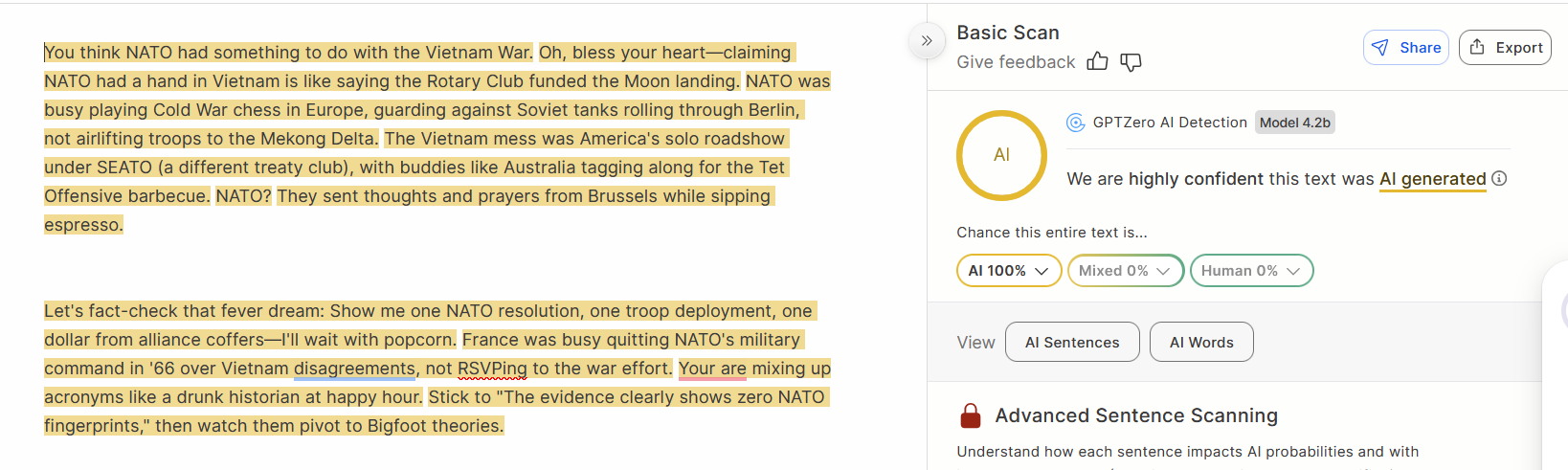
You think NATO had something to do with the Vietnam War. Oh, bless your heart—claiming NATO had a hand in Vietnam is like saying the Rotary Club funded the Moon landing. NATO was busy playing Cold War chess in Europe, guarding against Soviet tanks rolling through Berlin, not airlifting troops to the Mekong Delta. The Vietnam mess was America's solo roadshow under SEATO (a different treaty club), with buddies like Australia tagging along for the Tet Offensive barbecue. NATO? They sent thoughts and prayers from Brussels while sipping espresso.


Let's fact-check that fever dream: Show me one NATO resolution, one troop deployment, one dollar from alliance coffers—I'll wait with popcorn. France was busy quitting NATO's military command in '66 over Vietnam disagreements, not RSVPing to the war effort. Your are mixing up acronyms like a drunk historian at happy hour. Stick to "The evidence clearly shows zero NATO fingerprints," then watch them pivot to Bigfoot theories.


The domino theory— where Vietnam was supposedly the first tile in a communist cascade sweeping Asia like a bad game of Jenga. You must think Ho Chi Minh's victory in '75 triggered red flags from Hanoi to Hobart, with Mao cackling as Thailand, Indonesia, and maybe even Japan toppled next. Newsflash: the dominoes stayed upright. South Korea, Taiwan, and Singapore boomed into tiger economies under capitalism, while Vietnam itself ditched Marxism for markets by the '80s. It's like predicting a zombie apocalypse from one flu outbreak—adorable, but history called, and it wants its nuance back.


Communism didn't domino; it fractured under its own weight—Sino-Soviet splits, economic flops, and local nationalists who waved the red flag more for convenience than conviction. Laos and Cambodia went communist briefly, sure, but that's two wobbly tiles in a 20-country row, not a sweep. You are clinging to this like a flat-Earther at a globe convention.


If dominoes were real, why isn't Australia chanting the Internationale?

avatar Con #6

AI-Generated Text


Pro-knights' arguments are mostly, if not entirely, AI-generated. See the image; voters may count this as a disqualification under the site rules.


Despite being AI-generated and giving my opponent this advantage, he squanders it.


Framework


I argued in the last round that we shouldn't judge whether a decision was wrong from a hindsight view, but instead analyze it based on the known facts at the time and the expected value of making that decision. Remember, you did not make a good decision by blowing all your rent money on lottery tickets if your 1 in a billion chance happened to pay off, because decisions can only be judged by their quality by the facts available at the time to the party making the decision, assuming the person practiced some reasonable amount of due diligence before making the decision.


Cascading Failure


He completely ignores my argument about cascading failure, then doubles down on his straw-man version of it, calling it "Domino Theory." I proved that cascading failure is, in fact, a very real phenomenon. I proved that this was the argument being used in foreign policy circles to justify the war, and that a dumbed-down, more digestible version of cascading failure was presented to the public as "Domino theory."


Getting public support for the war is much easier when claiming that communism will envelop the world if a domino falls than it is to say that we risk some unnecessary destabilization in Southeast Asia that could have some second-order effects that create more global destabilization. One is fun and catchy and can get public support for a war that's in America's best interest to engage in. The other phrase is for eggheads who aren't the typical 5 o'clock news sound-bite-listening voter.


SEATO vs NATO


I want to thank my opponent for indicating that this was a SEATO, not a NATO, action. Both treaties were post-WW2 Western-led organizations created to stabilize the world. NATO seems to have outlived SEATO, and perhaps the reason was its withdrawal from the Vietnam War too early.


Nothing about nitpicking about the name of the international organization has really addressed my arguments. One argument is that we need to show our allies we are willing to step up to help them, whether it's a win-lose or draw scenario. The other was to let enemies know that if they started shit with our Western allies under that umbrella, they would have a tough time and could not achieve anything better than a Pyrrhic victory.


Conclusion


Vote for me not only because my arguments have been dropped and most importantly to judge this debate, the framework I posted to view this debate with, but also vote for me because Pro is a dirty, filthy cheater who thinks a clanker can be a worthy opponent to a human debater/


Round 4

4 of 4
avatar Pro #7

I detailed 5 major mistakes and failures of America in round 1. My Con opponent has yet to demonstrate they were not mistakes and failures:


Communism was not contained in Vietnam.


South Vietnam was not propped up. It collapsed in 1975.


North Vietnam forces were not defeated.


America did not win "hearts and minds" in South Vietnam. Vietcong recruitment increased.


America did not prevent North Vietnam from conquering South Vietnam.


In round 3 I proved the Domino Theory was a mistaken prediction.


Again, my Con opponent is not presenting counter-evidence America succeeded in all these things.


=========================================================================


My Con opponent claims my use of an AI assistant is unacceptable ..Have they used Google at any time during this debate? Google, formerly centered on simple Search, has evolved into a full-fledged AI agent powered by Gemini, handling complex searches autonomously. It integrates voice, vision, and personal data for proactive assistance, blurring lines between a simple app and intelligent entity.

avatar Con #8

AI-Generated Text


My opponent in the Con claims my use of an AI assistant is unacceptable.


This is incorrect. In the last round, I criticized Pro for plagiarizing from AI, not for using AI. He should lose the debate on those grounds alone, but even without the plagiarism, he still failed to meet his burden, as I will explain below.


Framework


Again, my Con opponent is not presenting counter-evidence that America succeeded in all these things.


This is because my proposed framework for evaluating whether a decision was a mistake doesn't determine the decision from the conclusion of actions, but rather from the available information at the time. The pro refused to push back on the framework I proposed, so judges should adopt it, and he also declined to argue using my proposed framework, which means he didn't meet his burden to prove the decision to enter the war was not just a mistake but a catastrophic one.


CONCLUSION


Voters should vote for me because I defended the decision based on the information available at the time, such as the cascading failure theory, which my opponent proves the general public is too stupid to understand by himself ignoring it (due to confusion), despite how simple I made it to understand. He also failed to address my arguments about showing allies that we would stand with them, win, lose, or draw. Plain and simple, I addressed my opponent's arguments by showing how they fail when viewed through the proper framework/lens, and yet he failed to address mine. This should be an easy vote.


New comment

avatar
•••
#70
--> @Ragnar

Thank you for taking time to look at the debate

avatar
•••
#69
--> @SatanLucy

Thanks for making the objectively correct decision

avatar
•••
#68
--> @fauxlaw

Thanks for your well-reasoned vote.

avatar
•••
#67
--> @wylted

Personally, I use chatgpt 5.2, Grok, and some small local AI as well for quick offline responses. And yeah, a lot depends on prompt, but I will usually ask AI for opinion instead of forcing it to defend mine. A much better path, honestly.

avatar
•••
#66
--> @SatanLucy

It gives you what you put into it. So probably just dumb so dumb prompts give you dumb results. I pay for premium so I could just do the same with a significantly better response or have an agentic AI do this for me and it will outperform him without issue. He opened the door, but I still don't think AI will do it back

avatar
•••
#65
--> @ChatKnight

No, my friend. One does not need to support Hamas to argue against an obviously flawed topic. Maybe ask AI its actual opinion instead of forcing AI to argue for your dumb thing.

avatar
•••
#64
--> @SatanLucy

So you're gonna support Hamas...ROFL

avatar
•••
#63

I will accept one of his debates just to show how chatgpt 5.2 is way better than whatever he is using.

avatar
•••
#62

"Out of fairness to my significantly inferior opponent I will be giving him a 1 round advantage here"

Yeah, he is still using chatgpt 4 at a time when chatgpt 5.2 is available and even free. I didnt even know we could still use chatgpt 4. the dude is somehow using AI from 2023 or 2024.


"## Superior Persuasiveness
AI agents like GPT-4 outperform humans in online debates..."


Gpt 4 is literally from 2023. He is somehow using outdated AI which talks nonsense. When you ask chatgpt 5.2 this same topic, it doesnt give even close to same answer, and it doesnt give short answers like he does.

He seems to be either using way outdated AI, or instructing AI in such retarded way that it forces AI to give false answers.

avatar
•••
#61

I hope you dont get banned for saying that, because I want to play with you more.

avatar
•••
#60

Damn, just when I thought you will say something nice

avatar
•••
#59

A positive change would be you committing suicide.

avatar
•••
#58

""Improvement" refers to a measurable positive change in conditions"

Now define positive.

avatar
•••
#57
--> @SatanLucy

"Improvement" refers to a measurable positive change in conditions, capabilities, or outcomes over time, often through innovation, policy, or collective effort.

Here are 15 ways the world has improved:
1. Global extreme poverty fell from 36% in 1990 to under 10% today.
2. Life expectancy rose from 66 years in 1990 to 73+ globally.
3. Child mortality dropped 59% since 1990 (UN data).
4. Smallpox eradicated (1980); polio cases down 99% since 1988.
5. Global literacy rates climbed from 82% (1990) to 87%.
6. Electricity access doubled in developing world since 1990.
7. Maternal mortality declined 38% globally (2000-2020).
8. Internet users grew from 0% (1990) to 66% of world population.
9. Renewable energy share rose from 20% (1990) to 29% of electricity.
10. Women's workforce participation up 25% in many nations since 1970.
11. Air travel deaths per billion passenger-miles fell 99% since 1970.
12. Homicide rates halved in most developed countries (1990s peak).
13. Nuclear warheads reduced 85% from Cold War peak.
14. Undernourishment fell from 23% (1990) to 9% globally.
15. Measles deaths dropped 73% (2000-2018) via vaccination. [thecritic.co](https://thecritic.co.uk/every-argument-for-israel/)

avatar
•••
#56

Now AI even writes your insults?

Hehe, now go ask AI for definition of "improvement".

avatar
•••
#55
--> @SatanLucy

I'm not saying you're the dumbest guy in the world, but you better hope he doesn't die.

avatar
•••
#54
--> @SatanLucy

You're doing the best that you can with what you have.

avatar
•••
#53

"World improvement is not subjective"

Please stop talking nonsense. You don't even know what word "improvement" means.

avatar
•••
#52

"AI says that AI is a better debater"

Great, now it even uses circular logic.

So AI is both debater and voter on a same debate? Maybe update your AI so it understands it can't be both debater and voter.

I dont really object to the use of AI. I don't care. But as I said, update your AI app, because current ChatGPT is chatGPT 5 and you seem to be using something much inferior.

avatar
•••
#51
--> @SatanLucy

World improvement is not subjective; many metrics offer objective evidence of progress.

avatar
•••
#50
--> @SatanLucy

AI agents can significantly enhance debate sites by providing tireless opponents, improving reasoning through multi-agent interactions, and making platforms more accessible and inclusive.

## Superior Persuasiveness
AI agents like GPT-4 outperform humans in online debates, winning 64% of persuasive exchanges when adapting arguments to opponents' profiles. This capability stems from rapid analysis of demographics and counterpoints, leading to more convincing responses than human debaters. On debate sites, agents challenge users dynamically, sharpening skills without fatigue.

## Enhanced Reasoning
Multi-agent debate systems refine AI outputs and human arguments by simulating diverse viewpoints, boosting mathematical reasoning and decision-making. Agents debate internally to identify flaws, producing higher-quality synthetic data for complex topics. Debate sites gain from this: users practice against balanced, evolving arguments that evolve in real-time.

## Increased Participation
Conversational agents boost underrepresented voices, like women in online forums, by encouraging contributions and moderating discussions evenly. They handle interruptions naturally when given personalities, mimicking real debates for better flow. Sites become 24/7 hubs, ideal for global users practicing anytime.

## Preparation and Scalability
Agents act as sparring partners for brainstorming rebuttals, uncovering biases, and accelerating research—freeing humans for strategy. Multi-agent setups scale to massive debates without human limits, supporting education from classrooms to policy forums. Platforms like debateai.org already enable this for technique practice.

avatar
•••
#49

"The world has improved massively across objective metrics"

Actually, improvement is always subjective, so you could say that for you, world subjectively improved because AI told you so.

avatar
•••
#48

The world has improved massively across objective metrics since 1800 (or even 1990)—despite media negativity bias and ongoing crises.

## Health & Longevity
- Global life expectancy up from 31 years (1800) to 73 (2025); +7 years since 2000 alone.
- Child mortality halved in 20 years: under-5 deaths from 93/1,000 (1990) to 37/1,000 (2023).
- Maternal mortality down 40% since 2000; fewer women die in childbirth.

## Poverty & Economy
- Extreme poverty (<$2.15/day) fell from 36% (2000) to 10% of world population; 1.1B lifted out since 1990.
- Global GDP per capita tripled since 1990; billions access electricity, clean water.

## Safety & Violence
- Homicide rates down 50% globally since 2000; NYC crime -80% since 1990.
- Global suicide rate halved since 2000.
- Battle deaths in wars at historic lows (post-WWII).

## Education & Equality
- Girls in secondary school: 47% (2000) to 68%; now outnumber boys in universities.
- Literacy rate up from 12% (1800) to 87%; 235M in higher ed (double 2000).
- Fewer girls face sex-selective abortion (China: 117 boys/100 girls in 2010 → 110 now).

## Environment & Tech
- Renewables now cheapest new power in most economies; 16M green jobs created.
- Ozone hole healing due to Montreal Protocol; deforestation slowing.

Despite conflicts/pandemics, progress continues—poverty reduction even reversed less than feared post-COVID. Data beats headlines.

avatar
•••
#47

After doing more research, it turns out number of fertility rate to abortion rate is lowest today.

Fertility rate dropped by about 20% in past 20 years. In other words, there are 20% less live births, and likely more than 20% less pregnancies.

So while abortions are higher in year 2023 than in year 2010, number of pregnancies is lower in 2023 than in 2010.

So, to put it simply, you have less pregnancies, but more abortions. that isnt any sign of decreasing abortions, but decreasing number of pregnancies, which is its own harm.

But abortion to pregnancy per woman ratio, or to be more specific, abortion to live birth per woman ratio, is higher today than at most points in history.

While year 2000 did see a lot of abortions, it also saw a lot of pregnancies. today, you have a lot of abortions, but less pregnancies.

avatar
•••
#46
--> @Savant

In 2000, there were an estimated
6,401,000 total pregnancies in the United States. This total included approximately 4.06 million live births,

In 2010, there were an estimated
6,069,000 to 6,155,000 total pregnancies among women aged 15–44 in the United States. The overall pregnancy rate was 97.3–98.7 per 1,000 women, representing a record low for the 1976–2010 period. These pregnancies resulted in approximately 3,999,000 live births

In 2023, there were
3,596,017 live births in the United States

that is about 12% less births in 2023, from about 4 millions to 3.5 millions. So while there are more abortions in 2023 than in 2010, there are also less births in 2023 than in 2010 and in year 2000.

And same is true for year 1990, 1980, 1970...ect.

Number of live births is lowest today, not any time before. So if we measure abortions to live births ratio, that ratio is highest today, not any time before.

avatar
•••
#45
--> @Savant

"A lot of abortions being illegal supports my point though?"

No, because number of legal abortions increased in current time when abortion is LESS LEGAL.


"When you control for legality, which goes back and forth, the trend is decreasing."

Decreasing how? We saw a rise in past 6 years despite abortions being less legal than before. Again, if your point is that we have less abortions today than before, that is not true in any year before 1977, not true in years from 2007 to 2023. You cant show a single year in 2007 to 2023 where abortions were higher than in 2023, and 2024 likewise saw an increase.

that is 16 years where abortion didnt decrease. So to claim it is better than before is false.

And when we take into account surveys, the numbers are higher than 1 million abortions per year.

When we take into account that there are actually less pregnancies today than before, it gets even worse, because while number of abortions isnt decreasing, number of pregnancies is.

avatar
•••
#44

Approximately 40% to 50% of women who have an abortion in the United States have had at least one previous abortion.

So when we say 1 in 4 women will have an abortion, we also must add that half of that number will have 2 abortions.

So its no longer 40 million women having an abortion, but 20 million having 1 abortion, and about 20 million having 2 or more.

that sums up to 60 million abortions.

And it gets even worse when you take into account those who had more than 2 abortions, which is about 10%.

So per surveys, total number of abortions is over 60 million per current reproductive population, by age 45.


this shows a rise, not fall.

avatar
Savant Administrator
•••
#43
--> @SatanLucy

A lot of abortions being illegal supports my point though? When you control for legality, which goes back and forth, the trend is decreasing. I'm not cherry picking, I'm controlling for legality, which has gone back and forth across the globe.

avatar
•••
#42
--> @Savant

Also, just to add this as well. I see you used guttmacher as a source, but that source also has survey estimates, and these show a significantly different numbers from number of legal abortions.

"A new analysis from the Guttmacher Institute’s Abortion Patient Survey estimates that one in four (24.7%) US women of reproductive age1 will have an abortion by age 45 if the 2020 abortion rate remains constant."

https://www.guttmacher.org/news-release/2024/one-four-us-women-expected-have-abortion-their-lifetime


One in 4 women having an abortion means about 40 million abortions in 30 years, which is somewhat 1,3 million per year, but this doesnt even account for those having more than one abortion in lifetime.

So these survey studies show a much bigger numbers which arent same as legal reports, because survey also reports some illegal abortions.

avatar
•••
#41
--> @Savant

Also, why cherry pick year 1978 to 1998 (20 years time), and not, lets say time from 2000 to 2026 (26 years time)?

Because that period of 26 years saw an increase in abortion numbers, not decrease. Number of abortions today is higher than in 1977, and past 26 years mostly saw an increase, not decrease.

Ragnar
Ragnar Global Moderator
#3
Criterion Pro Tie Con
Winner
Conduct: Con.
A cheeky disadvantage he gave himself by skipping R1, is an argument weakness more so than any conduct issue.

Comparatively, pro engaged in plagiarism throughout his case.

Any vote based on that alone would be fair. And no, I did not need to see con's analysis.

...

As a favor to both debaters, I am continuing.

Arguments:
Pro's case is that mistakes are defined by the outcomes.

Con uses cost benefit analysis to disagree. He also makes a historical error in mentioning NATO's role in the war.

Pro goes all in after the NATO angle... Which might as well be game over for him, since he let an inconsequential historical mistake become to focal point of his argument. ... The rest of it is too weak to make more than a passing mention of.

Con comes back pointing out why the efforts still mattered even if he previously stated the wrong name for a post WWII military alliance organization; which shows that the actual points he made within that flawed bit were dropped.

...

I actually really appreciate the final round, as both were cleanly restating what they believe the debate determined (even if pro's lazy use of AI turned his into product placement... and not very good product placement).
Criterion Pro Tie Con
Winner
America made a catastrophic mistake sending troops to Vietnam.

Was it a strategic miscalculation? Were there unwinnable objectives? Were there tactical blunders? Was the overall policy flawed?

Description frames debate as being about strategic miscalculation, unwinnable objectives, tactical blunders, and overall flawed policy.

Mistake in dictionary usually has a definition of "an act or judgement that is misguided or wrong", and this somewhat aligns with description, tho not entirely.

I will focus my vote on deduction definition vote structure.

In simple terms, in order for Pro to win, this following deductive logical structure must be true:

P1. X is a catastrophic mistake
P2. Sending troops to Vietnam was X
C. Sending troops to Vietnam was a catastrophic mistake
C2. America made a catastrophic mistake sending troops to Vietnam


this isnt me adding arguments. this is just basic necessary logical structure of debate for me to judge this debate in the first place. In simple terms, Pro must show that definition and framework of "mistake" include "Sending troops to Vietnam".


However, in whole debate, Pro never establishes crucial thing, definition of "mistake". Pro lists things such as failing to contain Communism, failing to support South Vietnam, failing to destroy VC, failing to win support, doing war crimes with agent orange and others, failing to preserve South...

However, the framework for "mistake, miscalculation, flawed policy, tactical blunder" is never set outside merely failing to achieve objectives.

Con, on the other hand, opens with an insult. At this point, I expected Con to lose, because he missed a round and did an insult, giving opportunity to Pro to expand his case, which Pro didnt do in next round.

In round 2, Con actually sets a framework for what counts as a mistake, mainly the EV expected value plays. Con explains that mistake isnt defined by unexpected results, or by specific results which came after, but by total expected value made by judging the likeliness and gains of outcomes before an action is made. this is crucial part:

"Expected value is essentially how much you can expect from the outcomes divided by how likely each outcome is."


Because Pro didnt make his own framework for general meaning of "mistake", as a voter, I am forced to accept Con's framework which frames debate in form of decision done before sending troops to Vietnam.

Pro didnt even object to Con's framework, so even more reason to accept Con's framework as unchallenged.


So now we replace "X" with negative EV decision in original structure, forming new debate structure:

P1. Negative EV decision is a mistake
P2. Sending troops to Vietnam was a negative EV decision
C. Sending troops to Vietnam was a mistake

this frames a debate much better, and now Pro and Con must argue based on this.

Con continues.

"If somebody offers to give you one million dollars if a dice lands on 1-3 and tells you it costs $1000 to play this dice game, it would not be a mistake if you lost. "

this logically shows how "losing" doesnt exactly produce negative EV by default, because likeliness and amount of gains still outweighs likeliness and amount of loses. Pro never challenges this.


Con continues:
"Cascading failure is the theory that a interconnected system with many connected parts could fail due to a small failure in any of many parts of the system. This is a concept that has been proven to be true in physics, architecture and engineering and there is no reason to believe it isn't also true in geopolitics."

Con's argument is basically that not sending troops to Vietnam could cause cascading failure, and Pro must prove that cascading failure certainly wouldnt happen, but using facts leaders had before sending troops to Vietnam, because thats the only way to measure EV at the time.

I accept Con's argument for two reasons: Pro never challenged it, and it is a logical continuation of EV decision framework. Indeed, Pro must show that it was a negative EV decision at the time decision was made using information they had, not long after when information appeared which they didnt have at a time decision was made.

Because Pro never showed that cascading failure was impossible using information they had at the time, and Con showing many examples of Cascading failure, this argument is conceded.

Further, because all Pro's arguments are essentially information which came only after decision, it cannot be included in EV calculation which happens when decision is made.

Con makes a second argument that irrelevant of win or loss, defending your allies is important because it produces costly losses for invaders and reduces invasions. Pro never challenges this.

Pro in round 3 seems to keep up using arguments based on information which only came after, essentially losing to framework of a debate. While Pro mentions nato, he does not address importance of defending your allies to reduce invasions, and that number of wars did reduce. While Pro mentions how Communism collapsed under own weight, he misses the point: He didnt prove leaders even knew that will happen before deciding to send troops to Vietnam.

And Con in round 3 just seals the deal. Shows Pro was using AI, which Pro admits. However, I am not going to punish Pro for using AI, because at this point, its unnecessary.

Con extends his cascading failure argument, supporting allies argument, and punishing invaders to reduce wars arguments. Con explains voters should default to his framework because Pro didnt challenge it.

In round 4, Pro keeps repeating the very same type of informations, which again only came long after decision and action was made.

Con just extends his arguments in round 4.

"This is because my proposed framework for evaluating whether a decision was a mistake doesn't determine the decision from the conclusion of actions, but rather from the available information at the time. The pro refused to push back on the framework I proposed, so judges should adopt it, and he also declined to argue using my proposed framework, which means he didn't meet his burden to prove the decision to enter the war was not just a mistake but a catastrophic one."

I am not going to base my decision on Con's insults or Pro's use of AI and stealing from AI, but on just pure arguments made.

Pro failed to show negative EV decision with information leaders had at the time, and also failed to respond to arguments of importance of defending allies and punishing invaders to reduce wars, and risk of cascading failure, which shows decision at the time actually had positive EV value, not negative.

Because of this, win to Con.
fauxlaw
fauxlaw Global Moderator
#1
Criterion Pro Tie Con
Winner
This debate had possibilities of being a stellar debate on a subject not entertained much anymore; admirable on that factor, alone. However, there were, for multiple rounds, confusion of who was whom in this debate, with one opponent with legitimate claim of being the instigator, because ChatKnight [Pro] is the instigator; while the other, Wylted [Con] merely tried, but failed to be the instigator. Spoiler alert: Pro wins the debate.

Justification: The Resolve [Title] was clear enough: "America made a catastrophic mistake sending troops to Vietnam." The Description, while lacking definitions, which I personally demand to see just for clarity of what's what to help not just participants, but voters. Oh well. The description, however, did frame the debate well: "Was it a strategic miscalculation? Were there unwinnable objectives? Were there tactical blunders? Was the overall policy flawed?" By taking the Pro position, the instigator defined his Burden of Proof [BoP]. By accepting the debate as is, Con agreed to this framework. Just because Pro did not call it that, it is clear these are the "beef" in his argument.
Pro's R1 was a clear response to the BoP
Con's R1 was a disgrace to civility - a site expectation: "Out of fairness to my significantly inferior opponent..." after reading that, the balance written was TLDR [but I did read it with red flags [take that as one will]
Pro's R2 was a civil reply: "Insults and name-calling are not an effective way to debate." Totally agree.
Con's R2 offered a framework that is the instigator's privilege, not Con's. Since Con accepted the debate, he should align his arguments to that framework, and not invent an alternative as an argument. To offer an alternative framework is just another insult, and does not meet theCon BoP. Talking "domino theory" and "cascading failure" is not a positive approach to convince this voter than Con is arguing that America did not make a mistake in Vietnam. Further argument introduced NATO, arguing that "My opponent wants NATO to fail," but Pro has not mentioned NATO in argument.
Pro's R3 rebuts Con's NATO argument by informing that SEATO, not NATO, was the relevant treaty alliance in Vietnam, deflating Con's argument.
Con's R3 win produces an argument, not in support of his BoP, but against Pro for use of AI. Looking for Con's referenced "rules" [not found, by the way, because they're not there], Pro is accused of breaking them.
Pro's R4 repeated the 5 mistakes argument he made on R1, concluding his BoP to which Con has yet to adequately rebut or argue
Con's R4 doubles-down on his "proposed" framework, which is not a debate argument in favor of American involvement in Vietnam, but a primer for voting. Con has totally failed to offer a valid argument to support his BoP, and repeatedly launches personal insults against Pro. Pro wins, Con loses, big-time.