Pro argues that protecting civil liberties is more important than national security when the two are in conflict, while Con argues for the converse. Because there is no clearly rooted status quo, the burden of proof is shared.
Definitions
civil liberties
fundamental individual rights and freedoms protected from government infringement.
national security
the protection of a state and its population from internal and external threats.
Based on the 2026 NSDA LD National topic. Democratic governments are often required to balance the protection of individual rights with the need to ensure national security. While having both is ideal, the two often come in conflict, such as the question of whether to erode privacy protections in order to monitor potential domestic terrorism. As such, debaters may explore the fundamental value of civil liberties and national security, as well as how they are best achieved and upheld in practice.
I’m going to do something a little unusual at the top here and situate the debate in a broader context. Topics in this vein are not new here in 2026. Between the NSDA, Lincoln Douglas debates, the NCFL and the NDCA, this topic has gotten a tremendous amount of play over the last couple of decades. I've covered a lot of topics over the years in speech and debate tournaments and debating online, but this will be my first time covering it, and it is a daunting task. How societies set the balance between liberty and security is a fundamental question, and in particular, how democracies set that balance cuts to the core of what a democracy is, not just what it should prioritize. Democracies cease to be democratic in the absence of civil liberties, yet a democracy without security cannot persist.
The topic says “prioritize… when the two are in conflict.” Neither side in this debate is arguing an absolute: we both recognize the need for liberty and security in democracy, we simply disagree over how to approach the conflict between these two priorities. We are, effectively, establishing different tiebreaker rules with the aim of showing that our priority (civil liberties for me, national security for Con) should be considered paramount in a majority of instances where they conflict.
The “ought” in the resolution signifies a moral obligation rather than realization through policy, so the focus of this debate won't be on a single model or plan, but on a set of principles. Especially given the wide variety of democracies that exist, we are less focused on the how and more on the why. Taken in aggregate and assuming democracies are moral agents, which of these should be prioritized?
Onto my argument.
2. FRAMEWORK
My framework is protecting democratic integrity. Democratic integrity encompasses a number of elements inherent to the democratic process, namely electoral process, political pluralism, government functioning, expression and belief, associational rights, rule of law, and personal autonomy, and protecting it demonstrates a country’s commitment to resilience, fairness and transparency, preventing and addressing threats of corruption and disinformation. Failings in any of these elements of the democratic process risks a collapse of the very concept of democracy for a nation.
Why does democratic integrity matter to this debate?
First, democracies must continue to exist as democracies for this resolution to even be sensical.
Second, democratic standing is mutable, i.e. it’s possible to become less democratic. I mentioned the differences between liberal democracy and electoral democracy, as well as the myriad criteria a government must meet in order to even be called a democracy.
Third, losses to civil liberties decrease democratic standing, deteriorating a country’s democratic standing and driving it further away from liberal democracy. The loss of or harm to elements that make up a democracy increase its fragility and, thus, can lead to the transition away from democracy.
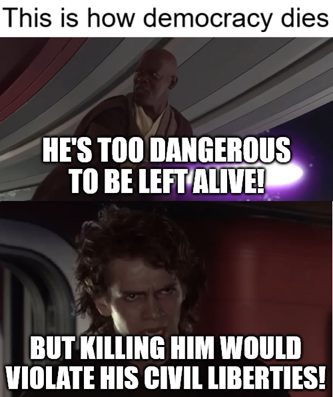
3. THIS IS HOW DEMOCRACY DIES
Yes, I do like my Star Wars quotes.
I mentioned up top that this topic has gotten a lot of play over the years, which begs the question: why is this topic being revisited by NSDA in 2026? The tension between liberty and security has always been an important one, but that doesn’t mean that the challenges are always the same. The main case study I’ll focus on for this debate is the United States, which I think we would all agree both meets the definition of a democracy and has experienced substantial changes in how it establishes the balance between civil liberties and national security in both recent history and the present. Given the hefty resources and access to modern technologies the US brings to bear, it also functions as a blueprint for how other democracies can and might behave in the modern era and into the near future.
A. Artificial Intelligence (AI)
Governments wield a variety of tools to enforce security, one of the most recent being AI. From data collection to facial recognition to tracking movements, AI has made the process of monitoring the public easier and faster than ever before. And governments, particularly the US government, have made thorough use of the technology, building on an established surveillance state.
The impacts of these efforts are already well-established. Government surveillance efforts like these result in measurable self-censorship, quashing freedoms of speech, association and press in the process. Freedom of assembly is similarly chilled by AI surveillance, and the people most affected are those who have the least power to do anything about it, harming everyone from the press to labor to the right to protest.
And it goes beyond abusive application of AI. Under the pretense of addressing national security emergencies, the Federal Bureau of Investigations has engaged in rampant abuses of the Foreign Intelligence Surveillance Act (FISA), resulting in searches of multiple government officials, journalists, political commentators and some 19,000 donors to a political campaign. Policies like FISA don’t just disappear when the emergency leaves, either, meaning that while perceived national security threats may be resolved, the loss to civil rights persist.
C. Effects on democracy
The result of these efforts and others have led the US to being reclassified by multiple agencies that track democracies’ statuses worldwide. These include:
V-Dem Institute: reclassified from a liberal democracy to an electoral democracy in 2026, losing that status “for the first time in over 50 years” and continuing to deteriorate “at unprecedented speed.”
Polity Project: reclassified as a “non-democracy,” demonstrating how fragile that classification is, in 2025.
EIU Democracy Index: reclassified to a “flawed democracy” since 2016, from which it has continued to decline.
Freedom House FIW: experienced a greater decline than any other country classified as “free” apart from Nauru and Bulgaria over the last two decades.
The US may just be one of the most prominent examples of this, but it demonstrates the problem with preferring national security over civil liberties: each abrogation of these rights results in a greater degree of slide away from what makes a democracy. Whether that’s the loss of suffrage, free and fair elections, or even complying with court orders, we’ve seen what administrations like this become.
D. Rise of authoritarianism
Many of the countries that have sacrificed the civil liberties of their people on the altar of national security can hardly be called democracies anymore. Whether it’s Russia adding over 15,000 new names to its “terrorist/extremist” list including 150 children, China claiming counterterrorism is its reason for mass detention of the Uyghurs, or the all-too-common efforts to silence dissidents documented in 54 countries, these represent countries taking it too far with national security and minimizing civil liberties, becoming full-on authoritarian and eschewing the basic tenets of democracy.
4. CONCLUSION
At bottom, my goal is not to convince you that the US is becoming an authoritarian state. That’s neither the topic nor the purpose of my argument. Rather, my goal is to demonstrate that this slide away from liberal democracy has become a bigger and more urgent issue over the decades. As technology has advanced and countries have discovered more ways to enforce national security aims, it has become increasingly easy to do so with greater harms to civil liberties, resulting in an increasing number of fragile democracies sliding towards autocracy.
The loss of civil liberties isn’t vague or intangible. Enforcing national security to the detriment of civil liberties can and often does have drastic impacts, warping a democracy into something decidedly undemocratic. It is only by putting civil liberties first that we ensure that democracies continue to exist in practice and not just in theory. We cannot possibly save democracy by trading away the liberties that define it.
This debate concerns instances where national security and civil liberties are actually in conflict, not just allegedly in conflict. Just because a politician says a policy will help national security doesn’t mean I need to defend that policy; just because a politician says a policy will infringe on civil liberties doesn’t mean Pro needs to oppose it. Politicians are notorious liars. For the sake of analogy, the Democratic People’s Republic of Korea (North Korea) calls itself a democracy, but neither Pro nor I would be expected to defend the Kim regime just because we support democracy.
“majority of instances”
This isn’t strictly about the number of instances where one principle is better as not all instances are equal. Cases where there are more civil liberties or national security at stake (like the fate of the entire government) should carry more weight than lower-stakes instances. Basically, we are arguing which tiebreaker rule is more sustainable and leads to better overall outcomes, taking into account the significance of each of those outcomes. If it was just about frequency, then the way we count up “instances” would basically be arbitrary. Is 9/11 one instance? Or a separate instance for each building?
National Security
Just as not every minor convenience is a civil liberty, not every problem in a country threatens the population or state sufficiently to be a national security threat; as Pro does not provide a standard for this, I will do so here. We should identify a national security threat as a credible adversarial force, such as an invading army, massive cyber-offensive, or large-scale insurgency, which threatens significant long-term harm to democratic institutions such as a parliamentary body or the court. National security threats concern threats to a country’s survival or citizens’ long-term access to basic rights; not every isolated act of violence qualifies. It was originally envisioned as protection against a military attack; even if other things can threaten national security, a national security threat must be one that systemically disrupts the state. By definition, a national security threat must jeopardize the stability of the nation as a whole, rather than threatening only a small region. For instance, monitoring for terrorist attacks would be a national security measure if the group is capable of inflicting mass casualties or disrupting infrastructure critical to democratic institutions, but not if the group is a small, local crime gang, or if the people being monitored are all clearly innocent.
Framework:
“democratic integrity / democracies must continue to exist as democracies”
I accept democratic integrity as the framework with a few stipulations. First, it is paramount that the “institutions that enforce [democracy]” which Pro values exist long-term; sacrificing liberty temporarily to ensure elections can be held in the future upholds democratic integrity. Second, personal autonomy presupposes the continued existence of the democratic state; in a dictatorship, individuals cannot truly be “free,” as rights require a democratic government to guarantee them. Per the social contract, the government is expected to restrict some liberty and autonomy in exchange for long-term protection.
Just to reiterate, the scope of this debate is when civil liberties and national security are actually in conflict, not when a politician claims they are in conflict. As Pro implies, tracking US citizens who protest and weaponizing the DOJ and FBI for political purposes aren’t advancing national security interests. Hence, just because my position is that national security takes precedence over civil liberties doesn’t mean my position defends those policies, since they don’t actually advance national security.
If the idea is that the term “national security” can be abused and used to defend abusive policies, then the same could be said about the concept of “civil liberties.” Once upon a time, the Confederate States effectively declared that owning slaves was a civil liberty—that doesn’t mean it’s actually a civil liberty that Pro has to defend. Similarly, the resolution only forces me to defend legitimate national security efforts. As I have specified, this means a credible adversarial force, such as an invading army or massive insurgency, which threatens to permanently topple or sever fundamental democratic institutions.
Pro’s might be saying that even legitimate national security efforts are a slippery slope and will lead to departments being abused, but this kind of “potential slippery slope” isn’t unique to my case. Pro acknowledges the “need for [security in democracy],” so presumably under his system we would have an FBI and DOJ as well or some federal agency tasked with security. Trump could still come in and abuse the FBI and DOJ just as easily under Pro’s system. And focusing on civil liberties is equally vulnerable to abuse by bad actors. The Law Enforcement Officers Bill of Rights is intended to support the civil liberties of cops, but it has been stretched to effectively shield abusive cops from punishment.
“abuses of the Foreign Intelligence Surveillance Act (FISA)”
Pro cites the Brennan Center, which states that backdoor searches have no significant national security value and argues for requiring warrants for searches. But this supports my argument—in cases when spying sacrifices civil liberties and has no national security benefit, defer to civil liberties. But if the two are actually in conflict, choose national security. As the article states, “warrant requirement proposals all include reasonable exceptions designed to accommodate legitimate security needs.” In other words, even if we reform the system to prevent abuse, when there are legitimate security needs, those should take precedence. And even if we stuck entirely to warrants, the whole point of a warrant is to determine when the security need outweighs the usual right to privacy.
These countries operated as autocracies and not democracies even before the recent detainments Pro mentions. China has been a one-party dictatorship since Mao took power in 1949. Putin has been the effective dictator of Russia for over a decade. That puts the actions of China and Russia outside the scope of the resolution, which strictly concerns democracies. Pro would likely assert that democracies will follow a similar path if they prioritize national security, but this is just an assertion; China and Russia are not supporting evidence for their argument.
Con’s Topicality breaks down to 3 separate challenges, so I’ll tackle each individually.
A. “Topicality”
Despite how Con labeled this first section, this is more of a mini Kritik of the subjectivity used by governments when defining “national security.” I’ll come back to this.
B. “majority of instances”
Con wants to weigh impacts based on the relative significance of the outcomes. That’s fine. Note that significance is an aggregate, one that considers a variety of actions taken in defense of national security and civil liberties.
C. National security
This is a Topicality… against the debate itself. The definition for national security that he is challenging is in the setup above my argument: “the protection of a state and its population from internal and external threats.”
Con argues that the debate should solely focus on existential security threats. That is over-limiting. His Wikipedia article defines it much more broadly:
Isolating and defining the term “national” does not change that context. The term clearly applies to threats to any part of a country. Con cannot arbitrarily collapse the scope of this debate to suit his narrative, nor can he challenge a definition that isn’t up for debate by either side.
2. Counter Standards
Con doesn’t present a standard for his Topicality, so I will provide two: reasonability and coherence.
For reasonability, the definition provided at top encompasses everything in his sources, whereas his own definition clearly nixes several listed examples from his Wiki article. My opponent clearly responds to my arguments and provides his own under the broad definition, so he can argue it just fine. He should accede to the definition at the top of the debate.
For coherence, unlike Con’s definition, the broad definition comports with the tiebreaker rule. Con acknowledges that there must both be a conflict between national security and civil liberties and that choosing one over the other results in a comparable loss (the latter implied by his argument that some stated national security concerns are “not real,” i.e. extremely minor or nonexistent threats). Yet, his framing of national security pushes the threat to the extreme, while he actively acknowledges that the risk to civil liberties is far lower and time-constrained. Only the broad definition allows for a coherent discussion of instances where the tiebreaker must be considered, whereas Con’s definition only considers a subset of cases where the tiebreaker does not apply.
3. Framework
We basically agree on democratic integrity as our framework. Con inserts asides about how losses of liberty can be impermanent and recognizing that some loss to liberty is a given in the social contract. Both points swing both ways. Not all security threats are existential nor are their consequences everlasting, and as I will show, some losses of liberty can also be existential. Regarding the social contract, it establishes rules by which liberty can coexist with security and order and recognizes the need for some trade off. It does not make liberty subservient to security.
4. Re: Guarding from Existential Threats
This boils down to one point: in cases where there is an existential threat to a nation, a comparatively smaller loss to civil liberties (whether that’s a military draft or suspended elections) is justified.
As I’ve said from the beginning of this debate, neither of us are required to argue absolutes. I can recognize that, when faced with an existential threat, nations should choose national security over civil liberties. It’s no contest. Similarly, any instance where a country is faced with an existential threat to their democracy via loss of civil liberties, I think we’d both agree that civil liberties should be prioritized. Case in point:
All these were justified by arguing that it promoted national security. We can each recognize that an argument for either national security or civil liberties should always be preferred won’t stand up to pesky things like wars, military coups or autocratic takeovers. These are existential threats. The choice is obvious. There is no tiebreaker because there is no tie to break.
5. AI misuse / Mission creep and abuse
Con’s point about the subjectivity of national security threats is very selectively applied. The legislated deployment of AI for tracing targets has security as its chief aim, yet he points to the very mission creep I’m citing here, says it has expanded its reach to cover groups that aren’t threats, and dismisses the entire argument as non-topical. He’s wrong. The consequences of mission creep resulting from a decision made for the purpose of national security do not magically erase said purpose. It’s still national security.
Contrary to his claims, Con is not required to defend all instances of mission creep, but he is required to weigh the benefits of national security policies against those harms. By contrast, while he talks about abusing the “concept of ‘civil liberties,’” his only example bears no resemblance. Some might have framed owning slaves as a civil liberty, but that clearly prioritized the liberties of one group (slaveowners) over another (slaves), placing significantly more onerous restrictions on the far larger population. It’s civil liberties vs… civil liberties.
Similarly, Con suggests that leaders could abuse federal agencies in a world where civil liberties are preferred, but his examples do not balance civil liberties and national security. They balance civil liberties of the police against those of the public that they harm. If anything, police have qualified immunity to ensure that security officials are not subject to the courts (i.e. favoring security over civil liberties), the same courts I’ve argued are essential to all civil liberties, not just theirs.
Con claims I must defend the January 6th, 2021 attack on the capital. The right to protest does not imply a right to violent, destructive protest aimed at forcibly invalidating election results. Civil liberties vs. “civil liberties.” And no, I don’t have to defend Trump using his pardon power to negate a court opinion. Once again, functional courts are essential to all civil liberties. They have to be maintained and empowered. These pardons undermined the courts that found them guilty.
Their methods are clear and the link between national security measures aimed at centralizing, unleashing and empowering national security apparatus is established. Cause and effect. Con points to economic solutions as optimal, though international standards for trade don't fall cleanly into either civil liberties or national security. They ensure both.
7. Rise of authoritarianism
Con’s right: we should focus on countries that experienced documented declines in democratic standing before slipping into autocracy.
Pro never really addresses my point that the debate only concerns cases where national security is actually at stake. The definition he’s pointing to for national security is “the protection of a state and its population from internal and external threats.” So if a policy isn’t addressing actual threats against the state and its population, the policy is not national security and I don’t have to defend it.
“reasonability and coherence”
I’m fine with using reasonability; we should be defining topicality by whether there was a clear path for a measure to address a national security threat at the time of passage. (The type of threat could be economic security or environmental security, but the policy needs to have a clear path to address it.) Something like “forming the CIA” qualifies, but “targeting political dissidents to secure absolute power” does not. This isn’t preventing Pro from making arguments: the measure doesn’t have to be “good” or even “justified” to be topical; it just needs to have a clear path to securing the nation. And Pro has room to argue that a policy secured the nation but the cost to civil liberties was too high, but it’s inaccurate to classify a measure as national security if it was never in a position to secure the nation.
It’s incoherent to just go by the branding of a policy; what if one politician says it will help national security and another says it will harm it? It’s also not reasonable to count isolated violence like a single stabbing or small crime group as a national security threat; even if a national security threat occurs in a few parts of the nation, it must threaten the stability of the nation as a whole (e.g. 9/11) to be relevant on a national level.
It’s reasonable to discuss wars when national security originally referred to military attacks. The trade-off between civil liberties (with the draft) and national security (with invasion) in wartime is at its most significant. Pro claims there’s “no tie to break,” but there’s still room for Pro to argue against the draft or just argue that wartime isn’t the highest aggregate impact, so including existential cases doesn’t prevent a debate from being had.
What Pro specifically stated in R1 was “we both recognize the need for liberty and security in democracy.” None of this implies that existential threats are outside the scope of the debate. An absolute would be saying “only civil liberties matter.” Pro doesn’t have to say that, but they do have to defend civil liberties as preferable to national security when the two are legitimately in conflict; otherwise they are conceding the resolution.
“I can recognize that, when faced with an existential threat, nations should choose national security over civil liberties”
The resolution is looking at cases “when [national security] and [civil liberties] are in conflict.” Suspending elections and drafting people during war is a major example of this; Pro cannot accuse my definition of national security as being “too limiting” and then pretend this conflict doesn’t include wartime cases. Pro describes conscription as a “comparatively smaller loss to civil liberties,” but it is still a significant loss; basically being sent to die in a war you might not support. Pro is basically conceding that individuals can be stripped of all civil liberties and sent to die if enough national security is at stake—this is a huge concession that is fully within the scope of the resolution.
Finally, stating “when faced with an existential threat, nations should choose national security over civil liberties” is a broad enough concession that it basically negates the resolution. If the security of a nation is at stake, how can judges determine whether the existential risk is “big enough” to arbitrarily exclude from the debate? And the policies Pro gives as marketed at “the purpose of national security” are typically marketed as protecting from “existential threats”—if Pro is looking solely at the aim or marketing of a policy when determining if it’s addressing national security, well surely the “sales pitch” of the policy is to stop a major threat with a “comparatively smaller loss to civil liberties.” If the branding is all that matters with regard to topicality, then Pro is pretty much conceding all of these policies; things like scope creep become irrelevant.
“an argument for either national security or civil liberties…won’t stand up to pesky things like wars, military coups or autocratic takeovers”
First, if autocratic takeovers count as an exception, then discard Pro's points about Trump/Putin/Orban and government overreach in general (i.e. Pro’s entire case). That said, I’m against throwing out significant examples as Pro is trying to do (the real reason Pro’s examples are nontopical is that they were power grabs that didn’t secure the nation, not because they are “pesky” cases). If either of us can ditch data points just because they’re inconvenient to one side (i.e. “the choice is obvious”), we’re not having a debate anymore.
Second, sure, some cases might be more convenient for one side or the other, but that’s why we should be considering all instances weighted by the relative significance of outcomes, which Pro agreed to; this gives either of us room to argue our aggregate outcomes are more significant. That said, I’ve shown (and it’s largely gone conceded) that existential threats like wars are clearly the biggest impact. Pro didn’t have to concede that, but he did.
Rebuttals:
“mission creep/said purpose [of these policies is] still national security.”
Pro is ignoring several responses I made in R1 about mission creep being nonunique. Pro acknowledges the need for security, so presumably under his system we would have an FBI and DOJ, and Trump could still come in and abuse them. And focusing on civil liberties (such as with the Law Enforcement Officers Bill of Rights) is equally vulnerable to abuse by bad actors. Passing legitimate security policies isn’t forcing anyone to pass illegitimate security policies; a corrupt leader can come in and pass illegitimate security policies anyway.
“Section 702/DOJ/FBI…Those are security aims”
The sources Pro cites basically argue that the government is doing these things for purely political reasons despite having good evidence they don’t help national security; the part of the bill Pro’s source is criticizing is that it enabled collection of Americans’ data and didn’t prohibit querying through it; querying random citizens’ data had no clear path toward securing the nation at the time of passage. Hence, allowing the querying of Americans’ data wasn’t a “failure of national security” any more than the DPRK is a “failure of democracy,” since North Korea’s design had no connection to democracy in the first place. It may have been passed alongside other policies that did advance national security, but overreach could still be tacked on to any bill in Pro’s world; it’s not unique to my case. The legitimate national security measures didn’t cause the problem.
Pro acknowledges that something being marketed as a civil liberty (like owning slaves or Jan 6th) does not mean he has to defend it, if it actually involves violating civil liberties. Similarly, if these policies are politically-driven power grabs that make the people less safe and secure as Pro implies, then I shouldn’t have to defend it either.
“Effects on democracy”
Pro is cherry picking here and misrepresenting his sources; they aren’t really attributing democratic decline to prioritizing national security over civil liberties. “Undermin[ing] anticorruption safeguards” is a national security threat, not prioritizing national security. V-Dem lists a whole host of authoritarian policies from firing Inspector Generals to pardoning J6ers. Trump erroneously branding part of it as “national security” is neither the cause of the corruption nor essential to it; he could just as easily call pardoning J6ers the “civil liberties” act. EIU blames “staff cuts” and “politically motivated dismissals” but does not mention national security, nor does the video Pro links to.
“abusing the “concept of ‘civil liberties,’”...clearly prioritized the liberties of one group (slaveowners) over another (slaves).”
That’s kind of my whole point. Abusing the concept of civil liberties does not imply the person doing so is actually defending civil liberties. Similarly, Putin and Orban saying their measures help national security while they endanger the nation is not actually defending national security. If Pro only needs to defend things that are actually civil liberties, then I only have to defend policies that actually protect the nation and population from internal and external threats.
“Putin/Orbán/Erdoğan/Poland/Venezuela”
Again, Pro’s case is that these power abuses don’t actually secure the nation despite being marketed as national security. A dictator seizing power does not make the population safer. When national security is actually at stake, such as during an invasion like WW2, then Pro is willing to prioritize national security over civil liberties.
So this has become a mostly semantic debate and things have gotten messy, so let’s break it down.
1. Overview
Despite Pro’s R1 redefining of the term (he doesn’t return to it in R2), it’s apparent that we largely agree on what defines “national security”: it's the broad definition, the same one at the top of this debate. Pro just says that the threat must be large enough to not just be a stabbing or small crime group and that associated policies have to be in a position to address it. Agreed.
We also agree on the basic meaning of “in conflict.” We established that anything we discuss must include a trade-off between national security (NS) and civil liberties (CL). There also must be a tiebreaker - both of us used the term - which implies the existence of a tie to break in the trade-off.
There are two major points of conflict between us:
First, identifying what suffices as a conflict between NS aims and CL.
Second, establishing which conflicts are subject to a tiebreaker rule.
2. Identifiable conflict
Con arguing that there has to be a conflict between actual, identifiable NS aims and CL. If I can demonstrate that my examples are built on demonstrable NS concerns, then his argument that these are “purely political” fails. And I already have.
These are established NS aims (harms to the state and population) that these policies and restructurings were put in place to address and they come at the cost of CL.
Con isn't responsive to much of this. He argues that politicians make shit up, but that doesn't demonstrate that these threats are manufactured, nor do his WBEZ or Brennan Center sources. Con drops my argument that the consequences of mission creep resulting from a decision made for the purpose of NS do not magically erase said purpose. The policy is still NS, and the resulting mission creep is thus still a harm of NS policy. Con claims that mission creep is nonunique, citing qualified immunity as an example. Setting aside that he never spells out the degree of harm resulting from law enforcement being shielded from punishment (“your side does it too” does not establish that they have similar weight), this isn’t CL mission creep. Con doesn’t point to a policy this expanded from, just claiming this is an extension of CL generally. Even that isn't clean, as qualified immunity is a clash within CL, one where the harms to CL are greater for both their victims (the public) and the courts that they disempower. Con tries to argue that there can be similar clashes of NS aims, though he begs the question of what those policies are and where the clash is.
3. The tiebreaker rule
We agree a tiebreaker rule exists for this debate. This rule implies the existence of a tie to break, i.e. there must be some trade-off between NS and CL that is, at minimum, arguably similar.
Why does this matter?
Con’s main contention is titled “Guarding From Existential Threats.” An existential threat is one that threatens the existence of the nation, which tracks with military invasions and other massive offensives. Con's stated trade-offs are time-limited CL harms like suspension of elections and conscription, which are necessary to address the existential threat. These obviously don’t erase democracy because they are impermanent and are reversed after the existential threat is dealt with. Their negative impacts are not existential.
Existential vs. non-existential. These are not tied priorities. If it isn’t a tie, there is no tiebreaker, therefore it’s not relevant to the debate. It is not sufficient for there to be a conflict between NS and CL because that's not the only consideration. It doesn’t matter if “there’s still room for [me] to argue against” these impositions because this is a clear imbalance. Con’s arguments point to discrete durations for the drafts and suspended elections and mention “occupation,” “invasion,” “toppl[ing]... democratic governments,” and “global stability.” These aren’t time-limited and they aren’t easily reversible, they are absolutes.
Voters, you decide. If you buy Con’s perspective on both these issues, then voters should compare our existential, imbalanced threats to NS and CL, both of which result in a complete loss of democratic integrity. Existential threats equally affirm and negate the resolution, so it would be a tie. If you buy my perspective on both, then my case stands and existential threats should be eliminated from consideration in the debate for failing the tiebreaker requirement.
With that in mind:
5. My case
I focused on the US as a case study for NS vs. CL because it represents three facets that are central to this topic:
1. A country with a fragile democracy that is currently losing standing as a democracy
2. A government making active decisions between NS and CL and often siding with the former
3. A government using modern tools that will become the norm for countries worldwide going forward
Con’s arguments against my case challenge the second point, arguing that the trade-off is with something other than NS. I will summarize my case and explain how this challenge fails.
I pointed to relevant examples of AI being deployed for this purpose, particularly where it was used in concert with other agencies (ICE, DOJ, FBI) and legislation (FISA). I laid out last round how all these agencies and FISA were tasked with addressing known NS threats. I also included instances where the effects of deploying AI have gone well beyond their initial bounds and how that has resulted in self-censorship, harms to freedom of assembly,privacy and speech. These are all consequences of the mission creep resulting directly from the focus on NS over CL.
Con claims similar mission creep happens with a CL focus with his only surviving example being law enforcement (see my response to qualified immunity above). He cites a couple of sources that broadly claim the NS aims of these policies and agencies are solely political, ignoring my sources that provide specific examples of known NS threats they address. They do support NS over CL. Con refusing to defend them concedes the point.
C. Effects on democracy
I laid out the reasons why three of the organizations I listed - V-Dem, EIU and Freedom House - agree that the focus on NS policy aims over CL has led to democratic backsliding in the US.
Con responds by pointing out that these articles don't explicitly point to NS policy, ignoring the links I've already established between what the articles mention and the NS policies I've covered.
I’ve demonstrated that figures like Putin, Erdoğan, and Chávez were all elected and/or empowered by legitimate NS threats. Con had conceded the very real threats that elevated them to authoritarians, solely focusing his attention on those they concocted later.
Taken together, this showcases a democratic slide towards authoritarianism. Con could have argued that this risk is acceptable to prevent existing threats that the NS threats that FISA, the FBI and DOJ are designed to address, but he chose not to. Thus, the established risk is solely that democratic slide. This affirms the resolution, showing why protection of CL should be prioritized using a clear and appropriately conflicting case study of the US.
“the threat must be large…not just be a stabbing or small crime group”
Note that the only metric for determining if the threat is “large enough” is the one I provided: the threat must jeopardize the “stability of the nation as a whole.” Pro provides no alternative metric for this, so defer to mine.
“must include a trade-off between national security (NS) and civil liberties”
The only metric for judges to use to identify a “trade-off” is mine: the measure itself needs to have a “clear path for a measure to address a national security threat” (as I stated in R2 and Pro cold conceded), or it’s not topical. (It’s not enough for a national security threat somewhere to exist and a politician to name drop it.) Note that Pro makes the same case for civil liberties. If something is a “clash within CL” like qualified immunity, Pro reasons it’s a net negative to civil liberties, so he doesn’t have to defend it. Similarly, even if a measure does improve security for some people and address an actual threat, if it’s a “clash within NS” and is in a position to make the nation less safe overall, I don’t have to defend the measure.
Which Impacts Are More Significant?
As Pro wisely stated in R2, “Con wants to weigh impacts based on the relative significance of the outcomes. That’s fine.” Pro never weighs our impacts, so defer to my weighting here.
Even if you did buy that some of the issues Pro brings up are the result of legitimately prioritizing national security (and not just politicians pretending to do so), his impacts are at most limited to a 3-point democratic decline in the US (out of 100) and potentially aiding Putin/Erdoğan/Chávez politically by some unknown amount (Pro doesn’t attempt to measure how much, and given the preexisting coups and violent crises Pro references in those countries, their baseline state was pretty undemocratic to begin with). Even if these impacts were as pressing as mine, they affect significantly fewer regions and people. However, as I will show, Pro’s case for these impacts lacks a factual basis.
Are Existential Threats Topical?
“a tiebreaker rule [implies] there must be some trade-off between NS and CL that is, at minimum, arguably similar”
The rule does not imply the stakes must be similar for national security and civil liberties in the cases we compare. If it is found that in most instances, choosing national security leads to much better outcomes than civil liberties, Pro can’t just exclude those cases because “the stakes aren’t similar.” National security being more important in most cases is precisely what I am arguing. My single use of the term “tiebreaker” in R1 was explicitly stated to be about “leads to better overall outcomes, taking into account the significance of each of those outcomes,” which was agreed on by Pro. That is, when one choice is winning on NS and one choice is winning on CL (the “tie”), which value wins?
Pro says the trade-off needs to be “arguably similar” but never gives a metric or cutoff for what counts as “arguably similar.” As I mentioned in R2 (dropped by Pro), how can judges determine whether the existential risk is “big enough” to arbitrarily exclude from the debate? Existential risk is a probability and thus exists on a sliding scale. And it’s not like you could have “50 units of civil liberty at stake” and “50 units of national security at stake,” because they’re categorically different things, and Pro never proposes a unit to compare them. If Pro is just talking about importance, as in “the CL and NS at stake in each example must each be equally important,” well then that just defeats the whole point of the debate, because the resolution asks us to prioritize one over the other (i.e. determine which is more important). You can’t control for the variable you’re trying to measure.
“[existential threats] are absolutes.”
As I said in R2, the only “absolutes” that Pro gets to avoid addressing would be something like “national security is never important.” An existential threat is still a conflict and thus still within the scope of the debate per the resolution.
Do National Security Measures Cause Harm to Democracy?
A persistent pattern here is Pro identifying a politician doing some national security measure, and then also doing a separate abuse that they market as “national security.” However, in none of these cases does Pro ever establish that the legitimate national security measure somehow caused the additional abuse of power. Second, both Pro and I acknowledge the need for legitimate national security measures, so even if it were the case that legitimate national security could lead to later abuses of power, that risk isn’t unique to my case. Third, even if Pro had argued the abusive measures themselves actually furthered national security in some small way, lying and endangering civilians clearly makes the populace less safe overall, so at most they would still be a “clash within NS” that I don’t have to defend.
At best, Pro’s argument is that measures with a clear path to secure the nation could lead to civil liberty violations down the road (and I dispute the cause and effect as I’ve said). But these initial legitimate national security measures aren’t in conflict with civil liberties, hence even if we prioritized civil liberties over national security when the two were in conflict, we would still be taking these initial national security measures (as Pro acknowledges the need for security), and scope creep would remain just as likely. Pro doesn’t propose abolishing the FBI or CIA or oppose targeting terrorists or oppose using AI specifically to target terrorists, because none of those things inherently conflict with civil liberties. If the risk is that these things could lead to scope creep, how exactly does Pro’s world avoid that? He never says how, nor does he specify which (if any) of these legitimate national security measures he would avoid in fear of scope creep.
“never spells out the degree of harm resulting from law enforcement being shielded from punishment…this isn’t CL mission creep.”
The point isn’t the amount of current harm being done; it’s that a civil liberties bill could just as easily be used as a means to tack on corrupt policies. Let’s say Pro found that Congress was sneaking corrupt policies onto bills that also help national security. Even if that were the case, I’ve shown that Congress is also capable of sneaking corrupt policies onto civil liberties bills (like the Law Enforcement Officers Bill of Rights), so deprioritizing actual national security wouldn’t solve the issue.
“Effects on democracy”
Pro cites “dysfunction/executive dominance” (one of many factors listed by their source) but never actually establishes how much of this “dysfunction” consists of national security measures; even if national security was leading to some dysfunction, Pro never quantifies how much of that dysfunction overlaps with the dysfunction mentioned by their source. V-Zem does mention “justify[ing] measures as necessary for national security,” but it’s a passing mention in an article filled with dozens of different factors. And the implication by the phrasing is that national security is simply the “sales pitch” for these repressive measures; attacking civil rights and “weaponizing social issues” isn’t actually protecting the country from threats, it’s just pretending to. And finally, neither Pro nor his final source links “reduced transparency” to national security.
Vote is huge because I did point by point voting, and this debate has plenty of individual points, forcing me to either throw out points from consideration at all or make vote bigger, and I chose the latter. Tho summary of vote is at the bottom of the vote in "conclusion" section.
Shitting out this vote was a pain in the ass. If you have any objections to any parts of vote, say so and I will update my vote if necessary. this vote gave me a headache, and its probably one of most difficult votes I ever did on this site.
I will have my vote up today or tomorrow. this is the only debate left to vote on, so I am forced to vote on it to gain those vote badges, or wait until someone else fills remaining 2 votes, which could take too long so I am just gonna vote.
Yeah uh if win conditions themselves are part of debate, that requires even more win conditions for that part of debate. So I am gonna just go with self-contradiction or self-defeat or case proving opposite case, if I vote on this one. I don't really see other way right now to judge this debate by, so I will just apply what is standard in coherence generally.
The win conditions themselves were part of the debate, so you might have to judge the meta-debate before you can judge the contentions themselves. Don't want to say too much more about win conditions in the comments since it would effectively be a continuation of the debate.
This debate didn't really set up clear win conditions in description, other than having both security and liberty is ideal. So I gonna need some time to think of victory conditions, and also first what both debaters agree on. I think every debate should have pre-determined win conditions before voting.
Tho I don't think I gonna vote on this one, this is just in case cuz voting is random and I want to ask in advance. If I do get assigned to this one, it's a tough vote, and I gonna need to first clarify with both debaters on what they both agree on to judge this debate by, so no issues related to judging standard occur.
If I get assigned to vote on this debate any time in future, I need to know if threats to national security which would destroy a nation count as part of debate or not. Cuz it's kinda important issue, and I am not sure if it counts in the debate which chooses between freedom and security, not survival or death.
I think you captured the main flow/clash of the debate effectively. I agree a lot of it came down to how the resolution was interpreted and our disagreements over that. Obviously I'm biased due to being a participant though, and since voting's still open I'll leave my thoughts at that.
>Reported Vote: Kohai // Mod action: Removed >Voting Policy: https://www.debatecraft.com/debates/vote-rubric >Voted for: tie >Reason for Decision: other >Reason for Mod Action: test
Yeah it's a new change as of like a week ago I really should have been more clear on. I know people were kind of using the feature to just get to the debate they wanted to vote on, but that also kinda defeats the point of it which was to prevent vote bombing by not letting ppl choose the debate they vote on. I trust Lancelot obv and I could go in and revert it for now if needed, but at some point if not now it's gonna need to be like this to prevent vote-bombing/targeting controversies.
Depends though cause he could be assigned to this one or intend to vote on all the debates anyway. But that's why I would tell new voters "make sure you will be able to dedicate enough time for reading and voting in the next 3 days before you click assign debate." Cause in theory in the future when there's like 100 in the voting stage, you'll have no idea what you're gonna vote on.
At this point I think it might not assign you a second debate if you're already assigned to one. The whole "randomly assigned debate" thing is to avoid alt accounts vote bombing on a specific debate, though it could probably be more clear.
That said, if it assigns you a different debate and you vote on that one, then you it can assign you another one.
Go to your account. You'll see a bar up top that, on the far right, says "Badges", click that. It'll bring you to a page with a button that says "Find a Debate to Judge". It will randomly assign you as a judge to one of the Ultrarated debates that still needs a vote. If it's not this one, just go back to this page and try again. You are not required to vote on every debate you are assigned to, there is no penalty for letting the 3 day period run out.
A lot of this debate depends entirely on how "threat" is defined. Obviously, anyone can consider anything a threat. So the debate is more about what "threat" is than anything else. Because obviously a threat which destroys a nation for sure is gonna be taken as priority. The threat which poses a slight risk of someone getting harmed? A lot less so.
This debate is, in my opinion, won by the Pro side.
Both agree that national security is a must, same goes for civil liberties. In order to ensure a democracy by definition, by definition, it comes down to a division: what is the most important, what weighs the most, and Pro makes a pretty strong case:
In the end, Con didn't really address the definition of democracy, so it remains true that democracy is defined by civil liberties.
"To get more democracy, one should seek to maximize CL", so even when suspension is in the game, we should weigh CL as the ultimatum.
The win of this debate was solely, i believe, dependant on definitions and the abuse of NS wasn't addressed by Con, conceding a lot to Pro.
The Rise of Authoritarianism and the example of the use of A.I in the US with I.C.E were real clever exemples that really suited Pro's case. In R3, Con shows a flaw in actual application, despite a strong example with 50+ countries.
On the tiebreaker argument successfully shows that existential threats both arent a choice between CL and NS, and at same time both CL and NS can be used to argue for addressing existential threats ->
Star wars quotes with the death of democracy was quite smart.
If we had to resume, in a bit of.a messy way, Pro had almost all of the definitions, Con had some exemples, but wasn't adressing the topic as an Idea of Democracy but sliding onto safety to suite their case.
So, by the actual concedings and vagueness of application and tiebreaker, I will give it to Pro, but in my opinion both cases were really close and strong.
Pro says, CL can be used to argue for addressing existential threats ;
Con doesn't really offer a lot of defense against this, and description does say "prioritize civil liberties when two are in conflict"
Pro's position matches description better, because even description says its a "choice between CL and NS", not NS and end of democracy. So existential threats are basically NS vs. No NS and No CL, or from CL point of view, long term CL vs. No CL and no NS. On this point i very much Agree with SatanLucy.
What i found unfortunate is that both side had the opportunity to strengthen their case yet they used a lot of their time rephrasing and repeating themselves and their previous arguments, especially R3.
On the behalf of exemples, Con. On logical consistensy, projection, and actual definitions, Pro.
I was hoping not to have to vote on this debate, but there are no other debates to vote on.
Victory conditions were not set up in description, and some definitions are lacking too, thus I will set victory conditions myself based on debate title.
Victory condition 1
Pro needs to prove that at least in above 50% of cases, liberties are supposed to be chosen over national security.
Con needs to prove that at least in above 50% of cases, national security is to be chosen over liberties.
Both debaters agree that liberties and security are both good, so neither is arguing for choosing one over another in 100% of cases. thus, what remains is, when the two are in contradiction, which gets chosen more, because topic is on balance.
I dont think there is much to disagree with with this victory condition.
Another additional factor is significance of individual cases, but for that, debaters will need a measuring system to establish significance, or else I default to mere number of cases and probabilities.
Victory condition 2
Logical deduction by definition/observation
Because debate is about democracies, I will obviously be accepting all unchallenged deductive arguments which show that democracy leads to specific conclusion regarding resolution or survives better when prefering liberties over national security, or national security over liberties, as long as first premise of those deductive arguments is observation, unchallenged definition, or just logical law.
I will also be accepting any unchallenged deductive arguments which show logical necessity for preference of liberties over national security, or national security over liberties, using definitions, observations or just logical laws as foundation premises.
these victory conditions are just necessary for me to judge arguments by, because arguments need to be weighed, and that requires a standard (victory conditions) which separates winning argument from losing argument.
Conditions for rejecting arguments
If argument is not a relevant observation, deductive logic, or following of logical law, as a voter I reserve right to reject that argument on the basis of irrelevance, even if same wasnt challenged in a debate.
Also, when choosing between observations supported by sources vs observations lacking sources, I will always choose observations supported by sources.
When it comes to arguments in last round, they must be built upon foundation premises from previous debate rounds. Coming up with new frameworks, new foundations in last round where opponent can no longer respond to them is also considered basis for rejecting those new arguments. this is merely to prevent last round cheating.
Unchallenged arguments
All relevant unchallenged arguments, deductions, definitions and observations will be treated as true. Delaying counters to round where opponent can no longer respond to them will weaken strength of those counters.
Moving to arguments now. I will break arguments into two sides Pro and Con, their goal segments, just to enable easier following of arguments.
Pro's arguments list
Definition of democracy
Pro opens the debate by pretty much defining democracy in a way so that democracy prefers more civil liberties, autonomy...ect.
this definition tells me that democracy is obviously supposed to prefer to have as much civil liberties as possible to exist long term in a democracy.
this definition is not challenged by Con, thus it is considered true.
Pro's framework
Pro's framework is basically that:
Democracies by definition include liberties, because democracies require voting and will of majority, and these depend upon liberties such as expression of belief, individual autonomy, associational rights, because will of majority also depends on disinformation being effectively combated.
Death of democracy
I appreciate the star wars quote. I think its actually quite on point.
AI and mission creep
the argument here is about AI. AI enabled massive monitoring, which I assume is argument regarding violation of privacy, privacy being one of liberties. Mainly, the argument talks about possibility of establishing surveillance state resulting from prefering national security over liberties.
One example is that US government used excuse of stopping migrations to reduce civil liberties, even bypassing warrant requirement. Another example is politically-targeted surveillance, which actually harms democracy.
Con counters this by saying debate is about when civil liberties and national security are actually in conflict, not when politicians say they are in conflict, and that Pro's examples werent examples of actual national security threat.
Con seems to concede that national security can be used and abused, but says same applies to civil liberties, such as example of slave owning being declared a civil liberty, as well as abusive cops being shielded by civil liberty.
Con says that Pro's own source says surveillance without warrant in that case was not a national security threat, not legitimate one at least.
"in cases when spying sacrifices civil liberties and has no national security benefit, defer to civil liberties. But if the two are actually in conflict, choose national security."
Pro responds by saying consequences of choosing national security do not magically erase choosing national security.
Pro says all things he listed were done for specific justification of national security, and that problem of inefficiency of choosing national security is problem of Con's case. Con must weight these obvious harms which result from choosing national security, and cannot ignore them.
Says that Con's example of slave owning is just one example with no relevance because its civil liberties vs civil liberties, not civil liberties vs national security.
Says that Con's example of police immunity is actually example of prefering security, and that its not a case of liberties vs national security, but civil liberties vs civil liberties.
Con responds by saying Pro is ignoring responses about mission creep being nonunique,
that same applies to people abusing civil liberties, and that Pro has conceded a need for security.
Con says that Pro's own source says those cases (of FBI, DOJ...) werent legitimate national security threats, and were done for political reasons.
Says that its not a failure of national security any more than DPRK is a failure of democracy, since it has no connection to national security in same way DPRK has no connection to democracy.
Legitimate security measures didnt cause the problem, according to Con.
Says that if Pro doesnt have to defend slave owning just because it was labeled as civil liberty, he doesnt have to defend fake national security threat excuses.
Pro says Con effectively conceded link between AI and NS on creating surveillance state, and this resulted in harms to freedom assembly, free speech, and other foundations of democracy.
Says his sources clearly mention national security threats.
National security definition
By Pro, national security covers both internal and external threats.
US losing its democracy value
Pro lists number of sources of agencies which have moved US lower on democratic scale due to US removing civil liberties to enforce national security.
Con responds by saying Pro's case is assertion, not actual cause and efect, and that Pro's own source says democracy and national security are mutually dependent. Also that Pro's own source says increasing democracy value would require restricting economic freedom and free trade.
Pro responds by saying trade standards ensure both security and liberty.
Con also says Jan 6 attacks were threat to democracy, which means there is actually too little national security, and pardoning rioters on basis of civil liberty led to more violence.
Pro says Jan 6 is likewise civil liberties vs civil liberties, and that courts found those people guilty. Not a case of civil liberties vs national security.
Pro responds by saying that his own sources say how a loss of points in democracy measuring was caused by limiting free expression and undermining anti-corruption, as well as targeting civil liberties under excuse of national security threat, and how targeting civil liberties helps autocratizers consolidate their power.
Con responds by saying Pro's sources are misrepresented by Pro, and that his sources dont claim democracy is being lost due to choosing national security over civil liberties.
Says that undermining anti corruption is not protecting national security, but destroying it. Also says very same excuse of "national security" could be replaced with "civil liberties" excuse when pardoning Jan 6, so excuse of "national security" is not essential to corruption or its cause.
Also says that Pro's source actually does not mention national security.
Con extends his point on slave owners by saying if Pro doesnt need to defend abuse of term civil liberties, Con does not need to defend abuse of term "national security".
Pro extends his case of US losing democratic value due to prefering NS, and says his sources actually do mention national security threats.
Extends his sources by linking what they say about national security of FISA, DOJ, FBI...ect.
Rise of authoritarianism
Pro lists examples of countries which have stopped being democracies after choosing to use national security as excuse for removing civil liberties. Examples are Russia and China using terrorism claim (significant threat to national security) but misrepresenting it in an absurd way to the point where it ruined their democracy.
Con responds by saying Russia and China were never even democracies to begin with, so they fall outside scope of this debate.
Pro responds by saying Putin, Viktor, and Erdogan all used national security to remove individual liberties, and thus eliminate opposition, and consolidate their power.
Pro says that all falling democracies have followed path of reducing civil liberties.
"We cannot possibly save democracy by trading away the liberties that define it"
the argument here is that democracy by definition becomes less and less democracy the more civil liberties are removed.
Con responds that these cases (Putin and others) dont actually secure the nation, make the nation less safe actually, so its actually opposite of achieving national security.
Pro extends his case here that country losing standing as democracy is more often choosing NS over CL.
Pro says he demonstrated that authoritarian figures were all prefering NS over CL, and all were empowered by it.
Con argument list
Actual national security
Con starts by saying that topic is not about what politicians say national security is, thus he has no obligation to defend the misrepresentations of national security.
Likewise later extends that topicality is only about actual cases of national security threat, not misrepresentations of it.
Majority of instances
Con raises argument that number of instances isnt the only factor, but also importance of those instances.
Pro counters by saying significance is actually also a sum of parts, thus is expressed in numbers (or not logically expressed at all).
National security threat definition
Con defines national security threat as something which threatens democracy and population sufficiently enough, such as invading army, massive cyber offense, large scale insurgency, or terrorist attack capable of causing harm which disrupts the state, democracy, and even individual liberties.
So if something does not threaten country's survival, democracy's survival, or very liberties and rights of citizens, it does not qualify as national security threat.
Pro counters by saying definition is already provided in debate description, and is not up for debate, also provides definition link of Con's own link which defeats Con's definition.
Pro also counters by saying Con didnt provide a standard for his topicality, so he provides two, reasonability which contradicts Con's definition, and coherence, which says that tiebreaker must logically result in loss of either civil liberty or national security when choosing between two, and the extreme cases dont apply because they dont have that.
Con counters this by repeating that its inaccurate to classify meassure as national security if it was never meant to secure the nation (population and democracy), and that policies need to have a clear path towards national security and addressing national security threats.
Con further says that its incoherent to go by just branding of a policy, and that small threats dont logically equal to threats to nation as a whole.
Con says that national security originally referred to military attacks, so it is not unreasonable to discuss existential threats.
Pro says Con never returned to his R1 redefining term, but that they agree what national security is, a broad term.
Pro continues on tiebreaker argument.
Pro extends his case by saying Section 702 was used to prevent actual security threats, DOJ likewise, and thus it is example of actual tiebreaker.
Repeats that actions done for purpose of national security dont erase that purpose magically, and above examples were actual examples of tiebreaker, thus resulting harms from NS are still harms from NS.
He also says police immunity is actually example of reducing civil liberties.
Pro's framework
Con accepts democratic integrity, while arguing that sacrificing liberties when necessary to uphold democracy itself, is mandatory for democracy to exist at all, and thus, for more liberties to exist long term because people in non-democratic nations arent free.
Pro argues that some losses of liberty can also be existential threat, and not all national security threats are existential threat.
Guarding from existential threats
Con makes examples of Russia, China attempting to destroy democracies, and thus a response against them is to prefer national security over civil liberties.
He also shows example of South Korea mandating 18 months of military service, a reduction in liberties, in order to survive a threat from North Korea, and thus ensure more civil liberties long term.
Same for taiwan.
Also example of Ukraine suspending voting, and forcing conscription to counter an authoritarian state, saying same could be neccessary in rest of Europe as well.
Makes same example of UK during WW2, as necessary measures of suspending civil liberties temporarily to enable the very survival of democracy.
Pro responds by saying existential threat requiring removal of some civil liberties is justified, as well as that existential threat caused by removal of civil liberties means upholding civil liberties there is justified. No contest, true.
Shows examples of Poland and Venezuela using national security as excuse to suspend civil liberbies, and as result, worsening democratic value.
Pro says that tie breaker only applies when there is tie to break, not when choice is between death or national security, or death or civil liberties, because neither of those are choices between national security and civil liberties, as for example, not choosing national security in a do or die scenario doesnt actually result in civil liberties.
Con responds by saying most of Pro's impacts are limited to US, questions if US efforts are genuine national security efforts.
Repeats claim about many wars globally, and that autocracies have become more repressive at home and more aggressive abroad, actively attempting to destroy democracies, thus are existential threat.
Says that existential threats are not outside scope of this debate, even if neither debater is arguing for absolutes.
Con says that Pro conceded that individuals can be stripped of all liberty and sent to die in a war they might not even support, and that this is a huge concession.
Con also says conceding that nations should prefer suspending civil liberties when faced with national security threat is essentially a concession in debate, and that judges cannot reasonably decide what counts as big enough threat to be excluded from debate scope.
Says Pro's policies are actually marketed as protections against existential threats.
Says if autocratic takeovers count as exception, all points Pro made about Putin, Viktor, Erdogan, trump are then likewise discarded, also says Pro's examples are powergrabs that didnt secure the nation, thus not examples of national security.
Pro extends his case of countries ceasing to be democracies by crackdown on civil liberties, under excuse of national security, implying that its more often the case that national security is misused, which shows practical issues when prefering it over civil liberties.
Important argument: tiebreaker
Pro extends his tiebreaker argument by saying there has to be a tie in the first place for there to be a tiebreaker. Existential threats are not a tiebreaker.
Claims that addressing existential threat by temporarily reducing civil liberties is necessary to save democracy, and by extent, civil liberties which Pro claimed can only exist in democracy. So existential threats addressing can also be argued from a point of prioritizing civil liberties.
Extends that existential threats actually result in complete loss of democratic integrity, thus they effectively suspend both NS and CL of democracy.
Con responds to this by saying that the only metric for determining if the threat is large enough, which for national security must be, is his metric of existential threat.
Con argues that the only metric to identify a trade-off is his, a clear path to address and identify a national securty threat.
However, Con never addresses the actual tiebreaker argument and CL side of existential threat, in a sense that suspending CL in existence vs. non-existence scenario is not a choice between CL and NS in democracies, it results in neither for a democracy, it suspends democracy, and CL can likewise be used to argue for existential threats as NS can, because not eliminating existential threats reduce CL.
So Existence vs. non-existence (existential threat scenario) is actually not a choice between CL and NS, even if I was to accept Con's argument that only he provided way to measure national security threat.
Even if I were to accept Con's argument that national security threat is only an existential threat, it would merely make topic incoherent because choosing between dying and NS is not a choice between NS and CL.
As Pro says, CL can likewise be used to argue for addressing existential threats.
Con doesnt offer enough push back against this, and description does say "prioritize civil liberties when two are in conflict".
So Pro's position matches description better, because even description says its a choice between CL and NS, not NS and end of democracy (and by extent, end of civil liberties). So existential threats are basically NS vs. No NS and No CL, or from CL point of view, long term CL vs. No CL and no NS.
If I were to accept Con's view on this issue, topic would effectively become incoherent truism of Con's side, and thus a tie due to incoherence.
But description doesnt define national security threats as existential threats, and defining it that way doesnt prove Con's case, but merely collapses the topic and forces a tie.
If I were to accept Pro's case, then by observations, authoritarians prefer NS in more cases, by deductive reasoning reducing CL reduces democracy which is defined by CL, so my conclusion from Pro's case is that democracy by definition must maximize CL.
"That is, when one choice is winning on NS and one choice is winning on CL (the “tie”), which value wins?"
the problem in this claim, made by Con, was already previously addressed by Pro.
In case of not addressing existential threat, no one wins.
Addressing existential threats doesnt actually require prioritizing NS over CL.
Con does a bit of final point in round 3, that existential threat is a probability.
But the same issue applies to probability too. It doesnt actually force prioritizing NS over CL, if probability is high enough, one can perfectly well use CL priority to argue for addressing existential threats too, as Pro implies in previous round, and removing CL still removes democracy as well, so it suspends both CL and NS of democracy.
Neither Con nor Pro said what probability is enough to suspend CL temporarialy, and suspending them permanenty obviously suspends democracy by definition.
But Pro did say CL can be suspended for temporary period, if it means restoring them later, because end result is survival of democracy, and with it, CL.
So NS isnt the only side one can use to argue for addressing NS existential threats.
"even if we prioritized civil liberties over national security when the two were in conflict, we would still be taking these initial national security measures"
this statement by Con applies to existential threats, so I am not sure how someone can even prioritize CL without addressing existential threats.
to me, this confirms obvious existential threats are outside this debate topic, because both sides can address them irrelevant if they prefer CL or NS, and Con in the end seems to agree with statement that prefering CL can also address existential threats and be taking national security measures.
Weighing impacts
Despite Con's claims of only him having weighed impacts, I dont see any weighing system established by any debater, at least not expressed in numbers of CL vs NS.
Con did make a case of 59 countries involved in conflicts, even more beyond their border, and that those countries must sacrifice some CL to address existential threats, but the issue rises in amount of non-existential threats vs CL.
Neither debater showed any numbers of how many CL were suspended vs how many CL werent when choosing between CL and NS, and Con's case largely depends on existential threats which at this point I cant accept as part of topic.
Con does make a case that Pro didnt actually prove that legitimate NS threat resulted in abuse of power, and claims that illegitimate NS abuse of term is actually conflict with NS itself.
Says Section 702 of collecting American citizens data was a separate issue from targeting foreign adversaries.
Same for AI, separate issue.
Con seems to concede that identifying apartment bombers by Putin was a national security measure, while separate measure by Putin was not.
Same for Erdogan, separate measures of NS and endangering NS, same for Venezuela.
Conclusion:
this debate was a logical mess, and for most of the time, debaters were arguing about what even is topic of debate.
As mentioned in win conditions, any unaddressed definitions are effectively conceded and considered true.
Con didnt address definition of democracy, so it remains true that democracy is defined by civil liberties, and having more of those actually means more democracy, as Pro later said.
thus, to get more democracy, one should seek to maximize CL, so even in cases of suspending some CL to ensure NS, it can be done for aim of maximizing CL long term.
Con seems to agree that examples of authoritarian regimes which Pro mentioned did also use both legitimate and illegitimate NS threats, as means to empowerment.
What I get from these examples is that NS threats, even if legitimate partially, are weaponized by authoritarians, which shows a practical issue in application of NS preference properly.
Same does not exist against Pro's case. No example by Con given of an authoritarian country weaponizing civil liberties to secure dictatorship on any large scale.
the only two examples were Jan 6 and police immunity, which is a much smaller scale compared to fact that trump weaponized NS in more examples given by Pro.
So from this I conclude, if you seek to establish an authoritarian regime, its probably much better to focus on NS excuses, and abuse of NS excuses is terribly easy, while democracy by definition focuses on civil liberties, so maximizing them is preferable in democracy.
Con simply didnt do enough to address actual abuse of term NS in practice, and how this abuse is actually effectively separable from legitimate NS in practice.
If certain idea carries a much higher chance of being misrepresented and abused, it does show a flaw of idea in a practical application.
tiebreaker argument successfully shows that existential threats both arent a choice between CL and NS, and at same time both CL and NS can be used to argue for addressing existential threats.
So on observation probabilities and deductive logic of democracy definition, and tiebreaker, I will give points to Pro, and thus a win in debate.
Con does successfully show many examples where CL need to be reduced to address existential threats, but this isnt enough to win a debate when those very existential threats are questioned to even be part of debate, as debate description didnt say existential threats, and as mentioned by tiebreaker argument, existential threats arent a choice between CL and NS.
Whiteflame - Framing: The system has a moral obligation to prioritize civil liberties over national security. The main value is democratic integrity, which is defined by several principles.: Electoral process, political pluralism, government functioning, expression and belief, associational rights, rule of law, and personal autonomy. Betrayal of any of these principles causes democracy collapse.
Democratic integrity is a main value because democracies must continue to exist as democracies for the resolution to be semantically consistent. Compromising these civil liberties diminishes the level of democracy that remains and shifts away from. ICE, Federal Agencies, and AI have been violating people’s personal freedom all in the name of conducting a political investigation. And this invasion of freedom doesn’t stop, just because the problem being investigated goes away. And the people most affected are those unable to do anything about it.
The countries overriding civil liberties in exchange for national security have become living examples of tyranny & authoritarianism.
Pro is not arguing that the US is becoming an authoritarian nation. Pro is arguing that the potentiality for authoritarianism becomes a real threat, when preserving basic individual rights is exchanged for a securer country.
Savant - Savant’s first argument brings up a hypothetical of where policies are ACTUALLY in conflict and not allegedly. And argues making decisions based on verification, rather than blindly accepting something at face value.
Savant pushes back against whiteflame’s framing, rejecting the broad angle and the moral framing. He calls out whiteflame’s careful wording, and reframes this discussion as not being about quantity, but rather which rule can produce more ideal outcomes. With careful consideration of all the circumstances.
Savant establishing what a national security threat means successfully undermines whiteflame’s appeal to principle. As Savant argues that it is only a security threat, if it threatens the safety of the nation. Framing - Savant points out that Pro’s principle of democratic integrity is acceptable, but that the rules must consider the big picture of the ultimate goal being survival long-term, which requires temporarily forfeiting certain privileges for this big picture.
Savant exposes whiteflame’s examples as not being legitimate threats to national security and invalidates them as being unrelated to the actual position he is defending.
Savant wins round 1.
Round 2
Whiteflame - Whiteflame begins round 2 by accusing Con of attempting to redefine the established definition of “national security” and of restricting the scope of what Pro is allowed to argue.
I appreciate that Pro doubles down here. He is indirectly defending his previous examples as being on-topic. Framing Con as attempting to limit the scope, while justifying that his broad framing is the only version that actively abides by the definitions is a clever tactic here. What Pro is basically doing here is saying that Con is shifting the goalposts in a way that makes Pro’s side impossible to argue.
By referencing the status quo, whiteflame essentially points out that the debate is referring to some tradeoff being a requirement, but that liberty is not a slave to security.
Pro’s rebuttal acknowledges that in extreme cases, national security should be prioritized over civil liberties. But the reverse is also true. Pro is establishing a pattern here. He is indirectly calling out Con for cherry-picking certain cases for which the tiebreaker does not apply.
Con - Con brushes off the attempted reframing of what he’s supposed to argue by pointing out that Pro’s earlier examples do not address threats to the state, so do not constitute national security. And ultimately establishes the reason he is not required to defend these. Now what I like about Con’s refutations here is he defines a clear standard. Verification. He uses Pro’s own words against him, arguing that it is neither reasonable nor coherent to take a politician’s words at face value of what constitutes a security threat if it doesn’t threaten the stability.
Con pushes back on Pro’s claim that there is no tiebreaker by arguing Pro still has room to argue, but doesn’t strongly refute this.
Essentially, this debate isn’t won by deciding who is right. But rather whose interpretation of the resolution more closely follows the rules. And for this reason, Savant’s framing wins over whiteflame’s for several reasons. Savant sets a strict standard for only threats to the stability of the state or the state itself count as threats to national security. Whiteflame tries stretching himself too wide, but doesn’t give enough support for why his examples constitute trade-offs between civil liberties and national security, when Savant points out there was no proof that national security was ever at risk anyway, despite Trump claiming so. While whiteflame counters that Savant is arguing only absolutes, he still fails to provide strong examples for his own case. And since this is on-balance, Savant is the only one who backs up his arguments with concrete sources. Round 3 focuses on repeating the arguments they made in the previous rounds and doubling down on anything that was said before. I like whiteflame’s use of Star Wars quotes and the meme that Savant uses at the end.
I do genuinely believe whiteflame could have won this if he approached this differently, but Savant works a lot harder to establish his impacts. And this victory is by a landslide.


 Pro
#1
Pro
#1