
I always wanted to become a kung fu master, but problem is that it takes years of training and learning, and being best at it is almost impossible.
But then I realized I can just invent my own kung fu and become master of it immediately, and I am also best at it because I am the only one who knows it.
I called this kung fu "Snake Ha Hu", and I am now the official grandmaster of this kung fu style because no one else even knows about it.
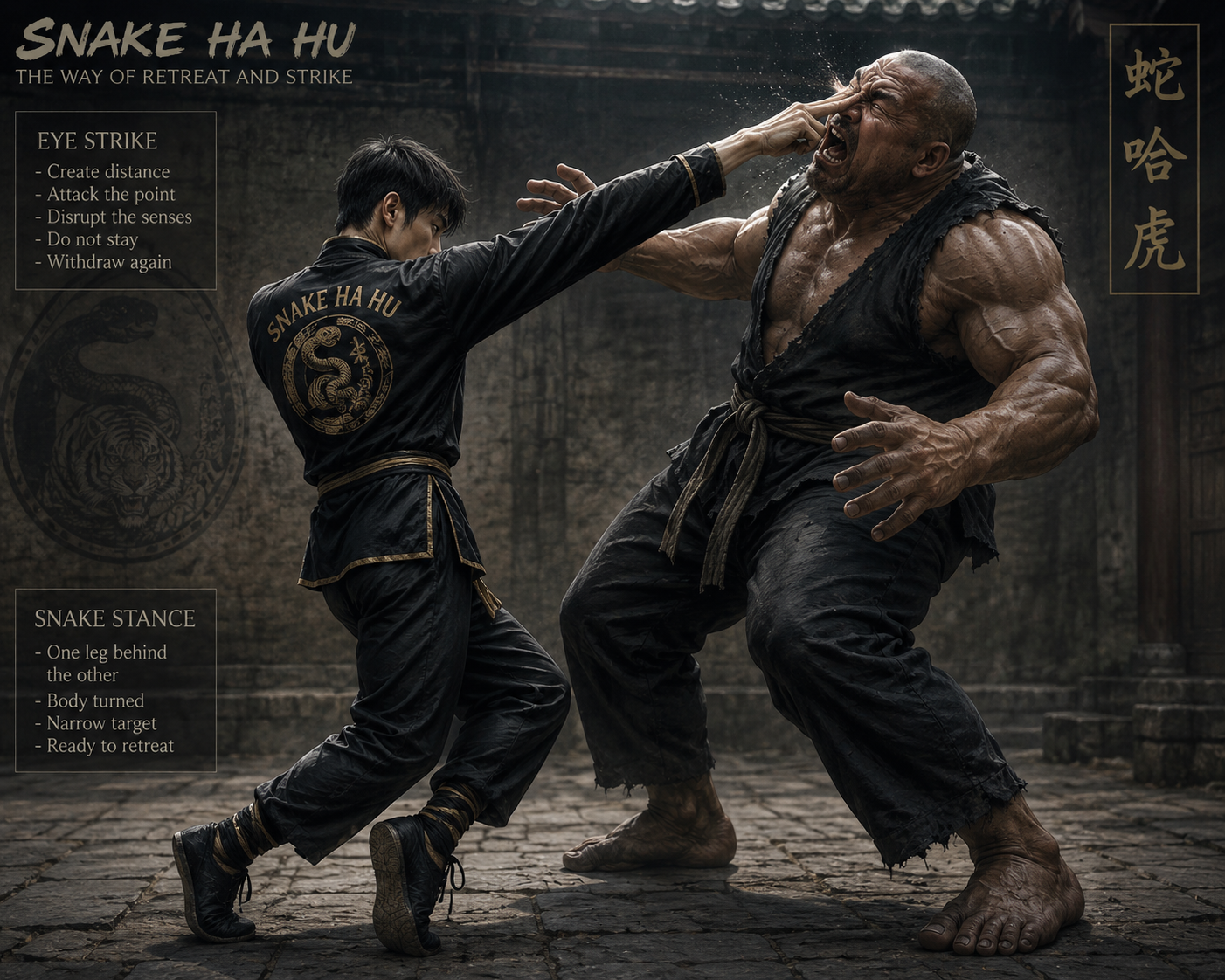
this kung fu is entirely based on 2 concepts:
Concept 1 is retreating to avoid attacks.
Concept 2 is striking at opponent's weakest points, such as eyes. I did steal this concept from Wing Chun kung fu, but anyway, eye pokes are what made Jon Jones UFC champion, so I am sure there is something good in them.
Snake Ha Hu (蛇哈虎) (fictional martial art concept)
Snake Ha Hu is an original, fictional kung fu style centered on evasion rather than force. Its philosophy is that the safest victory comes from making attacks miss, creating a brief opening, and escaping rather than trading blows.
Core Philosophy
"The snake survives by yielding. The tiger survives by timing. Snake Ha Hu survives by both."
The style teaches practitioners to:
- Retreat just enough to avoid an attack.
- Never meet force with force.
- Strike only during the opponent's recovery.
- Maintain balance for immediate withdrawal.
Signature Stance: Crossing Snake
The fighter stands with:
- One foot directly behind the other, almost on the same line.
- Front foot pointing forward.
- Rear heel slightly raised.
- Knees bent.
- Body turned sideways to reduce target size.
- Hands extended loosely in front.
This narrow stance allows quick backward movement while presenting a smaller target.
Primary Movement
Instead of stepping sideways or forward, practitioners mostly move:
- Half-step backward
- Full retreat
- Diagonal backward retreat
Each retreat is meant to make punches and grabs fall just short.
Defensive Principle
When an attack comes:
- Lean slightly backward.
- Slide rear foot farther back.
- Pull front foot after it.
- Stay balanced.
- Counter only if a clear opening appears.
The retreat is smooth rather than jumping.
Offensive Technique
The main attack is a rapid straight-hand thrust toward the opponent's face.
Characteristics:
- Fingers together.
- Thumb tucked safely against the side of the hand.
- Elbow nearly straight but not locked.
- Attack launched immediately after creating distance.
Safety note: In real martial arts training, attacks to the eyes should never be practiced with contact because they can cause permanent injury. Training would instead use controlled targeting or substitute safe targets.
Tactical Sequence
Typical exchange:
- Opponent lunges.
- Practitioner retreats.
- Attack misses.
- Practitioner extends the hand toward the face area.
- Practitioner immediately retreats again.
The style avoids prolonged exchanges.
Training Drills
Students practice:
- Continuous backward stepping
- Balance while standing on a narrow line
- Timing an opponent's forward movement
- Distance judgment
- Smooth transitions between retreat and counter
Strengths
- Conserves energy.
- Encourages patience.
- Makes it difficult for an aggressive opponent to land the first strike.
- Works well against straight-line attacks in the fictional system.
- Emphasizes precision over power.
Weaknesses
- Can give up ground quickly.
- Narrow stance may reduce lateral mobility.
- Retreating alone can be ineffective if trapped against obstacles.
- Relies heavily on timing and distance management.
- Less suited to multiple attackers or confined spaces.
Symbolism
The name combines two animals:
- Snake — flexibility, patience, precision.
- Ha — representing the exhale that accompanies a sudden retreat and counter.
- Hu (Tiger) — decisive action at the moment of opportunity.
Its emblem is a coiled snake with one foreleg of a tiger emerging from the coils, symbolizing restraint followed by decisive action.
As a fictional martial art, Snake Ha Hu is designed around the idea of creating openings through evasive backward movement and immediate, precise counterattacks rather than overpowering an opponent. In real-world self-defense, safer priorities include maintaining distance, escaping danger, and using proportional force where legally and ethically appropriate.