Where does the mind reside?

Started by SkepticalOne

Replies
54
Posts
55
Page
2 / 2

Conversation

#31 •••
@SkepticalOne
But why would we say that other than ignorance?

"Something that isn't material is nonmaterial" seems like a truism, not ignorance. It's true that some theists argue beyond this, which requires speculation, but philosophy requires some amount of justified speculation, which isn't quite the same as ignorance even if it's below a proof. I think that that speculation is a bit out of scope if we're just discussing dualism though.

Edit post

#32 •••
@Savant
Something that isn't material is nonmaterial"


This is a distinctly different sentiment than "this seems unlikely to have a material cause, thus the cause is probably nonmaterial".


One is a tautology. The other is a fallacy.

Edit post

Take the risk of thinking for yourself, much more happiness, truth, beauty, and wisdom will come to you that way. - Christopher Hitchens

#33 •••
@SkepticalOne

Does "x is unlikely to be material" not mean the same thing as "x is likely nonmaterial"? I think the fallacy would be "I don't know, therefore" rather than "this seems more likely"

Edit post

#34 •••
@SergeantLynch

The mind works with the brain to give meaning to a simple stimulus and extend its influence beyond the physical experience.

Edit post

#35 •••


Hmmmm, general anesthetic shows that there is no afterlife.

Edit post

#36 •••
@FLRW

That is how you shut down the brain.

Edit post

#37 •••
@Debby

Or


The brain works the mind and everything is a physical experience.


Depends upon airy fairyness.

Edit post

#38 •••
@SkepticalOne


SkepticalOne wrote:
Mental illness may be like a damaged radio receiving a perfectly good signal. The signal itself hasn't necessarily disappeared; the damaged receiver introduces static, distortion, and interference, so the resulting sound no longer accurately reflects the original broadcast

If a radio is damaged, the classical channel doesn't suddenly become heavy metal. The channel doesn't become English AND Spanish.

When the brain suffers severe damage, an individual's personality can completely change. The difference between responsible, polite, even tempered, and impulsive, profane, and volatile is more than just static. This is the difference of descriptions for Phineus Gage before and after a 3.5 foot rod was blown through his frontal lobe.

Individuals with a severed corpus callosum often have dual consciousness. Split brain patient known as Paul S famously had one side of his brain wanting to be a draftsman, and the other an automobile racer. Dr. V.S. Ramachandran described another patient where one hemisphere was a theist and the other an atheist.

This isnt symptoms of faulty receiver. These cases (and many others like them) demonstrate consciousness is emergent properties of a physical brain.


I doubt two separate consciousnesses are created. More probably what happens is you have one consciousness that is aware of what happens in one half of the brain but not in the other. So. it doesn’t demonstrate consciousness is an emergent property of the physical world/brain, which seems unlikely in the extreme to me because, how would you go from something like physics, atoms etc to something as unique as consciousness? That is a question a physicalist has to answer and there are no real answers that can be given.

Edit post

#39 •••
@Magoroth
More probably what happens is you have one consciousness that is aware of what happens in one half of the brain but not in the other.


...Aware of what happens in one half of the brain, but not the other? It's almost as if it was completely dependent on the matter of the brain. Tell me more.


Edit post

Take the risk of thinking for yourself, much more happiness, truth, beauty, and wisdom will come to you that way. - Christopher Hitchens

#40 •••
@SkepticalOne


SkepticalOne wrote:
I realize I still owe you that explanation of “evidence” that consciousness is not produced by brain, I will try to get focused and start to work on that tonight.


I can never find the time, I'm going to end up giving it in an abbreviated form, or in pieces in this thread. I retired a little over a year ago and I wondered what I would do with myself, but now I can't figure out how I found the time to go to work.


Yes, I think that would be the most helpful. From the dualist perspective, what is the mind made of? Where does it reside? How does it work with the material brain?

You want the dualist perspective to be explained within your materialist framework; dualism philosophy does not fit into materialism philosophy. It’s something of a non-sequitur response to require something nonmaterial to possess material qualities, as if you don’t understand what the term nonmaterial means. You want to know what sort of material the nonmaterial is made of, what is its location in space, and what are the mechanics by which it works with the material brain. With those questions you are asking for the nonmaterial to be defined as material.


I think it is also important to point out the objections you attempt to turn back on monism dont hit quite like you want. Monism doesn't define mind as something independent of material. There is no immaterial substance. Anything 'immaterial' is contigent on material.


These are declarations of faith, rather than arguments. Would you find “There is immaterial substance” and “Anything immaterial is not contingent on material” as a logical counterargument?


So an 'immaterial' mind is emergent from material. It's not hard to understand how something that is an extension of material can affect material. It is unclear how something completely untethered to material made up of not-material can interact with it though. I hope you will tackle this interaction problem head-on.


Will you tackle the emergence problem head on? It is unclear how something completely material can produce a nonmaterial entity. Can you explain how material brain properties can produce nonmaterial phenomenal properties? To simply say it “emerges” is a declaration of faith, it isn’t explanatory. Materialism needs to explain how physical processes in the brain give rise to subjective conscious experiences. The hard problem is the problem of experience, how can you explain on a strictly material basis why there is something it is like to entertain a mental image, or to experience an emotion?” Why does it “feel like something” to be a human being?

Edit post

#41 •••
@Sidewalker

The mind is dependent on the brain to interpret experience from the stimulation the brain responds to.

Edit post

#42 •••
@Sidewalker
I can never find the time, I'm going to end up giving it in an abbreviated form, or in pieces in this thread. I retired a little over a year ago and I wondered what I would do with myself, but now I can't figure out how I found the time to go to work.

I hope to have the same issue when I retire. *fingers crossed*


You want the dualist perspective to be explained within your materialist framework;


I've never requested that. I was hoping you might explain your perspective a little better. That is all.


These are declarations of faith, rather than arguments.


It is a declaration of faith to point out how attacks miss because they assume a dualist perspective? Okay. If you say so. I'm not here to bicker.


Will you tackle the emergence problem head on?


I cant. Its called the "hard problem of consciousness" for a reason. Being unable to answer this question is not a reason to accept dualism though. Ignorance doesnt prove dualism.


That being said, I didnt see anything arguing for dualism - only attacks against materialism. Is your acceptance of substance dualism built on attacks of materialism? If so, I dont think your views are necessarily warranted.


Edit post

Take the risk of thinking for yourself, much more happiness, truth, beauty, and wisdom will come to you that way. - Christopher Hitchens

#43 •••
@Debby

Or the Brain is the ultimate in multi-functional independent organic management systems, wherein mind is just a nominal appreciation of but one function.

Edit post

#44 •••
@SergeantLynch

The brain and mind work together to process thoughts, feelings, awareness and consciousness.

Edit post

#45 •••
@SkepticalOne

As I committed, here is roughly half of my promised argument that consciousness is not produced by the brain.


There are plenty of scientific studies that provide evidence that mental activity in human beings incorporates a lot of function that is completely external to the brain, the consensus opinion in the scientific community is that any serious consideration of the basis of mind must include the nervous system, the heart, and the sense organs in that analysis.


Throughout history shamans, saints, and sages Poets, artists, medicine men and women, and everyday language have referenced a connection of the heart with "knowing" and "awareness". Almost all Native American cultures have believed that whole people think with their hearts and traditionally advise us to “follow a path with a heart”. Today, these metaphors have become a scientific reality, with scientific evidence clearly demonstrating what we have always known “in our hearts” so to speak. The heart is now known by science to play a major role in our overall consciousness. Neural transmitters have been found connecting the heart and brain and the associated electrical and chemical impulses have been mapped and sequenced.


Studies have shown that the heart has its own complex intrinsic nervous system that is sufficiently sophisticated to qualify as a "little brain" that operates and processes information independently of the brain or nervous system. The heart's nervous system contains around 40,000 neurons with an elaborate circuitry that enables it to act independently of the cranial brain – to learn, remember, and even feel and sense. It is reasonable to conclude that the heart is not just an organ of consciousness but has some degree of autonomy as far as awareness/consciousness is concerned.


Neurocardiologists have found that 60 to 65% of the cells of the heart are actually neural cells, not muscle cells as was previously believed. They are identical to the neural cells in the brain, operating through the same connecting links called ganglia, with the same axonal and dendritic connections that take place in the brain, as well as through the very same kinds of neurotransmitters found in the brain. Quite literally, in other words, there is a "brain" in the heart, whose ganglia are linked to every major organ in the body, to the entire muscle spindle system that uniquely enables humans to express their emotions.


The heart is also a very powerful electromagnetic generator. It creates an electromagnetic field that encompasses the body and extends out anywhere from eight to twelve feet away from it. It is so powerful that you can take an electrocardiogram reading from as far as three feet away from the body. The intriguing thing is how profoundly this electromagnetic field effects the brain. All indications are that it furnishes the whole electromagnetic wave spectrum from which the brain draws its material to create our internal experience of the world. The role this electromagnetic field plays makes it clear that consciousness extends beyond the brain, and even beyond the body, to an immaterial field surrounding the body.


A final consideration regarding the heart is exemplified by people who have gotten heart transplants who quite often exhibit new behaviors of the late donor without any previous knowledge of such behavior. It appears the heart has its own memory,, and the associated learned behavior moves with the transplanted heart.


Finally, there is good reason to posit some attenuated degree of consciousness at the cellular level. Science speaks of "body intelligence" to address a resoundingly broad range of phenomena that intellect or mere "brain" study cannot address. Remember those weird kids that ate chalk in grade school? They are invariably found to be calcium deficient and yet intellectually they do not even know what calcium is, that they are calcium deficient, or that chalk actually contains calcium. There is a body intelligence that transcends brain that develops a "taste" for chalk. That is a rather simple example that can easily be challenged but it is one of many thousands that cannot be explained without recognizing that the intelligence of the body far transcends the physical brain.


In summary, the idea that consciousness is a product of the brain is not supported by scientific studies, the scientific consensus is that much more than the organ of the brain is implicated in consciousness. The logical conclusion is that consciousness is not a product of brain, instead, it appears to be distributed throughout the whole organism.


I will work on the second portion of my argument that consciousness is not produced by the brain next, there are valuable perspective issues that result from studying the evolution of consciousness over time. The evolutionary record demonstrates a continual rise in degrees of sentience that culminated in brains and conscious human beings, but it does not support the presumption of a cause and effect between brain and consciousness.


Edit post

#46 •••
@Sidewalker

Consciousness fades as the brain dies even though consciousness functions independently of the brain.

Edit post

#47 •••
@Sidewalker


The claim that the heart is 60–65% neural tissue is false. The heart is almost entirely muscle cells. Its "little brain" consists of just 40,000 neurons used for local pumping reflexes. The human gut has 500 million neurons. If this theory had any merit, the gut should rate above the heart I'd think. Regardless, neither have a role in generating conscious identity.


The heart’s magnetic field is subject to physics (like everything in the physical world) and obeys the inverse-square law. It drops to near-zero millimeters from the skin. It does not project a 12-foot interactive bubble (that's demonstrably false), and the brain does not decode it to create our internal experience.


The most damning proof against a heart-centered consciousness comes from modern surgery. Patients who receive artificial hearts have their biological hearts completely removed and replaced with plastic pumps. They experience no loss of memory, no loss of emotion, and no loss of personal identity. On the other hand, a brain-dead patient can have a perfectly beating heart, but their consciousness is gone forever. Regular biological heart transplants go through denervation as well (the vagus and inputs are severed) - there is no effect to consciousness.


Ultimately, you're confusing something that can influence the mind with something that generates it. The heart provides feedback to the brain (eg. racing heart = anxiety), but it is the brain that compiles those signals into the consciousness, not the other way around.


Also, fwiw, chalk eating generally isn't about low calcium, but low iron. Chalk is useless in solving this deficiency. PICA is a neurological error that drives a craving for texture and eating useless things. ..Not some type of systemic (sub)consciousness.


The most puzzling part for me is that you're argument is meant to refute consciousness being emergent from the physical brain, but every part of your post advocates for consciousness coming from a brain of some type or other. If it weren't for the factual errors, psuedoscience, and running counter to scientific consensus I could be on-board. Its more plausible than independent spaceless mental stuff.


Edit post

Take the risk of thinking for yourself, much more happiness, truth, beauty, and wisdom will come to you that way. - Christopher Hitchens

#48 •••
@Debby


Debby wrote:
Consciousness fades as the brain dies even though consciousness functions independently of the brain.


Hmmmm...Sort of a contradiction there Debs.


A. "Consciousness fades as the brain dies"...Is self explanatory.


B. "Even though consciousness functions independently of the brain"...See A. above.


What A. tells you is that consciousness is wholly a function of the brain.

Edit post

#49 •••
@SergeantLynch

The mind functions independently of the brain. But the brain provides the stimulation for the mind to process.

Edit post

#50 •••
What A. tells you is that consciousness is wholly a function of the brain.


All animals are conscious to whatever degree.


Great access to more complex meta-space mind/intellect/concepts and ego is a whole other story


There is a distinction to made between these two above. Occupied space experiences leads to both of the above.


Eternally occupied space is eternally complemented by meta-space maths ---also includes to some degree, static-like geometries that, manifest dynamically, for the most part---

Edit post

#51 •••
@ebuc

Consciousness is limited by the brain, but it’s reach is beyond the brain.

Edit post

#52 •••
@Debby


Debby wrote:
The mind functions independently of the brain. But the brain provides the stimulation for the mind to process.
Debby wrote:
Consciousness is limited by the brain, but it’s reach is beyond the brain.


Both short statements are overtly contradictory.


A. If the mind is independent then it does not require a brain, otherwise it is not independent.


B. If the brain limits consciousness, then the reach of consciousness is not beyond the brain.


Airy-fairyness is not always logical, which for sure is a perfect basis for fairy tales.


But a problem always arises when you attempt to employ airy-fairyness and fairy tales as the basis of fact.

Edit post

#53 •••
@Sidewalker

Not too take away from your info, just an aside:


AI...' Vagus Nerve (CN X): Extends from the brainstem down into the thorax and abdomen, carrying parasympathetic fibers that help slow down the heart rate and regulate cardiac rhythm. [1, 2, 3]


Glossopharyngeal Nerve (CN IX): While it does not directly innervate the heart muscle itself, it plays a closely related regulatory role by carrying sensory/baroreceptor signals from the carotid sinus (near the heart/major blood vessels) to the brainstem to help monitor blood pressure and reflexively influence heart rate. '...

https://www.youtube.com/watch?v=lieEQP1GHXU


Edit post

#54 •••

Experience { ergo occupied space } > consciousness { to whatever degree } > humans greater access to meta-space mind/intellect/concepts and ego.


Two-ness { other-ness O O } as the minimal set for conscious-ness, however, the two-ness needs at minimum, a line-of-relationship of interaction between the two.


Ex O----O is simple example, tho I prefer an outer geodesic curvature of Gravity ( ), .... (O)(O) .... , ergo, Gravitational ( ) embracement as the minimal set for consciousness i.e. awareness to whatever degree of connected to other-ness.


An human infant stands, then experiences Gravity and falls over.


Then there is 4th-ness that has to be included in the above minimal 3-ness set for conscious awareness and that is the background space within which the above is taking place. So four distinct catagories need to be consider as the whole set of existence in the above scenario.


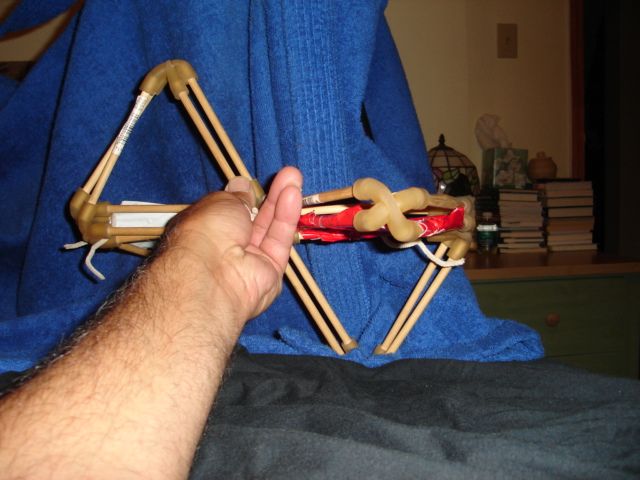
...> Minimal structural integrity in 2D is a triangle { 3 diagonals leaning into each other }, and in 3D a tetra{4}hedron --4 faces, 4 vertexes, 6 edges{ lines-of-relationship }---


...> Minimal systemic integrity is 4-ness. With the 3D tetrahedron we find two distinct sets of 4-ness. However, we may conclude that the 4 faces are just openings of truly non-occupied space --if the tetrahedron was considered as all that Universe is--- and, 4 vertexes, that, are distinct from six lines-of-relationship, in that,


the 4 vertexes are hubs/energy centers, of three-ness, where three lines of relationship meet.


1} vibrating vertexial hubs Y Y Y --vibrating as if considered as a field osscilating { if not other } motion---


2} vibrating lines-of-relationship /\/\/\ or as ^v^ set of 6-ness


3} four openings, however, since the lines-of-relationship and the vertexial hubs are in vibratory osscilations states/phase of motion, the truly non-occupied space existence with the vibrating tetrahedron, is being minimized with those boundaries i.e. if truly non-occupied space occurs within those boundaries, my guess, that the occupied space hubs and relationships would tend to rush in to fill any true vacuum with the boundaries of the vibrating tets openings. I dunno


@ = eternally vibrating, finite, occupied space as Universe composed of vertexial hubs of three primary kinds. 1{ outer surface Gravity ( ), inner surface Dark Energy )( and internal physical reality. --note by slight of consciouness and mind, ive transposed the vibrating tetrahedron to be in associated in some way or another with my space and time tori. Perhaps four horn tori since the tet has four openings, and each horn tori may some minimal set of truly non-occupied space appearing then filled, only to appear elsewhere in minimal hole at inner tangental { ? } surface of horn torus, with it self,


Note: in the above ive taken liberties in using that ...@... symbology for Universe as a single tetrahedron, or. four space and time horn tori, and I know way am endorsing that as my belief of what Universe is.


I know this getting long, however, I feel the need to remind any reader, that, the cubo{6}-octa{8}hedron aka in Synergetics as the Vector Equlibrium or as the jitterbug vector flexor, has 24 edges/chords/lines-of-relationship, and transforms into a few exotic shapes one of which can occur in two differrent ways, and that is the 4 doubled bonded triangles, that, define the a Euclidean version geometry of the EMRadiation sine-wave ^v


..> not shown here ^v is the horizontal { - - } the two double bonded triangles with two more peaks. Let me see if I can inload a picture of one these ive made.


Edit post

#55 •••
@ebuc

That’s a poorly designed toy

Edit post