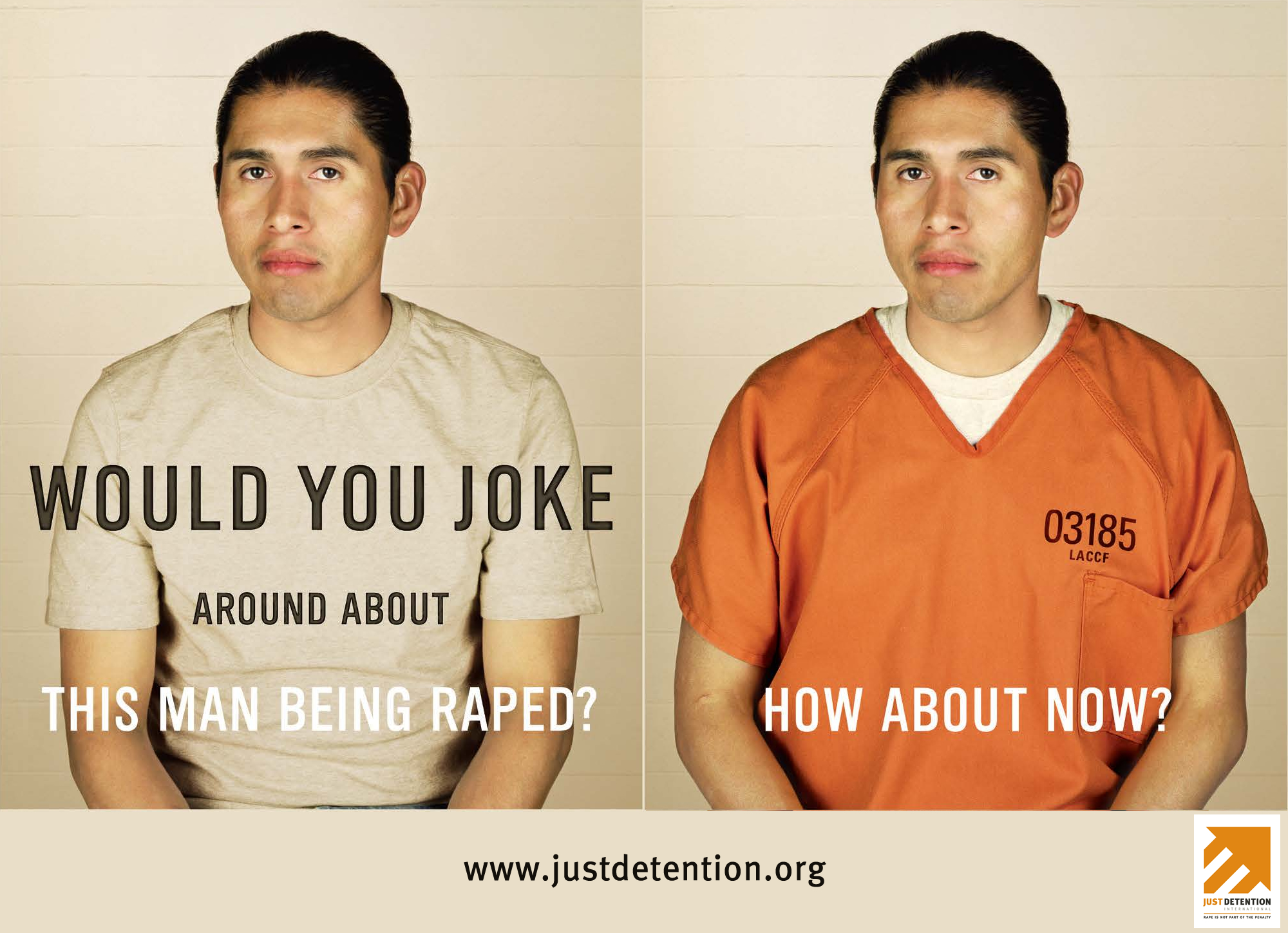
To the CIA rape dungeon you go.
Every US prison is technically a rape dungeon.
No Escape: Male Rape in U.S. Prisons
"A Florida prisoner whom we will identify only as P.R. was beaten, suffered a serious eye injury, and assaulted by an inmate armed with a knife, all due to his refusal to submit to anal sex. After six months of repeated threats and attacks by other inmates, at the end of his emotional endurance, he tried to commit suicide by slashing his wrists with a razor. In a letter to Human Rights Watch, he chronicled his unsuccessful efforts to induce prison authorities to protect him from abuse. Summing up these experiences, he wrote: "The opposite of compassion is not hatred, it's indifference."
P.R.'s bleak outlook is not unjustified. Judging by the popular media, rape is accepted as a commonplace of imprisonment, so much so that when the topic of prison arises, a joking reference to rape seems almost obligatory. Few members of the public would be surprised by the assertion that men are frequently raped in prison, given rape's established place in the mythology of prison life. Yet serious, sustained, and constructive attention to the subject remains rare. As Stephen Donaldson, the late president of the organization Stop Prisoner Rape, once said: "the rape of males is a taboo subject for public discussion . . . . If ever there was a crime hidden by a curtain of silence, it is male rape."
Without question, the hard facts about inmate-on-inmate sexual abuse are little known. No conclusive national data exist regarding the prevalence of prisoner-on-prisoner rape and other sexual abuse in the United States. Indeed, few commentators have even ventured to speculate on the national incidence of rape in prison, although some, extrapolating from small-scale studies, have come up with rough estimates as to its prevalence. With the staggering growth of the prison population over the past two decades, such ignorance is more unjustifiable than ever.
Prison authorities, unsurprisingly, generally claim that prisoner-on-prisoner sexual abuse is an exceptional occurrence rather than a systemic problem. Prison officials in New Mexico, for example, responding to our 1997 request for information regarding "the 'problem' of male inmate-on-inmate rape and sexual abuse" (the internal quotation marks are theirs), said that they had "no recorded incidents over the past few years." The Nebraska Department of Correctional Services informed Human Rights Watch that such incidents were "minimal." Only Texas, Ohio, Florida, and the Federal Bureau of Prisons said that they had more than fifty reported incidents in a given year, numbers which, because of the large size of their prison systems, still translate into extremely low rates of victimization.
Yet prison authorities' claims are belied by independent research on the topic. Indeed, the most recent academic studies of the issue have found shockingly high rates of sexual abuse, including forced oral and anal intercourse. In December 2000, the Prison Journal published a study based on a survey of inmates in seven men's prison facilities in four states. The results showed that 21 percent of the inmates had experienced at least one episode of pressured or forced sexual contact since being incarcerated, and at least 7 percent had been raped in their facility. A 1996 study of the Nebraska prison system produced similar findings, with 22 percent of male inmates reporting that they had been pressured or forced to have sexual contact against their will while incarcerated. Of these, over 50 percent had submitted to forced anal sex at least once. Extrapolating these findings to the national level gives a total of at least 140,000 inmates who have been raped.
An internal departmental survey of corrections officers in a southern state (provided to Human Rights Watch on the condition that the state not be identified) found that line officers -- those charged with the direct supervision of inmates -- estimated that roughly one-fifth of all prisoners were being coerced into participation in inmate-on-inmate sex. Interestingly, higher-ranking officials -- those at the supervisory level -- tended to give lower estimates of the frequency of abuse, while inmates themselves gave much higher estimates: the two groups cited victimization rates of roughly one-eighth and one-third, respectively. Although the author of the survey was careful to note that it was not conducted in accordance with scientific standards, and thus its findings may not be perfectly reliable, the basic conclusions are still striking. Even taking only the lowest of the three estimates of coerced sexual activity -- and even framing that one conservatively -- more than one in ten inmates in the prisons surveyed was subject to sexual abuse.
It is evident that certain prisoners are targeted for sexual assault the moment they enter a penal facility: their age, looks, sexual orientation, and other characteristics mark them as candidates for abuse. Human Rights Watch's research has revealed a broad range of factors that correlate with increased vulnerability to rape. These include youth, small size, and physical weakness; being white, gay, or a first offender; possessing "feminine" characteristics such as long hair or a high voice; being unassertive, unaggressive, shy, intellectual, not street-smart, or "passive"; or having been convicted of a sexual offense against a minor. Prisoners with any one of these characteristics typically face an increased risk of sexual abuse, while prisoners with several overlapping characteristics are much more likely than other inmates to be targeted for abuse. Yet it would be a mistake to think that only a minority of extremely vulnerable individuals face sexual abuse. In the wrong circumstances, it should be emphasized, almost any prisoner may become a victim."
https://www.hrw.org/reports/2001/prison/report1.html