
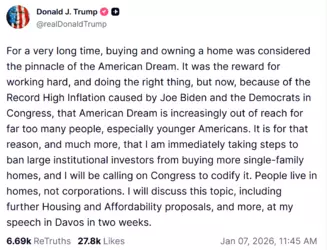

I wish he would just confiscate and redistribute all the houses, but Maga Maoism must take one step at a time into the bright future. Orange Sun in the Sky! Still a good move by The Donald, to balance out my recent criticism.
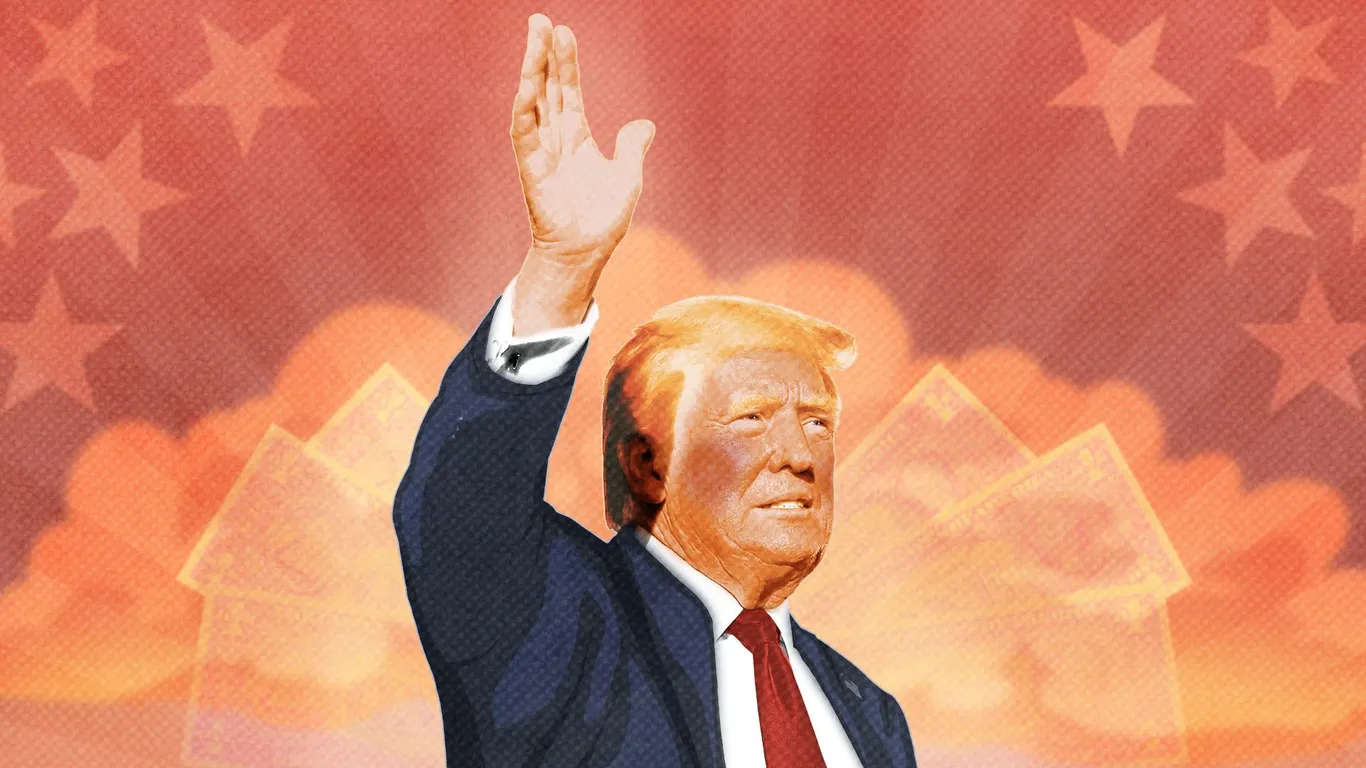
I wish he would just confiscate and redistribute all the houses, but Maga Maoism must take one step at a time into the bright future. Orange Sun in the Sky! Still a good move by The Donald, to balance out my recent criticism.
the percentage of Americans who own homes is lower than before.
Now, while I enjoy having a house, I cant really imagine whats it like to pay rent and be technically homeless.
But trump wont fix anything. He barely fixed the debt by a small bit. You are giving a guy too much credit even tho he will achieve nothing much.
Reality is, until you start paying Americans universal basic income, as well as income per kid in family, nothing will be fixed. It takes a bit of Communism to fix things. World works thanks to Communism, and if Americans lack money for home, solution is to give them money for home, to help them buy home. there is no other solution.
What trump does is trying to reduce demand to reduce price, but that is more likely to reduce supply than price.
😂😂😂
Ask Trump what his dad did for a living and how Trump stayed so rich...
Bahhahhahah
The US is a definitively secular nation, founded on complete separation of the State and religion. The Left Wing of US realise this but don't realise that pure freedom requires as low tax and free access to guns as possible. The Right Wing of US don't realise that secular pure freedom means the LGBTQ+ and abortion agendas both end up in line with US's liberty-first ethos.
It is left-wing to be pro-life. You are backing poor babies being born at the inconvenience of the already-born. Go figure.
how Trump stayed so rich
Its easy to be rich when you inherit millions. You would actually have to make effort to not stay rich.
Donald Trump received at least $413 million from his father, Fred Trump, over the decades, largely through a vast network of financial support and tax avoidance schemes, rather than a small loan as he often claimed, according to a major 2018 investigation by The New York Times. This support included setting up trusts, undervaluing properties, padded invoices, and other questionable financial maneuvers that effectively transferred vast wealth, equivalent to hundreds of millions today, while avoiding significant taxes.
Key Details from the Investigation:
Methods: Creation of sham corporations, undervaluing assets, and marking up invoices by 20-50% to shift wealth.
And for those unaware, these are literal crimes. the crime consists in selling things for higher price, but when paying taxes, writing lower price or income to reduce taxes which have to be paid (taxes scale up with price/income).
Also, creating fake corporations to send money to, to avoid tax on income, is another form of fraud.
Also, the small loan of "1 million dollars" was given in 1975. At that time, that was equivalent of today's 10 to 40 million dollars.
Million dollars is a lot of money today. In 1975, it was huge, much bigger.
Poor people dont get 40 million dollar loan. Its one of many advantages of being born rich.
Pretty sure his father largely built and owned apartment buildings, not single-family homes, and Trump himself invested in luxury real estate development in Manhattan and later country clubs/casinos. I do think the casino business is deplorable and have criticized Trump for that, but there isn't anything inherently wrong with building homes/apartments, as that increases the amount of housing available and lowers prices. Some of his father's properties are housing co-ops, where tenants each own a 'share' in the overall building and can vote for a board to manage the building, so it's even done very democratically.
They weren't institutional investors with billions of dollars buying up existing single family homes on the market and turning them into rental properties, thus driving the cost of housing sky-high for everyone else. That's a relatively new problem in America; it started after 2008 when a large amount of distressed properties emerged on the market due to widespread foreclosures. It was fueled by low interest rates and then given a shock infusion during COVID.
Alone I stand in the autumn cold
On the tip of Manhattan
The Hudson flowing southward;
I see a thousand towers crimsoned through
By their lit windows deep-dyed,
And a hundred barges vying
Over murky green waters.
Seagulls cleave the air,
Fish glide in the limpid deep;
Under freezing skies a million creatures contend in freedom.
Brooding over this immensity,
I ask, on this boundless land
Who rules over man's destiny?
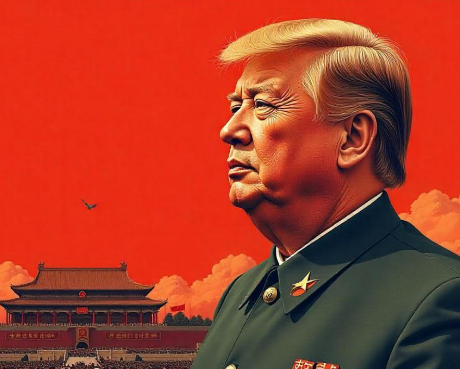
Chairman Trump
Yappity yap.
Lot of talk to say the Trumps were the rich predators that bought up places people could own to live and used it as theyf ancied charign as much as they wanted even using illegal immigrant labour for a lot of the cleaning and maintenance.
This man is most of what he claims to despise.
The US is a definitively secular nation, founded on complete separation of the State and religion. The Left Wing of US realise this but don't realise that pure freedom requires as low tax and free access to guns as possible. The Right Wing of US don't realise that secular pure freedom means the LGBTQ+ and abortion agendas both end up in line with US's liberty-first ethos.
It is left-wing to be pro-life. You are backing poor babies being born at the inconvenience of the already-born. Go figure.
He got a teeny tiny loan though.
The US is a definitively secular nation, founded on complete separation of the State and religion. The Left Wing of US realise this but don't realise that pure freedom requires as low tax and free access to guns as possible. The Right Wing of US don't realise that secular pure freedom means the LGBTQ+ and abortion agendas both end up in line with US's liberty-first ethos.
It is left-wing to be pro-life. You are backing poor babies being born at the inconvenience of the already-born. Go figure.
I don't think Trump's ban on institutional buyers will have a positive effect on the housing market by any stretch of the imagination. I managed sales for a new home construction company when the wild price increases occurred, the institutional investors did not cause the dramatic price increases.
Housing is a 55 trillion-dollar market, disruption of such a huge market will have dramatic effect on the general economy and employment, which will cause a cascading effect that magnifies the effects of the disruptions. You have to be very careful when you start fucking around with a 55 trillion-dollar market segment of the economy, and simply eliminating institutional investors will be very disruptive, without having the intended effect of reducing home prices much at all.
New home construction is very sensitive to demand, a typical new home subdivision is basing construction starts on the previous two- or three-month's sales, unsold inventory is very costly to a builder in many ways. Eliminating the institutional demand will eliminate a portion of the supply accordingly, and it's naive to think builders will simply build too many homes and make prices drop.
Pretty much everyone would rather own than rent, so new home construction is made up of people who can qualify for a mortgage and institutional investors that provide rental homes for those who don't qualify yet. Banning institutional investors won't measurably change the number of buyers who can qualify for a mortgage, eliminating the rental demand will simply reduce housing starts accordingly, which will have a negative effect on employment, which will mean fewer people will qualify for mortgages, which is a big part of the cascading effect I mentioned. In the end, banning institutional investors will make it harder for consumers to get into a single-family home, not easier.
The wild price increases where a matter of supply and demand, and huge increases in material costs. It was a drop in mortgage interest rates to the lowest ever that caused the housing market to explode, more buyers qualified at the lower rates, and the rental market provided more lucrative cash flow to the investors, and Covid caused fundamental market changes that contributed to the huge increase in single family home demand. More people working from home, made people need one or two more rooms for office space and the threat of Covid was all about density, and density considerations fundamentally changed the housing market. Living in apartments means closer proximity to others, and closer in homes meant closer proximity to others during the Covid also, this increased demand for single family homes and made living further out where homes are more affordable more practical. Supply is also limited by the construction industry's capacity to build, 50% of the home builders went bankrupt in the 2008 housing fiasco, builder construction capacity was severely diminished and slowly recovering.
All of that combined increase in demand outpaced supply, the builders just couldn't build fast enough to meet that huge demand, and it was exacerbated by the Covid supply chain disruptions. In the aftermath of Covid, the cost of lumber increased 700% in one year, and the recent tariff mania has a huge impact on construction costs (a majority of the US market's lumber, and over 90% of the gypsum comes from Canada, tariffs contribute to the affordability crisis much more than institutional investors do.
So, the cost of construction increased dramatically, and the builders just couldn't build fast enough to meet demand, and that is what caused the wild price increases that made homes unaffordable. That situation peaked in 2022, builders can keep up with demand now, material costs have normalized, and supply chain disruptions have been resolved, so now, a reduction in demand will simply reduce supply, which reduces employment, which will reduce the number of qualified buyers.
Blaming institutional investors for the affordability problems is a convenient matter of scapegoating, and consequently, banning them from the housing market will exacerbate, rather than solve, the affordability crisis.
I agree. Blaming institutional investors for the affordability problems is a convenient matter of scapegoating, and consequently, banning them from the housing market will exacerbate, rather than solve, the affordability crisis.