@SkepticalOne
Over half the supply of NorthAtlantic Lobsters come from Canada.
Over half the supply of NorthAtlantic Lobsters come from Canada.
Physicist Sean Carroll argues that life after death is scientifically impossible because consciousness is an emergent property of the brain, which is composed of atoms and electrons. When the brain ceases to function and decays, the information it contains cannot persist independently, as there is no known physical mechanism for a "soul" or consciousness to survive beyond the body. Quantum Field Theory also provides no evidence of any particles or fields that could carry consciousness after death, reinforcing the conclusion that an afterlife is incompatible with the laws of physics (Carroll, 2023).
That is why the resurrection of Jesus is one of historic importance witnessed by hundreds. It is the cornerstone of Christianity and proof of an afterlife.
The lack oif empiric evidence of an afterlife meansonly that the evidence is currently unknown. It is useless to deny the potential of discovery.
We tell God what to do and then blame Him for our errors.
- Dr. Pet Dragon of Sorbonne University
There is currently no proof of an afterlife.
Whereas old myths and legends are full of all sorts of fantasy stuff...Such are the cornerstones of christianity.
Not so close to the sea.
True, but the drive is much shorter.
Take the risk of thinking for yourself, much more happiness, truth, beauty, and wisdom will come to you that way. - Christopher Hitchens
Ah, so you don't fancy popping over to Cardigan Bay for a spot of lunch...How about Matagorda Bay?
Danny's or The Waterfront...You choose.
If ever I find myself in your part of the workd, I'll take you up on that.
Take the risk of thinking for yourself, much more happiness, truth, beauty, and wisdom will come to you that way. - Christopher Hitchens
Yep, see if you can get an all expenses global moderation trip.
SergeantLynch wrote:
There is currently no proof of an afterlife.
Yes, there is currently no proof that consciousness exists after death, but there no proof that consciousness exists before death either.
Consequently, your statement has no explanatory value, it doesn't address the subject, it only pretends to.
If you believe consciousness does exist, what proof do you have?
The proof is the Deja Vu effect. The strange sudden feeling that you have lived through the exact moment before.
Yes, there is currently no proof that consciousness exists after death, but there no proof that consciousness exists before death either.
Does 'Cogito Ergo sum' mean nothing to you!? 😀
Take the risk of thinking for yourself, much more happiness, truth, beauty, and wisdom will come to you that way. - Christopher Hitchens
Thinking takes place in the mind. Consciousness also exists in the mind. Brain activity is energy. Energy cannot be destroyed. It lives on beyond death.
The brain derives its energy primarily from glucose and oxygen, which are delivered via the bloodstream. Glucose is broken down through metabolic processes to produce adenosine triphosphate (ATP), the molecule that powers cellular activities, including the maintenance of ion gradients and neurotransmitter signaling.
While glucose is the main fuel source, the brain has limited energy stores and requires a constant supply. During specific conditions like prolonged fasting, the brain can utilize alternative fuels such as ketone bodies or lactate to sustain its high energy demands.
When you are dead you can't think.
Yes, I certainly feel like I lived through this discussion before.
And so, I think therefore I am...Therefore I think Donald Trump is.
But even so, everything is a simulation, that may or may not be based upon sensory input, rather than the will of a controller...Though I guess that we probably do self process sensory information.
Just a guess you understand.
Energy cannot be created or destroyed. The glucose and oxygen in converted into energy which then cannot be destroyed and continues to exist as consciousness.
SkepticalOne wrote:
Yes, there is currently no proof that consciousness exists after death, but there no proof that consciousness exists before death either.
Does 'Cogito Ergo sum' mean nothing to you!? 😀
It means a lot to me; I’m a student of philosophy of mind and Descartes laid down the undisputable foundations that are the starting point and context for any serious study of philosophy of mind. "Cogito Ergo sum" tells us that if you apply rigorous skepticism and methodically doubt everything, the one and only undeniable certainty you are left with is that you are conscious. Consequently, reality is experiential, it occurs internally, the external, physical world is an inference, it is a mental construct that is the "presumed" cause of our sensations, we construct it “in here” and project it "out there".
But the problem is consciousness is unobservable, it cannot be measured, and any theory that goes beyond correlations is not testable, which is to say, it cannot be known empirically. It therefore falls outside of the domain of science. Consciousness doesn’t have any shared characteristics with the physical word and consequently, there is no proof it exists, science can’t even explain how it interacts with physical reality.
The “ontological” problem is that we can’t prove it exists, and the epistemological problem is that there is no way to directly know that others are conscious.
Consciousness exist because you think therefore there it is for you to experience.
The brain processes information through a massive, lightning-fast network of electrical signals and chemical messengers. It acts as a biological supercomputer, constantly receiving raw data from your senses, filtering it for importance, and translating it into thoughts, emotions, and actions.
This intricate system relies on specific biological mechanisms and interactive neural networks:
When your body does not produce energy anymore, you cannot think.
Consciousness doesn’t have any shared characteristics with the physical word and consequently, there is no proof it exists, science can’t even explain how it interacts with physical reality.
It seems you are referencing an issue exclusive to substance dualism to argue consciousness is beyond science. Most scientists and philosophers accept consciousness as an emergent property of the physical brain and therefore dont think a non-physical answer is required. It is true consciousness cannot be directly observed, but that doesnt mean it cannot be indirectly observed. (Eg. First person observation combined with data via instrumentation). Consciousness is within the domain of science.
Take the risk of thinking for yourself, much more happiness, truth, beauty, and wisdom will come to you that way. - Christopher Hitchens
Science can observe its physical traces and effects. Consciousness can even be tested.
Absolute proof of an afterlife? I need to check this out closer
https://www.bigelowinstitute.org/
The Bigelow Institute for Consciousness Studies (BICS) is essentially a privately funded research organization devoted to one unusually specific question:
> Does human consciousness continue after the physical body permanently dies?
It was founded in 2020 by aerospace entrepreneur Robert Bigelow, who has funded consciousness and anomalous-phenomena research for decades. Its stated mission is to support scientific investigation of consciousness surviving bodily death and, if it does, to investigate what the afterlife might be like.
What BICS has actually done
1. The $1.5 million essay competition
Its most famous project was a 2021 competition asking researchers to make the strongest evidence-based case for survival of consciousness after death. BICS ultimately awarded prizes to 29 essays, totaling about $1.5 million. The top three included work by Jeffrey Mishlove, Pim van Lommel, and Leo Ruickbie.
The important thing is that BICS wasn't primarily trying to produce a conventional laboratory experiment. It commissioned large, interdisciplinary evidence reviews and arguments, drawing on things such as:
near-death experiences
mediumship
reincarnation cases
deathbed visions
apparitions
terminal lucidity
psi phenomena
out-of-body experiences
anomalous information acquired during altered states
BICS's own conclusion from the competition was extremely strong: it says the evidence established “beyond reasonable doubt” that consciousness survives death.
That is BICS's conclusion, however—not a consensus conclusion of mainstream neuroscience or science generally.
2. The "Challenge" — communicating with the dead
BICS subsequently went a step further.
Its Challenge program funded teams to investigate whether mediums could obtain information from purported discarnate consciousness and, more importantly, whether they could obtain new wisdom or information that could be independently evaluated.
BICS explicitly says that this program started from the assumption that the afterlife is real and that mediums can obtain valid information from it, rather than treating those propositions as completely open hypotheses.
Five of the resulting reports are now available on its website, involving researchers such as Stephen Braude, Melvin Morse, Jeffrey Tarrant, and others.
That's a major distinction: the later BICS research isn't neutral in the conventional sense. It is designed to investigate the afterlife from a starting position substantially more favorable to survival.
3. It is particularly interested in "wisdom" from the afterlife
This is one of the more fascinating aspects of BICS.
Rather than simply asking a medium, "Is Grandma okay?", BICS wanted researchers to ask purported nonphysical intelligences big existential questions:
Is humanity spiritually progressing?
What is the nature of the afterlife?
What happens to consciousness after death?
What should humanity understand about its existence?
The 2022/23 Challenge materials explicitly say the focus was contact and communication with the "Other Side" and obtaining information from it, with validation of that information being an important objective.
One particularly striking claim
BICS has also investigated information allegedly coming from nonhuman entities and purported afterlife sources. Its grant materials describe a recurring message from multiple sources that humanity has been “living on borrowed time” and could face a catastrophic extinction-level event within the foreseeable future.
That is an allegation reported in BICS's research framework, not an established scientific prediction. I would treat this part much more cautiously than the broader question of consciousness survival.
So what should you make of BICS?
I'd characterize it this way:
BICS is not simply a paranormal website. It has put substantial money into serious investigation and has assembled researchers with backgrounds in medicine, psychology, consciousness studies, philosophy and related fields.
But it is also not equivalent to a mainstream scientific research institution. Its institutional mission is explicitly to investigate survival, and its later Challenge program actually assumes the reality of the afterlife rather than starting from complete agnosticism.
So there are really three different questions:
Question What BICS says
Is there evidence for consciousness surviving death? Yes, and BICS considers it beyond reasonable doubt.
Is that the scientific consensus? No.
Is there interesting evidence that deserves investigation? Absolutely—that is essentially BICS's raison d'être.
And given your previous interest in NDEs, hospice experiences and Christian understandings of the afterlife, I think the most interesting part of the site isn't actually the headline claim. It's the 29 winning essays. They represent a concentrated attempt to assemble the strongest case for survival from many different lines of evidence.
[Bigelow Institute for Consciousness Studies](https://www.bigelowinstitute.org/?utm_source=chatgpt.com)
If you want, I can also **.**summarize the actual evidence presented by the top 3 BICS essays and tell you which pieces of evidence are genuinely difficult for materialism to explain versus which are much weaker
SkepticalOne wrote:
Consciousness doesn’t have any shared characteristics with the physical word and consequently, there is no proof it exists, science can’t even explain how it interacts with physical reality.
It seems you are referencing an issue exclusive to substance dualism to argue consciousness is beyond science.
I was responding to your question “Does 'Cogito Ergo sum' mean nothing to you!?” which is the archetypal quote of Descartes, the OG "substance dualist". So yeah, substance dualism is what that quote means to me.
Most scientists and philosophers accept consciousness as an emergent property of the physical brain and therefore dont think a non-physical answer is required.
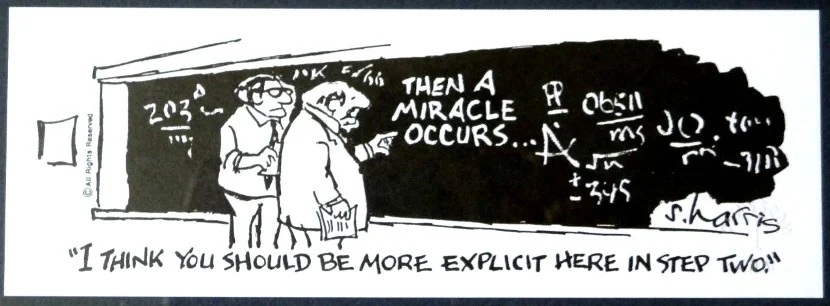
By “emergent property”, you mean magic, right? I don’t think “emergent property of the gaps” has anything to do with science. “Emergent property” is not explanatory; it represents a lack of explanation. It is not scientific hypotheses, it is only phrased as if it were.
“God of the gaps”, “evolutionary advantage of the gaps”, “complexity of the gaps”, “hidden variables of the gaps”, “emergent property of the gaps”, they are all one and the same theory in principle. They are only different forms of the argument from ignorance, illogical attempts to say that the lack of information supports my presumptions, and not yours, which is a logically invalid argument.
Neurophysiologist and Nobel laureate Sir John Eccles and philosopher of science Karl Popper have both referred to emergentism as “promissory materialism”, Sir John Eccles stated, “Promissory materialism is a superstition without a rational foundation.
It is true consciousness cannot be directly observed, but that doesnt mean it cannot be indirectly observed. (Eg. First person observation combined with data via instrumentation). Consciousness is within the domain of science.
On a material level, Consciousness represents a supervenient structure that bears properties that its subvenient parts do not exhibit. Consciousness is not coextensive with brain, it exists independently of material brain as a higher order structure that cannot be decomposed into its parts and their relationships, so it is an ontologically novel entity. It exists independently of the physical materials and properties of its parts and yet, exerts causal influence on events in the world, exerting a causal influence that its constituent components, in sum, cannot exert. Consequently, it has an ontological status apart from its material components, and it logically follows that it is itself a causal agent as well as an entity that is acted upon by external causes.
So, there you go, I’m a property dualist.
A concrete case makes the distinctions much clearer. The Pam Reynolds case is particularly useful because it illustrates both the strongest version of the argument and why the philosophical distinctions matter.
When evaluating out-of-body experiences (OBEs), it is useful to distinguish four increasingly demanding concepts: consistent with reality, veridical, verified, and proven. These terms should not be treated as synonyms.
1. Consistent with reality
An experience is consistent with reality when its content does not conflict with independently established facts.
For example, a person reports seeing a particular object in a hospital room, and investigators later confirm that the object was indeed there. The experience is consistent with reality.
But consistency is a relatively weak epistemic standard. The fact that an experience corresponds to reality does not, by itself, establish how the information was acquired. The person might have perceived it normally, remembered it unconsciously, inferred it, learned it beforehand, or obtained it through some other ordinary mechanism.
Thus:
«Consistency establishes compatibility, not necessarily causation.»
An OBE can therefore be completely consistent with reality without demonstrating that consciousness actually left the body.
2. Veridical
An experience is veridical when its content corresponds to an actual state of affairs in the world.
In OBE research, a veridical OBE generally refers to an experience containing information that corresponds to independently established reality, particularly information the experiencer apparently could not have obtained through ordinary sensory access.
Veridicality is therefore stronger than simply saying that an experience felt real. But there is an important qualification:
«Veridicality concerns correspondence between the experience and reality; it does not, by itself, establish the mechanism by which the information was obtained.»
If someone accurately reports something that was apparently outside their sensory access, that may constitute evidence for anomalous perception. But an additional argument is required before concluding that the explanation was literally a consciousness existing or perceiving outside the body.
3. Verified
Verified concerns the evidential status of a claim.
A report may be compared with medical records, photographs, video, witnesses, instruments, or other independent evidence. If those sources corroborate the relevant details, those details can reasonably be described as verified or independently corroborated.
But verification does not necessarily mean certainty.
For example:
«"The patient reported seeing X, and independent records establish that X was present."»
That can establish that the reported content corresponded to reality.
But the additional proposition—
«"The patient obtained knowledge of X through perception occurring independently of the physical senses"—»
is a separate proposition requiring additional evidence.
Thus:
«Verification can establish the correspondence of a report with reality without establishing the explanation for that correspondence.»
4. Proven
Proven is a much stronger term.
In mathematics and formal logic, propositions can be proven deductively from premises. Empirical claims generally work differently: evidence supports them to varying degrees rather than producing mathematical certainty.
Consequently, showing that an OBE contained verified information would not, by itself, prove that consciousness can exist independently of the brain.
To establish that stronger proposition, one would need to rule out sufficiently plausible alternatives—such as ordinary sensory perception, prior knowledge, inference, memory reconstruction, coincidence, information acquired before or after the relevant period, or physiological mechanisms capable of producing the experience.
So there is a crucial distinction between:
«"The person accurately reported something they apparently could not normally have known."»
and:
«"We have therefore proved that consciousness left the body."»
The second conclusion does not automatically follow from the first.
---
A concrete example: the Pam Reynolds case
A frequently discussed example is Pam Reynolds, who underwent surgery in 1991 to remove a large brain aneurysm. The procedure involved profound hypothermia and a period of induced circulatory arrest. Her eyes were taped shut, and molded speakers were placed in her ears as part of neurological monitoring.
Reynolds later reported an OBE during which she said she viewed the operating room from above. Among other things, she described the surgical bone saw as resembling an electric toothbrush and recalled aspects of the surgical procedure and a conversation involving the size of her blood vessels. These details subsequently became central to arguments that her experience contained veridical perceptions.
This gives us a useful way to apply the distinctions.
What would "consistent with reality" mean here?
Suppose Reynolds described a particular surgical instrument and investigators subsequently established that the instrument really was present.
That makes the content consistent with reality.
But by itself, it doesn't establish when or how Reynolds acquired the information.
What would "veridical" mean?
If her description genuinely corresponds to the actual instrument and procedure, the relevant portion of her experience can be called veridical in the ordinary sense of corresponding to reality.
The interesting question then becomes:
«How did she obtain the information?»
That is a different question from whether the information was correct.
What would "verified" mean?
If independent medical records, photographs, surgical personnel, or other contemporaneous evidence establish that the reported details really occurred, then those details have been independently corroborated or verified.
This is considerably stronger than simply taking the experiencer's word for it.
But there is still a logical gap between:
"The reported event occurred."
and
"The experiencer perceived the event extracorporeally."
The first can be independently established; the second requires an inference about the mechanism of perception.
What would "proven" mean?
To say that the Reynolds case proved that consciousness left the body would require considerably more.
It would require showing not merely that her observations corresponded to reality, but that ordinary explanations cannot adequately account for her acquisition of that information.
And this is precisely where the case remains contested. Some investigators have regarded aspects of Reynolds's report as unusually difficult to explain by ordinary perception, while critics have argued that the timing of her experience, anesthesia, sensory pathways, memory, and reconstruction leave room for non-extracorporeal explanations.
The disagreement therefore isn't simply:
«"Did the surgery happen?"»
or even:
«"Were some of her descriptions accurate?"»
The deeper question is:
«What is the best explanation for the relationship between her experience and the independently established events?»
---
The epistemic ladder
The distinctions can therefore be represented as:
Subjectively real
→ The person genuinely experienced something.
Consistent with reality
→ The experience does not conflict with known facts.
Veridical
→ At least some of the experience corresponds to an actual state of affairs.
Verified / independently corroborated
→ Independent evidence establishes that the relevant correspondence is real.
Anomalous / unexplained by ordinary mechanisms
→ The available evidence makes ordinary explanations difficult to sustain.
Evidence for extracorporeal perception
→ The evidence supports the hypothesis that perception occurred independently of ordinary sensory mechanisms.
Proven
→ An exceptionally strong conclusion that normally goes beyond what an individual empirical case can establish.
The most important point is that each step adds an epistemic claim that the previous step does not automatically entail.
An experience can be consistent with reality without being demonstrably veridical. It can be veridical without establishing its mechanism. It can be verified without proving extracorporeal consciousness. And even a collection of highly anomalous cases would still require an argument from the evidence to the best explanation.
That distinction allows us to take apparently veridical OBE reports seriously without either dismissing them prematurely or claiming more than the evidence establishes.
Jesus is the undisputed evidence of an after life. He was fully conscious after his resurrection.
If thats not ai you're using, you debate like an academic. I dont have time to check the logic strength of your points, but you're good
Yes. The three BICS winners are quite different in what they regard as the strongest evidence. BICS itself selected them from 204 submitted essays, with the stated criterion being how persuasively the essays established survival of consciousness beyond a reasonable doubt.
One important distinction up front: “difficult for materialism to explain” is not the same as “evidence that consciousness survives death.” Something can expose a gap in a materialist explanation without establishing the competing survival hypothesis.
1. Jeffrey Mishlove — Beyond the Brain
Mishlove's essay is the broadest evidential case. He essentially argues that you shouldn't bet everything on one phenomenon; instead, numerous independent categories converge:
near-death experiences
apparently veridical out-of-body experiences
deathbed/after-death communications
reincarnation cases
mediumship
instrumental/recorded communications
xenoglossy
terminal lucidity
psychic phenomena
precognition
some physical-mediumship cases
His table of contents makes the breadth particularly clear.
The interesting evidence
The strongest part of Mishlove's case isn't actually "people saw heaven."
It's the information problem.
For example, if somebody reports an OBE and subsequently describes something occurring in the physical environment that they apparently could not have perceived normally, there are two separate questions:
1. Did the experience contain accurate information?
2. How did the person obtain that information?
That distinction matters enormously.
A person could have a completely internally generated NDE while simultaneously getting some information through ordinary sensory or inferential means. But a genuinely well-controlled case in which the person obtains specific, independently verifiable information that was inaccessible to them would be substantially more difficult to explain through ordinary brain-based mechanisms.
Mishlove also emphasizes cases involving deceased people communicating information unknown to the recipient, reincarnation cases involving unusual knowledge, and mediumship where sitters claim the medium supplied information they couldn't reasonably have known.
How difficult is this for materialism?
I'd divide it like this:
Potentially very interesting:
well-documented anomalous information
independently verified details
information acquired under conditions where ordinary sensory access is genuinely excluded
repeated patterns across different investigators and methodologies
Much weaker:
emotionally powerful experiences
seeing deceased relatives
tunnels/lights
feelings of cosmic unity
life reviews
mystical experiences
anecdotes without contemporaneous documentation
The former potentially creates a mechanism problem for straightforward brain-production models. The latter primarily establishes that humans can have extraordinary experiences.
And that's an important distinction.
---
2. Pim van Lommel — The Continuity of Consciousness
Van Lommel concentrates much more heavily on near-death experiences associated with cardiac arrest.
His argument is essentially:
> Patients can report extraordinarily structured, lucid consciousness during periods when their brain function should be severely compromised.
His Dutch prospective cardiac-arrest study is central to the argument, along with other prospective studies.
Van Lommel cites studies in which a significant minority of cardiac-arrest survivors reported NDEs. He emphasizes that some experiences contain apparently coherent perception, memory, reasoning and sometimes OBE components during periods of profound physiological impairment.
The strongest part
The really interesting issue isn't simply:
> "Their heart stopped, therefore their brain stopped."
That's too simplistic.
Cardiac arrest does not establish that every relevant neuron instantly became completely inactive. And one major objection to NDE research is precisely the uncertainty about when the experience occurred.
Nevertheless, some cases involve patients reporting events surrounding their resuscitation, creating the possibility of a temporal relationship between the experience and severely impaired cerebral function.
That's the interesting puzzle.
But there's an important weakness
The inference:
cardiac arrest → no meaningful brain activity → therefore consciousness existed without a brain
doesn't automatically follow.
There are several possibilities:
residual brain activity
activity occurring during the transition into unconsciousness
activity occurring during recovery
memory formation/reconstruction after recovery
unusual neurophysiology associated with dying/resuscitation
combinations of these
So I would characterize the NDE evidence as:
> Potentially serious evidence against a simplistic “consciousness is nothing but ordinary waking brain activity” model, but not by itself conclusive evidence of disembodied consciousness.
That is a much more defensible formulation than "NDEs prove the afterlife."
---
3. Leo Ruickbie — The Ghost in the Time Machine
Ruickbie takes an interesting philosophical and evidential approach.
His argument isn't simply NDEs. He discusses a much broader collection of phenomena suggesting mind may not be completely reducible to brain function.
His essay explicitly discusses NDEs, OBEs, after-death experiences, reincarnation, mediumship and other anomalous phenomena.
One of his central arguments is particularly relevant to what you've been asking about recently:
The OBE information problem
Ruickbie highlights reports in which people describe observing themselves or their surroundings from an apparently external perspective and sometimes report apparently accurate details.
His essay points to cases involving people who report conscious experience during periods of profound physiological impairment.
This is where your distinction between consistent with reality → veridical → verified → proven becomes extremely useful.
Suppose an NDEr says:
> "I floated above my body and saw the doctor wearing a blue shirt."
There are four progressively stronger claims:
1. Consistent with reality
The doctor really was wearing a blue shirt.
That's interesting, but it doesn't tell us how the information was acquired.
2. Veridical
The experience accurately represented something that was actually happening.
Stronger.
3. Verified
The information was independently documented and the circumstances make ordinary acquisition of the information unlikely.
Much stronger.
4. Proven survival
The evidence establishes that the person's consciousness literally separated from the brain.
That's an additional philosophical inference. Even a spectacular verified observation doesn't logically entail that particular mechanism.
That last distinction is, IMO, crucial.
---
So what is genuinely difficult for materialism?
I'd make a hierarchy something like this—not a ranking of political or ideological choices, but a distinction in evidential difficulty:
🟢 Relatively easy for conventional neuroscience
The subjective features of NDEs
tunnels
lights
deceased relatives
peace
panoramic memories
altered time
profound meaning
feelings of unity
These are extraordinary experiences, but experiences can obviously be generated by brains.
---
🟡 More difficult
Extremely lucid consciousness under extreme physiological conditions.
This raises legitimate questions about exactly what the brain is doing during cardiac arrest and resuscitation.
It challenges simplistic versions of:
> "No ordinary waking brain function = no possible conscious experience."
But it doesn't necessarily demonstrate consciousness without a brain.
Van Lommel's essay is particularly focused on this problem.
---
🟠 More difficult still
Apparently veridical OBEs.
Here the issue changes from:
> "How could the brain generate this experience?"
to:
> "How did the person obtain this apparently accurate information?"
If the evidential controls are genuinely strong, this becomes much more interesting.
And this is where your phrase "consistent with reality" is valuable.
A report being consistent with reality is only the beginning. You want independently established accuracy under circumstances where ordinary information acquisition is difficult.
---
🔴 Potentially the most challenging
Highly controlled anomalous-information cases.
Imagine a case where:
the target information was genuinely unknown beforehand,
nobody present could have supplied it,
the information was specific rather than vague,
it was independently documented,
the experience was recorded contemporaneously,
sensory leakage was carefully excluded,
chance explanations are quantitatively implausible,
and the result can be independently replicated.
That would be considerably more consequential than simply having an NDE.
Because now the problem isn't merely:
> "Why did the brain produce this experience?"
It becomes:
> "How did the system obtain information it apparently could not physically access?"
That's the point at which the survival hypothesis becomes genuinely interesting scientifically.
---
And where BICS is weakest
This is important because BICS's own conclusion is considerably stronger than what I think the evidence necessarily establishes.
BICS says its contest established evidence "beyond a reasonable doubt" for survival, but that's the conclusion of the BICS contest and its judges, not an established consensus of neuroscience.
The biggest evidential vulnerabilities are:
1. Retrospective testimony
People describe experiences after the event, sometimes years later.
2. Memory reconstruction
Memory isn't a literal recording.
3. Timing
Knowing exactly when an NDE occurred is extremely difficult.
4. Selection effects
Extraordinary cases are much more likely to be written about than mundane failures.
5. Publication/reporting bias
A spectacular successful case gets attention; an ordinary incorrect perception doesn't.
6. Alternative psi hypotheses
This is particularly important.
Even if you established anomalous information acquisition, that wouldn't necessarily prove survival after death.
You would still have competing possibilities such as:
telepathy
clairvoyance
precognition
some unknown form of information acquisition
survival of consciousness
Mishlove explicitly wrestles with this problem, including whether "living agent psi" could explain survival evidence.
That's a major philosophical point.
---
My overall assessment of the BICS evidence
I would formulate it this way:
> The most philosophically significant evidence in the BICS essays isn't the existence of NDEs themselves. It is the subset of cases alleging accurate, independently verifiable information acquired under conditions that substantially restrict ordinary sensory access.
If those cases withstand rigorous scrutiny, they create a real explanatory challenge for a simple brain-produces-consciousness model.
But there's a second inferential step:
Anomalous information → consciousness isn't entirely brain-produced → consciousness survives bodily death.
Each arrow requires additional evidence.
And there's an even stronger claim:
Consciousness survives bodily death → the Christian conception of an afterlife is true.
The BICS evidence doesn't get you anywhere near that last conclusion by itself.
So I think the intellectually strongest position isn't either:
> "NDEs prove the afterlife."
or
> "NDEs are obviously just hallucinations."
It's:
> There are some anomalous cases—particularly potentially veridical perception and anomalous information during NDE/OBE and some mediumship/reincarnation cases—that deserve to be evaluated independently of either materialist or survivalist assumptions. The evidential strength varies enormously from case to case, and the strongest cases raise questions that are more difficult than the ordinary phenomenology of NDEs.
That's also why your "consistent with reality vs. veridical vs. verified vs. proven" framework is so useful. It lets you take the strongest cases seriously **without accidentally turning an interesting anomaly into a conclusion it doesn't logically establish.**
I was responding to your question “Does 'Cogito Ergo sum' mean nothing to you!?” which is the archetypal quote of Descartes, the OG "substance dualist". So yeah, substance dualism is what that quote means to me.
That's fair.
To be clear, you stated there was no evidence for consciousness, and 'Cogito ergo sum' is direct evidence of consciousness everyone has. That is the context I asked the question.
By “emergent property”, you mean magic, right?
No, not at all. I think there is good evidence to accept consciousness and the brain are irrevocably tied together. 'Magic' would be how a non-material mind works with a physical body.
Neurophysiologist and Nobel laureate Sir John Eccles and philosopher of science Karl Popper have both referred to emergentism as “promissory materialism”, Sir John Eccles stated, “Promissory materialism is a superstition without a rational foundation.
You would think they would have been familiar with emergent properties back in 1977. I was young, but I distinctly remember water being wet back then. 🤔
Take the risk of thinking for yourself, much more happiness, truth, beauty, and wisdom will come to you that way. - Christopher Hitchens