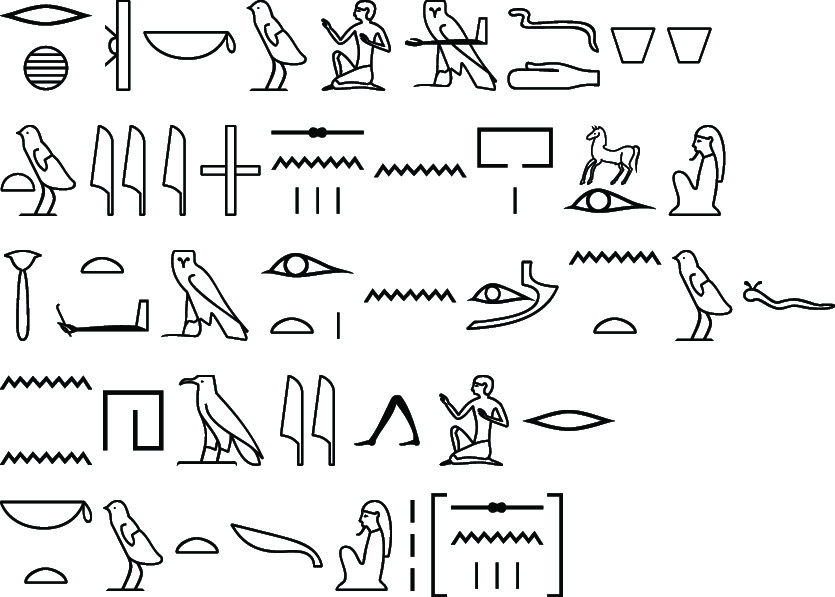
There are a few problems with your string of Egyptian hieroglyphs. making it apparent this is a Chat GPT construct, or some other AI disaster. There are 20 total characters in your string [you may think there are 22, but two sets, #'s 13/14, and 15/16 are really intended to be two-character ligatures, which are infrequently used in Egyptian, but they do occur. So, by the characters in your sequence:
[1] [S29] should be a single line as shown at left to match all other characters in your string, not an outline, unless all other characters are also outlines. No ancient scribe, nor modern Egyptologist would or should blend the two styles.
[2] Characters 2,4,5,6,8 & 9, [X1, V31, N17, Aa1, Aa1] should not be represented by baselines that wander up and down within the vertical space occupied by those characters. They should be either all grounded on a common baseline, or a common line roughly in the vertical middle of the rest of the characters. There are further characters violating this rule, but those identified are sufficient to demonstrate lack of proper writing.
[3] Character 4 [V31] is backward. There are rules in ancient Egyptian of reading direction, and the characters face one direction if read left-to-right, or another direction R-to-L. All other characters face appropriately for L-to-R. They face to left if read L-to-R. An educated ancient scribe or modern Egyptologist would know this. The handle of the basket of V31 is to the right, therefore, to be read R-to-L, but the balance of the string is read L-R.
[4] Some characters, for compaction of space, should be stacked, such as #5/6 [N29, Aa1], one over the other, and minimized I'm size, or squeezed to fit in the vertical space. There are 3 other examples in this string.
As it happens, character [16], is a proper ligature.
Characters 18, 19 [G4, G1], in order, a buzzard and a vulture, do not appear together as represented here to form any word in ancient Egyptian. They are similar in appearance, and easy to confuse, but no skilled scribe would combine these two characters because of their distinct usage patterns. Two vultures together [G1] is, however, a common pairing. However, the previous 4 characters of the string do not form any ancient Egyptian word, or words in combination with the last characters. It's possible your two [18, 19] characters are really a vulture [G1] and a falcon [G5], but the same conditions as above are for this combination, as well.
S29 X1 V31 N29 Aa1 G4 G1 G5

Old Chinese proverb: when the finger points to the moon, the unlearned child looks at the finger.