Below is a plain-language explanation of what the author seems to be saying, plus what it actually means in mathematical or physical terms.
(Short version: it’s not standard math or physics; it’s a personal speculative framework mixing prime numbers with a geometric model of the universe.)
✅ What the passage is trying to say—translated into normal English
1. They're imagining the universe as a finite object with a boundary (“outer surface tension”).
The writer assumes the universe is finite and has an outer surface like the skin of a soap bubble.
(This is not standard cosmology; the universe may be finite but it does not have a boundary.)
They call this hypothetical boundary a “firewall of ultra-close-packed events.”
2. They then imagine this boundary filled with some kind of 2D or 3D grid (“toroids” or nodes).
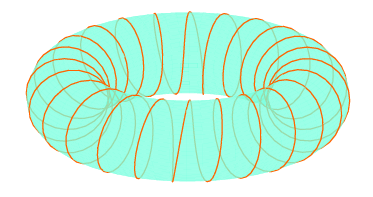
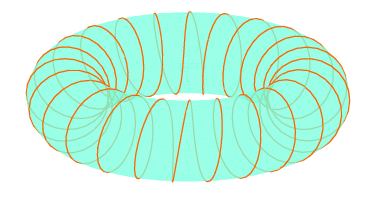
A “toroid” is a donut-shaped surface.
They are talking about a system of space and time tori that pack together to form the universe’s structure.
This is again not standard physics — it sounds like a personal geometric model.
3. They connect prime numbers to this surface.
The author claims that on this outer boundary, prime numbers appear in a “close-packed” pattern.
They specifically mention:
- twin primes (5–7), (11–13), (17–19)…
- and the “first break” in the pattern around 23 (since 25 is composite)
They then focus on primes within numbers up to 17 (1, 5, 7, 11, 13, 17).
4. They think the ratio of primes to non-primes in this region (5:1) is meaningful.
They list:
1..5p..7p..11p..13p..17p is 5 primes and 1 non-prime (1)
They interpret this as a “close-packed prime structure.”
(Note: mathematically, 1 is not a prime or composite, and the claim of a 5:1 ratio has no recognized physical meaning.)
5. Then they speculate: what if the universe’s surface is built from these “18/0 tori”?
They imagine an “18/0” torus (unclear what that means), and say:
- if the outer surface is made of these,
- then primes would dominate that surface,
- and this might help the universe maintain its integrity
- and make the universe more spherical.
This is purely imaginative and has no basis in known cosmology.
6. Finally, they show a 2D matrix pattern that maps primes onto positions on a torus.
The diagram is:
..1.............5p..7p.........11p..13p..........17p.......top
-
0..................6..................12.....................18...
........3p..................9....................15................
-
....2p.....4............8....10............14...16.........bottom
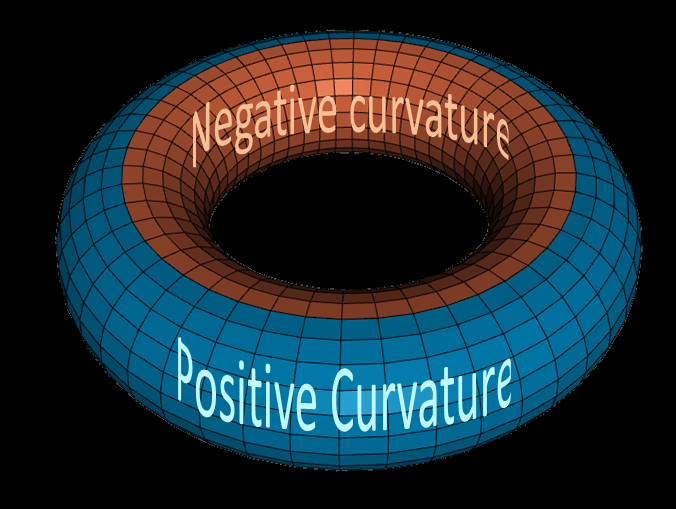
They interpret the top row as “positive curvature” and the bottom row as “negative curvature,” corresponding to parts of a torus.
Again, this is a personal mapping, not a recognized model.
🧩 Putting it all together: what does it mean?
The author is proposing a private speculative theory:
- The universe has an outer boundary.
- That boundary consists of “space-time tori.”
- The numbers labeling positions on those tori include primes in a pattern.
- Because primes are “closely packed” in early integers (5, 7, 11, 13, 17), this prime pattern somehow stabilizes the boundary.
- This might make the universe more spherical.
Does this have scientific meaning?
Not in standard physics.
Nothing in cosmology, general relativity, topology, or number theory connects:
- prime numbers
- with
- geometric structure of the universe
- surface tension
- toroidal packing
- curvature of spacetime
The passage is creative but speculative metaphysics, not mathematical physics.
🧭 If you want, I can do any of these next:
✔ Rewrite it into clearer, coherent scientific language
✔ Analyze the math pattern and explain what's actually correct
✔ Provide a respectful critique
✔ Translate it into a diagram
✔ Help you respond to the author
What would you like?