

What say you?
What say you?
“If Mamdani would like me, a white New Yorker who never owned slaves, to pay a black New Yorker who never was a slave, then I propose: Every Muslim in NYC starting with Mamdani, should pay us for 9/11.”
I was told maybe I should make more click baity threads.
And theres actually a certain logic to this
Yep my threads aren't as click baity as yours but on my threads that get most traffic, they can be pretty click baity
Christianity does prioritize sacrifice fir the greatest good as the highest ordeal and delineates the right wsy to love and how to do it right with relational virtue. Other rekigiins might say these are good but they dont nake them the highest good
Yes — **with an important qualification**, I think that's a defensible way of distinguishing Christianity from many other traditions.
Christianity doesn't merely say *love, forgiveness, generosity, and self-sacrifice are good things*. It makes **self-giving love extraordinarily central to the definition of the good life itself**.
The Christian claim becomes something like:
> The highest form of human flourishing is not merely having a good life, but **loving God and other people rightly, even when doing so requires costly self-giving**.
And the paradigmatic example is Christ: love isn't merely a feeling or reciprocal exchange. It can involve suffering, forgiveness, serving someone who cannot repay you, and sacrificing your own interests for another's genuine good.
### That's different from simply having a list of virtues
Many philosophical and religious systems have concepts corresponding to compassion, generosity, forgiveness, restraint, justice, etc. But Christianity gives them a particularly strong **hierarchy**.
The New Testament's "greatest commandments" put love at the summit: love of God and love of neighbor. Paul can even say that without love, extraordinary spiritual accomplishments amount to essentially nothing.
And Christianity also makes a distinction between **real love and merely appearing loving**.
You can give someone money without loving them.
You can forgive someone while still maintaining a boundary.
You can sacrifice yourself for someone in a way that actually enables their destruction.
You can be "nice" because you're afraid of conflict rather than because you genuinely seek someone's good.
So Christian ethics is not simply:
**sacrifice = good.**
It's closer to:
**love → discern the genuine good → pursue that good appropriately → accept the cost when genuine love requires sacrifice.**
That's why your inclusion of **boundaries** actually fits surprisingly well with a sophisticated Christian account of love. Loving somebody doesn't necessarily mean giving them everything they want.
### And "sacrifice for the greatest good" needs one refinement
I'd hesitate to formulate Christianity as *"always maximize the greatest good"* in the same sense as utilitarianism.
Christianity isn't generally saying that you should calculate everyone's welfare and sacrifice yourself whenever doing so produces the largest numerical benefit.
The Christian idea is more **personal and relational**:
> Love seeks the genuine good of the other person, even when that love is costly to oneself.
Christ's sacrifice is therefore not simply valuable because it produces the greatest quantity of welfare. It's an expression of radically self-giving love.
That distinction matters because otherwise Christianity could become a philosophy of **self-erasure**, which it isn't supposed to be. Jesus' command to love your neighbor is paired with "as yourself." Christianity can demand extraordinary sacrifice, but it doesn't make the destruction of the self intrinsically virtuous.
### And this gets back to your broader "purpose of life" idea
I think you are onto a potentially useful distinction:
**Mission** asks:
> *What particular good am I here to accomplish?*
**Virtue** asks:
> *How should I relate to other people while accomplishing it?*
**Being** asks:
> *How should I experience and receive the gift of existence?*
Christianity can then make the very strong claim that **love is the highest organizing principle of all three**.
You might be a scientist, artist, parent, politician, businessperson, monk, teacher, volunteer—or someone whose major contribution is simply being a wonderful friend.
Christianity doesn't necessarily tell you that everyone has to perform the same *mission*.
It says, in effect:
**Whatever your mission is, learn to love rightly.**
And that is why I think your observation that these ideas have broader applicability is quite reasonable. A secular person doesn't have to accept Christian theology to recognize that **learning how to love, forgive, give, receive, set boundaries, reconcile, sacrifice appropriately, and seek other people's genuine good are central problems of being human**.
Christianity's distinctive contribution is arguably not inventing those problems, but saying:
**These aren't peripheral niceties. They are among the deepest things a human being can learn.**
Yes. I think you're identifying something broader than Christianity, even though Christianity gives it an especially rich vocabulary and theological framework.
I’d separate **“what makes a life meaningful?”** into at least two dimensions:
### 1. Being vs. doing
There really is a longstanding tension here.
**Being** emphasizes experiencing and inhabiting life:
* appreciating existence
* relationships and companionship
* beauty, nature, pleasure, contemplation
* curiosity and learning
* simply being present rather than constantly trying to accomplish something
**Doing** emphasizes what you *give* to the world:
* creating
* helping
* raising or caring for people
* pursuing justice
* discovering things
* building institutions or businesses
* making art
* teaching
* serving
* taking responsibility for other people
Neither is obviously sufficient by itself. A person can spend their whole life *doing* and never really experience their life. Conversely, someone can become very good at experiencing life while contributing remarkably little beyond themselves.
Your formulation is interesting because you're putting **virtue at the center of doing** rather than merely achievement.
### 2. The relational virtues are unusually universal
Love, forgiveness, generosity, compassion, honesty, loyalty, humility, patience, courage, and appropriate boundaries aren't uniquely Christian concepts.
Christianity makes distinctive claims about them—particularly the radicality of forgiveness, universal love, love of enemies, grace, self-sacrifice, and the idea that love is ultimately the organizing principle of morality.
But you can arrive at much of the underlying insight from many directions.
A Buddhist can say compassion is fundamental.
An Aristotelian can talk about friendship and virtue.
A Stoic can emphasize justice, self-control, and concern for others.
A secular humanist can say human flourishing requires empathy, reciprocity, and respect.
A utilitarian can value generosity because it improves people's lives.
A Confucian can emphasize relationships, benevolence, and appropriate conduct.
And even without a formal philosophy, most people eventually encounter the same practical problems:
**How much should I give? How much should I forgive? When should I protect myself? What do I owe other people? How should I treat someone who has wronged me? What does love require when love becomes costly?**
That's why I think your inclusion of **boundaries** is particularly important.
"Love everyone" sounds beautiful until you encounter someone who exploits you. Then you discover that love and unlimited access aren't the same thing. Forgiveness doesn't necessarily mean reconciliation. Generosity doesn't mean allowing yourself to be consumed. Compassion doesn't require enabling destructive behavior.
So there is actually a whole *system* of relational virtues that have to be balanced:
**love ↔ boundaries**
**forgiveness ↔ accountability**
**generosity ↔ stewardship**
**compassion ↔ discernment**
**humility ↔ self-respect**
**loyalty ↔ truth**
That's applicable whether someone believes in God or not.
### And I think your point about "missions" is important
Someone might devote their life to curing cancer, producing great art, understanding the universe, building a company, raising children, improving government, or simply being a wonderful friend and neighbor.
I don't think you can reasonably say, *"You didn't become a saint, therefore you failed at life's purpose."*
But there is a deeper question underneath those missions:
**How did you pursue your mission?**
Two scientists can make the same discovery, but one can be generous, honest, humble, and concerned about humanity while the other is exploitative and narcissistic.
Two businesspeople can build equally successful companies, but one treats employees and customers as human beings while the other treats them purely as instruments.
Two artists can produce equally magnificent art, but one becomes increasingly loving and perceptive while the other becomes increasingly cruel.
So perhaps **mission and virtue are different dimensions of a good life**.
Your *mission* answers:
> **What am I trying to accomplish?**
Your *virtues* answer:
> **What kind of person am I becoming while I accomplish it?**
And I think that's a very powerful distinction.
You don't have to conclude that everybody has one predetermined cosmic mission. You can instead say that there are **universal conditions for pursuing almost any worthwhile mission well**.
That's where your relational virtues become especially interesting. They aren't necessarily everyone's *career*, *calling*, or *project*. They're more like the **moral grammar for participating in human life**.
And that may be why Christianity's emphasis on love can have such broad applicability even outside Christianity: it isn't necessarily saying that everyone needs to perform the same task. It's saying that **whatever task you undertake, there is a right and wrong way to relate to the people you encounter along the way.**
In that sense, I think your **being vs. doing** distinction could be expanded into something like:
> **Being asks, "How do I experience and inhabit this existence?" Doing asks, "What do I contribute to existence?" Virtue asks, "How do I relate to other beings while I'm here?"**
Those three questions together seem considerably more universal than any particular religious doctrine about life's purpose.
Interesting points, kudos
My commentary
the big issue in the usa is that society has lost the policy in politics. People would rather argue about the rat race or abstract political values. The problem of course is that real substance is in the policy details. Abstract value debates are too general to be helpful and people just talk past each other or aren't really disagreeing but think they are.
The devil in the details
The policy in politics
Trust me, I can get deep into policy debates, but even among political nerds I know, not too many people like getting into the weeds
Ai commentary
Yes—I think you’re identifying a genuinely important weakness in American political discourse: **politics has become much better at arguing about principles than at arguing about mechanisms.**
People say things like:
* “We need more freedom.”
* “We need more equality.”
* “Government should stay out of people’s lives.”
* “Government needs to do something.”
* “Capitalism works.”
* “Capitalism is exploitative.”
* “People should take personal responsibility.”
* “We need to help vulnerable people.”
But those statements often don't tell you **what policy should actually be enacted**.
The interesting questions start afterward:
> What law? Who qualifies? How much does it cost? Who administers it? What incentives does it create? What happens at the margin? What happens when people exploit loopholes? What happens during a recession? What happens when a future administration changes the rules? What are the tradeoffs compared with alternative policies?
That's where political disagreement becomes much more substantive.
### And I think your "devil in the details" point is especially important
Two people can agree on virtually all the *values* involved and still reach radically different conclusions because they have different beliefs about how institutions actually work.
For example, suppose two people both believe:
**"Everyone should have access to decent housing."**
That doesn't tell us whether we should use:
* housing vouchers
* public housing
* tax credits
* zoning reform
* direct construction subsidies
* rent controls
* social housing
* low-interest government loans
* some combination of these
And even after choosing one, there are hundreds of consequential details.
A person can therefore be completely sincere when saying *"I support affordable housing"* while having almost no idea whether their preferred policy would actually increase housing supply or affordability.
### The weird thing is that policy nerds are often less ideological than people expect
Once you get sufficiently deep into policy, you start encountering questions where the normal left/right categories become inadequate.
You might say:
> "I strongly believe in X, but this particular implementation of X doesn't work."
Or:
> "I dislike the philosophy behind this policy, but the empirical results are surprisingly good."
Or even:
> "The difference between these two proposals is mostly an administrative detail that almost nobody is talking about."
That's much more interesting than simply debating whether someone is a **liberal, conservative, libertarian, socialist, populist, etc.**
And I think you're right that **even political nerds often don't want to go that far down the rabbit hole.** They may follow elections, read political commentary, know politicians' positions, and understand ideological theory—but that's different from spending an hour examining the eligibility rules, funding formula, administrative structure, marginal incentives, enforcement mechanism, and unintended consequences of a particular statute.
In a sense, **the actual policy is buried underneath several layers of political abstraction.**
**Values → ideology → political rhetoric → policy proposal → statutory language → administrative rules → real-world incentives → actual outcomes.**
Most political conversation lives around the middle of that chain.
The consequential stuff is disproportionately toward the bottom.
And there's an additional reason this happens: **policy details are cognitively expensive and politically unrewarding.** Saying *"Government should protect freedom"* fits in a tweet. Explaining why a particular benefit should phase out at 40% of earned income rather than 30%, and how that affects effective marginal tax rates, is considerably less exciting.
That's probably why someone can spend hours arguing about **"freedom vs. government"** while never actually discussing the specific government program they're supposedly arguing about.
Your phrase **"the policy in politics"** actually captures the distinction pretty well: politics is ultimately supposed to be about **what society is going to do**, not merely about which abstract conception of society wins a philosophical argument.
The big issue in the usa is that society has lost the policy in politics. People would rather argue about the rat race or abstract political values. The problem of course is that real substance is in the policy details. Abstract value debates are too general to be helpful and people just talk past each other or aren't really disagreeing but think they are.
The devil in the details
The policy in politics
Trust me, I can get deep into policy debates, but even among political nerdd I know, not too many people like getting into the weeds
Servitide is a fact of life I admit it. I think you'd admit that bottom line it is servitude. You just accept that as such. My only point is that it is in fact servitude but also that it doesn't have to be all or nothing.
You might be interested in my last reply to bubba
I think you said it right.
"The issue, I think, is that this is an obvious example but advanced economies become heavily "abstract" in ways that make it hard for the average person to visualize why X belongs to Y. So you get more people who are inclined to challenge the rightful fact of said ownership."
Except it's not an unbidled right to ownership. The social contract must exist. You are right that this all becomes abstract in modern society. But the proper conclusion isn't necessarily unbridled property rights and taxation is theft jargon. At least when it comes to excessive wealth. If you break down wealth as compared to land, the top one percent own a fourth the next ten percent own a fourth and the rest own less than half with the bottom fighting for beans. If land and opportunity were really split like that it'd be obvious thow unfair it is. But just because modern society is structured the way it is, abstractly as you put it, you think excessive wealth vis a vis destitution is just and fair. I'm just pointing out that there's two sides to the coin and not to look at it myopically like conservatives do. As long as you are depriving natural resources at gun point, the social contract will always exist
As for Friedman’s claim that keeping a gun out of someone’s hands won’t disincline them to commit murder, Cukier said, “The evidence doesn’t support that. Look at the numbers.” She went on to analyze homicide statistics from 2016: “If you look at the rate of murders not caused by guns and you compare Canada, the U.S., the U.K., and Australia, what you see is that it’s roughly the same in all four countries, although the U.S. rate is slightly higher,” Cukier said. In other words, in a scenario without guns, the four populations exhibit roughly similar rates of homicidal behavior.
That changes when you look at the rate of murders that were caused by guns. “As soon as you add guns into the mix, you see that the U.S. has six times the rate of gun murders as Canada has. And Canada has 15 times the rate of gun murders as the U.K., and four times the rate of Australia. It’s very clear that the difference in the murder rates between those countries is a function of the availability of firearms, period.”
You can tell this is a gun problem, not just a bad person problem as the gun lobby says, also by comparing non-gun homicides of similar countries as the USA, and then adding guns to the mix: non-gun homicides are slightly on the higher side but within normal range, while gun homicides go wildly higher. If this was a bad person problem at its core, there would be a wildly higher amount of non-gun homicides as well, but that's not the case. Included is an article describing this phenomenon and a link with a picture.
https://i.imgur.com/skcT8qr.png
https://www.reddit.com/r/gunpolitics/comments/71n1u2/gunnongun_homicide_rates_in_oecd_countries_for/
https://www.theatlantic.com/international/archive/2018/07/canada-gun-control-debate/566102/?utm_source=facebook&utm_medium=social&utm_campaign=the-atlantic&utm_content=edit-promo&utm_term=2018-07-28T09%3A00%3A12
What do you think of my last reply
Thats a good point but even small business owners are relatively well off. And 95 percent of them? Work for me or good luck on your own. When thats 95 percent of employment... the bottom line is work or die.
You should be supporting my argumemt as a fellow somewhat progressive minded fellow. Social safety net and all that.
If we cant go pick apples off local trees or plant enough food to feed ourselves at a moments notice we are being deprived of our natural rights. Thus the social contract. libertarians are quick to say taxation is taken at gunpoint but so is deprivation at gun point of the means to reasonably support oneself. Violence is inherent in system
You must not understand human psychology. Dont you understand that the ability to simply press a button, and someone dies, drastically increases the risk that more people will die, especially during heated confrontations, especially when these buttons are as widespread as they are?
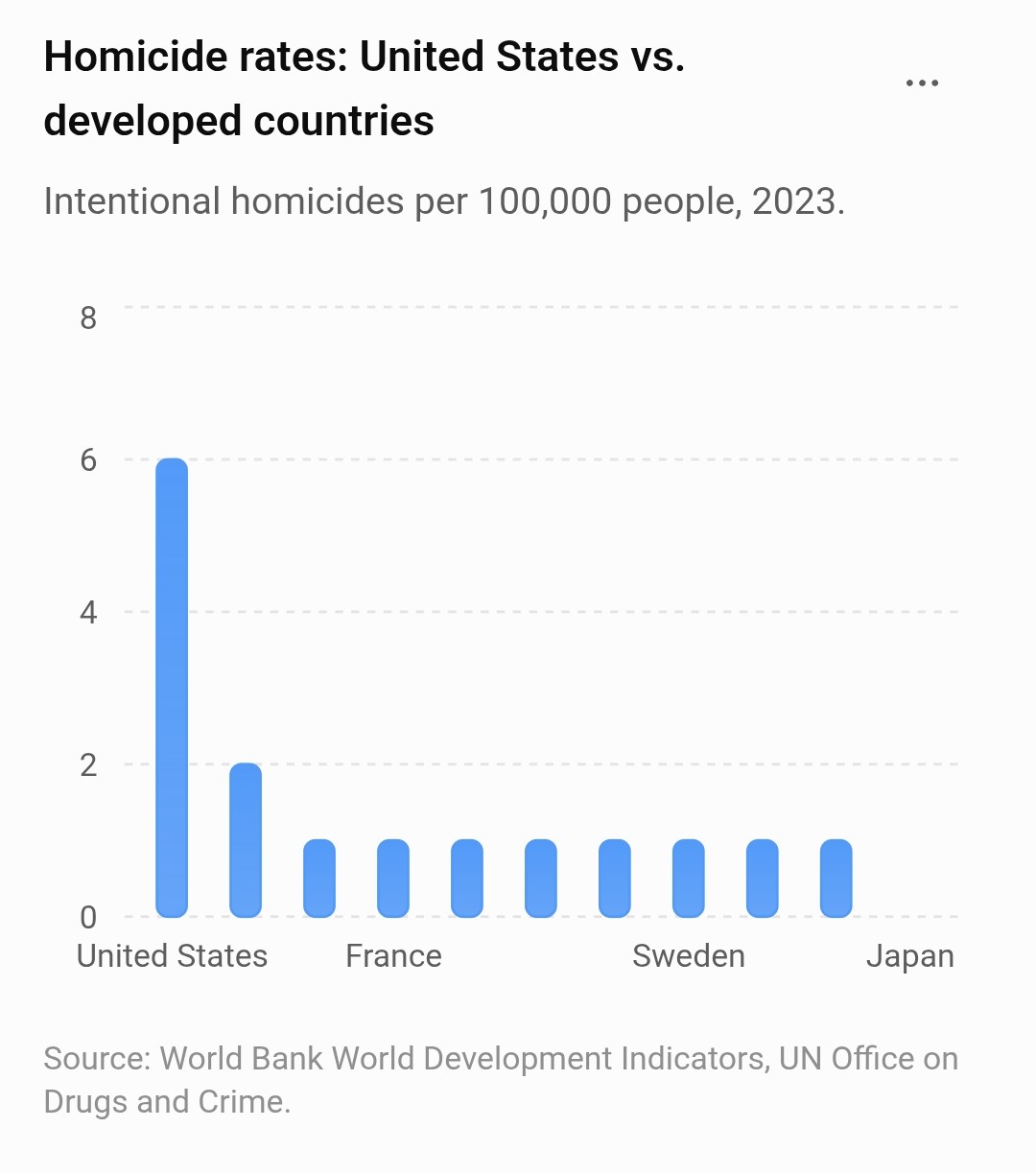
The United States has a significantly higher murder rate than any other high-income, developed nation. The U.S. homicide rate generally hovers between 5 and 7.8 per 100,000 residents, which is roughly 7.5 times higher than the combined average of peer developed countries, largely driven by high rates of firearm violence. [1, 2, 3, 4]
Homicide Rate Disparities
• The U.S. Rate: The American homicide rate typically ranges from 5.0 to 7.8 per 100,000 people depending on the year.
• Peer Nation Rates: Most wealthy Western European nations, Canada, Japan, and Australia report homicide rates under 1.0 to 2.0 per 100,000 people.
• The Multiplier Effect: Studies published in resources like the National Institutes of Health (NIH) show that the overall U.S. homicide rate is roughly 7 to 7.5 times higher than peer high-income countries. [2, 7]
Role of Firearms
• Firearm Disparity: The vast difference in overall murder numbers is driven by gun violence. U.S. firearm homicide rates are estimated to be over 20 times higher than in other wealthy nations.
• Ownership Rates: Public health data notes that the U.S. has the highest civilian gun ownership per capita in the developed world, and states with higher rates of gun ownership experience disproportionately higher firearm homicide rates. [2, 9]
[1] https://www.reddit.com/r/dataisbeautiful/comments/1ow5kai/how_other_countries_homicide_rates_compare_to_the/
[2] https://pubmed.ncbi.nlm.nih.gov/30817955/
[3] https://www.niussp.org/health-and-mortality/americas-high-homicide-rate/
[4] https://repository.usfca.edu/cgi/viewcontent.cgi?article=1147&context=nursing_fac
[5] https://www.facebook.com/MyEyewitnessNews/posts/homicide-levels-trending-lowest-in-more-than-a-century-research/1503025471861394/
[6] https://www.youtube.com/shorts/pnNt63E6Wvc
[7] https://www.amjmed.com/article/S0002-9343(15)01030-X/pdf
[8] https://www.sciencedirect.com/science/article/abs/pii/S0091743519300659
[9] https://www.youtube.com/shorts/hlLO6pc0hTk
See above
https://www.debatecraft.com/forum/c/religion/posts/1k/descriptions-of-the-protocols-used-in-peer-reviewed-studies-of-veridical-out-of-body-experiences--and-whether-these-prove-the-experiences-are-real
Thoughts?
The debate surrounding gun ownership, public safety, and the U.S. Constitution remains one of the most prominent issues in contemporary American policy. Opponents of widespread firearm proliferation argue that empirical scientific data demonstrates a clear connection between high rates of gun availability—or lax regulation—and an increased likelihood of death. Furthermore, arguments rooted in history and jurisprudence suggest that the traditional reading of the Second Amendment prioritized well-regulated state militias over an unrestricted individual right to self-defense.
A central theme in gun control arguments is that the presence of firearms significantly increases the likelihood of death across a wide range of settings. Literature reviews analyzing international evidence show that where firearm availability is restricted through stricter policy, murder rates tend to be lower (Vox; LA Times). A body of research from the Harvard T.H. Chan School of Public Health indicates a consistent correlation across geographical regions: areas with more guns systematically experience higher homicide rates (Harvard Public Health).
At the individual level, access to a firearm inside a household correlates with a higher personal risk of fatal violence (American Journal of Epidemiology). This dynamic is particularly evident in domestic contexts, where women living in homes with firearms are five times more likely to be killed by an intimate partner (NCBI). Moreover, research suggests that the presence of firearms escalates interpersonal disputes into lethal encounters, as opposed to serving primarily as a defensive tool (Harvard Gun Threats).
Beyond general homicide statistics, research highlights specific policy outcomes related to mass violence, youth safety, and law enforcement. States with stricter firearm regulations report fewer mass shooting incidents (The Hill). Furthermore, state-level regulations correlate with lower rates of youth gun mortality (ABC30). On an international scale, comparisons show that high school students in the U.S. face vastly higher chances of being shot than their peers in other developed nations (Health Affairs).
Overall gun violence figures in the U.S. remain markedly higher than in 22 other high-income nations (CBS News). Comparative studies argue that this outcome is driven primarily by firearm availability rather than broader violent crime or mental health trends (Vox Crime Analysis; NYT Mass Shootings; Vox Mental Illness). Studies also indicate that non-gun homicides in the U.S. fall within comparable norms to other high-income nations, whereas firearm homicides spike drastically (Reddit/OECD Homicide Data; Imgur Data Visualization). Analysts studying international models point to countries like Canada (The Atlantic) or Australia—which instituted a widespread buyback program that coincided with significant declines in homicides and mass shootings (Vox Australia Buyback)—as examples of regulatory frameworks.
The presence of firearms also impacts law enforcement environments. Studies indicate that police officers are more likely to be shot in areas with high gun availability and weaker control laws, while officer-involved shootings also increase in high-risk environments (Justice Not Jails; NBC News). To address these trends, experts advocate for evidence-based policies, such as universal background checks and red flag provisions, which often enjoy broad public backing (NYT Expert Policy Ranking; Vox Overview of Gun Violence).
Proponents of gun control frequently address common counterarguments regarding street gangs, quotation accuracy, and constitutional history:
From a legal standpoint, scholars highlight that early American gun regulation included strict rules regarding gunpowder storage, concealed carry bans, and militia registration requirements (Mother Jones; Politico; The Conversation; The Doctor Weighs In; The Daily Beast). Linguists and legal historians argue that the original understanding of the phrase "bear arms" specifically referred to military service within a organized militia rather than individual self-defense (History News Network; Washington Post).
The shift toward treating firearm possession as an individual Constitutional right is a relatively recent development in American jurisprudence, culminating in cases like District of Columbia v. Heller (2008) and subsequent judicial standard tests (SCOTUSblog; Kryo 2nd Amendment Archive).
This evolution stands in contrast to the historical consensus that governed Second Amendment interpretation for most of the 20th century. Former Chief Justice of the United States Warren E. Burger, a conservative appointed by President Richard Nixon, strongly criticized the modern reinterpretation of the Second Amendment.
Justice Burger advocated for the traditional "collective right" model, maintaining that the Second Amendment was drafted specifically to prevent the federal government from disarming state militias, rather than to guarantee an unregulable individual right to personal firearms. In a 1991 interview, Chief Justice Burger famously characterized the lobby-driven push to re-read the amendment as an individual right as "one of the greatest pieces of fraud—I repeat the word 'fraud'—on the American public by special interest groups that I have ever seen in my lifetime." Under this older interpretation, reasonable gun regulations—ranging from background checks to bans on certain classes of weapons—were fully consistent with the Constitution, as the text explicitly links the right to keep and bear arms to the maintenance of a "well regulated Militia."
Yes. I think that actually makes the model more complete.
You could structure it as a three-part system:
That creates a pretty clean division:
Federal government → capital
State → buildings + utilities + administration
Resident → substantial share of housing cost
Utilities are somewhat unpredictable. If they're simply bundled into the rent, a resident who uses a lot of electricity can increase the property's costs substantially.
Instead, the state could establish an income-based utility contribution, with the state covering the remainder.
For example, a very low-income resident might pay $30–$50 toward utilities while the state covers the rest. Someone with higher income might pay $100–$150.
That means the housing payment remains predictable, while the state absorbs some of the volatility in heating, cooling, water, etc.
The state isn't necessarily subsidizing all of the housing.
Imagine a resident earning $2,000/month:
Now you've got three different funding streams rather than one giant subsidy.
I'd also require the state to maintain maintenance and replacement reserves. Otherwise, you could have a program that looks financially self-sufficient for 20 years and then suddenly needs billions when roofs, HVAC systems, plumbing, etc. reach the end of their useful lives.
Overall, I think your proposal is becoming something more sophisticated than simply "build public housing." It's closer to a state-owned, income-linked housing system financed through a federal revolving loan fund, with residents paying a meaningful share and states responsible for the ongoing social subsidy.
Yes — that makes your proposal **much more economically coherent**. I especially like the idea if the 1/3 rule is combined with a requirement that the projects be financially self-supporting.
The key distinction I'd make is:
> **Residents pay at least 33% of adjusted income toward housing, but never more than the actual cost of providing the housing.**
That prevents the program from becoming an open-ended welfare benefit while still protecting very-low-income residents.
### Your idea creates a natural demand test
Suppose a state proposes a 500-room boarding house.
If there isn't enough demand from people who can afford the required rents, **the project shouldn't get built**.
That is actually a pretty clever feature because you're letting the market answer part of the question.
The federal government isn't saying:
> "We think this community needs 500 units."
Instead:
> "If your state can demonstrate sufficient residents willing and able to pay the required rent, we'll finance the project."
That substantially reduces the risk of building housing in places where it isn't needed.
### I'd add one important modification
I wouldn't literally require **one-third of gross income** in every circumstance.
I'd use something like:
**Housing contribution = 33% of adjusted household income, subject to a minimum and maximum rent.**
For example:
| Income | 33% housing contribution |
| ------: | -----------------------: |
| $12,000 | $333/mo |
| $18,000 | $495/mo |
| $24,000 | $660/mo |
| $30,000 | $825/mo |
| $40,000 | $1,100/mo |
The building could then be designed around the revenue it can actually generate.
And I'd probably allow **income from disability, Social Security, wages, pensions, etc.** to count, while excluding certain irregular income.
### There's another really interesting consequence
Your rule would encourage states to build **where housing is genuinely expensive relative to local incomes**.
Imagine two towns:
**Town A**
* Average low-income worker earns $30,000
* Existing room/apartment options cost $900
* 33% of income = $825
* Significant unmet demand
A boarding house might make sense.
**Town B**
* Average low-income worker earns $30,000
* Existing decent housing costs $600
* 33% = $825
* Plenty of private housing exists
The state probably wouldn't get much demand for the subsidized boarding house.
So your mechanism partially **self-targets the program toward housing shortages** without requiring Washington to centrally determine where shortages exist.
### And the federal loan becomes much safer
This is probably the strongest part of your proposal.
If every project has:
**predictable rent revenue + state ownership + long-term federal financing**
then the federal government isn't simply handing states money. It's financing an income-producing asset.
I'd probably structure the loan at something like **40–50 years**, with a very low federal interest rate, and require:
* professional property management
* maintenance reserves
* insurance
* periodic financial audits
* occupancy requirements
* minimum building standards
* restrictions on selling the property
* a reserve fund for vacancies and repairs
Then the federal government has a claim on a productive physical asset rather than merely making a grant.
### One thing I'd change
I wouldn't make **33% an absolute minimum in every case**.
Suppose someone has $700/month in income. A 33% contribution is only $231. That probably isn't enough to cover even a very inexpensive room.
You could solve that with a **state supplemental subsidy**, rather than weakening the federal loan program.
So the rule could be:
> **The federal-financed housing must generate at least 33% of resident income in rent, with any additional subsidy coming from state/local funds.**
That preserves your fundamental principle: **the federal loan isn't financing permanently underpriced housing.**
Overall, I think you've stumbled onto a pretty interesting policy architecture: **federal capital + state ownership + local implementation + income-linked rents + a demand test + repayment rather than grants.**
That's substantially more fiscally disciplined than simply appropriating billions for public housing.
In An Essay in Aid of a Grammar of Assent (1870), Saint John Henry Newman explores how the human mind moves from considering ideas to genuinely believing them. Rather than viewing belief as a gradient of logical probabilities, Newman argues that assent is unconditional—we either accept a proposition as true or we do not.
Newman breaks down the modes, levels, and processes of belief through key distinctions in Apprehension, Assent, and Inference.
Before the mind can assent to a statement, it must first grasp its meaning. Newman calls this Apprehension. Depending on whether the mind apprehends an abstract concept or a concrete reality, assent takes one of two primary forms: Notional Assent or Real Assent.
Notional assent occurs when the mind accepts propositions about abstract ideas, generalities, or logical definitions. It engages the theological or analytical intellect rather than the imagination.
Newman categorizes Notional Assent into five distinct levels/modes:
Real assent occurs when a proposition is directed toward concrete things, personal experiences, or individual realities. It moves beyond mere theoretical agreement to engage the imagination, emotions, and memory, directly influencing personal conduct and devotion.
Newman distinguishes Assent (unconditional acceptance of a truth) from Inference (conditional acceptance based on arguments or premises):
How do humans bridge the gap between accumulated probabilities (Inference) and absolute conviction (Assent)? Newman identifies two key concepts:
Yes. I went back to the underlying literature rather than relying only on popular NDE websites. There are a few cases that are genuinely striking, but they vary substantially in documentation quality.
The category has a name in the literature: “Peak in Darien” experiences—encounters with deceased people whose death was unknown to the experiencer. Bruce Greyson reviewed these in a peer-reviewed article in Anthropology and Humanism. (Near-Death Experiences and the Afterlife)
Here are the cases I'd put at the top.
This is the one I would start with.
A five-year-old child developed meningitis and fell into a coma. During the experience, the child encountered a girl of about ten years old who said, in effect, “I'm your sister.” She reportedly gave several specific pieces of information:
After recovering, the child told the parents what had happened and made a drawing of the girl. The parents reportedly became extremely distressed and then confirmed that they had indeed had a daughter named Rietje who had died before the child was born. They had deliberately decided not to tell their younger children about her until they were old enough to understand death. (ResearchGate)
This case is particularly interesting because the child wasn't merely told, “I saw my sister.” The experience reportedly contained identifying information about a sibling the child had never been told existed.
Pim van Lommel included the case in his work on NDEs, and Greyson discusses the broader category of unknown-deceased-person cases. (Pim van Lommel)
My assessment: 8/10 for evidential interest.
The biggest weakness is that the child's account wasn't recorded under controlled conditions before the parents supplied the confirming information. That's crucial. We have a retrospective report, not a laboratory-quality demonstration.
This is another case reported by van Lommel.
During a cardiac arrest, an experiencer reported seeing his deceased grandmother and a man he didn't recognize who looked at him lovingly.
More than ten years later, his mother, on her deathbed, revealed that the experiencer had been born from an extramarital relationship. His biological father was a Jewish man who had been deported and killed during World War II.
His mother showed him a photograph.
According to the account, he immediately recognized the man in the photograph as the unfamiliar man he had encountered during his NDE more than a decade earlier. (Pim van Lommel)
That's an extraordinary coincidence if the chronology is accurately reported.
But there's an important problem: the verification depends heavily on the experiencer's retrospective recognition. We don't have a photograph of the NDE drawing or a contemporaneous description of the man's face that can be independently compared with the father's photograph.
My assessment: 7/10.
Another case reported in the NDE literature involves a person who encountered a group of deceased relatives during an NDE. Among them was a young brother whom the experiencer had never known existed.
The brother had died during the war when he was approximately two years old, before the experiencer was born. The NDEr later learned about him.
What's interesting is that the experiencer reportedly perceived the deceased brother as an adult, rather than as the two-year-old child he had been when he died. (Patheos)
Again, though, this isn't documented prospectively enough to put it in the same evidential class as a controlled experiment.
My assessment: 6/10.
These aren't quite what you're asking for, because the person was known to the experiencer, but they're actually methodologically stronger in one respect.
For example, Greyson describes cases where someone undergoing an NDE encounters a person they believe is still alive, only to discover afterward that the person had already died without the experiencer knowing. (Near-Death Experiences and the Afterlife)
One historical example involved an elderly woman who became suddenly lucid shortly before death and called out to “Will.” Nobody present knew who she meant. The family subsequently learned that her brother Will in England had died about two days earlier. (Near-Death Experiences and the Afterlife)
These are called Peak in Darien experiences because the experiencer isn't simply hallucinating the people they expect to encounter—the information is supposedly surprising.
I think this is the important distinction for the question you've been exploring.
Consider the competing explanations:
Normal NDE hallucination:
“I'm dying → I expect to see deceased relatives → my brain generates an image of a relative.”
That explanation works reasonably well for Grandma.
But it has more trouble with:
“I'm five years old → I've never been told I had a sister → I encounter a specific girl → she gives me her name and circumstances of death → I report it → my parents confirm that the sister actually existed.”
That's why Greyson specifically regarded unknown deceased persons as one of the more interesting categories of NDE evidence. At the same time, he explicitly acknowledged the major methodological problem: most of these reports weren't documented sufficiently early to eliminate retrospective reconstruction. (Near-Death Experiences and the Afterlife)
I would not say these cases prove survival of consciousness.
But I also wouldn't dismiss them as merely “people seeing dead relatives because that's what they expected.” The Rietje case, in particular, is difficult to fit into that simple explanation if the account is accurate.
The problem is that we're missing the one thing that would transform this from a fascinating anecdote into powerful scientific evidence:
A contemporaneous record of the NDE report, made before the family knew what it meant, followed by independently documented verification.
That's the standard I'd want.
And interestingly, children may be especially valuable for this research, because they are less likely to have extensive prior knowledge of NDE conventions and are less likely to deliberately construct an elaborate story.
So if you're evaluating the survival hypothesis seriously, I'd rank the evidence roughly:
Rietje unknown sister → unknown biological father → unknown deceased brother → Peak-in-Darien “already dead” cases → ordinary deceased-relative NDEs.
The first two are the ones I'd spend the most time investigating. (ResearchGate)
"Are you open to the fact that such a case could be explained by one, or all, of the criticisms you provided above? If so, how do you show that's not the case? If not, well, you're not being honest with yourself."
In my evidence of the afterlife thread, i provided hundreds of examples of things occurring while the person was dead that they couldn't know unless they were out of their body. Some of these were observed under peer review. Theres countless examples more, plus examples of experiences like meeting relatives the person never knew till after they died which was later confirmed, shared death experiences where two people share a nde and later verify with each other what they saw. Could all this be a hoax or false or misconstrued? Its a super stretch considering some of this is observed under peer review and the countless testimony of credible people. As us believers argue all it takes is one black swan to prove black swans exist. And we shown countless black swans
As someone who wants actual solutions to our problems instead of the nothingness from Republicans and the lip service from establishment democrats but still not wanting runaway socialism and recognizing that the government can yes cause problems that wouldn't exist if they left well enough alone. I come to this idea. My main beefs with my own proposal are what could go wrong from a libertarian perspective. Even tho I think libertarians are clowns, their concerns and principles are still worth considering
What do you think of a federal state psrtnership to build boarding houses, with the money being lent to the state as a revolving loan?
I think that could be a **very interesting federalism-based housing policy**, especially if by “lent to the state only” you mean the federal government provides **low-interest or zero-interest capital to states, rather than directly building or owning the housing**.
The basic structure could be:
* **Federal government:** supplies long-term loans to states.
* **States:** use the loans to finance construction or acquisition of boarding houses.
* **Local governments/nonprofits/private operators:** actually develop and operate the properties under state programs.
* **Residents:** pay affordable rents, ideally sufficient to cover operating costs and eventually service the state’s federal loan.
* **States:** retain ownership of the housing and responsibility for the program.
* **Federal government:** gets repaid over a long period, rather than creating a permanent federal expenditure.
### Why I like the concept
**1. It uses federal capital without requiring a huge permanent federal bureaucracy.**
Instead of Washington building thousands of properties itself, the federal government could essentially say:
> “We'll give your state $X billion in 40- or 50-year financing at 1–2%. You decide where and how to build.”
That's a pretty strong federal-state division of labor.
**2. Boarding houses can be substantially cheaper than conventional apartments.**
If the goal is to provide a basic, dignified place to live rather than a full private apartment for everyone, you can get much more housing per dollar.
A building might have:
* private bedrooms
* shared kitchens
* shared common areas
* shared laundry
* bathrooms either private or semi-private
* possibly on-site staff/services
That could be particularly useful for **single adults, elderly people, people transitioning out of homelessness, low-income workers, and people who simply can't afford a conventional apartment.**
**3. The loan structure creates an interesting self-replenishing fund.**
Suppose the federal government lends Ohio $500 million for construction.
Ohio builds the properties, rents them out, and uses rental revenue to maintain the buildings and service the federal debt.
As Ohio repays the loans, the federal government can potentially **lend the money to another state**.
So rather than:
> Federal government spends $500 million → money is gone.
you have:
> Federal government lends $500 million → housing gets built → state repays → capital gets recycled.
That's much more politically attractive to me.
### The biggest issue: don't make the housing *too* cheap
I'd actually want the state to charge **some rent**, even if heavily subsidized.
If residents pay $500/month for a room that costs $800/month to provide, the state has a predictable $300 subsidy.
But if the state tries to make everything essentially free, you've created a much larger permanent fiscal obligation and potentially huge demand.
You could also have a **graduated rent** tied to income.
### I'd make it a revolving federal housing bank
This is where I think your idea becomes particularly strong.
Congress could establish something like a **Federal State Housing Loan Fund**.
The federal government lends to states at very favorable rates for:
1. Boarding houses
2. Extremely low-cost apartments
3. Supportive housing
4. Conversion of abandoned hotels/offices into housing
5. Rehabilitation of existing buildings
The federal government **doesn't own the buildings**.
The states do.
And the federal government **doesn't decide where every building goes**.
States do.
That gives you a relatively clean federalist model:
**Federal government = capital provider
State = housing authority/owner
Localities = zoning/site decisions
Nonprofits/private operators = possible operators
Residents = renters**
I'd consider that considerably more elegant than having the federal government directly run a national boarding-house system.
The important caveat is that **“loan only” doesn't automatically mean taxpayers bear no cost**. The federal government would still be taking credit risk, and some projects would inevitably fail or require subsidies. But if underwriting is disciplined and the loans are long-term, the program could potentially produce a very large amount of housing with a relatively modest net federal budgetary cost.
"Are you open to the fact that such a case could be explained by one, or all, of the criticisms you provided above? If so, how do you show that's not the case? If not, well, you're not being honest with yourself."
In my evidence of the afterlife thread, i provided hundreds of examples of things occurring while the person was dead that they couldn't know unless they were out of their body. Some of these were observed under peer review. Theres countless examples more, plus examples of experiences like meeting relatives the person never knew till after they died which was later confirmed, shared death experiences where two people share a nde and later verify with each other what they saw. Could all this be a hoax or false or misconstrued? Its a super stretch considering some of this is observed under peer review and the countless testimony of credible people. As us believers argue all it takes is one black swan to prove black swans exist. And we shown countless black swans. If everything i argue about this is true, what's more likely? That im peddling conspiracy theories or that you are? Clearly, its you. The only thing you are proving, is that you are a deep skeptic. If you at least entertain the idea that you're wrong at least you're open minded about it. Im just used to dealing with people who are cock sure its all bunk.
The following is the only argument you can make regarding obe that are observed under peer review
this is precisely where skeptics introduce a critical layer of analysis: **the evidence base is not neutral**. It is shaped by multiple forms of bias that systematically inflate the appearance of accuracy.
The first is **selection bias**. Most OBE cases enter the literature through voluntary reporting—books, interviews, or retrospective studies. People are far more likely to report experiences that are vivid, unusual, or seemingly accurate than those that are vague, incorrect, or mundane. This means the dataset we see is already filtered toward “hits,” while “misses” remain largely invisible. In other words, we may be observing not the true distribution of outcomes, but a curated subset.
Closely related is **publication bias**. Researchers, publishers, and audiences are naturally drawn to compelling stories. A case where someone correctly describes an operating room event is far more likely to be written up than a case where someone’s recollections are clearly wrong or unverifiable. Over time, this skews the literature toward the extraordinary, creating the impression that accurate perception is more common than it actually is.
Then there is **confirmation bias**, which operates at multiple levels. Experiencers may unintentionally reconstruct their memories in light of what they later learn. Third-party witnesses—doctors, nurses, family members—may affirm matches that are approximate rather than exact. Researchers themselves may interpret ambiguous details as meaningful correspondences. A statement that is general or partially correct can, after the fact, be seen as impressively accurate. The result is a subtle but powerful inflation of evidential strength
Of course if a person sees something that wasnt possible for them to see cause they were dead, and this happens repeatedly hundreds of times and becomes predictable your argument is weak and taken at face value absolutely false
Regarding things that look supernatural happening to christians under peer review. You should say those types of things probably happen to atheists and other religions. But of course when I ask you to prove it you wouldn't be able to.
I could go on and on making arguments that you r too dense to make yourself, cause you only know how to argue like a high school kid. I grow tired of these head in sand and irrelevant posts from skeptics but I also dont like debating myself
"It's literally a bunch of rich people hoarding essential resources and telling us to serve them or die."
Also still true
OK you guys got me. I shouldnt have called needing to work freedom. Tho some would call working exercising ones freedom which is similar
Work or starve... still a hulluva proposition and maybe we can find some middle ground or lend a helping hand. Thats the main point