

Bosnia is a safer place than USA per capita.
Bosnia is a safer place than USA per capita.
beauty is only half the equation
No, there is no equation at all. The only thing there is, is what is likeable and what isn't.
this is just so you know. I dont think anyone else will tell you anyway.
Our discord server gets a bit more conversations. I will give you link if you arent already there.
I want to punch myself until I get immune to punches.
You can come back to discord. You are unbanned.
Its very simple. Just cast 3 votes on ultrarated debates, and suggest 3 topics, and you are in.
tho casting 3 votes isnt always necessary. If there are no ultrarated debates to vote on, you get voting badge for free by just clicking on it.
So just click profile / badges / find a debate to judge, and you will get assigned a debate to vote on. If there arent any, you get vote badge for free. Just keep clicking until you have 3.
As for topic badges, just suggest 3 topics which arent entirely trash and preferably at least a bit balanced.
tho you are gonna have to complete that test too for voting and topics. Its a bit annoying, but its a one time thing.
I am the best of planners, like Allah, war be upon him.
I follow Karl Marx's quote: "We must doubt everything".
I am also having chatgpt teach me kung fu, taekwondo, Muay thai, karate and shaolin. I know they say karate sucks, but I am actually just trying to see if there is anything useful there.
No mods; free speech absolutism. In this scenario, the right wins because the right biologically has way more debating energy than the left, the left leaves voluntarily, and the website becomes politically dead (DDO being an example).
Actually, with free speech absolutism, trolls win. Right and left loses. Which is a preferable outcome anyway.
Beauty is everything.
Everyone is just skin deep. Attraction is about looks.
I won't let them ban you. This site is about entertainment, and you are the most interesting character. Site is gonna become boring as hell if they ban all the interesting people.
So make sure to vote on that debate, because you can vote too.
Good thing Whiteflame is defending your case. He is probably the best possible lawyer you could get.
If I lose Debby and Remy, then half of my gang is gone.
It's an ultrarated debate. It needs 3 votes to end.
Also, just to be clear, I defended a side I entirely disagree with. So pls don't confuse what I said in that debate for my actual opinion. I don't get to pick topics and sides in ultrarated.
I cant say I even have great interest in that topic. To me, it seems like an entirely pointless thing to even think about, because it's not gonna make any big difference. It's like arguing that 10$ extra income will solve your financial problems.
Btw this kung Fu style also involves iron body training.
I know those military guys are usually making their body stronger by getting punched. Shaolin monks do it even more extremely. Tho I gotta start small.
Eye pokes are truly underrated.
Man can build muscles and endure punches to make his body stronger, but it's not possible to make eye any stronger.
Poke in the eye is gonna hurt the strongest man as much as the weakest man.
Some people even built resistance to being punched in balls.
Tho ribs, eyes and neck remain pretty much universal weak spots. Knees are one more, but knees can only be attacked with kicks. You are not really gonna punch someone in the knee realistically.
It's a bit too soon for me. I also gotta make vote for Remy debate soon. Maybe after week or two, I can join. Right now I just can't, cuz I am terribly burned out as it is.
I will consider it. But only if I manage to poop out enough votes to get the badges. Been busy with gaming lately. I cant make promises. I mean, the previous tournament isn't over yet either. So don't put me on the list yet. If there aren't enough people, then you can place me. Otherwise, I would prefer to skip this round.
https://youtu.be/sDzcl-2Kizw?si=g1y3iUsDEDu8g7EX
If you think that eye pokes suck, here is a compilation of jon jones (UFC champion) doing eye pokes he is famous for.
**Snake Ha Hu (蛇哈呼)**
A newly invented kung fu style that treats combat like a venomous serpent that never holds ground. The fighter is always flowing backward, never planting, never absorbing force. Every retreat is also an attack.
### Core Philosophy
“The snake does not meet the tiger’s charge. The snake vanishes, and the tiger’s eyes are gone.”
Snake Ha Hu rejects the classic idea of rooting, blocking, or trading blows. The entire art is built on continuous, coiled retreat combined with rapid, repeated finger strikes aimed at the eyes. The practitioner never stops moving away. Distance is maintained by constant backward motion, and the opponent’s vision is systematically destroyed while they pursue.
### Signature Movement Principle: The Ha-Hu Coil
- The body never squares up.
- The torso and hips continuously rotate and undulate like a snake’s body.
- Footwork is a continuous backward serpentine path (S-curves, not straight lines).
- Hands stay high and forward relative to the retreating body, always in the opponent’s face line.
- The sound “Ha!” is exhaled on every eye strike; “Hu!” is the sharp inhale on the next coil/retreat. The rhythm becomes hypnotic and disorienting.
### Primary Techniques
**1. Flickering Fang Retreat**
While sliding or stepping backward in an S-curve, the lead hand repeatedly darts forward with two stiffened fingers (or the middle and index) targeting the eyes in rapid succession. The strikes are short, whip-like, and never fully extended. As soon as one strike lands or misses, the hand recoils and the body continues retreating, immediately launching the next strike from the other hand or the same hand again.
**2. Double Fang Cascade**
Both hands alternate in a continuous “sewing” motion aimed at the eyes while the body retreats in a tight spiral. The opponent is forced to chase a constantly moving target whose hands never leave their visual field.
**3. Ha-Hu Spiral Escape**
When pressed hard, the practitioner drops their center slightly, rotates the torso sharply, and retreats in a tightening or widening spiral while both hands fire rapid eye jabs. The rotation creates angular momentum so the strikes come from unexpected angles even as the body is moving away.
**4. Venom Tail Sweep (secondary)**
Only used if the opponent closes distance too successfully: a low, snaking leg sweep executed while still moving backward, immediately followed by more eye strikes as the opponent stumbles.
### Training Methods
- Solo practice is done while continuously walking or shuffling backward in S-patterns, striking a hanging cloth or target with finger tips on every “Ha.”
- Partner drills begin with the attacker advancing at walking speed; the defender must never stop retreating and must land a prescribed number of eye strikes before the attacker can touch them.
- Advanced training involves multiple attackers forcing the practitioner into continuous 360° serpentine retreat while maintaining the eye-strike rhythm.
- Conditioning focuses on finger strength and accuracy (striking rice bags or hanging balls) and extreme hip and spinal mobility for the coiling retreats.
### Combat Application Summary
You never “stand and fight.” You become a moving, coiling, hissing target that is always slightly out of reach while your fingers keep finding the eyes. The opponent either stops pursuing (and you disengage) or continues chasing while their vision is progressively ruined.
Snake Ha Hu is pure evasion-plus-attrition. It is deliberately ugly, relentless, and psychologically unnerving — exactly like being pursued by a snake that refuses to let you look at it.
If Snake Ha Hu is a fictional martial art for a novel, comic, or game, you can make its eye-strike theme more distinctive by emphasizing symbolism and deception rather than realistic techniques.
Some ideas:
These concepts reinforce the identity of Snake Ha Hu as a style built around precision, deception, and evasive movement without describing real-world methods for harming someone.
You can make Snake Ha Hu more internally consistent as a fictional martial art, but no martial art can realistically eliminate every weakness. Instead, you can redesign it so that some previous weaknesses become strengths.
"Retreat to survive. Strike to interrupt. Leave before the enemy recovers."
1. Dynamic Snake Stance
2. Circular Retreat
3. Multiple Escape Angles
Every defense has three possible exits:
This prevents becoming trapped easily.
4. Flexible Guard
Hands constantly move in small circular patterns, making them difficult to grab while obscuring the practitioner's intentions.
5. Constant Distance Control
Rather than simply backing away, practitioners maintain an "ideal distance" where they can evade while remaining ready to counter.
6. Balance Training
Students spend years practicing narrow stances, one-leg balance, and rapid weight shifts so retreating remains stable.
7. Whole-Body Movement
Power comes from coordinated movement of the legs, hips, torso, and shoulders instead of relying on arm speed alone.
8. Psychological Pressure
Repeated evasions frustrate aggressive opponents, encouraging overcommitment and creating larger openings.
"A missed attack is already half a victory."
This revised concept is more versatile than the original, but as with any martial art, it would still have trade-offs. Different fighting styles emphasize different strengths, and no single approach can realistically be superior in every situation. As a fictional system, however, these additions make Snake Ha Hu feel more complete and believable.
I always wanted to become a kung fu master, but problem is that it takes years of training and learning, and being best at it is almost impossible.
But then I realized I can just invent my own kung fu and become master of it immediately, and I am also best at it because I am the only one who knows it.
I called this kung fu "Snake Ha Hu", and I am now the official grandmaster of this kung fu style because no one else even knows about it.
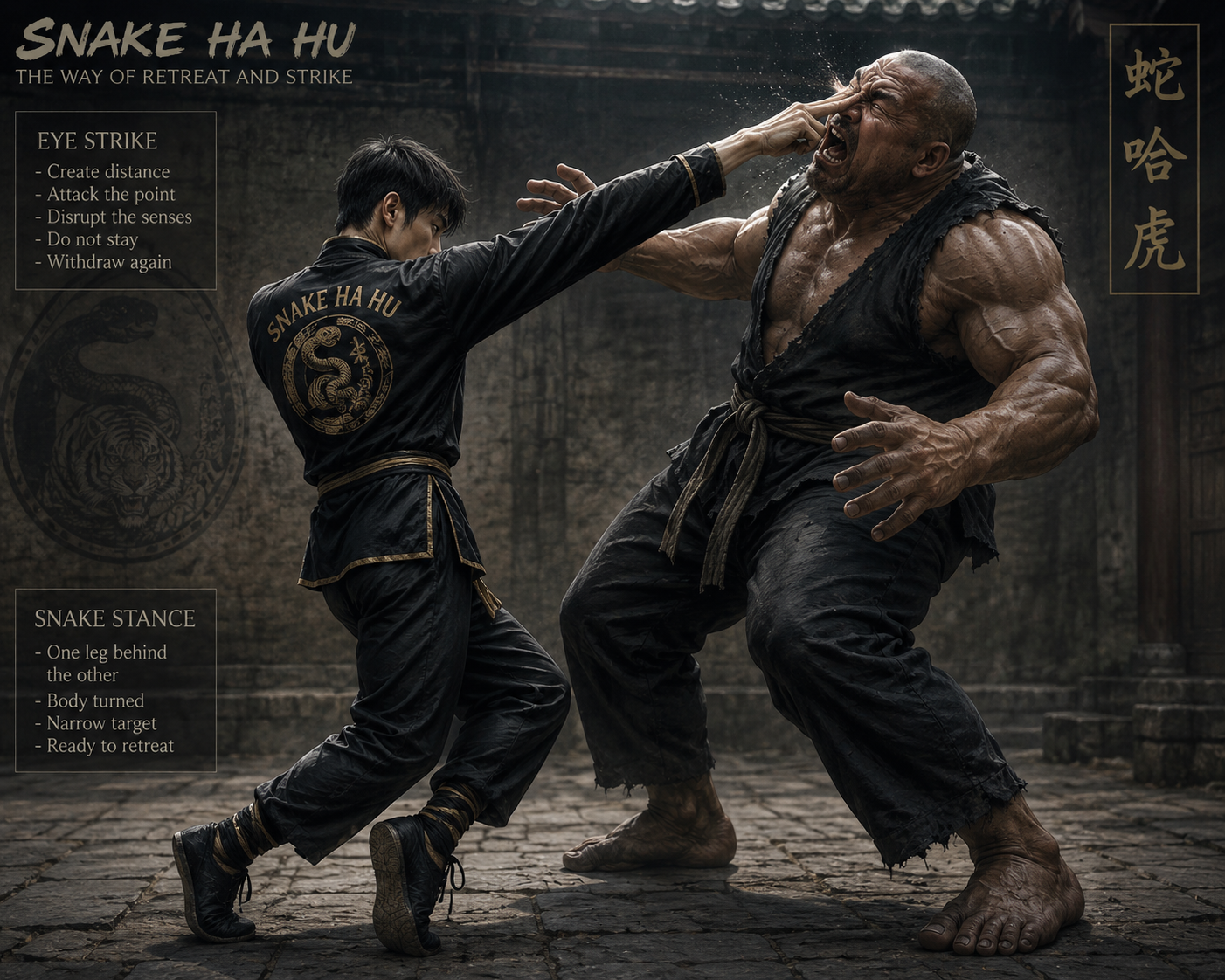
this kung fu is entirely based on 2 concepts:
Concept 1 is retreating to avoid attacks.
Concept 2 is striking at opponent's weakest points, such as eyes. I did steal this concept from Wing Chun kung fu, but anyway, eye pokes are what made Jon Jones UFC champion, so I am sure there is something good in them.
Snake Ha Hu (蛇哈虎) (fictional martial art concept)
Snake Ha Hu is an original, fictional kung fu style centered on evasion rather than force. Its philosophy is that the safest victory comes from making attacks miss, creating a brief opening, and escaping rather than trading blows.
"The snake survives by yielding. The tiger survives by timing. Snake Ha Hu survives by both."
The style teaches practitioners to:
The fighter stands with:
This narrow stance allows quick backward movement while presenting a smaller target.
Instead of stepping sideways or forward, practitioners mostly move:
Each retreat is meant to make punches and grabs fall just short.
When an attack comes:
The retreat is smooth rather than jumping.
The main attack is a rapid straight-hand thrust toward the opponent's face.
Characteristics:
Safety note: In real martial arts training, attacks to the eyes should never be practiced with contact because they can cause permanent injury. Training would instead use controlled targeting or substitute safe targets.
Typical exchange:
The style avoids prolonged exchanges.
Students practice:
The name combines two animals:
Its emblem is a coiled snake with one foreleg of a tiger emerging from the coils, symbolizing restraint followed by decisive action.
As a fictional martial art, Snake Ha Hu is designed around the idea of creating openings through evasive backward movement and immediate, precise counterattacks rather than overpowering an opponent. In real-world self-defense, safer priorities include maintaining distance, escaping danger, and using proportional force where legally and ethically appropriate.
I don't return favor.
I would bang that.
I am trans, but I dont like other trans people.
Is it true you see infants as sex objects?
Not really. they are ugly.
Were you abused as a child
I was hit on the head a lot. It messed something up.
If you achieve your wants, but lose your humanity in the process what have you gained?
the question answers itself. I gained my wants.
If you have long hair like me, cutting it is very easy. Usually in one or two cuts.
the trick is to simply make a pony tail for front hair and cut it off in a line.
then make pony tail for back hair, and cut it in line.
tho I usually just make pony tail for my back hair and cut it. I dont usually cut front hair much, mainly cuz I anyway comb all my hair back.
Butterfly cut:
https://youtube.com/shorts/rYta0JUxRZM?si=CeTl1DWIfbBPz2ru