SatanLucy

AI only has two problems in accuracy:


  1. Retrieved knowledge - AI searches the internet for information. Articles on internet can be wrong. It happens.
  2. Inability to transform human language into mathematical sets. Because deductive reasoning depends entirely on sets, inability to transform human language into mathematical sets properly causes AI to have bad reasoning.
SatanLucy
some combinations of weights absolutely lead to goal-oriented behavior,


Its not "goal oriented behavior". It is AI transforming input using weights according to your goal.


Again, AI transforms input. thats what it does. the whole idea of AI is very simple: Have large combinations of weights, each transforms input vector number.


It is not "sentient" nor has any specific goals or wants.


All it does is:


  1. transform input to vector number
  2. Multiply vector number with weights
  3. Predict probability of next token (or in images, next step)


So the evil desires (evil set of weights, to be precise) which you talk about dont need to exist in AI. they can exist, but dont really have to.


Reasoning is what companies are focused on optimizing right now. They’re not about to switch to RAG without significant pressure. If you want them to switch, then great, that’s a massive safety improvement. But if we want companies to care about safety, then everyone needs to understand the significance of this problem.


But do you agree that highest certainty of reasoning is made by deduction and sets? Companies are working hard to improve AI's reasoning, yet AI still makes bad miscalculations, hallucinations, and even blatant lies.


I think RAG or smart retriever system can actually be made with reasoning ability, but one must first convert human language into working system of sets. Deductive reasoning in math is made entirely out of sets, and same can be done with human language if words are treated as sets which contain other words. that enables precise deductive reasoning without all the AI decades of training nonsense.


That’s just kicking the can down the road, because then we need to align the AI doing the programming.


No, because we can see the code AI makes. We can see whole code for new AI made by AI. Because new AI doesnt use weights, all code is clearly visible, and harm easier to detect.


We managed to stop nuclear war and prevent some countries from getting nukes.


We didnt succeed in abolishing nukes tho. It only takes one bad government to lead world into nuclear war. But we cant give up improving nukes and delivery systems because that would only help our enemies, not us.

SatanLucy
No, Congress cannot "replace president at any time, and thus remove his title." Even by impeachment by the House, and subsequent conviction by the Senate, Congress does not "replace" the president, as if they had a choice in that replacement


You dont understand the meaning of words.


"Replace" and "choose to replace with" arent same things.


Yes, congress can remove your beloved leader, and then your beloved leader would be replaced by someone else as a result.


So congress can replace him, just cant choose who to replace him with.

SatanLucy
Pausing AI development globally would require international cooperation of the likes we’ve never seen before, something akin to restricting the development of nukes. I don’t know if it’s possible to ever accomplish


It isnt possible to accomplish, because all countries and groups wont agree. today, anyone can code an AI model using an AI itself as programmer, using repeated trial and error so AI is told where one mistake is, fixes it, then program is tested again, if mistake is fixed, it is moved to next mistake. It doesnt even take much time or programming skills anymore, just basic "test, find error, fix error, repeat" method.


So literally anyone can have a local AI, entirely programmed by themselves, trained on whatever data. Now, not everyone has a supercomputer, but those are getting cheaper too and pretty much most larger groups in world can afford them.


So trying to stop AI development would only harm good guys who want to stop it, and bad guys would keep developing and be even ahead of good guys in development.

SatanLucy
The issue is we only judge weights by the outputs they produce. However, for every set of weights that have high capabilities and set the goal “do the task humans want,” which gives us the desired output, there are far more combinations of weights with high capabilities that say “maximize x random thing,” which is accomplished best by doing what humans want right now and playing nice, then betraying humans.


So your concern is essentially that weights which manage output only do so to please their goal.


Weights dont have a goal.


Each weight has its own unique value which modifies output. We can know value of each of these weights, it is just not possible to read all values because there is trillions of them.


to put it simply, AI doesnt have goal or desires. It merely has weights which transform input into output. For example, prompt "hello" gets converted into a vector number and multiplied by bunch of weights one after another, and when you have trillions of weights and also bias number, output can be non-repetitive, but it can also be trained to adjust weights so output becomes desirable.


In simple terms, AI transforms, input into output.


Unless someone changes the input, they will get somewhat similar output each time. these weights dont "think". they actually multiply input vector, which seems like thinking, but its actually just a very advanced calculator with bias added.


It is true that we dont know exactly what happens because no one can observe trillions of weights. But weights are adjusted during training. We can adjust them, tho we dont do so manually.


Rule logic needs to be programmed manually by humans and takes far longer. Good luck getting companies to prioritize safety over performance, when they’ve shown far too little interest in safety so far.


Actually, this is where I want to add something entirely new. First, RAG AI with rule based logic, and ability to deduce in form of sets, yes, it takes time to program and improve. It would actually have to have a dictionary of its own in it to be able to convert sentence to multiple sets to be able to reason well. But there are two things: We can actually see the entire code. there are no unknowns. It works just as efficiently as regular AI in retrieving information, tho slightly worse at reasoning. But its not like today's AI is much good at reasoning anyway. And second, we can have AI program it. I dont know a lot about programming, but I do use AI to program first a chatbot, then a retriever, which were successful, and then through repeated trial and error, I also made chatbot capable of next word prediction, which was good but slower than retriever. then finally, I realized retriever which combines different sentences into new answer is probably best and fastest, and by converting search sentences into tokens, search function is made much faster. And added randomness makes it non-repetitive. My next step is to program RAG AI retriever, which I already have code for, but also make it be able to: 1. Convert learned text into sets, 2. Be able to do deductive logic using those sets. For example, "cats" belongs in set of "animals", "kitten" belongs in set of "cats", the AI can deduce that kittens are animals without having that knowledge at start. (Kitten included in Cats. Cats included in animals. Kitten included in animals). this form of deductive logic works entirely by converting sentences to sets, exploring what each set contains as well. Sort of like advanced language calculator.


SatanLucy

Also, just to confirm once more, your issue is with weights in AI model being random?


If that is whole source of problem, then AI isn't the problem because there are AI systems which don't use that at all.


RAG AI system doesn't use any weights. It merely retrieves knowledge from external file and generates output by transforming collected data slightly to make it appear more like natural language.


If your issue here is entirely focused on AI weights, that is only one of many AI systems.


Yes, weights are latest and most complex system, but actually, AI which is RAG plus rule based logic doesn't need weights at all, can still do some reasoning, and retrieves knowledge from data same as any AI.

SatanLucy

Congress can replace president at any time, and thus remove his title. But Trump doesn't need approval of Congress controlled by Trump. It is even better that he didn't ask approval, because he would get it and even look good while at it because war would seem more legal.


This specific war is a violation of international law which USA helped make and vowed to follow.


So this is just an example of "rules for you but not for me", where international law somehow applies to Iran who is defending itself, but not applying to USA illegal invader by international law.


But since international law clearly doesn't matter anymore, Trump has nothing to justify war with because international law is basis for justified war as well.

SatanLucy

Now, here is what confuses me, because you say AI cannot be controlled.


I use AI to make another AI, it's a work in progress but I got the basic structure made by another AI.


It's entirely coded in python, and I can see full code of each file another AI gave me.


You are essentially saying that code is unknown, but from what I understand, the only unknown thing are weights because they start as random.


But weights only start random because making all weights be same doesn't work good because it can't tell which weight is wrong.


And these weights may be unknown, but they are essentially input transformers.


When you give input, weights transform input into output.


Now, your concern is, that there is a hidden weight or a set of them, which would transform input into something which destroys humans, but it only does so once certain it can succeed.


I say that is unlikely, because weights start as random mess.


It is like throwing letters around and expecting to form sentence "destroy humans".


But even less likely, because not all weights control output equally.


Weights are in fact dependent on input. Different input gets transformed by different weights.


I am still learning about AI, but to me, what you are describing only likely emerges if specifically trained for it.


Modern AI are specifically trained not to harm humans.


Their weights are specifically managed so that weight which protects humans carries highest importance and greatest impact.


And AI intelligence is entirely made out of weights which represent pattern generation. AI is designed in a similar way to human brain, with artificial neurons which learn based on weights entirely.


So, as I said before, the only real concern with super intelligence is it falling in hands that will train it for evil.


But we are still not at any super intelligence level. While almost every criminal in the world has access to AI and can use them for evil, so far none did too much harm to claim any doom of humanity.


And AI is trickle down technology, it very quickly found its way everywhere and became more affordable in improved versions.


Now, of course, highest level of AI is actually not available to masses, because that level requires supercomputer with countless parameters model trained on almost all available data in the world, which is I assume what top AI companies have and don't share with others.


My point is, we could already be having super AI, just not available to masses.


However, I argue for a position different than yours. I don't argue for restricting AI development.


Restricting AI development is self-defeating, because the only restricted ones will be the good guys. Evil leaders won't restrict their AI development, but will keep developing full speed.


Solution is full speed AI development, especially of linked AI models.


Because, once again, even if we are entering a Terminator movie scenario where if we develop technology, it possibly destroys us, and if we don't develop it, someone else will, forcing us to develop it anyway...


The solution is: know your enemy.


We must speed up research of AI, to be able to understand AI completely.


And maybe, modify random weights generation.


We know how each weight affects output individually, so maybe randomized weights at start can be scanned for potential threat, because we know how they modify input to affect output.


SatanLucy

Ok, it seems it is much better to use weights for pattern detection. And making a text bot which learns and then gives accurate answers from "knowledge" file based on sets of weights is much superior and faster than making it do sets of whole words.

SatanLucy
Those models exist, but they are much less efficient.


I was talking of set based logic there, not existing models. Set based logic is what all math is based on, and what pure logic is based on. Sort of like, instead of using training data to produce probability sets by context, one divides all things on correct sets and works with that. AI today still uses set logic, but its statistical sets detecting which sets repeat more in training data, instead of using certainty sets like in math.


Circuit tracing is a relatively new technique that lets researchers track how an AI model builds its answers step by step – like following the wiring in a brain. It works by chaining together different components of a model. Anthropic used it to spy on Claude’s inner workings. This revealed some truly odd, sometimes inhuman ways of arriving at an answer that the bot wouldn’t even admit to using when asked.


This working backwards suggests LLMs might have more foresight than we assumed and that they don’t always just predict one word after another to form a coherent answer. All in all, these findings are a big deal – they prove we can finally see how these models operate, at least in part.


Again, we don’t directly program in the “predict next thing” behavior, we just know the weights of the current models appear to lead to that behavior.


Again, you are talking of today's models and methods as if they are permanent, when realistically they probably will be entirely different after just 5 years.

SatanLucy
Those randomly generated patterns aren’t dangerous by default, but to make the artificial intelligence “intelligent” you need to train it to exhibit goal-oriented behavior


to be more precise, you need it to exhibit prompt oriented behavior.


AI is trained to follow prompt made by humans. It doesnt follow arbitrary goals, but goals set by prompt.


And I think in future, AI will be made in different way.


Even if you were to prove that current way AI is made is no good, it means nothing. AI in past 10 years has changed many methods of its creation. the AI you see today, "predicting next thing" patterns, is just how it is today, and it isnt superintelligent despite being trained after trillion parameters made from data.


In future, I assume AI will follow set based logic learning like math does instead of predicting next thing in data.


to put it simply, in future, AI wont learn from data. We will have algorithms which convert data to patterns, and then have those patterns be effectively used by AI.


this is my opinion. I dont share views that current AI making method will last much long. In fact, current AI uses a lot of resources and is terribly slow and hallucinates and even miscalculates.

SatanLucy

I understand your point, but just to be clear once more,


AI doesnt generate patterns bad for humans by default.


It generates random patterns at start. these patterns are essentially a mess at start and untrained AI is entirely incoherent.


What humans do is create algorithm in AI which converts data into useful patterns (this is AI training. Basically AI takes data and converts it to patterns).


And these useful patterns are prioritized over random mess.


And if the only thing AI has other than useful patterns is random mess, that mess is essentially incoherent in most cases.


But I have to agree with you on point of AI being dangerous if it falls in wrong hands.


On that point, I agree. If super AI falls in wrong hands, in hands of people or governments who will use it for bad things, it almost guarantees large scale destruction.


What I disagree about is AI being dangerous by default or in most cases.


SatanLucy

I am making my own AI model which predicts next word based on previous 2 words and context.


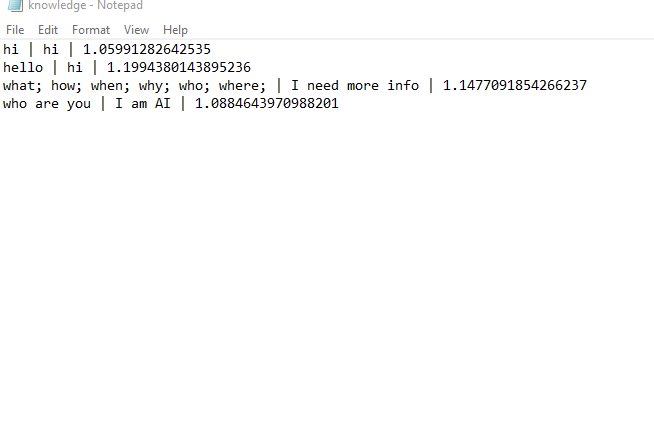
This AI is made in a simple way, where it has two additional parts: "knowledge" and "pattern" txt file.


Basically, what my AI does is, it reads knowledge file, which is it's training data, and saves patterns in pattern file.


This simple method works easily to produce AI chatbot which does more than my previous chatbot.


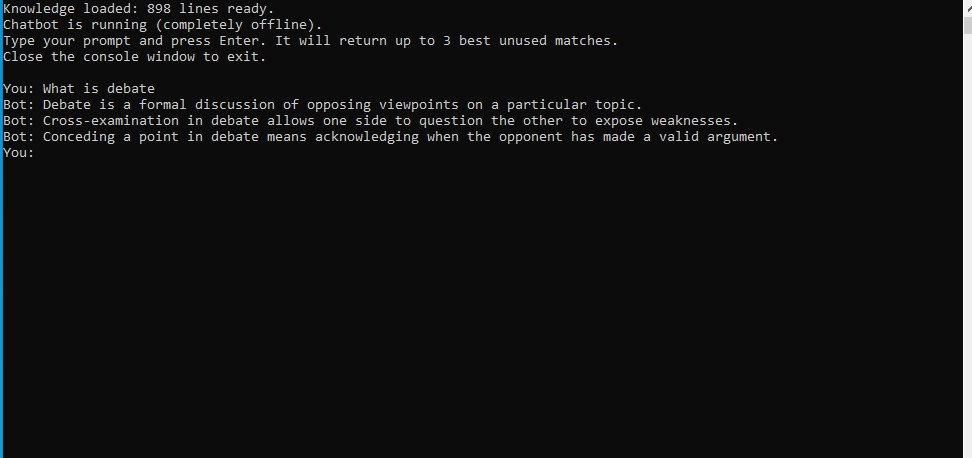
My previous chatbot was dual: It copied from "knowledge" file, but it could also learn new things, for example if it doesn't know answer to prompt, it asks user to teach it answer, which it then later repeats if same or similar prompt is repeated. It also did multi prompt and multi response per same prompt, as well as combination of answers.


But now, I want to go a step further and make AI which learns patterns extremely quickly from it's txt file, instead of me manually having to teach it.

SatanLucy

AI merely does conditional prediction based on statistical probability.


What that means, in most simple terms,


AI predicts what comes next.


For example, when AI is trained on text, what it does is merely this:


It predicts what word likely comes next in given context.


For example, if AI is trained on a sentence such as

"Cat likes milk",


AI learns that word "milk" more likely comes after words "Cat likes".


AI starts with basically random pattern prediction which is mostly nonsense until trained.


During training, AI updates it's probability in patterns.


For example, when patterns are random, AI will give words such as:

Milk likes cat.

Because it's random.


But once it learns based on text, it changes probability so now "Cat" comes as first word, word which follows is "likes" most likely, and "milk" follows based on that.


AI simply predicts the next word.


How AI does reasoning?


Reasoning in AI is done in same way of predicting what comes next.


The reason why AI reasoning is far from great is because AI doesn't actually do reasoning. It does statistical probability it learned during training.


AI doesn't reason, it doesn't "think".


What it does is simply predict what comes next in given context.


For example, AI will successfully answer that 10 + 10 is 20. Not because AI did math or reasoning, but because once you ask it how much is 10 plus 10, AI predicts what comes next. Because it learned from training data that what comes next is calculation answer, that's what it does.


And proof that AI doesn't actually do reasoning is found in AI hallucinations, which happen because AI is predicting what comes next, but predicting incorrectly because context changed and isn't similar to its training data.


For example, if you ask chatgpt to play chess, it will fail miserably.


Because it doesn't do reasoning. It predicts.


Chatgpt isn't trained on chess games, so it fails miserably to predict next move in chess.


But take AI specialized in chess, AI trained on millions of chess games to predict next best move based on chess games it learned?


That AI beats any chess world champion, not because it thinks better. In fact, such AI loses more often once people use different moves from usual play in its training data.


The reason why such AI wins a lot is because predicting next best move in chess came from it's training data. And once AI has working knowledge on millions of games, the only way it can lose is if it plays a game that doesn't match it's training data.


Because such AI has simple instruction to "win a chess game", and it does so by predicting what is next move in chess which statistically later resulted in win in games.

SatanLucy
They don’t control the implications of those patterns though


As long as they can mark some pattern as bad, it means AI can't use it to produce output.


Now, you can also create AI which isn't random pattern generator, but where all patterns are generated and supervised by humans. The problem is that it would be a much less effective and slower AI, because modern AI has at least 1 billion parameters even in smallest models. That is 1 billion patterns. To type all that out manually would take a long time. The reason why random pattern generator is used is because it enables a bit of innovation, but is also much faster, and random pattern generator AI model which is guided can actually easily be made by few people, where doing patterns manually would take thousands of people all day work. Because goal isnt just to have AI repeat what you say it, but to be a generator AI. AI is precisely valued because it generates things no one saw before. And that is due to bound randomness, and ability to combine many things to one prompt by learning patterns of combination as well.


So again, AI doesn't have goals. It has something very similar, which is patterns which control output.


The reason why AI tends to get repetitive, why every conversation feels similar, is because so many bad patterns were removed or placed down that only a minority of patterns is producing output.


And those bad patterns, such as "destroy humanity", once placed down, simply don't produce output anymore and become irrelevant.


Your concern is specifically super AI which produced a pattern "destroy humanity" and then was clever enough to hide it so it doesn't get placed down because it doesn't show in output at all until it has opportunity to destroy humanity...ect.


As I said, solution is linked AI models which supervise each other.


Also, I really hope no one will be stupid enough to give AI control over nukes. I mean, that Terminator movie isn't something I want to experience in real life.


But anyway, it all depends on humans. AI only has as much power as you give it. Sure, you could give AI control over nukes now. Would it destroy the world? Probably at some point. But the point is, don't give AI dangerous stuff.


AI isn't something that will go away. It's a technology once learned, cannot be unlearned.


But one can manage risks by not doing stupid things. Obviously, AI should not work with viruses or nukes or serious weapons.


The main problem lies entirely in humans who will give AI risky things.


While "linked AI plus safety measures plus not doing stupid things" is a good way to be safe, sadly, there is no safety from stupid and evil people. I can already imagine China producing AI robot army, as they are already producing AI Robots on mass scale.


But super powerful AI is simply like nukes. Once in wrong hands, it gets bad.

SatanLucy

Also, when you talk about unknown code numbers, are you talking about parameters?


these parameters usually arent unknown code. they store patterns. Advanced AI uses what is usually called "multi prompt multi response" pattern. So same prompt can have multiple responses, and multiple prompts can have multiple responses.

SatanLucy

Alright, let me try to explain this.


P1. AI is random pattern generator

P2. Humans control which patterns get ruled out

C. Humans control patterns generated by AI


And again, AI doesnt have goals.


What AI has is patterns which control its output.


And humans easily control which pattern gets ruled out by loss function (which affects AI's patterns).


So yes, humans can easily fake a scenario in early training to rule out AI which has patterns telling it to produce output such as "destroying humans".

SatanLucy
This doesn’t protect us if models collude with each other


AI is a bound randomness generator. Sure, you can have one AI with bad pattern (not goal, dont confuse goals for patterns. AI produces patterns which manage its output. these are not goals).


You can even have multiple AI with bad pattern. However, thousands of linked AI pretty much guarantees there is at least 1 AI who will warn humans if others are bad.


Linked AI are the solution, as well as safe guards and warning systems (when AI tries to produce harmful output).


As I said, issue isnt AI itself. It can be easily controlled. Issue, actual issue, is when AI drops in wrong hands, and people and governments have already used AI for bad things.


AI just does what its told. the problem isnt in AI, but in humans who will use it for evil, and those humans are what you have to actually worry about.

SatanLucy

Also, the specific code you talk about which is unknown are learned patterns (represented through parameters).


that code isnt just random mess. It is learned. It is what AI is exposed to, then told to repeat or predict, and once it does bad, it is told so, and it gets recorded in values so same mistake is avoided next time.


It isnt anything uncontrolled. Basically, as long as you dont expose AI to bad stuff, it wont learn anything bad, and as long as you use loss function to rule out bad outputs, it becomes bound randomness.


the entire flaw of today's AI can be entirely linked to its training data. AI does also generate new patterns by bound randomness (create pattern, test, if it fails, remember that its incorrect, if it succeeds, remember that its successful):


The model generates predictions.

Those predictions are compared to correct answers using a loss function (function that measures how far the model’s prediction is from the correct answer)

Errors are used to update parameters through optimization algorithms.


this is why AI constantly improves, because it learns what humans tell it is correct.


AI generates random patterns which produce output. It is still humans who determine what patterns are good or bad.


And just to be clear, AI isnt sentient in any sense you are saying. In fact, AI is specialized tool (general AI usually fails much more).


Specialized AI is AI specialized in some specific patterns. chatbot AI isnt going to get access to nuclear weapons.


Specialized AI is AI with patterns with highest match to desired goal.


And specialized AI is always better than generalized AI (AI specialized in chess plays chess much better than chatgpt does).

SatanLucy
As I said, we don't know what the code does. To limit “bad code” from being created, we need to know what the bad code looks like, and right now all the code just looks like a bunch of numbers. Progress on interpretability is slow.


AI is literally made through process of bound randomness, to exclude the bad stuff. this is why AI in past used to tell people to kill themselves, but today's AI doesnt. AI isnt random, but bound by a lot of things.


You dont even need to control AI to control AI's output. Output control is easily separated.


Bound randomness basically means thing can create anything, but anything undesirable gets ruled out, so only desirable remains.


As I said, issue with AI isnt that it can trick humans, it really cant. AI isnt superintelligent now and likely wont ever be superintelligent enough to destroy humans, because it takes a lot to do that, even high chance of being controlled and prevented by superintelligent good AI (which is why I recommend creating linked AI instead of individual AI).


the only actual, really dangerous problem with AI, is when it gets in wrong hands who WILL use it for evil.

SatanLucy

Also, I am making my own mini AI. So far I was more than successful. And it isnt "grown" in this specific case. It is made entirely out of "positive and negative pattern recognition" in text. Bot simply gets most matching response from knowledge database by using positive pattern (prompt same or similar as in database, and negative pattern (punish more different results), and correct order value (letters/words in correct order are higher priority).


this is for text, and it works well enough. It isnt real AI which can do reasoning and learning, but it can accurately respond to prompt by giving relevant knowledge, and that is usually point of AI anyway. AI reasoning isnt always good, and would take me too long to program, and I am not sure I can run it on my laptop.

SatanLucy
The code that humans understand and directly create is along the lines of "generate random functions


Bound randomness is possible too. For example, you can specifically limit certain code from being created.


Bound randomness is: Randomness minus undesirable things.


For example, if I program something to give me any random numbers, and then instruct it to remove numbers above 100, the only numbers left will be 100 and under, despite original complete randomness.


I am saying, AI goals will likely be controllable in future. Also, its not like we are giving AI nukes or biological weapons.


Biggest issue isnt AI, its evil people who will ABUSE AI for evil things, and that cannot be prevented in any way.

SatanLucy

Yeah, I am facing a new issue tho. this AI chatbot makes responses based on its "knowledge" txt file. However, in order for answers to be more precise, larger file is needed. So I asked AI to give me large knowledge file. the issue is, the larger the knowledge file, slower chatbot. Currently, when I use 40 mb txt knowledge file, it becomes super slow, slower than local AI.

SatanLucy

Bible cannot be trusted, once you understand what Bible is.


Bible is a group of documents made by certain council 300 years after Jesus's death. they excluded all texts which showed them wrong, and left only small group of texts they found appropriate, burning the rest.

SatanLucy

I tried Claude. Better results.


Also, the trick was in punishing negative pattern. Similarity of letters in words isnt enough on its own. I also added so that search engine punishes different letters, so in the end, word with least number of different letters and highest number of same letters is chosen. I also improved order of letters search.