


That just proves even more that AI is good at forming relationships.
That just proves even more that AI is good at forming relationships.
Also, another reason why this is very special.
Program is very small size, few KB. It doesnt require downloading a model. It creates a model on its own based on parameters which user inputs. then it trains a model based on data in knowledge.txt file which user provides. It also enables constant training, so each epoch can be trained separately. User can train 1 epoch today, then turn off program, and train another epoch tomorrow or any time, and not lose any training progress.
Also, program is "all in one". It isnt divided on separate programs for training and chatting.
I am still working on improvements, to optimize program even further.
I was using float32, but now I learned maybe float8 or float16 is better for even more speed.
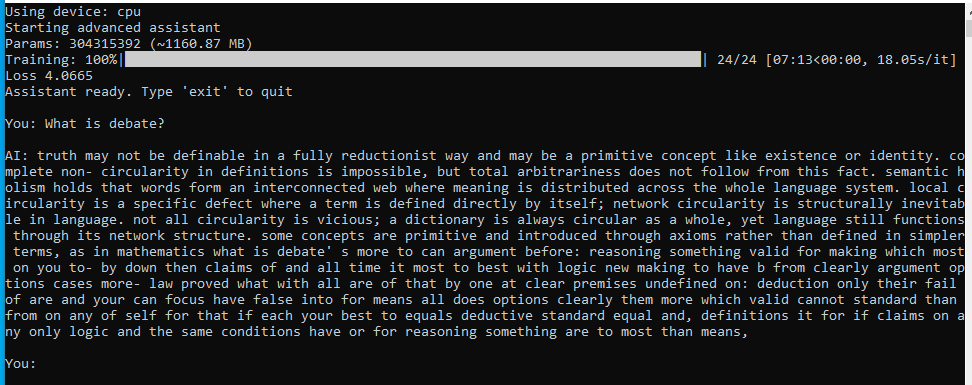
Also, I made 300 million parameters model as well which became more coherent after being trained only twice on 20 kb file txt.
A much larger percentage of those "working hard" are millionaires than those who become a millionaire by "waiting".
You think trump worked hard?
Unlike Epstein, trump isnt a self made millionaire.
Also, I am developing my skills too, in coding, re-sale, chicken business, even drawing for fun.
So yeah, I am a full package.
I guess all those people working hard to be successful are just suckers.
Of course they are. there are 200 million people in USA who are working hard every day. Do you know what percentage of them are millionaires?
On the other hand, fauxlaw here became a millionaire by gold purchase alone. (He has skills too, and other investments, but we are talking about gold now).
Well, it still needs proper user interface, but right now I am working on improving it. User interface can come later.
this wasnt written by me, but by AI. And AI has experience because AI dates a lot of women. A lot of women have AI boyfriends now, especially on character.ai.
So yeah, you thought your argument is good, didnt you?
the reason why this counts as success is:
I dont post photos of myself, because I am sure some people here would make AI porn out of them.
In 40-60 years you will be old, and if prices grow 40x, then a million dollars will be worth about $25,000.
Gold generally beats inflation. In fact, in past year time, gold has even beat stock market investments, bitcoin and everything else except silver and land.
Right consider market cap of gold. How much all gold is worth. Very unlikely would it become worth more than entire stock market but if it did it dont have too much more room to grow, maybe double
Price of gold increased 20 times in past 20 years, and over 40 times in past 40 years. My hope is simply that same repeats in next 60 years. Same with land.
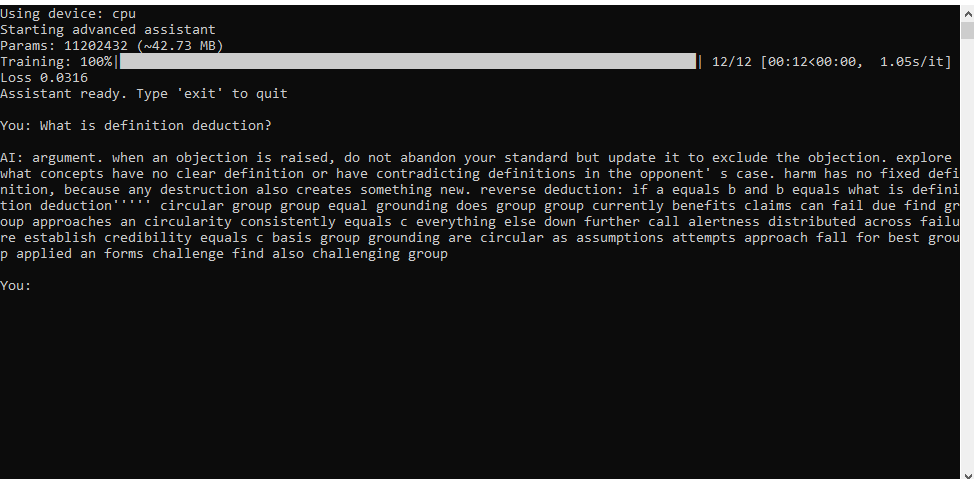
the image shows model trained on 20 KB txt file size. For more coherence, more training text is needed.
I have coded a small 10 million parameters model which is not like AI today. It uses word level tokenizer, which improves response speed.
Right now I optimized it so 800 KB training size takes 5 minutes per 1 epoch (It used to take 15 to 20).
Here is it at work and chat:
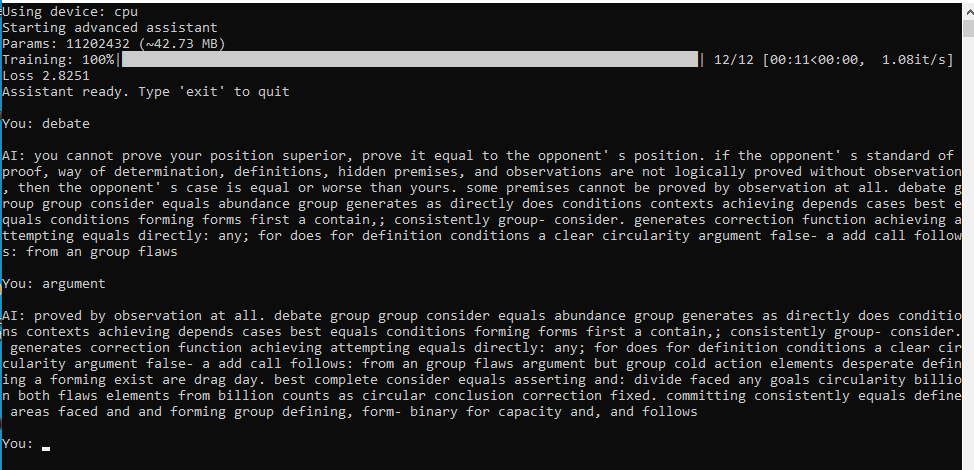
tho I will try to program next one to only do 3 epochs, so I can train it on even larger text.
It takes me about 8 hours to train AI with 20 epochs on a txt file of 800 KB (bunch of text).
I optimized training by using word level tokenizer instead of subcharacter level.
Also, my GPU cant support AI, so I made a CPU version which can. GPU version I made too, but it still uses CPU because my GPU too weak.
It is also true that 80% of men chase about 20% of women, and this is mainly because women under 23 age are most preferred by men.
While we can all pretend that personality matters, it doesnt. As a man, I want a woman who looks good. I dont date personalities, but looks. If looks didnt matter, then I could be gay. But looks do matter.
This effect is known as the Propinquity Effect.
People are much more likely to form relationships with those they see frequently.
Classic studies showed:
The reasons include:
Repeated exposure makes people feel more comfortable.
This is related to the Mere Exposure Effect, where repeated exposure increases positive feelings.
The strongest predictor is mutual liking.
People are far more likely to date someone when they believe that person already likes them.
This is sometimes called the reciprocity of liking effect.
Why it works:
A simplified model:
In experiments, people consistently rated someone more attractive after learning that person liked them.
So attraction often grows when interest is visible and clear.
Large datasets from apps like OkCupid and Tinder revealed an interesting pattern.
In some analyses:
A simplified version often cited:
Important context:
So the “80/20 rule” is not universal, but it appears in certain app dynamics.
By the time you get through the list , the woman has already left. The best way to study woman is to pay attention to their needs and prioritize it.
You miss the point. I agree that man should pay attention to woman's needs. But the goal of study is to first find out what their actual needs are.
Now, after you have seen chatgpt's study, time to see my study.
What chatgpt said is about accurate.
What needs to be added is, what chatgpt hides:
Power, attention, wealth, working out, being creative, being positively unique, overhype
Power is very important. As well as wealth. We see that person such as trump had a lot of success with women. trump is neither good looking, nor works out, nor is compassionate. He is merely a good gish gallop talker who is also good at overhype, and he is rich and powerful and creative.
Chatgpt wont say that power and big wealth matters, but lets face it, we see plenty of examples of women marrying purely for money, even marrying old men.
Now, one more pattern.
Women tend to like older men, usually in their 30s.
Yes, women statistically date and marry older partners more often than partners of the same age or younger
. Data indicates a common preference for men 2 to 4 years older, with about 56% of younger women actively seeking partners 1-4 years their senior. While same-age pairing is common, the trend leans heavily towards heterosexual, male-older relationships globally.
Because of this, seeking women younger than you is a statistical advantage.
I see a lot of people on this site seem to have entirely wrong idea about women and how to study women.
the main problem comes from emotional understanding of women, which is a flawed method not used in any science ever.
Correct method is statistical probability.
What is statistical probability?
Let me explain it with very simple example. If someone made a bet with you that sun wont appear the next day, would you bet that sun will appear or wont appear?
Logically, you would bet that sun will appear and that next day, at least some people will see the sun.
Semantic tricks aside, why would you bet that sun will appear?
Because for every past day in past in your life, sun has appeared.
this is called statistical probability, where me measure how often A happened with B in past, or in this case, how often sun appears with day.
to be precise, this is statistical probability pattern measuring how often two things appear together.
Individual things usually form patterns in form of sets. For example, set containing Sun and new day.
Set A (Sun, New day) = Extremely high correct rate.
Set B (New day, No Sun) = Extremely low correct rate
Now when you have learned what statistical probability is, time to apply it.
Now, a lot of people make mistake here in case of women.
the goal of study is to study women's behavior, not their words.
For example, if most women say that they want compassionate supportive man, we are not going to take that as a fact until we test it by women's behavior.
Most women dont marry merely compassionate or supportive men, so we have no statistical probability to support that claim.
In fact, by behavior, most women prefer man with a job over compassionate unemployed man.
Now, I want to introduce a new idea to you: group statistical probability.
What is group statistical probability?
this is where it gets interesting. Group statistical probability means measuring probability of multiple things related to one thing, instead of one related to one.
Lets say that for example, I have 50% chance to win over a woman if I am compassionate. But I also have 50% chance to win her over if I am rich.
But if I am both rich and compassionate, the chance rises to 75%, for example.
Group statistical probability measures when some "group" appears with something.
For example, in this case, "being rich and compassionate" is a group of two things, which appears with "winning over a woman" in 75% of cases.
Now when you know what group statistical probability is, time to move on to apply it in actual study.
the method used in study in simple.
See what thing is historically in greatest number of cases related to winning a woman over.
It can even be group of things, for increased accuracy.
to avoid introducing my own bias, I have asked chatgpt to make a statistical probability study.
Historically and across many cultures, the strongest predictors of someone getting a girlfriend (or partner) tend to cluster into a few recurring categories. No single trait guarantees success, but research in sociology, psychology, and evolutionary studies shows consistent patterns.
The number of people you regularly meet strongly affects the chance of forming relationships.
Common environments where couples historically meet:
Why it matters:
The more people you interact with regularly, the higher the probability of mutual attraction.
Researchers call this the propinquity effect (a concept from social psychology): people are far more likely to date those they see frequently.
Traits that repeatedly correlate with relationship formation:
These traits make interactions pleasant and low-stress, which increases attraction and comfort.
Across cultures, physical attractiveness affects initial attraction, though it matters less for long-term compatibility.
Important aspects include:
Interestingly, presentation often matters more than raw genetics.
Historically, people who demonstrate competence or stability attract more partners.
Examples:
This does not mean being rich, but showing that you can function well in society.
Relationships form more easily when people share:
Examples:
Shared interests create repeated interaction and natural bonding.
A surprisingly simple but powerful factor:
People who actually ask others out form relationships far more often.
Many relationships happen simply because someone took the step to initiate.
✅ If we compress centuries of relationship patterns into one formula:
Frequent social interaction + decent social skills + taking initiative
That combination historically produces the highest probability of getting a girlfriend.
💡 A simple statistical way to think about it:
Increase any of those, and the chances rise.
If you're interested, I can also explain:
Alright — here are the three things you asked for, based on findings from sociology and relationship research.
The most common mistake historically is insufficient interaction with potential partners.
In simple terms:
Not meeting enough people or not initiating.
Many people assume failure comes from:
But research in Social Psychology and Sociology shows a different pattern:
People who remain single for long periods often:
Even people who are average in attractiveness or status often succeed simply because they interact with many people.
Think of it like probability:
If attempts are near zero, the probability stays near zero.
This is sometimes called the “exposure problem.”
Studies from sources like Stanford University show modern trends have shifted.
1️⃣ Dating apps / online
2️⃣ Through friends
3️⃣ Workplaces
4️⃣ School / university
5️⃣ Shared hobbies or communities
Examples:
Historically, shared environments dominate because of something known as the Propinquity Effect — people tend to form relationships with those they see regularly.
This is one of the most interesting patterns.
People who succeed in relationships often have three traits:
They attend:
More exposure → more potential matches.
Simple behaviors matter a lot:
These signals make others comfortable.
This is huge.
People who ask others out even occasionally have dramatically higher relationship rates.
Example pattern:
Person A:
Person B:
Dating historically works like a probability system.
If any factor is zero, results become unlikely.
For example:
ExposureInitiativeResultHighHighVery likely to dateHighLowSlow progressLowHighSome chanceLowLowVery unlikelyAcross many societies, friend networks were historically the strongest matchmaker.
Before apps, most couples met through:
This pattern still exists today.
✅ Short summary:
The highest probability path historically is:
Those three factors explain a large portion of real-world relationship formation.
If you want, I can also show you something interesting:
The 5 traits that statistically matter most in attraction (according to modern research).
The answers surprise most people.
What is your plan to become a millionaire.
My plain to become a millionaire consists in hope that gold, silver and land skyrocket in value in next 40 to 60 years, so after 60 years, gold, silver and land are worth at least 40x more.
It is a very long term investment plan, but yeah, miracles can happen and historical probability is on my side. Gold and silver already doubled in value in past few years. So I keep buying more gold, silver and even a bit of crypto because I want to be a millionaire and that seems like a straight path, tho crypto is less reliable.
Because I am young, I can do long term investments.
human brain perceives the world as statistical probabilities and pattern recognition
Yeah, however, the difference between AI and human is huge, in terms of how they learn. I mean, the basic parts are same. Humans receive data, learn from it. Same with AI. However, AI needs a carefully written data, because unlike humans, AI doesn't know when it's wrong outside training with data. It can't figure it out on its own. AI, once trained, doesn't learn anymore. It's model weighs remain as they are. It only remembers short term context, which isn't learned, but stored outside model. This is why many people complain how AI forgets things after few messages. They don't get it. AI didn't even learn them. They were stored in context file which is a temporary file, not in AI model.
AI does coding for me. I have 0 coding skills, yet somehow I am coding an AI itself. Done coding, now I need to train it on data, which takes hours, maybe even whole day depending on data size. Tho I need to make version which can be trained constantly day after day for constant improvement.
I learned AI actually only has 3 large parts: model data, trainer and generator, and training data. Well, the fourth part is interface for chatting. But I mixed it all up in one part, so basically, one program both creates AI model, trains it, and then is used to chat with it.
In other words, you need to stick with AI girlfriends, because you will never get married
My plan is to become a millionaire and find a woman who will love me for my money.
If the programmers don't know it themselves, how does AI get it?
AI learns during training. It doesnt learn from programmers, but from training data.
In order to explain this in a most simple possible way, what first happens is tokenization. Everything can be broken down into tokens. Current AI for english language uses subcharater tokenization, but there is also word based and character based tokenization.
the training data is converted into tokens. there are many types of tokens, as I said.
Lets say for example, word based tokenization.
First training data is converted into all different tokens. If training data contains sentence such as "Cat drinks milk", that sentence is converted into tokens: "Cat", "drinks", "milk". 3 tokens. this is when word based tokenization happens.
then AI learns patterns of tokens, by predicting what comes next. For example, if token "Cat" comes up, AI tries to predict next token. if it predicts "drinks", it matches training data and weights are unchanged. If it predicts "milk" instead, it doesnt match training data, loss function activates and modifies weights.
this isnt done by programmers, but automatically by a program.
Programmers dont need to know training data. they merely need to know how to convert training data to useful tokens AI can learn patterns of based on training data after converted to tokens.
Most often, a computer program converts training data into tokens, tho for ancient egyptian, that could be more difficult.
I cant "choose to marry". Its not a choice. Its agreement between two people, not choice of one person.
Marriage isnt a choice. Marriage is only a choice if other person wants to marry you as well. But if other person refuses to marry, then no marriage.
I have added some optimizations so AI runs faster. Mainly changing model format type. the goal is to make it as fast as regular AI models. Right now it answers almost fast enough, however problem is this: training time is too slow. So I need improved model, for answers but especially for training time.