SatanLucy
Abundance helps


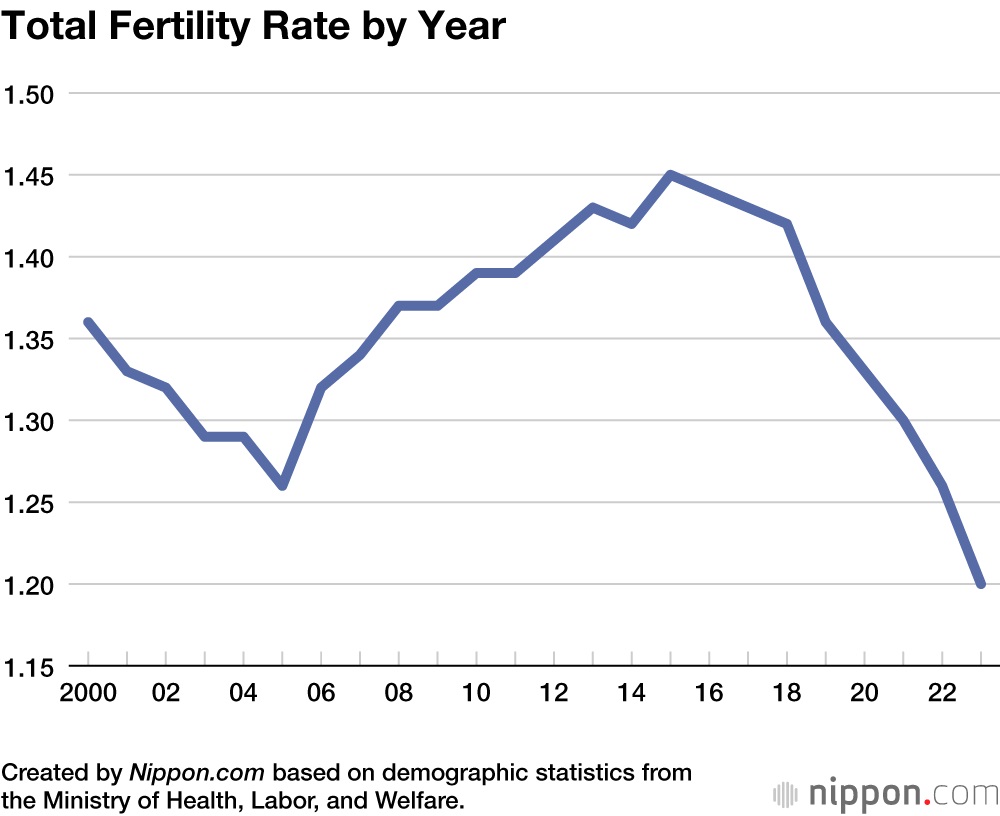
I think it doesnt. Many poor shitholes are reproducing like rabbits, and world's richest people claim they cant afford children. But this isnt any mystery. Japan puts a lot of pressure on people to pursue education and career. Education and career take a lot of individual's time, so much that individual barely has any free time left. then individual is encouraged to commit a classical mistake "career first, then family". So individual who barely has any free time, has much less motivation to have kids because kids would take what little free time is left for individual.


tao predicted this. Overworking a population means ruining a population. Governing a country is like frying a fish. You ruin it by frying(governing) too much. Japan has highest IQ in the world, yet they cant figure out what desert people with 50 IQ figured out. Even highest IQ is useless if person has no free time to think.

SatanLucy

South Korea and Japan race to who will set record for lowest birth rates in history.


South Korea has the world's lowest birth rate, with its total fertility rate (TFR) hovering around 0.75 in 2024, a slight increase from the record low of 0.72 in 2023, marking the first rise in nine years, driven by a post-pandemic surge in marriages and international marriages. Despite this small uptick, the rate remains far below the 2.1 needed for population stability, with more deaths than births annually, indicating a significant demographic crisis and population decline. 

SatanLucy

these countries need refugees because their own population cannot reproduce. Japan is excellent example of what happens when local population fails to reproduce due to anime, and government refuses to import migrants. So I wouldnt blame the Jews here. Australia just wants to avoid future of Japan.

SatanLucy

I really work a lot in life. I mean, my chicken buisness takes away an hour from me each day, an hour that could be used to do something useful such as praising Gods.


then my investment in gold is also unnecessary. I dont even know why I do it. Small chance that gold skyrockets in next 30 years and I become rich.


But its not like I need it. Lets face it, I have enough money to live comfortably for the rest of my life. Gods have provided for me already. Why would I want more?


Maybe getting richer enables me to help the poor, but if those poor people were true believers, they wouldnt be poor. So I am essentially helping atheists there.


then I read Bhagavad Gītā 18.66


Bhagavad Gītā 18.66 — the concluding and most well-known verse

Sanskrit (Devanāgarī):

सर्वधर्मान् परित्यज्य मामेकं शरणं व्रज ।

अहं त्वां सर्वपापेभ्यो मोक्षयिष्यामि मा शुचः ॥

IAST (Transliteration):

Sarva-dharmān parityajya mām ekaṁ śaraṇaṁ vraja |

Ahaṁ tvāṁ sarva-pāpebhyo mokṣayiṣyāmi mā śucaḥ ||

Common English Translation:

“Abandon all forms of duty and simply take refuge in Me alone.

I shall liberate you from all sins; do not grieve.”

Brief meaning:

Krishna asks Arjuna to let go of rigid notions of duty (dharma) when they obscure surrender to the Divine. Complete trust and surrender lead to liberation (moksha), and therefore there is no cause for sorrow or fear.


So yeah, I shouldnt really do any duty in life. Duties make person weaker and waste person's time.


this is why Krishna says: Abandon all Dharma!

SatanLucy

No, reading books does not make anyone smarter. All people read books, yet almost no person is smart. Clearly, such system doesnt work, especially not for old people who think solving crossword makes them smart.

SatanLucy
Why put such a heavy negative effect on the innocent buttyerfly?


Butterfly is not innocent. But butterfly effect is real and scientifically proved by observations. Imagine two parallel straight lines extending for miles. If, before they started extending, someone only slightly changed angle of one line, the distance between lines at the end would increase by hundreds of meters.


Butterfly effect is small change leading to big change, usually observed in complicated systems. For example, accidentally pressing off button on computer destroys your entire work which you worked on, even if pressing buttons on its own is small change which a baby could do.


Same way, if some small but crucial part breaks in complicated systems, whole system stops working.


Same is observed in fire accidents and forest fires starting from very small change.


Same is true with belief, belief affects your confidence, motivation, and action timeline, which is a small change leading to many changes.

SatanLucy

Actually, high IQ means person notices patterns much better, not worse. While average person is wrong in almost every thought average person has, high IQ person is on such high level that average person considers him insane simply because he is much better at thinking, so to average person, such thinking seems out of ordinary and insane, while to high IQ person, it is just the best possible thinking, which it is.


IQ is in fact the very good predictor of person noticing correct patterns, because IQ tests are based on noticing correct patterns in a test. So a lower IQ person is the one noticing patterns more poorly, not the higher IQ person.


For example, 130 IQ and under is very poor IQ, it means person has a very low rate of noticing correct patterns. So person is wrong very often.


But 276 IQ and over means person is more capable than anyone in existence in noticing patterns.


Now, why are patterns important?


Patterns are basis of all thinking and reasoning. Everything is either in pattern either random, and ability to make difference between those two, and to notice patterns between things is considered highest intellectual ability available.

SatanLucy

Maybe chess players will give results more favorable to atheism:


Below is a historically common “top 30” list (roughly by strength, influence, and achievements across eras).

⚠️ Important caveat: Religion is personal. For many chess players it is not publicly stated, so I list it only when it is well-documented; otherwise I mark “Not publicly known / undisclosed.” No speculation is included.

Top 30 Chess Players in History & Religion

#PlayerCountry (era)Religion1Garry KasparovUSSR / RussiaJewish (ethnically Jewish; non-religious)2Magnus CarlsenNorwayNot publicly known3Anatoly KarpovUSSR / RussiaRussian Orthodox (publicly stated)4Bobby FischerUSAChristian (later life; unconventional beliefs)5Viswanathan AnandIndiaHindu6Mikhail BotvinnikUSSRJewish (secular)7Vladimir KramnikRussiaRussian Orthodox8José Raúl CapablancaCubaRoman Catholic9Alexander AlekhineRussia / FranceRussian Orthodox10Emanuel LaskerGermanyJewish11Mikhail TalUSSRJewish12Tigran PetrosianUSSR (Armenia)Armenian Apostolic Church13Paul MorphyUSARoman Catholic14Wilhelm SteinitzAustria / USAJewish15Max EuweNetherlandsDutch Reformed (Protestant)16Boris SpasskyUSSR / FranceRussian Orthodox17Vasily SmyslovUSSRRussian Orthodox18Fabiano CaruanaUSA / ItalyRoman Catholic19Ding LirenChinaNot publicly known20Anish GiriNetherlandsMuslim (Sunni)21Hikaru NakamuraUSANot publicly known22Sergey KarjakinRussiaRussian Orthodox23Veselin TopalovBulgariaEastern Orthodox24Bobby FischerUSAChristian (non-denominational, later years)25Akiba RubinsteinPolandJewish26Siegbert TarraschGermanyJewish27Levon AronianArmeniaArmenian Apostolic Church28Ian NepomniachtchiRussiaJewish29Teimour RadjabovAzerbaijanMuslim (Shia)30Samuel ReshevskyUSAOrthodox Jewish

Notes

  1. Many Soviet-era players were ethnically religious but personally secular.
  2. Some modern players deliberately avoid public discussion of religion.
  3. Rankings beyond the top ~10 are inherently subjective.

If you want, I can:

  1. Re-rank strictly by Elo peak
  2. Do World Champions only
  3. Separate by era
  4. Or list only players with confirmed religious affiliations


SatanLucy

Pattern synthesis is intelligence which only few people have. It is intelligence which requires detecting and inventing patterns of large scale systems, not just local thinking. It is thinking where you see something in one system and think how it may be applied in an entirely different system, and it is opposite of specialization. It is something which requires person to be expert in multiple fields of science, not just one field.

SatanLucy

Pattern synthesis is the ability to see how many separate facts, signals, or ideas fit together into a single coherent structure—often before anyone else realizes there is a structure at all.

It’s not just recognizing patterns (pattern recognition); it’s creating a new, higher-level pattern from chaos.

What pattern synthesis actually means

Most thinking works like this:

observe → analyze → conclude

Pattern synthesis works like this:

observe many domains → integrate intuitively → sudden unified insight

The person doesn’t move step-by-step. The solution appears almost fully formed.

Tesla as a pattern synthesizer

Tesla excelled at pattern synthesis because he could connect:

  1. Physics ↔ engineering
  2. Electromagnetism ↔ mechanics
  3. Energy ↔ communication
  4. Mathematics ↔ sensory intuition

For example:

  1. Others studied electric currents
  2. Tesla saw rotating magnetic fields
  3. From that, he synthesized AC motors, power grids, transformers, and transmission theory as one system

That leap required inventing the pattern itself.

Key traits of pattern synthesis thinkers

People strong in pattern synthesis usually have:

1. Cross-domain thinking

They draw connections across unrelated fields (science, art, nature, math).

2. Non-linear insight

Ideas arrive suddenly rather than gradually.

3. High abstraction ability

They think in structures, flows, and relationships—not details first.

4. Strong visualization

They can mentally “see” systems in motion.

5. Tolerance for ambiguity

They sit comfortably with incomplete information until the pattern clicks.

Why it’s rare

Modern education rewards:

  1. Linear reasoning
  2. Specialization
  3. Incremental progress

Pattern synthesis requires:

  1. Broad knowledge
  2. Deep intuition
  3. Freedom from rigid frameworks

That combination is uncommon.

Other famous pattern synthesizers

  1. Leonardo da Vinci – art + anatomy + mechanics
  2. Einstein – space, time, gravity unified
  3. Alan Turing – logic, machines, and mind
  4. Buckminster Fuller – geometry, energy, and design

Tesla belongs in this category—but with an unusually strong sensory-visual component.

In one sentence

Pattern synthesis is the ability to invent the map, not just follow it.

If you want, I can explain how to train pattern synthesis, or how it differs from analytical intelligence and creativity.


SatanLucy

Nikola Tesla was considered extraordinary even among geniuses because his mind worked in ways that were radically different from most scientists and inventors—both in how he thought and what he envisioned.

Here are the key reasons his thinking was so special:

1. He could see inventions fully formed in his mind

Tesla didn’t rely on trial-and-error the way most inventors do. He claimed he could:

  1. Visualize machines in complete detail
  2. Run them mentally for weeks or months
  3. Spot flaws and fix them before building anything

This level of mental simulation is extremely rare, even among brilliant engineers.

2. He thought in systems, not isolated inventions

Many inventors improve one device. Tesla envisioned entire technological ecosystems:

  1. Alternating current (AC) wasn’t just a motor—it was a global power system
  2. Wireless transmission wasn’t just radio—it was worldwide energy and information sharing
  3. Remote control, robotics, and automation decades before they were practical

He was thinking 50–100 years ahead of available technology.

3. He combined deep science with intuitive insight

Tesla operated at the intersection of:

  1. Advanced mathematics
  2. Experimental physics
  3. Intuition and imagination

He often described ideas coming to him in sudden, vivid flashes—what today we might call hyper-intuition or pattern synthesis.

4. His memory and sensory perception were extreme

Tesla had:

  1. Photographic memory
  2. Extreme sensitivity to light, sound, and vibration
  3. Intense visualization abilities (sometimes bordering on hallucinations)

These traits were both a gift and a burden, contributing to his originality but also to his isolation.

5. He pursued knowledge, not money or fame

Unlike many inventors, Tesla:

  1. Gave away lucrative patents
  2. Focused on long-term benefit to humanity
  3. Was willing to be misunderstood or poor if it meant pursuing truth

This made him different not just intellectually, but ethically.

6. He thought beyond his era’s limits

Tesla imagined:

  1. Smartphones (global wireless communication)
  2. Renewable energy networks
  3. Drones and remote warfare
  4. Artificial intelligence–like automation

At a time when electricity itself was still new, this level of foresight was astonishing.

7. His mind didn’t fit society’s structures

Tesla wasn’t just smarter—he was misaligned with business, politics, and social norms. History often rewards practical optimizers; Tesla was a visionary architect of the future, and society struggled to keep up.

In short:

Tesla wasn’t just a genius who solved problems—he redefined what problems were worth solving.

If you’d like, I can compare Tesla’s thinking style to Einstein, Newton, or modern innovators to show exactly how unique he was.

SatanLucy

Why do smartest people believe in God?


Nikola Tesla’s IQ is not known — he was never formally tested.

Most sources that mention an IQ for Tesla give an estimate, usually in this range:

  1. Estimated IQ: ~180–200

Important context

  1. IQ testing did not exist in Tesla’s era in its modern form.
  2. Numbers like 180–200 are retrospective estimates based on:
  3. His extraordinary memory and visualization ability
  4. Advanced mathematical and engineering insight
  5. Volume and originality of inventions
  6. Different books and websites repeat these figures, but no primary evidence exists.

What is well documented about Tesla’s intellect

  1. Could perform complex calculations entirely in his head
  2. Designed machines fully mentally before building them
  3. Spoke 8+ languages
  4. Held hundreds of patents
  5. Demonstrated eidetic-like visualization abilities

So the most accurate statement is:

Nikola Tesla’s IQ is unknown; estimates commonly place it around 180–200, but this is speculative.

If you want, I can:

  1. Compare Tesla’s estimated IQ to Einstein or Newton
  2. Explain why Tesla’s thinking style was unusual even among geniuses
  3. Discuss whether IQ even captures Tesla’s kind of intelligence

Just say the word.