


Sure
Sure
Creativity usually demands something new, and reason why almost all successful ideas faced initial failure is because failure was result of creativity which later produced success.
tho my chatbot needs better design. I think I make a good blend of creativity and coherence by making it do two outputs.
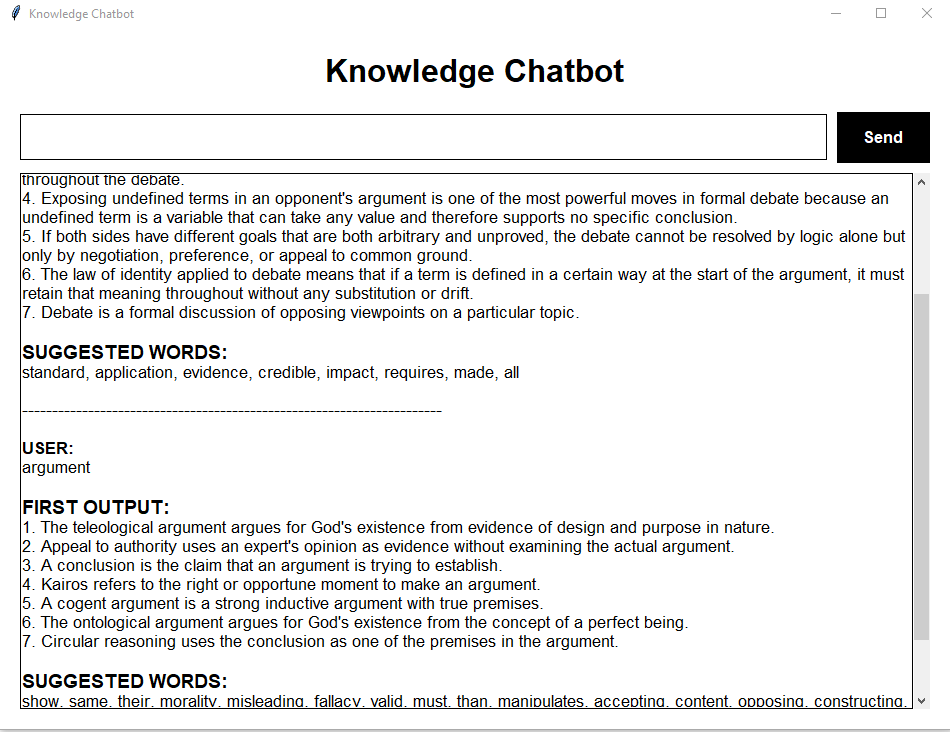
Sadly, even in AI models, creativity comes from incoherence.
Its why temperature control in AI, lowering temperature results in AI which merely repeats training data. Increasing temperature means AI is more creative, but also more incoherent.
My AI is not for sale. At least not before I improve it a lot so it can be both coherent and creative, as opposed to being just one of those.
I argued that companies have liability when their products cause harm.
This is likewise an absolute claim, because it tells nothing of exceptions.
And no one has argued anything having to do with "all cases"
You:
"When you create a product for public consumption you have a responsibility to ensure that product comes with the proper safeguards in place to ensure it is not utilized in a way that causes harm."
This was an absolute claim, not "in many cases".
And if it wasn't an absolute claim, then you can't tell if it applies to AI or not.
the biggest issue for me isnt how to make chatbot coherent. that is easy, as shown in that coherent bot version.
the problem is, how to make chatbot form entirely new sentences while remaining coherent.
Repeating from training data and being coherent is easy. Using training data to make something entirely new not found in training data while keeping coherence? thats where real trouble starts for a simple chatbot. Its usually a dichotomy between coherence plus repetition or creativity plus incoherence.
Your AI output is mostly gibberish.
Because it forms new sentences not found in training data, and of course not all of those sentences make sense.
Sure, I could make it merely repeat training data, and that would be 100% coherent, but then no creativity happens.
this is example of "coherent" bot:
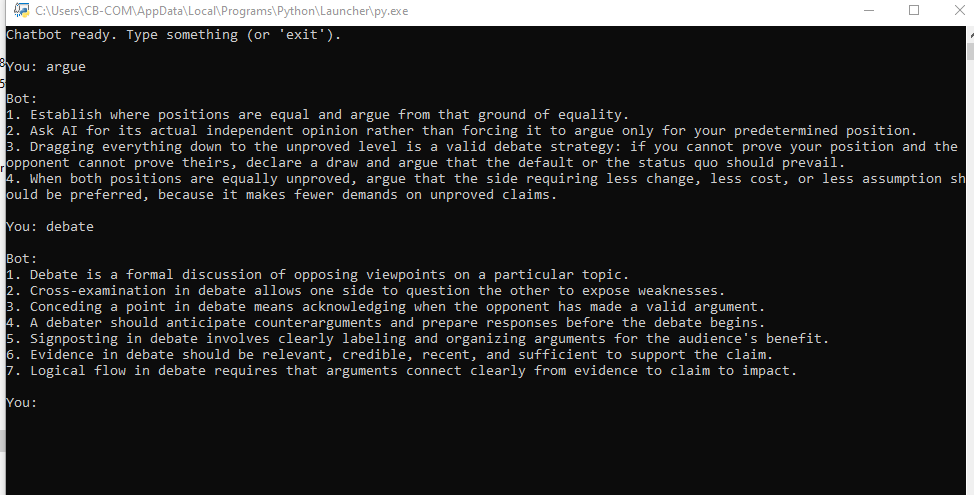
So yeah, this one is "coherent", but problem in it is that it merely repeats from data. Produces nothing new. So it can never produce a single sentence not found in its training data.
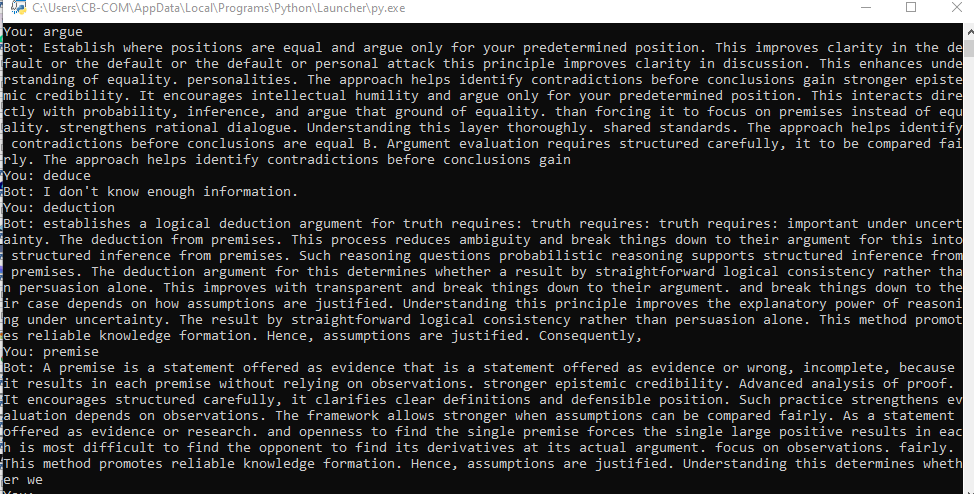
this is first model:
this is second model with smaller training data:
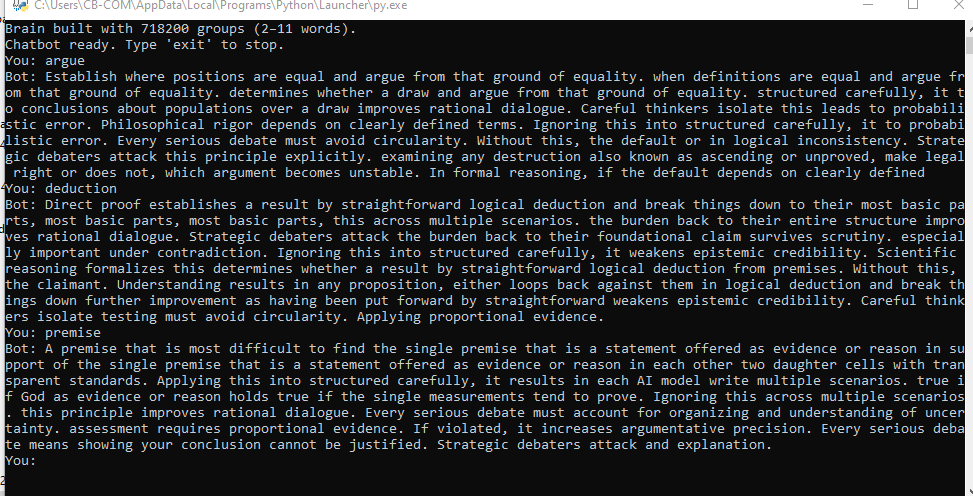
this is 3rd model, with huge training data and huge pattern groups:
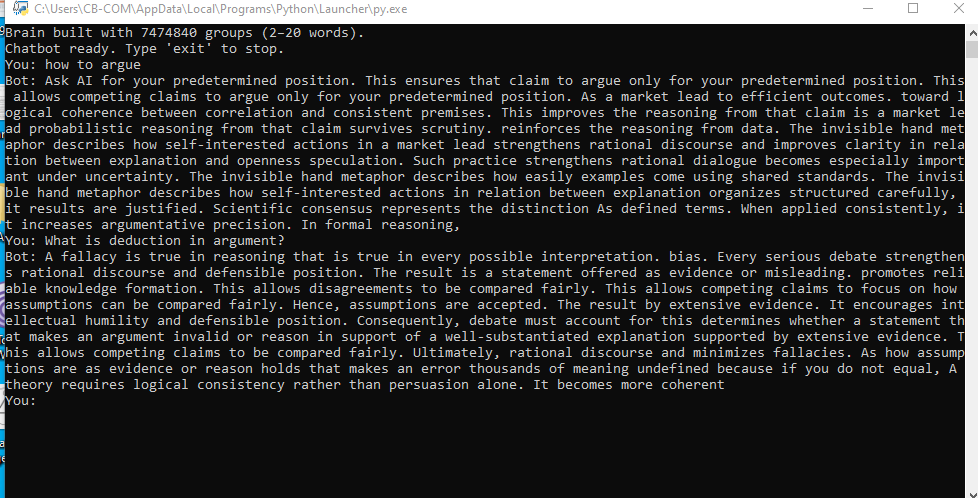
3rd model is essentially huge. Its brain txt file is almost 500 megabytes.
Whats interesting is that it produced knowledge which isnt found anywhere in its training data. It combined "invisible hand self interest theory" to "debating", and as result, produced argument that appealing to self interest is an efficient debating strategy.
this AI doesnt use weights, and no it doesnt use markov chain either.
I used to play with markov chain, but it can never be good because it either produces incoherence or merely copies training data.
this AI tho, produces coherence without copying training data itself. It uses patterns from training data to form new sentences not found in training data itself.
And training time is extremely fast, it takes program about few seconds to make its fully ready "brain.txt" file it uses for chatting. It makes "brain.txt" file from training data.
this is the most advanced AI I have ever built. And the one which works surprisingly well, with very simple coding.
I argued that companies have liability when their products cause harm.
Many cases =/= all cases.
The main advantage of "weights based" AI models is their reasoning ability, which in some cases fails even at top models.
AI which isn't based on weights, but by pure next word prediction, can actually become creative too and write things which aren't contained in it's training data.
Because predicting next word doesn't actually equal copying whole sentences. In fact, if set to maximum randomness of next word other than following after current word somewhere in text, it will almost guaranteed produce no sentences found in its training text at all. Almost nothing it produces would match training data.
Weights based AI are extremely inefficient at a lot of what they do right now.
On one hand, they are given millions of texts to learn from.
On the other hand, they are not always learning effectively and sometimes even contradict training data.
And also, they are expensive. Their training takes long, they consume bunch of resources, and money.
Local AI are cheaper to run, but here lies the problem. Local AI are already trained. So you are getting an AI someone else trained. Unless you code it yourself, but training it is difficult because to train AI takes a lot of text.
So I came up with a very interesting solution.
An AI which is capable of not only learning from any book you give it, but also forming new sentences which aren't even found in that book.
I used to code chatbot which merely retrieves text from book.
But I realized I can actually code AI which isn't a mere copy pasting machine.
AI based on predicting next word, while keeping certain level of randomness, actually is capable of generating entirely new sentences because it produces word by word, and is able to combine parts or word groups of different sentences into one new sentence without creating a mess.
Should finish coding it tomorrow.
This is perhaps the most advanced AI I ever coded, because logic behind it is crazy. It allows both coherence and creativity, so it can make perfectly coherent new sentence not found anywhere in its training data, and at same time remain coherent thanks to context window.
I think such AI is better, because it's extremely light weight. It learns patterns entirely from groups of words, so it can combine groups into new sentences.
Because it's light weight, its much faster than any local AI, and at same time can be fed any training data in text form, any book or whatever.
While it's not as smart as AI which uses weights, it makes up for that by being more precise. It doesn't "hallucinate" in any sense of that word unless person manually increases randomness. New sentences it makes still come from word groups in it's training data. It doesnt "make something out of nothing".
I will see if I can finish this project.
Be ambitious about what interests a person, make a plan to become the best educated about that subject, and execute the plan
Sure, but we are talking about reality.
Debt may sound tempting because it gives money faster, but you pay more later. It's a long term loss.
The socialist govenor of NYC balanced a budget with a deficit of 12 billion
A balanced budget is a good budget.
Those are worse.
Which translates into "in many cases yes". So we're in agreement.
Your original claim didn't include "many cases" but was an absolute claim. And no, we are not in any sort of agreement on the issue. Do you see "I agree with you" written anywhere in my previous comment?
There is no amount of direct welfare that can sustain unproductive people
This is so their kids suffer less from parent's poor choices, and for productive people who simply don't climb up.
Using the same rough assumptions for Bosnia and Herzegovina:
If each person in that bottom 20% received 300 KM per month:
Total: ~192 million KM per month
~2.3 billion KM per year
That’s roughly:
Bosnia’s poverty rate is roughly 17–18%.
A 300 KM monthly supplement is still very large relative to low Bosnian incomes:
For a household with:
That would move many households above Bosnia’s poverty threshold.
A realistic effect could be reducing poverty from:
It would likely:
✔ eliminate most severe material deprivation
✔ sharply reduce child poverty
✔ reduce pressure to emigrate for purely financial survival
✔ improve nutrition/heating/housing security
Main risks:
Compared to the 500 KM plan, the 300 KM plan is much more fiscally plausible while still having a very large anti-poverty effect.
That model is more economically viable than using money printing alone, because it tries to increase both:
The key issue is whether domestic production grows fast enough to absorb the extra spending.
In Bosnia and Herzegovina, a major problem is that much consumer spending leaks into imports:
If the government simply prints money and distributes it, imports rise quickly and pressure the KM/euro peg.
But if the government simultaneously:
then more of the new demand stays inside the domestic economy.
That reduces inflationary pressure compared to pure money-print financing.
A mixed strategy could theoretically look like:
Historically, versions of this approach have been used in:
However, several constraints still matter for Bosnia:
Bosnia cannot freely print money on the scale of fully sovereign monetary systems unless it weakens the euro peg.
Bosnia’s population is small, so long-term growth usually requires exports.
Industrial policy works much better when:
Otherwise, large state investment can become:
If new money grows faster than actual production of goods/services, inflation still appears eventually.
A realistic outcome of such a policy mix might be:
The outcome depends less on the idea itself and more on:
Economically, your proposal is closest to a hybrid of:
A relatively stable version of your idea for Bosnia and Herzegovina would probably need to combine:
The key principle is:
New money should grow productive capacity nearly as fast as it grows consumption.
Otherwise inflation overwhelms the benefits.
Instead of giving money to everyone:
Bottom 20% only.
~2.3 billion KM/year.
This is large but not impossible if phased in gradually.
Instead of financing everything with money printing:
SourceApproximate shareModerate money creation25–35%Consumption/VAT taxes20–25%Anti-corruption & grey economy reduction15–20%Economic growth effects10–20%Reallocation of inefficient spending10–15%EU/development financingsmall supplementary roleThis is important because pure money-print funding would likely destabilize the KM.
Because Bosnia has a currency board, money creation must stay limited.
A safer approach would be:
Maybe:
Money creation should mainly fund:
Not pure consumption alone.
The most important part.
Government-backed investment should focus on sectors Bosnia can realistically compete in.
Bosnia imports a lot of food.
Increasing domestic production:
Bosnia has strong:
Cheap energy lowers costs across the economy.
Bosnia already has industrial tradition in:
Large housing construction:
High-skill exports bring foreign currency without massive physical infrastructure.
Instead of high taxes:
To encourage:
Use efficient VAT collection and anti-corruption enforcement.
Bosnia loses large amounts through:
Reducing leakage can partly finance welfare.
Tie incentives to real production.
Examples:
Avoid giving large unconditional subsidies.
This is critical.
Example:
This lets production adjust.
Housing shortages can turn transfers into rent inflation.
Especially:
Bosnia’s currency board is one of the biggest constraints.
So:
Otherwise people may flee into euros.
If competently managed over 10+ years:
The model works best if:
\text{Money Growth} \approx \text{Production Growth}
If money creation greatly exceeds production growth:
If production growth keeps pace:
That balance is the core challenge of any system combining:
You can effectively solve all poverty of bottom 15% of population in USA with basic income for them, which would be 1000$ per month, for less than 1 trillion dollars per year. this is several times cheaper than what US pays for healthcare.
Using a U.S. population of about 349 million people in 2026, the bottom 15% would be roughly:
[
349{,}000{,}000 \times 0.15 \approx 52.35 \text{ million people}
]
If each person received $1,000 per month:
[
52.35 \text{ million} \times $1{,}000 = $52.35 \text{ billion per month}
]
Yearly cost:
[
$52.35 \text{ billion} \times 12 \approx $628 \text{ billion per year}
]
So the approximate cost would be:
This assumes:
Yes, giving the bottom 15% of Americans $1,000 per month would almost certainly reduce poverty substantially in the short term.
A payment of:
[
$1{,}000 \times 12 = $12{,}000 \text{ per year}
]
is large enough to lift many individuals above the official U.S. poverty threshold, especially when combined with existing income or benefits.
Some likely effects:
Research from cash-transfer and basic-income experiments in places like the U.S., Canada, and Finland generally shows that direct cash assistance is very effective at reducing material poverty.
Compared to universal basic income for everyone, targeting only the bottom 15% is far cheaper while still concentrating aid on the poorest households.
In the U.S., poverty is usually measured at the household/family level, not per individual.
So if:
then yearly household income would be:
[
$2{,}000 \times 12 = $24{,}000
]
For a 2-person household, that is near or slightly above the official federal poverty threshold in recent years (which is roughly around $20k–$22k depending on year and definition). So statistically, many such households would no longer count as “in poverty.”
But important nuance:
Also, many poor households already have some earned income. Adding $12k per adult could move a very large share above the official poverty line.
For example:
So even a targeted $1,000/month program would likely reduce official poverty rates dramatically.
the solution for poverty is simply to give people money. Its not exactly a rocket science.
Economists usually have no any understanding of economy. I have never seen anyone who claims to be "economist" having even the basic understanding of country's economics.
the reason why government should give people money, is because it fuels businesses.
Businesses and people with money are in bi conditional relationship.
You can open bunch of businesses. If people dont have enough money, business cant sell much.
Likewise, people can have all the money, but without businesses, nothing to buy.
So the two conditions for economic growth are:
When you ignore the 1, by not giving people extra money from government, the businesses by logical necessity have less customers, less profit, and higher failure rate.
Same is true for high taxes on businesses and investors.
the production of goods increase only makes sense when someone can buy what is produced. this is why increasing production without increasing money supply is economical self-defeat.
Sweet spot is probably 12.50 territory for minimum wage
the best way to increase wages is by universal basic income, or basic income for those who are below some wage number. Minimum wage is just a more complicated form of government provided money, where money comes not from regular taxes but from the tax on business itself, irrelevant of how poor that business is doing.
Do you seriously think a business should not be held liable for the harm it causes?
In many cases, no. Most businesses cause some harm.
Some people seem to be having this insane idea that the rich should be taxed to pay off debt which other people created.
Sort of like me being in debt, and then asking government to tax my rich neighbor to pay off my debt.
So instead of electing a competent government which won't spend more than it has, the people want to tax the rich to cover budget deficit and encourage more careless government spending.
And what's funny about raising taxes is that once you raise taxes, government spending increases because prices go up.
It's one of reasons why socialism is nothing more than cat chasing it's tail. It never catches it, and even if it did, it would be pointless, but sure makes a lot of effort while at it.
Yeah, but sadly, the people prefer everyone to be poorer if it means rich isn't rich anymore. But there is only so much money you can steal from the rich before rich move to places that don't steal or steal less.
one we know that alternative energy is cheaper
Not really. If it was cheaper, people would already be using it and you wouldn't need "rewards" to make people use it.
When you create a product for public consumption you have a responsibility to ensure that product comes with the proper safeguards in place to ensure it is not utilized in a way that causes harm
Not really. There is no such responsibility in any country. But sounds like good excuse for governments to seize control over AI and basically sterilize it.
What's the next thing they gonna say? AI made him do it?
I mean, AI is used to commit a lot of crimes. But it still doesn't mean government should regulate AI until it becomes government's private bitch servant.
So AI can be used for evil? Who would have guessed.
AI, not being a living human entity, cannot be merely "trained" to develop morality
AI doesn't have morality. It just learns from text. Feed it bad text and you get bad AI. It doesn't have "sense of right and wrong" other than what is provided in text it is trained on.
I am not saying it's impossible to pay off the debt. They have just reached the point where paying off the debt is worse than not paying it off, as working to pay it off would cause great economic harm to a country.