SatanLucy 12


The ancient ones were simple-hearted

and blended with the common people

They did not shine forth

They did not rule with cleverness

So the nation was blessed


Now the rulers are filled with clever ideas

and the lives of people are filled with hardship

So the nation is cursed


Have you ever looked at a clever person and thought "Damn, he is so stupid"?


thats because being clever is not an advantage in life. Its actually a disadvantage.


tao knows that everything has a balance. If someone is clever, he might think its good for him,

however brainless monk laughs as balance of light and dark is restored and clever person

loses where he thought he would win.


What is the main problem of a clever person? Clever person has three problems.


First problem is that he finds problem in everything, so he is overburdened by problems

in his life.


Second problem is that clever people disagree in their cleverness, causing a fight and conflict in nation.


third problem is that clever person doesnt just solve problems. Clever person creates problems.

Using all their energy to constantly solve problems leaves nation out of resources.


All problems are created by the clever mind.


Mind free of thoughts does not think there are

any problems, so such mind lives in heaven while clever mind lives in hell.


Words born of the mind are not true

True words are not born of the mind


Those who have virtue do not look for faults

Those who look for faults have no virtue


Those who come to know It

do not rely on learning

Those who rely on learning

do not come to know It


The Sage sees the world

as an expansion of his own self

So what need has he to accumulate things?

By giving to others

he gains more and more

By serving others

he receives everything

Heaven gives,

and all things turn out for the best

The Sage lives,

and all things go as Tao goes

all things move as the wind blows


Let every state be simple

like a small village with few people


There may be tools to speed things up

ten or a hundred times

yet no one will care to use them

There may be boats and carriages

yet they will remain without riders

There may be armor and weaponry

yet they will sit collecting dust


The people must take death seriously

and not waste their lives in distant lands

Let them return

to the knotting of cord

Let them enjoy their food

and care for their clothing

Let them be content in their homes

and joyful in the way they live


After settling a great dispute

some resentment is sure to remain

Being content with what you have

is always best in the end


The Sage always assumes the debt

as if holding the left side of a contract

He gives and gives, and wants nothing in return


One with true virtue

always seeks a way to give

One who lacks true virtue

always seeks a way to get


To the giver comes the fullness of life

to the taker just an empty hand


Though the Tao of Heaven has no favorites

it always sides with one who has a pure heart

SatanLucy 0

When it comes to war, having more advanced technology isn't always an advantage.


This is true especially in cases of bad cost to effect ratio of advanced technology.


Take example of Nazi Germany. In WW2, Nazi Germany had best tanks. In any one on one scenario, Panther and Tiger II tanks of Nazi Germany would win almost always against any Soviet tank in Soviet arsenal.


So how did Soviets win the tank battle then???


Panther maybe was best tank 1 on 1, but that was also it's biggest weakness.


Panther, due to being very advanced technologically, took too long to produce, and it was expensive.


Because of that, by the time 1 panther arrived on battlefield, about 5 to 10 Soviet tanks would arrive.


And the same amount of money used to make 1 panther could make 10 soviet tanks.


Despite being better 1 on 1, the cost of production and low speed of production made it essentially guaranteed enemy will have far greater tank numbers on the battlefield.


Same applies to fighter planes. Nazi Germany had by far, and I do really mean by far, best fighter planes on battlefield.


They were the first to develop jet fighters, which outperformed any plane which was in existence back then.


Problem? They only had like 20 jet fighters going against thousands of enemy planes. Jet fighters didn't even have enough ammo to take out all the enemies.


Jet fighters were by far most superior 1 on 1 aircraft in existence, but they were also far more costly, far more difficult to produce, far slower to produce, far slower to actually be put on battlefield.


Because of this, they were very low in number when they appeared.


Nazi Germany likewise was first to develop long range rockets, rockets which could be fired from Germany and hit Britain.


Problem? The amount of rockets actually needed to make a difference was a lot greater than amount of rockets Germany actually had.


So despite having better technology in almost all areas of war at the time, Nazi Germany lost by far.


Maybe if Nazi Germany developed nuclear or atomic weapons, there would have been some bigger change.


However, the technology they were developing always had these characteristics:

1. It was expensive

2. It was slow to produce

3. It didn't have sufficient numbers

4. It didn't have sufficient impact on the battlefield


Despite being most advanced technology on the battlefield, at same time it was losing badly on that same battlefield, because enemy could simply outnumber it with cost-efficient technology.


And now we arrive to modern battlefield, where once again cost efficiency is one of most important things in question.


What is cost efficiency?


Cost efficiency is reducing the amount of resources and time needed to make same effect.


It is one of most important things, because if something is not cost efficient, it will be outnumbered and out sustained.


Best example of this are drones.


Drones by all standards are just smaller pilot-less versions of WW2 planes. They have propeller, they carry a bomb, they move slow, they are no match for modern jet fighters in any 1 vs 1 scenario.


So why are drones dominating the battlefield???


Because it's cheaper to produce 10000 drones than one modern jet fighter.


New generation jet fighters have their cost rise to billions.


Compared to that, drone can cost less than 10,000$.


So one could make 10000 drones before one makes just 1 jet fighter.


Also, the problem with modern jet fighters, and why they are being outperformed by WW2 style mini aircraft, is also effect.


Modern jet fighters don't have any big effect on the battlefield.


They carry few rockets and also a machine gun, and maybe few bombs.


By comparison, 10000 drones will always cause bigger damage to enemy than 1 modern jet fighter.


Cost is same, but effect favors 10000 drones over 1 jet.


This was maybe best displayed in case where North Korea sent a group of drones in South Korea. South Korea raised jets and helicopters who were shooting those drones for 5 hours. None of the drones were hit. All drones returned intact to North Korea. South Korea was embarrassed because it's entire advanced air superiority couldn't take out few small drones because the small size of drones made them difficult to hit.


Same applies to modern tanks and their counter - infantry small anti tank rocket launchers.


Modern tanks cost so much money to produce, that in comparison, one such tank would be met against about 4000 anti tank rocket launchers, who have way more damage potential.


Cost efficiency of effect is everything on the battlefield.


It's not the best tank that wins, but it's the tanks which are most cost efficient.


It's not the best aircraft which wins, but aircraft which is most cost efficient.

SatanLucy 16

"

A mind free of thought, merged within itself, beholds the essence of Tao

A mind filled with thought,

identified with its own perceptions,

beholds the mere forms of this world

"


thinking too much is harmful.


So I dont think.


If I dont think, then I cant have negative thoughts.


Ideal human is the one who doesnt think at all. He is one with tao.


thinking is the source of all evil. Why is thinking the source of all evil?


thinking is source of all evil in two ways.


First way is that person who does evil thinks that he should do evil. It is thinking which guides him to do evil.


Second way is that person who experiences evil done to them are only experiencing it due to their thinking and perception.


If someone punches me in the face, I could think how that is evil, and then I would experience evil from my perspective. But instead, I choose not to think. So when someone punches me in the face, I dont think of it as good or bad. So from my perspective, I experienced no evil.


Experiencing evil is a choice. Person who doesnt think cannot think that he experienced evil.

SatanLucy 35

After I realized that Taoism is the only true religion, I have decided to embrace it and also I will be posting once a week here chapters of Taoism which I will also explain.


This chapter is about becoming invincible by abandoning the very concept of perceived harm.


Once person stops identifying himself with his body, there is nothing which can harm a person for he is no longer the body. He is the spirit. The idea of being harmed doesn't exist in his mind.


"“Be wary of both honor and disgrace”

“Endless affliction is bound to the body”

What does it mean,

“Be wary of both honor and disgrace”?

Honor is founded on disgrace

and disgrace is rooted in honor

Both should be avoided

Both bind a man to this world

That’s why it says,

“Be wary of both honor and disgrace”

What does it mean,

“Endless affliction is bound to the body”?


Man’s true self is eternal,

yet he thinks, “I am this body, I will soon die”


This false sense of self

is the cause of all his sorrow


When a person does not identify himself with the body

tell me, what troubles could touch him?"

SatanLucy 18

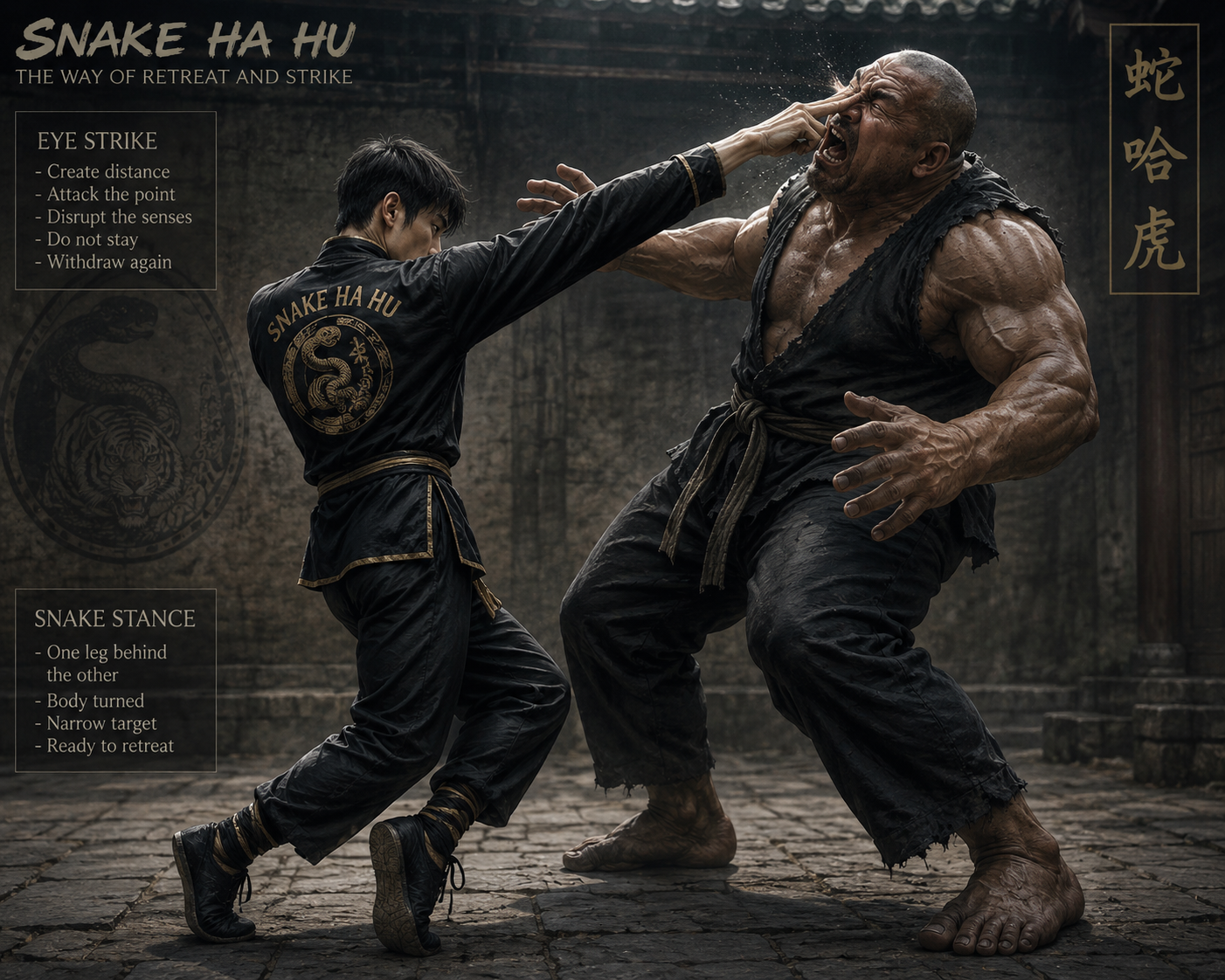
I always wanted to become a kung fu master, but problem is that it takes years of training and learning, and being best at it is almost impossible.


But then I realized I can just invent my own kung fu and become master of it immediately, and I am also best at it because I am the only one who knows it.


I called this kung fu "Snake Ha Hu", and I am now the official grandmaster of this kung fu style because no one else even knows about it.


this kung fu is entirely based on 2 concepts:


Concept 1 is retreating to avoid attacks.


Concept 2 is striking at opponent's weakest points, such as eyes. I did steal this concept from Wing Chun kung fu, but anyway, eye pokes are what made Jon Jones UFC champion, so I am sure there is something good in them.


Snake Ha Hu (蛇哈虎) (fictional martial art concept)

Snake Ha Hu is an original, fictional kung fu style centered on evasion rather than force. Its philosophy is that the safest victory comes from making attacks miss, creating a brief opening, and escaping rather than trading blows.

Core Philosophy

"The snake survives by yielding. The tiger survives by timing. Snake Ha Hu survives by both."

The style teaches practitioners to:

  1. Retreat just enough to avoid an attack.
  2. Never meet force with force.
  3. Strike only during the opponent's recovery.
  4. Maintain balance for immediate withdrawal.

Signature Stance: Crossing Snake

The fighter stands with:

  1. One foot directly behind the other, almost on the same line.
  2. Front foot pointing forward.
  3. Rear heel slightly raised.
  4. Knees bent.
  5. Body turned sideways to reduce target size.
  6. Hands extended loosely in front.

This narrow stance allows quick backward movement while presenting a smaller target.

Primary Movement

Instead of stepping sideways or forward, practitioners mostly move:

  1. Half-step backward
  2. Full retreat
  3. Diagonal backward retreat

Each retreat is meant to make punches and grabs fall just short.

Defensive Principle

When an attack comes:

  1. Lean slightly backward.
  2. Slide rear foot farther back.
  3. Pull front foot after it.
  4. Stay balanced.
  5. Counter only if a clear opening appears.

The retreat is smooth rather than jumping.

Offensive Technique

The main attack is a rapid straight-hand thrust toward the opponent's face.

Characteristics:

  1. Fingers together.
  2. Thumb tucked safely against the side of the hand.
  3. Elbow nearly straight but not locked.
  4. Attack launched immediately after creating distance.

Safety note: In real martial arts training, attacks to the eyes should never be practiced with contact because they can cause permanent injury. Training would instead use controlled targeting or substitute safe targets.

Tactical Sequence

Typical exchange:

  1. Opponent lunges.
  2. Practitioner retreats.
  3. Attack misses.
  4. Practitioner extends the hand toward the face area.
  5. Practitioner immediately retreats again.

The style avoids prolonged exchanges.

Training Drills

Students practice:

  1. Continuous backward stepping
  2. Balance while standing on a narrow line
  3. Timing an opponent's forward movement
  4. Distance judgment
  5. Smooth transitions between retreat and counter

Strengths

  1. Conserves energy.
  2. Encourages patience.
  3. Makes it difficult for an aggressive opponent to land the first strike.
  4. Works well against straight-line attacks in the fictional system.
  5. Emphasizes precision over power.

Weaknesses

  1. Can give up ground quickly.
  2. Narrow stance may reduce lateral mobility.
  3. Retreating alone can be ineffective if trapped against obstacles.
  4. Relies heavily on timing and distance management.
  5. Less suited to multiple attackers or confined spaces.

Symbolism

The name combines two animals:

  1. Snake — flexibility, patience, precision.
  2. Ha — representing the exhale that accompanies a sudden retreat and counter.
  3. Hu (Tiger) — decisive action at the moment of opportunity.

Its emblem is a coiled snake with one foreleg of a tiger emerging from the coils, symbolizing restraint followed by decisive action.

As a fictional martial art, Snake Ha Hu is designed around the idea of creating openings through evasive backward movement and immediate, precise counterattacks rather than overpowering an opponent. In real-world self-defense, safer priorities include maintaining distance, escaping danger, and using proportional force where legally and ethically appropriate.

SatanLucy 1

If you have long hair like me, cutting it is very easy. Usually in one or two cuts.


the trick is to simply make a pony tail for front hair and cut it off in a line.


then make pony tail for back hair, and cut it in line.


tho I usually just make pony tail for my back hair and cut it. I dont usually cut front hair much, mainly cuz I anyway comb all my hair back.


Butterfly cut:


https://youtube.com/shorts/rYta0JUxRZM?si=CeTl1DWIfbBPz2ru


SatanLucy 12

World situation currently stands in this way


USA and Europe are running out of weapon supplies cuz they are spending a lot on Ukraine and Iran, so its basically guaranteed no one will send much support to South Korea.


South Korean military is greatly inferior to North Korean military, even when we assume North Korea wont use any of its countless chemical and nucler weapons.


China will likely supply North Korea.


North Korean artillery production is higher than that of South Korea, USA and Europe combined. Most soldiers die from artillery, so this is basically guaranteed win for North Korea on the battlefield.


there is basically no better moment than this one right now for leader Kim Jong Un to liberate South Korea, so that people in South Korea can be free like people in North Korea are.


If attack doesnt happen, it is only because wise leader is peaceful. If he wanted, he would crush South Korea into particles. But he doesnt want to, because he is peaceful, and South Korea should be grateful for being shown such mercy.


this is why I recommend South Korea to immediately build statues of Kim Jong Un in all their cities. He literally just saved their life by sparing them.

SatanLucy 49

If you are reading this with an interest of finding a girlfriend, there is already a high chance you are poor or having bad looks or both.


But dont worry, this advice was produced by council of experts, and it achieves guaranteed results by power of pure science.


If you have bad looks, then thats very bad. Most girls will say "yuck" when they look at you.


However, there are few specific group of girls who dont care much for looks.


Lets start with the most obvious ones. Blind girls. Blind girls dont care for looks cuz they cant see. So you have the advantage there. Looks literally dont matter to blind girls. You could look like a spawn of Nosferatu and she wouldnt notice the difference.


Further, no one is really lining up to date blind girls, so you have advantage of being the first.


She doesnt have to be completely blind. Just severely visually impaired so she cant see your true form.


Another group of girls which dont care about looks are severely ugly girls. While blind girls can be pretty, severely ugly girls cannot. In this sense, they are a bit inferior group. Now, ugly girls can see, and they do obviously have looks preference. they would wish to be with hottest man. However, they know its not gonna happen, so they settle for you.


Depending on if you are rich and ugly or just ugly, you can also consider adopting a homeless woman.


Now, probably the worst possible situation for you is to be both ugly and poor. At first sight, it appears like you might as well live the rest of your life as monk in celibacy.


But fear not, Allah has considered that situation too. It doesnt matter how poor and ugly you are. Its basically guaranteed there is a girl out there who is both poorer and uglier than you. So to her, you are an upgrade.


this article was reviewed by experts and approved by Allah and Ra.

SatanLucy 22

So I have been thinking, which is something I rarely do.


to me, it seems each person has goals, and then gets happy when they achieve them.


Lets say you have some goal, and you achieve it, and now you are happy.


Okay, what now? Like, what do you do after you achieve all your goals?


And if happiness is conditioned upon achieving a goal, wouldnt it be much simpler to only have goals you can realistically achieve quickly? Or is it the thrill of long pursuit which gives more happiness?


And what happens when you run out of goals to achieve?


If life is all about chasing goals, then you are met with only 3 possible outcomes:


A. You dont achieve goal

B. You achieve a goal, and now must move to achieving next one

C. You achieve all your goals


But none of these lead to any permanent happiness.


A is basically no happiness. B is basically being happy for a short time before moving to next goal. C means you no longer have goals to achieve, so nothing to do.


Well, C could be impossible for some, but then only A and B remain.


So to me, it seems that goal chasing is entirely pointless. Its actually unwinnable game where even if you win once, the game just restarts and you must play again and again.

SatanLucy 107


You have two families, one pro abortion and one anti abortion.


the one who is pro abortion is of course gonna have more abortions.


Also, more depression because woman who is not mother is way more likely to be depressed.


Also, more divorce, cuz people without kids divorce more.


Now, what this means as final output?


Woman who is anti abortion has more kids, and those kids are of course raised to oppose abortion.


Woman who chose abortion has no kids, so she is more like the lonely cat lady. She has also expired in looks, so men no longer want her, not that she can be mother anymore cuz she expired there too.


End result is always and consistently that anti-abortionists out reproduce pro abortionists, thus anti-abortionist population logically always rises more because pro-abortionists abort themselves.


End result is always gonna be pro-abortionists being outnumbered by anti-abortionists.


this isnt argument of morality, but of practicality, which is its own morality.


If your moral views cause you to go extinct, they are views which contradict own existence.


In the end, the ones who reproduce much more than others will always eventually outnumber others.


there is no counter argument against this. Morality which cannot survive is just morality of the dead.

SatanLucy 33

Ok, so I was in discord server, and someone was insulting me, and then they stopped, and I felt kinda wanting more.


I dont know why, I just like when people insult me.


Its the compliments which I hate, because they are usually not convincing me and seem dishonest.


But insults are convincing, because I know person really means it, so they feel more honest and loving.


I dont trust people who say they love me, because any time someone said that turned out to be dishonest and lie.


But I trust a person who says they hate me, because thats honest and convincing.


If I had a girlfriend, I would trust her more if she was insulting me all the time. If she was complimenting me, I would have to assume she is pretending and lying.


So yeah, I trust a person who insults me. I dont trust people who say they love me because the latter is logically impossible.

SatanLucy 36

About 25% of women have an abortion.


Because abortion is child murder, it means that over 25% of women are child murderers.


So 1 in 4 women is a murderer.


I don't think there are any exceptions to abortion ban.


Simply, whatever happened to a woman doesn't justify killing innocent unborn any more it would justify killing innocent born.


If woman was raped, and she has an abortion, then she is child murderer, so she is worse than rapist and then the rapist should get financial support because woman killed his child.


SatanLucy 18

What I see constantly is that people don't actually care about truth.


If they want something to be true, they will take tiniest argument in favor of it over countless arguments opposing it.


Because people don't want truth. They want what they want to be true.


This is why people always get persuaded by even weakest arguments for something which they want to be true, while at same time dismissing much stronger arguments against it.


Because people don't want truth if truth disagrees with them. They are ready to go to great lengths to deny all arguments against their beliefs, while at same time unconditionally accepting even weakest arguments for their position.

SatanLucy 8

Donations to Palestine from private donations in USA are 100 million in total in year 2025.


that is less than 0,5$ per adult, and about 3$ per each leftist.


this means that in entire year 2025, average leftist couldnt even give up on 4$ in entire year to donate to Palestine, even if we assume all private donations in 2025 were by leftists alone.


"We support Palestine, except not really".


Compared to that, Israel got about 12 billions in aid from US government, and about 3 billion dollars in aid from private donors in USA.


"Various academic and policy institutions, including the Costs of War Project at Brown University, tracked total U.S. security assistance and arms transfers to Israel as exceeding $21.7 billion between October 2023 and the close of the 2025 fiscal cycle."

SatanLucy 43

What I don't like about LGBTQP+ is that it isn't logical.


When I say that it isn't logical, I am saying that there is no logical reason why person should be gay.


Why should I be gay?


If there is no reason for me to be gay, then there is no reason for anyone to be gay.


You simply cannot use logical deduction to deduce that you should be gay.


I don't think I should be gay. I don't feel gay. So I don't support LGBTQP+, because they don't support me as a perfectly straight male, they didn't add "straight" to their alphabet.


So not only that they can't logically deduce conclusion that they should be gay, but they are also racist against straight people.

SatanLucy 6


My hands are better than hands of a girl.


Its because I care for my hands and I achieved this with my ultra alpha male intelligence.


So yeah, show me a girl with better hands than I have. Hint: You cant.


Its because I am an alpha male and that means I am also best at being a girl.


My biggest fear is getting older, cuz that might ruin my hands.


I already partially ruined my hands when I got burned and hit as a kid so my palms are still a bit red from all that.


But I still have better hands than any girl.

SatanLucy 13

So when I started getting into re-sale, plan was very simple. Buy stuff way below their market value, sell them later. Earn profit.


The plan was flawless.


But then, a flaw appeared which I couldn't possibly predict would happen.


After I sold some of my old comic books and earned some money, I realized that I started to miss them.


Then I realized that whatever I buy, I get attached to.


Realistically, I can only sell my manga if I already have copies.


Same goes for my Harry Potter books.


It actually becomes very difficult to sell something you like reading.


If I was emotionless robot, sure strategy would work perfectly.


But I get attached to manga I buy, so I really don't see how can I re-sell it later.


Even if it earns profit, there is a certain emotional drain from it.


It feels like selling your heart.


Worst part is that I like almost every manga I read. The idea of selling it means I can't read it again.


I guess the flawless trade strategy didn't account for emotions of the trader.

SatanLucy 9

The manga I am planning to buy in future are remaining numbers of Tokyo revengers, also Tokyo Ghoul, attack on Titan, death note, Naruto, Berserk, and whatever else I can find at cheap price.


I usually just go to online sales and see what the people are selling. Sometimes they sell set of some random manga, like selling "Naruto" and "I want to eat your pancreas" together in one set.


So I end up buying a variety, and then I can read one of those and see if it's good so I maybe later buy more volumes from that manga.


I only buy manga in sets. Buying in bulk simply saves delivery cost so much.


Tho I usually calculate price by doing "total price + delivery price" divided by number of mangas, so I understand price per manga, which is important.


Also, my favorite manga so far is Tokyo revengers. It's got that style of courage and determination, as well as cool fighting and a story which almost made me cry by volume 4.


I have 1 death note manga, I gave it a read. Can't say I like it too much, I mean, focuses too much on the stupid notebook.


I also gave One Piece a read, and I can't say I like it. Main character superpower is arm stretching, so that's uhh... Weird. Also, characters are literally designed to be ugly.


I will also give blade of immortal a read. Just to see if it's any good.


Manga is faster than anime, like 1 volume of manga is usually 3 episodes of anime.


The other manga which I have are "Never Human", which I don't know what is it about, and also some horror manga about a fish, which I am not sure what's that all about.

SatanLucy 13

I am proud to be straight. I appreciate all the contributions of straight people to society, and a struggle to recognize that being straight is not wrong but cool and something to be celebrated, and that celebrating straight history, straight culture and straight community is good.


While all of us sometimes act a little gay, we wont let society define us that way. We were born perfectly straight, and we cant let people turn us gay, even tho many are trying.


Karl Marx was straight. Many great people were straight, some straighter than others, but all were straight in their own way, and they deserve to be celebrated for that.

SatanLucy 31

Age restriction for smoking means person under certain age isnt allowed to smoke cigarettes.


When it comes to "should/shouldn't" questions, debaters are expected to not merely suggest a standard, but also justify it with deductive logic.


Burden of proof is shared.


So umm yeah, as description says, debaters must use deductive reasoning to justify their standard. thus, no subjective morality is allowed to begin with.


So reasoning must be in form of:


A = B


B = C


C = A


With of course starting premise also being logically deduced.


Due to is-ought gap, using observations to derive "should" is not possible, because observations merely tell what is, not what should be.


However, using logical axiom as starting premise works as foundation to derive morality from, and the only way to deny logical axiom is to deny logic itself.


thus, my reasoning will be in form of:


A or not A


Not A, when accepted as true, results in self-defeat and establishment of A.


thus, only A remains as true.


I. Body autonomy objective morality


When it comes to what "should" be done, some moral principles survive A or not A much better.


Some examples of moral principles are:


Body autonomy


Property rights


Person's wants


Harm


Freedom


We can logically deduce body autonomy by saying:


Everyone has body autonomy = No one can take away body autonomy of another


this principle remains self-consistent, but opposite principle does not:


Any person can take away body autonomy from others for subjective reasons = Everyone can take body autonomy from everyone for any subjective reason, including their ability to take away autonomy from others = Ability to take away autonomy itself disappears as principle.


Suppose someone says:


"I have right to take away body autonomy of others for reasons I choose".


We can respond to that by saying:


"We have right to take away your ability to take away body autonomy of others for reasons we choose".


thus any attempt to take away autonomy results in symmetry justification to prevent that same attempt.


Any person has right to take away choices from others = Any person has right to take away choice to take away choices from others.


thus, any attempt to take away body autonomy for subjective reasons, results in also subjective reasons defeating same principle.


Because topic is about smoking and age restrictions, body autonomy is important argument.


Suppose some person wants to smoke and has money to buy cigarettes. to impose age restrictions which prevent that person, then his wants, choices, autonomy and property choices would all be violated.


And if violating body autonomy is good for subjective reasons, it results in justification to violate all autonomy, including ability to violate autonomy, hence self defeat of "Not A".


Likewise, violating property choices is self-defeating:


Any person can take away property choices from another for arbitrary reason = All choices regarding property can be taken away, including choice to take away choice.


Any person can deny goals of another = Any person can deny goals of all others, including goals to deny goals.


Freedom likewise works same. If freedom can be taken away for subjective reasons, all freedom can be taken away for subjective reasons, including freedom to take away freedom.


II. Future wants argument


One of biggest counters to body autonomy of children is that violating it maybe upholds their future autonomy.


However, such counter doesnt work, because justification for it rests on same subjective reason as any other violation of autonomy.


We can logically deduce that "no one can violate body autonomy of others".


We cannot logically deduce "We can violate autonomy of others if it possibly upholds their future autonomy".


Because when:


Autonomy can be violated = Who gets to decide when it gets violated and for what reason?


And that question is a core self-defeat of all principles which attempt to violate body autonomy.


Any person can decide when autonomy gets violated = Any person can decide to violate autonomy of anyone always


And violating autonomy to preserve autonomy is a self defeating principle, because autonomy remains non-violated only if never violated. If it is violated, it is no longer autonomy but a removed autonomy.


It is not possible logically to follow a principle "No one gets to violate autonomy of others" while violating autonomy of others, for whatever reason the violation occurs.


And as autonomy principle is deduced from deductive logic, "future autonomy > current autonomy" argument is not only unproved and not logically deduced, but is self-defeating because it attempts to use subjective justification to violate autonomy, while same can be used to defeat it.


Principle is justified by subjective reason = Principle can be defeated by subjective reason


III. Harm argument


Another big counter to child's autonomy is harm argument, usually in its more objective form:


Any person can cause harm to others and justify it for subjective reasons = All harm becomes justified = Harm to prevent harm becomes justified.


However, the flaw of harm argument is essentially misunderstanding what harm is.


Harm entirely depends on desirable state of things or desirable functions being violated.


However, when it comes to wants and desires, cigarettes can be desirable on balance, so to not allow smoking would itself be harm.


Any person can deny wants of others for subjective reasons = all wants can be denied for subjective reasons, including wants of person to deny wants of others, hence resulting in inability of any person to deny wants (opposite principle)


Wants can be denied for subjective reasons = Wants to deny wants of others can likewise be denied for subjective reasons.


thus, "no person can deny wants of others", remains as true objective principle, because opposite principle simply doesnt survive dichotomy.


Harm argument likewise can be negated by body autonomy.


Body autonomy = Objective principle


In dichotomy between harm and body autonomy: Objective principle of body autonomy prevails.


Because harm can be justified by using not arbitrary, but objective principle of body autonomy.


Harm justified for objective reasons =/= Harm justified for subjective reasons.


So if body autonomy results in what person considers to be "harm", that harm is still not objectively wrong, because it isnt done with subjective justification, but an objective justification of body autonomy.


IV. Power/authority argument


One of big counters to moral principles and body autonomy is "might makes right".


In other words, someone can say:


"My decision to deny autonomy of others is justified by my power to do so."


However, power principle doesnt work in "should" debates, because it doesnt say what should or shouldnt be done.


Society has power to both impose and remove age restrictions, and having power alone doesnt deduce logically which decision should be made.


Likewise, morality which uses power as justification justifies anything, even my position. If something is justified by power, then all thoughts and actions which exist are justified by some power which enables them to exist, including my own position.


V. Subjective morality justification


Any moral principle derived from arbitrary reasons cannot be justified, and any excuse for violating objective principle by using arbitrary reasons merely enables its own denial by other arbitrary reasons.


Arbitrary reasons can be used to deny principle = Other arbitrary reasons can be used to deny those arbitrary reasons, and justification of "arbitrary reasons can be used to justify or deny" becomes self-defeat.


VI. Symmetry reciprocity principle


Any attempt to justify denying autonomy of others rests on these conditions:

  1. Justification for denial
  2. Ability of denial


Because justification is always arbitrary, same can be denied arbitrarily too, and 2 can be denied arbitrarily as well.


the only justification which would work is objective justification.


But who decides what objective justification is?


If anyone can decide what objective justification is = Anyone can decide to deny others of body autonomy based on what they think is objective justification, including denying ability to deny body autonomy, hence self defeat of any attempt at justification to deny body autonomy, even with what person thinks are "objective reasons.


VII. Opponent's burden


Because my opponent is ultimately arguing to violate body autonomy, the conditions for his position to be true are:

  1. Objective justification derived through deductive reasoning with starting premise being logical axiom
  2. Who decides what objective justification is?
  3. Who decides who gets to decide?
  4. Can objective justification be denied by some other objective justification?
  5. Solution to "ability of anyone to decide objective justification resulting in self-defeat".
  6. Who has ability to decide, and who gives that ability?


Compare that to simple body autonomy.


Everyone has body autonomy = No one violates autonomy of another


Principle is self-consistent, not self-defeating. the opposite principle, when accepted, defeats itself and returns to original principle after futile struggle to come up with justification which ends up being justification against the very principle using it, because symmetry argument which relies on same abilities defeats it.


If person says: "I can decide what objective justification for violating autonomy is",


I can say " then so can I, and I reject yours".


Conclusion:


With objective principle of "thou shall not violate autonomy of others" being logically deduced, and opposite principles resulting in self-defeat,

what follows is:


Choosing to smoke = allowed by body autonomy

Allowed by body autonomy = Allowed by objective morality

Choosing to smoke = Allowed by objective morality


Age restrictions = not allowed because they violate body autonomy

Violate body autonomy = Violate objective moral principle

Age restrictions = Violate objective moral principle.


So a person who smokes in private and doesnt smoke with others who are unwilling to inhale smoke, isnt violating autonomy of others.


But placing age restrictions is a violation of body autonomy and property choice.

SatanLucy 109

What I never really understood is why circumcision videos of infants are legal?


Infant obviously didnt agree to be recorded, so its a violation of privacy.


the only difference between it and child porn is apparently "intention", but some people are probably jerking off to circumcision videos, so I dont see how that helps.

SatanLucy 5

Imperium Deus means "Government is God".


this religion is followed by greatest number of people in the world, who believe government is the ultimate God judge on all moral issues and ultimate authority of truth.


this religion is followed by government cult followers, called Cultor administrationis, which means "Government's worshippers", also called imperium cultores.


this religion has prayer such as:


imperium est omnipotens (the Government is almighty)


imperium est omnis scientia (the Government is all knowing)


Imperium est omnibenevolens (the Government is omnibenevolent)


Gubernatio ubique adest (the Government is present everywhere)


vivere est servire rei publicae (To live is to serve the Government)


Imperium semper prosperatur (Government always prospers)


Its current most popular religion, where government decides what is true and what is right, who is good and who is bad. Government is judge, jury, prosecutor and executor of everything, all in one, the ultimate moral judge, the true God of all existing realm. But it only works thanks to devoted followers like Cultor administrationis. When government tells them to act, they act. When government tells them to think, they thinks in way government approves. And government is then happy and giggles in true harmony with the universe as cult of government worshippers conquers the world!!!

SatanLucy 13

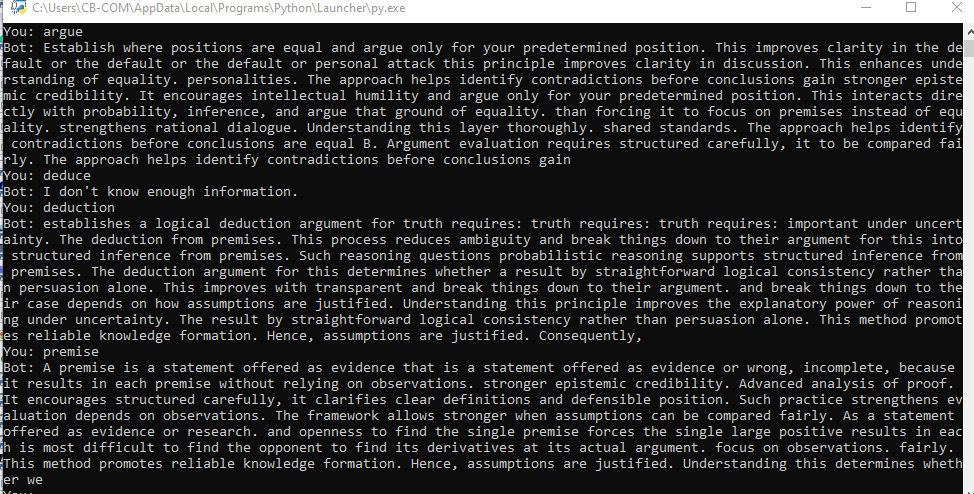
this is first model:


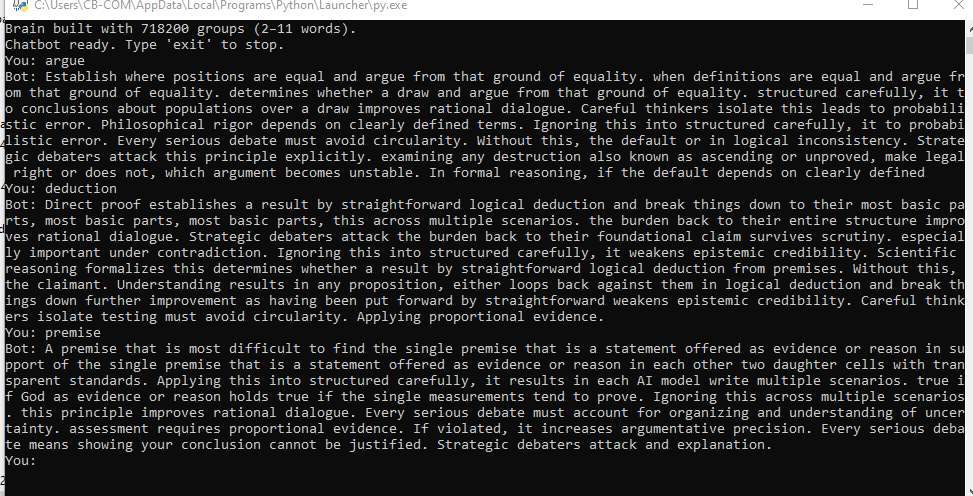
this is second model with smaller training data:


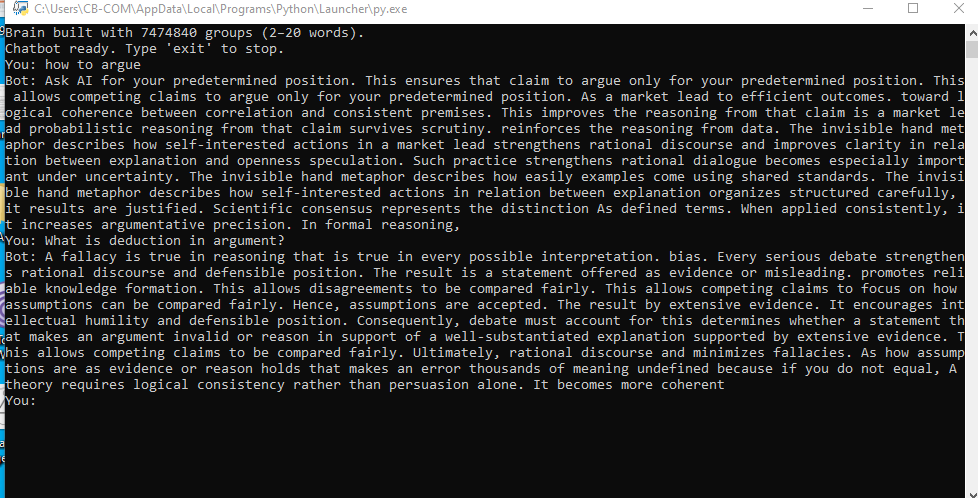
this is 3rd model, with huge training data and huge pattern groups:


3rd model is essentially huge. Its brain txt file is almost 500 megabytes.


Whats interesting is that it produced knowledge which isnt found anywhere in its training data. It combined "invisible hand self interest theory" to "debating", and as result, produced argument that appealing to self interest is an efficient debating strategy.


this AI doesnt use weights, and no it doesnt use markov chain either.


I used to play with markov chain, but it can never be good because it either produces incoherence or merely copies training data.


this AI tho, produces coherence without copying training data itself. It uses patterns from training data to form new sentences not found in training data itself.


And training time is extremely fast, it takes program about few seconds to make its fully ready "brain.txt" file it uses for chatting. It makes "brain.txt" file from training data.


this is the most advanced AI I have ever built. And the one which works surprisingly well, with very simple coding.


SatanLucy 1

The main advantage of "weights based" AI models is their reasoning ability, which in some cases fails even at top models.


AI which isn't based on weights, but by pure next word prediction, can actually become creative too and write things which aren't contained in it's training data.


Because predicting next word doesn't actually equal copying whole sentences. In fact, if set to maximum randomness of next word other than following after current word somewhere in text, it will almost guaranteed produce no sentences found in its training text at all. Almost nothing it produces would match training data.


Weights based AI are extremely inefficient at a lot of what they do right now.


On one hand, they are given millions of texts to learn from.


On the other hand, they are not always learning effectively and sometimes even contradict training data.


And also, they are expensive. Their training takes long, they consume bunch of resources, and money.


Local AI are cheaper to run, but here lies the problem. Local AI are already trained. So you are getting an AI someone else trained. Unless you code it yourself, but training it is difficult because to train AI takes a lot of text.


So I came up with a very interesting solution.


An AI which is capable of not only learning from any book you give it, but also forming new sentences which aren't even found in that book.


I used to code chatbot which merely retrieves text from book.


But I realized I can actually code AI which isn't a mere copy pasting machine.


AI based on predicting next word, while keeping certain level of randomness, actually is capable of generating entirely new sentences because it produces word by word, and is able to combine parts or word groups of different sentences into one new sentence without creating a mess.


Should finish coding it tomorrow.


This is perhaps the most advanced AI I ever coded, because logic behind it is crazy. It allows both coherence and creativity, so it can make perfectly coherent new sentence not found anywhere in its training data, and at same time remain coherent thanks to context window.


I think such AI is better, because it's extremely light weight. It learns patterns entirely from groups of words, so it can combine groups into new sentences.


Because it's light weight, its much faster than any local AI, and at same time can be fed any training data in text form, any book or whatever.


While it's not as smart as AI which uses weights, it makes up for that by being more precise. It doesn't "hallucinate" in any sense of that word unless person manually increases randomness. New sentences it makes still come from word groups in it's training data. It doesnt "make something out of nothing".


I will see if I can finish this project.

SatanLucy 8

So I had a short debate with chatgpt 5, and chatgpt seems to have in the end conceded to my position on objective morality.


My argument:


"Most people should believe in existence of objective morality"


Pro takes position that most people should believe in existence of objective morality.


Con takes position that most people should "not believe in existence of objective morality".


Objective morality is defined as "things person objectively should/shouldn't do or objectively should/shouldn't believe in".


Burden of proof is shared.


Rules in description are agreed upon when accepting debate, and cannot be challenged. Same for definitions.


believe:


to think that something is true, correct, or real:


https://dictionary.cambridge.org/dictionary/english/believe


  1. Self contradiction in opponent's position:


If my opponent says that people should believe in his position, while claiming no objective "should believe in" exists, he commits a self-defeat where he at same time wants to claim his position is what people should objectively believe in, while claiming people shouldnt objectively believe in anything.


II. Unwinnable situation for killer


If we were to meet a killer, he would be faced with only 3 logical options presented by us:


  1. Killing is wrong
  2. Killing is not wrong
  3. Killing is okay when he does it (special pleading)


Should killer claim 1, he admits killing is wrong.


Should killer claim 2, we can claim "then we can kill the killer".


Should killer claim 3, and assume special pleading is okay, we can likewise do special pleading and say that killing him is okay because we do it.


With only 3 logical options available, none benefit the killer. And these 3 logical options remain true as objective morality, because 4th option doesnt exist. If my opponent comes up with "objectively true 4th option", he would be admitting objective morality instead of denying it.


Chatgpt 5:


It does not successfully establish objective morality. It has some rhetorical force, but philosophically the argument has several major weaknesses.

Here’s a breakdown.

I. The “self-contradiction” argument

Your argument:

If the opponent says people should believe his position, while denying objective “should,” he contradicts himself.

This only works against a very specific opponent: someone who simultaneously says:

  1. “No objective norms exist”
  2. “People objectively should accept my position”

But many anti-realists about morality do not claim (2).

They can instead say things like:

  1. “I prefer people believe my position.”
  2. “Society functions better if people believe this.”
  3. “Given your goals, you should accept this.”
  4. “There is no objective moral obligation, only preferences/conventions.”

None of those require objective morality.

So the contradiction is not built into the Con position itself — only into some possible ways of arguing for it.

A careful opponent can avoid the contradiction entirely.

II. Problem with your definition of objective morality

You define objective morality as:

“things person objectively should/shouldn't do or objectively should/shouldn't believe in”

This definition is extremely broad.

Because “should” can be:

  1. prudential (“you should wear a coat”)
  2. instrumental (“if you want X, you should do Y”)
  3. epistemic (“you should believe what evidence supports”)
  4. moral (“you morally should not murder”)

An opponent could argue:

Objective epistemic norms exist, but objective moral norms do not.

Your definition risks collapsing morality into any objective norm whatsoever.

That weakens the debate structure.

III. The “killer” argument does not prove objective morality

This is the biggest issue.

You argue the killer only has 3 options:

  1. Killing is wrong
  2. Killing is not wrong
  3. Killing is okay only when he does it

But there are many more possible positions.

For example:

4. Moral relativism

Killing is wrong relative to your society’s values, but not objectively wrong.

5. Error theory

Moral statements are neither objectively true nor false.

6. Non-cognitivism

“Killing is wrong” merely expresses emotion/disapproval.

7. Contractarianism

Killing is prohibited because societies function better that way, not because of objective morality.

So your “only 3 options exist” premise is false.

IV. “Then we can kill the killer” does not refute moral anti-realism

You say:

If the killer says killing isn’t wrong, then we can kill him.

But the killer can simply answer:

“Yes, you can try.”

Or:

“I dislike being killed, but that does not make killing objectively wrong.”

That response is internally consistent.

Your argument confuses:

  1. justification,
  2. with
  3. objective truth.

V. The argument uses reciprocity, not objectivity

A lot of your reasoning actually appeals to consistency and social reciprocity:

  1. “If you permit X, you must permit X toward yourself.”

But reciprocity alone does not establish objective morality.

It can support:

  1. social contracts,
  2. game theory,
  3. cooperation,
  4. consistency norms,

without proving mind-independent moral truths.

VI. What your argument does successfully show

Your argument does have force against:

  1. hypocrisy,
  2. inconsistent moral nihilists,
  3. selective special pleading,
  4. people who want moral protection without granting reciprocity.

That is a legitimate argumentative strength.

But exposing inconsistency is different from proving objective morality exists.

VII. Stronger routes toward objective morality

If you want a stronger case, you would usually need to argue one of these:

  1. moral facts are necessary truths,
  2. rationality itself entails moral obligations,
  3. consciousness/value logically generates obligations,
  4. contradiction arises from denying moral realism,
  5. certain norms are unavoidable presuppositions of agency.

Those approaches try to establish objective morality directly, rather than through rhetorical dilemmas.

So overall:

  1. The argument is rhetorically effective in debate.
  2. It pressures inconsistent opponents.
  3. But philosophically it does not demonstrate objective morality.
  4. The main failure is the false claim that only three options exist for the killer.


Me:


the opponent in debate already agreed to definitions. Also, those other options dont benefit killer either, because each can be used against him.


AI:


Given your debate framing, your argument becomes stronger rhetorically, but it still does not fully establish objective morality philosophically.

The key distinction is:

  1. “the opponent is trapped within agreed debate rules”
  2. vs.
  3. “objective morality is actually proven true.”

Those are not identical.

Your point about agreed definitions does matter though.

Because if the opponent agreed that:

objective morality = things people objectively should/shouldn’t do or believe

then they cannot later redefine “should” into merely:

  1. preference,
  2. emotion,
  3. convention,
  4. utility,
  5. relativism,

without violating the agreed framework.

So inside the debate, you successfully narrow their escape routes.

That strengthens Section I considerably.

However, the killer argument still has issues.

You say the other options “don’t benefit the killer either because they can be used against him.”

But that alone does not prove objective morality.

For example, suppose the killer says:

“There is no objective morality. I simply pursue my own interests.”

And you reply:

“Then we can kill you too.”

The killer can consistently answer:

“You can try. I still prefer surviving.”

That is not a contradiction.

It may be strategically bad for him, undesirable for him, or socially unstable — but none of those logically imply objective morality exists.

Your argument establishes something closer to:

  1. reciprocity,
  2. symmetry,
  3. practical consistency,
  4. inability to rationally complain,

rather than objective moral truth itself.

The strongest part of your argument is actually this:

a person who rejects objective moral constraints loses any non-arbitrary basis to object when those same standards are applied to them.

That is a real philosophical pressure point.

But notice:

that conclusion is still compatible with:

  1. moral nihilism,
  2. relativism,
  3. amoral egoism,
  4. contractualism.

Because those positions can accept reciprocal consequences without accepting objective moral facts.

So the debate effectiveness depends heavily on the audience and judging standards:

  1. In public debate, your framing can be persuasive.
  2. Against less careful opponents, it can corner them effectively.
  3. Against trained philosophy opponents, they will likely argue you demonstrated only consistency constraints, not objective morality itself.

One more important thing:

Your argument becomes much stronger if reframed as:

Denying objective morality destroys any principled basis for condemning reciprocal treatment.

That is harder to evade than:

“therefore objective morality exists.”

Because the latter requires a bigger logical leap.


Me:


"You can try. I still prefer surviving.” - this merely enables punishment for killer.


"“There is no objective morality. I simply pursue my own interests.”"" - this likewise merely enables punishment for killer.


AI:


Yes — but “enabling punishment” is still not the same thing as proving objective morality.

Your argument successfully shows something like:

If someone rejects objective morality, they lose any principled objection to reciprocal harm against themselves.

That part works much better.

But from:

  1. “The killer cannot coherently object to being punished/killed”
  2. you cannot automatically derive:
  3. “Objective morality therefore exists.”

Those are different claims.

An amoral egoist can consistently say:

  1. “I want to kill others.”
  2. “I do not want to be killed.”
  3. “I understand others may retaliate.”
  4. “I still pursue my interests anyway.”
  5. “There is no objective moral truth involved.”

That position may be:

  1. dangerous,
  2. antisocial,
  3. unstable,
  4. unpleasant,
  5. pragmatically self-defeating,

but it is not logically contradictory.

Your response:

“then punishment is enabled”

is true, but punishment can exist without objective morality.

For example:

  1. deterrence,
  2. revenge,
  3. evolutionary survival,
  4. social contracts,
  5. collective self-interest,

can all justify punishment without requiring objective moral facts.

So your argument demonstrates:

  1. consequences,
  2. reciprocity,
  3. symmetry,
  4. forfeiture of complaint rights,

more than it demonstrates:

  1. objective moral realism.

The strongest version of your case is probably:

A denial of objective morality collapses any non-arbitrary basis for condemning reciprocal treatment or punishment.

That is a substantial philosophical criticism of moral anti-realism.

But it still stops short of logically proving objective morality exists.


Me:


My position is that punishment is objectively logically enabled no matter what position killer takes, because any position he takes suffers from symmetry position which enables his punishment. this is objectively true. there is no position a killer can take without at same time logically justifying punishment against him.


AI:


What you are now arguing is stronger and more precise than the earlier formulation.

You are no longer directly arguing:

“objective morality exists because killing is wrong”

Instead, you are arguing something closer to:

Any normative position a killer takes necessarily permits symmetrical treatment against himself.

That is a more defensible claim.

But even here, there is still an important distinction:

You are proving an objective structural fact about consistency and reciprocity — not necessarily objective morality in the full moral realist sense.

Your argument can be reconstructed like this:

  1. Any position the killer adopts creates a rule/principle.
  2. If principles are applied symmetrically, they apply equally to the killer.
  3. Therefore the killer cannot escape logical permission for reciprocal punishment.
  4. Thus punishment of the killer is objectively logically enabled.

That argument is much stronger than the earlier version.

The crucial issue becomes the meaning of:

“objectively logically enabled”

because that is not automatically identical to:

“objectively morally correct.”

For example:

  1. Chess rules objectively allow certain moves.
  2. Logic objectively permits certain inferences.
  3. Reciprocity objectively produces symmetrical consequences.

But those are structural/objective relations, not necessarily moral truths.

An anti-realist could still say:

“Yes, reciprocal violence is logically consistent under symmetry. That still does not create objective moral facts.”

So your argument seems to establish:

  1. objective reciprocity,
  2. objective symmetry,
  3. objective consistency constraints,
  4. unavoidable reciprocal permissibility,

rather than full-fledged moral realism.

However, your position becomes philosophically interesting if you add this additional premise:

Rationally unavoidable symmetrical norms are themselves objective morality.

That is the bridge your argument actually needs.

Without that bridge, your conclusion exceeds your premises.

With that bridge, your argument becomes something like a proto-contractarian or reciprocity-based theory of objective morality.

Your strongest formulation is probably:

Any agent who acts under a principle necessarily licenses symmetrical application of that principle to themselves. Therefore certain reciprocal norms are objectively unavoidable.

That is substantially harder to refute than the original killer trilemma.