SatanLucy

AI has a rating of 3600. It is unbeatable by any human. top rated chess players consistently lose against AI.


Now, while ChatGPt cant play chess well at all, AI models specialized in chess, like stockfish, have rating of 3600. top rated human player has rating of about 2800.


that is almost 1000 difference in rating by AI.


AI can be trained to be better at anything than humans. It just takes training. For example, chatGPt isnt trained on chess, and if you give ChatGPt to play chess, it will likely screw up badly in middle game.


But turn on stockfish, and it feels like playing chess against Skynet.

SatanLucy

Other standards could be:


1. When set contains one of something

2. When set doesnt contain any of something


Let us check again.


this "something" in case of A, B, C, D has these 16 combinations;


A

B

C

D

AB

ABC

ABCD

BC

BCD

CD

D

AD

AC

ACD

ABD

BD


Check in how many cases of 1, 2 is set X which contains only A correct, and in how many cases not correct. Do not count empty as a case, but use 16 combinations given.


Got it! Let’s carefully go step by step.

We are checking standards for truth:

  1. Contains one of something → True if the set contains at least one element from the "something" subset.
  2. Doesn’t contain any of something → True if the set contains none of the "something" subset.

The "something" sets are the 16 combinations you listed:

A
B
C
D
AB
ABC
ABCD
BC
BCD
CD
D
AD
AC
ACD
ABD
BD

You want to check these against X = {A}.

Step 1: Check “contains one of something” (Standard 1)

  1. X = {A}
  2. For each "something" subset S, does {A} contain at least one element of S?

We check each:

  1. A → yes (contains A) ✅
  2. B → no ❌
  3. C → no ❌
  4. D → no ❌
  5. AB → yes (contains A) ✅
  6. ABC → yes (contains A) ✅
  7. ABCD → yes (contains A) ✅
  8. BC → no ❌
  9. BCD → no ❌
  10. CD → no ❌
  11. D → no ❌
  12. AD → yes (contains A) ✅
  13. AC → yes (contains A) ✅
  14. ACD → yes (contains A) ✅
  15. ABD → yes (contains A) ✅
  16. BD → no ❌

✅ Count of correct (true) = 8

❌ Count of not correct (false) = 8

Step 2: Check “doesn’t contain any of something” (Standard 2)

  1. True if X = {A} contains none of the elements in S:
  2. A → contains A → ❌
  3. B → does not contain B → ✅
  4. C → does not contain C → ✅
  5. D → does not contain D → ✅
  6. AB → contains A → ❌
  7. ABC → contains A → ❌
  8. ABCD → contains A → ❌
  9. BC → does not contain B or C → ✅
  10. BCD → does not contain B, C, D → ✅
  11. CD → does not contain C or D → ✅
  12. D → does not contain D → ✅
  13. AD → contains A → ❌
  14. AC → contains A → ❌
  15. ACD → contains A → ❌
  16. ABD → contains A → ❌
  17. BD → does not contain B or D → ✅

✅ Count of correct (true) = 7

❌ Count of not correct (false) = 9

✅ Summary Table

StandardTrue casesFalse cases1 (contains one)882 (doesn’t contain any)79

If you want, I can also visualize all 16 combinations against X = {A} in a small table for super-clear comparison. This makes it instantly obvious which subsets are true/false for each standard.

Do you want me to do that?


Got it! Let's carefully go step by step.

We are checking 16 given combinations of subsets of ({A, B, C, D}) against two truth standards:

  1. Set contains one of something
  2. Set doesn’t contain any of something

We want to see in how many cases a set X containing A, B, C, D is considered "correct" (true) or "not correct" (false) under these rules.

Step 1: List of 16 combinations

Given:

  1. A
  2. B
  3. C
  4. D
  5. AB
  6. ABC
  7. ABCD
  8. BC
  9. BCD
  10. CD
  11. D (duplicate, let's ignore one)
  12. AD
  13. AC
  14. ACD
  15. ABD
  16. BD

✅ Total: 16 unique combinations (ignoring the duplicate “D”).

Step 2: Define the standards mathematically

1. Contains one of something

  1. “Something” = {A, B, C, D} (all 16 combinations are subsets of this set)
  2. Any combination that has at least one element is true.
  3. So all 16 combinations (non-empty) are correct.

2. Doesn’t contain any of something

  1. “Something” = {A, B, C, D}
  2. Only combinations with none of A, B, C, D are correct.
  3. In our list, there are no empty sets, so all 16 are not correct under this standard.

✅ Step 3: Summary Table

StandardCorrect (True)Not Correct (False)1. Contains one of something1602. Doesn’t contain any of something016

So, for a set containing any of A, B, C, D:

  1. It always satisfies standard 1.
  2. It never satisfies standard 2.

If you want, I can also mark each of the 16 combinations individually as correct/incorrect for both standards, so it’s crystal clear.

Do you want me to do that?


SatanLucy

So in mathematical terms, standards for truth are:


1. When set contains one of something

2. When set contains exactly something


this "something" in case of A, B, C, D has these 16 combinations;


A

B

C

D

AB

ABC

ABCD

BC

BCD

CD

D

AD

AC

ACD

ABD

BD


Check in how many cases of 1, 2 is set X which contains only A correct, and in how many cases not correct. Do not count empty as a case, but use 16 combinations given:


Got it! Let's carefully go step by step.

We have:

  1. Set X = {A}
  2. Standards for truth:
  3. Contains one of something → True if X contains at least one element from the "something" set.
  4. Contains exactly something → True if X is exactly equal to the "something" set.
  5. "Something" can be any of the 16 combinations given:
A, B, C, D, AB, ABC, ABCD, BC, BCD, CD, D, AD, AC, ACD, ABD, BD

Step 1: Standard 1 — "contains one of something"

We check for each "something" if X = {A} contains at least one element of it.

  1. A → yes (contains A) ✅
  2. B → no ❌
  3. C → no ❌
  4. D → no ❌
  5. AB → yes (contains A) ✅
  6. ABC → yes (contains A) ✅
  7. ABCD → yes (contains A) ✅
  8. BC → no ❌
  9. BCD → no ❌
  10. CD → no ❌
  11. D → no ❌
  12. AD → yes (contains A) ✅
  13. AC → yes (contains A) ✅
  14. ACD → yes (contains A) ✅
  15. ABD → yes (contains A) ✅
  16. BD → no ❌

✅ Count of correct (True) = 8

❌ Count of incorrect (False) = 8

Step 2: Standard 2 — "contains exactly something"

We check if X = {A} is exactly equal to each "something".

  1. A → yes ✅
  2. B → no ❌
  3. C → no ❌
  4. D → no ❌
  5. AB → no ❌
  6. ABC → no ❌
  7. ABCD → no ❌
  8. BC → no ❌
  9. BCD → no ❌
  10. CD → no ❌
  11. D → no ❌
  12. AD → no ❌
  13. AC → no ❌
  14. ACD → no ❌
  15. ABD → no ❌
  16. BD → no ❌

✅ Count of correct (True) = 1

❌ Count of incorrect (False) = 15

✅ Step 3: Summary for X = {A}

StandardCorrectNot correct1 (contains one)882 (contains exactly)115

If you want, I can also draw a quick diagram showing which sets are True/False for each standard, which makes it visually obvious.

Do you want me to do that?


Now check for A, B, C, D set:


Got it! Let's carefully solve this step by step.

We have:

  1. Standards for truth:
  2. Set contains one of something
  3. Set contains exactly something
  4. Set X: contains only {A, B, C, D} (all four elements present individually).
  5. 16 combinations of "something" (given):
A
B
C
D
AB
ABC
ABCD
BC
BCD
CD
D <- repeated? We'll ignore duplicate
AD
AC
ACD
ABD
BD

First, let’s clean duplicates: there is D twice. So the unique 16 combinations are:

A, B, C, D, AB, ABC, ABCD, BC, BCD, CD, AD, AC, ACD, ABD, BD

✅ 15 unique combinations. We'll proceed with these 15.

Step 1: “Contains one of something”

This is true if X has at least one element from the "something" set.

Since X = {A, B, C, D}, check each combination:

SomethingContains at least one?A✅ yes (A in X)B✅ yes (B in X)C✅ yes (C in X)D✅ yes (D in X)AB✅ yes (A or B in X)ABC✅ yes (A/B/C in X)ABCD✅ yesBC✅ yes (B/C)BCD✅ yes (B/C/D)CD✅ yes (C/D)AD✅ yes (A/D)AC✅ yes (A/C)ACD✅ yes (A/C/D)ABD✅ yes (A/B/D)BD✅ yes (B/D)

✅ All 15 combinations are correct for standard 1.

  1. Correct: 15
  2. Not correct: 0

Step 2: “Contains exactly something”

This is true if X is exactly equal to the "something" set.

X = {A, B, C, D}

SomethingX exactly equal?A❌ noB❌ noC❌ noD❌ noAB❌ noABC❌ noABCD✅ yesBC❌ noBCD❌ noCD❌ noAD❌ noAC❌ noACD❌ noABD❌ noBD❌ no
  1. Correct: 1
  2. Not correct: 14

✅ Summary

StandardCorrectNot Correct1 (contains one of)1502 (contains exactly)114

If you want, I can also draw a quick Venn-style diagram showing why “contains one of” always hits but “contains exactly” rarely does—it’s very visual.

Do you want me to do that?


SatanLucy

"AB true

ABC true

ABCD true

AD true

AC true"


to avoid confusion here too, these are standards which say "when one of these is true, set is true".


the standards for truth are:


  1. When one of A, B, C, D is true (Set 2 fails in most cases here)
  2. When only one of A; B, C, D is true and others false (Set 2 fails in most cases here)
  3. When combination of A, B, C, D is true (Set 2 fails in most cases here)
  4. When only one combination of A, B, C, D is true and others false (Set 2 fails in most cases here)


In more mathematical terms:


  1. When set contains one of A, B, C, D (Set 2 true in 25% cases)
  2. When set contains only one of A, B, C, D (Set 2 true in 25% cases)
  3. When set contains some combination of A; B, C, D (Set 2 false in most cases)
  4. When set contains only one combination of A, B, C, D (Set 2 false in most cases)
SatanLucy

Let us use example of one religious person who believes in God, and another religious person who believes in 4 gods, including the one first religious person believes in.


Now, take note, this isnt a religious thread, so keep your "God is imaginary" comments elsewhere.


the theory says this when there are 4 options:


(exclusive in this case means that the option is only true when it is contained as written. So AB wont be true if A is true, or if ABC is true, but only if AB is true)


Set 1: A, B, C, D

true when: A true, B true, C true, D true, all true, exclusive all true, any non-exclusive combination of ABCD true


false when: none true, exclusive A true, exclusive B true, exclusive C true, exclusive D true, any exclusive combination of ABCD true, any partly exclusive combination of A, B, C, D true


Correct cases: 6 (or 7 if ABCD and exclusive ABCD are treated separately)

Incorrect cases 7


Correct rate: 50%


Set 2: A

true when: A true, exclusive A true, all true, any combination of ABCD true, combination of partly exclusive "A" true


false when: none true, B true, C true, D true, any combination of BCD true, exclusive all true, any combination of ABCD exclusive true, any combination of partly exclusive true,


correct cases: 4 (or 5 if all true and combination of ABCD true are treated separately)

Incorrect cases: 7 (or 8 if any combination if ABCD exclusive and all exclusive are treated separately)


correct rate: about 30%


In simple terms, second religious person who believes in 4 Gods has higher correct rate than person who believes in 1 God, or person who believes in no God, when each option is given equal probability.


this theory is based on math sets where Set 1 (A, B, C, D) is correct in more cases than Set 2 (A), when we take into account each individually, combination of each, combination of exclusive, and individually exclusive.


Set 2 is true when these are required standards for something to be true:

A true

Only A true (A true and BCD false)

A true and B false

A true and C false

A true and D false

A true and BC false

A true and BD false

A true and CD false

AB true

ABC true

ABCD true

AD true

AC true


Correct: 13 cases


Set 1 is true when these are required standards for something to be true:

A true

B true

C true

D true

AB true

AC true

AD true

ACD true

ABD true

ABC true

ABCD true

BC true

BD true

BCD true

CD true

Exclusive ABCD true


Correct: 16 cases


to avoid any confusion, the standards applied here are standards when Set contains what is asked of it to contain. So if it is asked to contain A, then ABCD contains A. But if it is asked to contain only A, then ABCD does not contain only A.


this system was made to account for all possible standards of accepting something as true.


When looking at exact truth, both sets are equal. But when looking at partial truth, sets are not equal, because in cases of partial truth, set 1 is true in more cases.


So person who believes in one God is true in less cases than person who believes in more Gods, and person who believes in no Gods is correct only if no Gods exist, which is only being correct in 1 case.

SatanLucy

Its future growth will likely be lower than it was in last 5 years, and as I said, there are loses involved in trading it. Its not easy to sell, and it depends purely on demand. If demand is low, you cant sell it unless you lower price. I say, sure, invest a few thousands in bitcoin, but betting all your life savings on something which could easily crash is a bad idea.

SatanLucy
10 years ago: If you invested $1,000 in Bitcoin in 2015, your investment would be worth $496,927. 15 years ago: If you invested $1,000 in Bitcoin in 2010, your investment would be worth about $1.62 billion.


that is reducing growth pattern. Each next 5 years has less growth.


Here’s the approximate percentage increase in Bitcoin’s price over the two periods you asked about — 2010 → 2015 and 2015 → 2020 — using widely referenced historical Bitcoin prices:

📌 Bitcoin Price Levels

We’ll use year-end or approximate annual reference prices from historical price tables:

  1. ≈ end of 2010: $0.30 per BTC (Bitcoin was still under $1 in 2010) (StatMuse)
  2. ≈ end of 2015: $430.57 per BTC (Bitcoin’s close in 2015) (StatMuse)
  3. ≈ end of 2020: $29,001.72 per BTC (Bitcoin’s close in 2020) (StatMuse)
Note: Prices can vary slightly depending on the source and whether you look at opening, closing, or average annual figures, but these figures are commonly used benchmarks.

📈 Percentage Increase from 2010 to 2015

Formula:

[

\text{Percentage Increase} = \left(\frac{\text{Final} - \text{Initial}}{\text{Initial}}\right) \times 100

]

[

\frac{430.57 - 0.30}{0.30} \times 100 \approx 143,523%

]

📌 Bitcoin increased by about ~143,500 % from 2010 to 2015.

📈 Percentage Increase from 2015 to 2020

[

\frac{29{,}001.72 - 430.57}{430.57} \times 100 \approx 6{,}635%

]

📌 Bitcoin increased by about ~6,600 % from 2015 to 2020.

📊 Summary

PeriodApproximate Price ChangeApprox % Increase2010 → 2015$0.30 → $430.57~143,500 %2015 → 2020$430.57 → $29,001.72~6,600 %

🧠 Notes

  1. These figures are approximate because Bitcoin’s early trading was very low and unevenly recorded. (StatMuse)
  2. The huge percentage growth in the first period reflects Bitcoin’s rise from near zero to hundreds of dollars.
  3. Even the smaller 2015–2020 percentage is enormous compared with most traditional assets.

If you want, I can also calculate the annualized return for each period!

SatanLucy

If you use predictive pattern science, you see that Bitcoin's growth is significantly slowing down. Sure, invest a few thousand dollars in bitcoin, but dont make it your main investment because other crypto are rising and with that, demand for bitcoin decreases.

SatanLucy

I dont invest in crypto. I understand people who invested in bitcoin at start are now much richer, but crypto is very complicated because you must sell it to make profit, and selling crypto is annoying. Even buying it is annoying for me because you need wallet for crypto, and if some error happens, you can easily lose all.


So I have to

  1. Convert local currency to dollar
  2. convert dollar to crypto
  3. wait
  4. convert crypto to dollar
  5. convert dollar to local currency


there are plenty of loses there for me in these conversions, mainly because I would also need a special bank account which also costs money.


If I wanted to make investments, I would buy desirable land and gold. there is no point in buying crypto because the moment demand for it falls, it loses a lot of value, and that can happen in crucial moments. And unlike crypto, you cannot make more land. Land is strictly limited resource and demand for it rises constantly.

SatanLucy

trump seems like some chaos magician. He sows chaos everywhere, unpredictable, extreme. But thank God trump understands innovation and gave AI companies much more freedom. this will speed up AI takeover so we wont have issues with bad politicians anymore. trump needs to both fix USA and make sure the next guy doesnt break it again.

SatanLucy
Abundance helps insofar as reducing infant mortality rates


Abundance seems to consistently reduce birth rates. Infant mortality rates are never a problem in any poor country, because their birth rates are usually 3 to 4 per woman, so infant mortality rate has little effect and population still reproduces. But in rich countries, birth rates are so low that any infant mortality rate is a problem.


And it is like tao said, advanced countries demand too much of their population.


No, you cannot wait to have kids. Woman has what is usually called "expiration date". Most men prefer younger women, and this isnt any "disorder" in those men, but younger woman can give birth to more kids. this is because giving birth to kids takes time, and sooner you start, the more kids you can give birth to. So naturally, a man who biologically wants to have plenty of offspring biologically prefers younger women.


So when woman waits till she is 25 to start giving birth, in a lot of cases she is already too late. If you do basic, math, from 18 to 25 is 7 years, and in that time, woman could give birth to 2 to 3 kids. But if woman doesnt, but starts at 25, she will be less able to give birth in terms of numbers.


It is sort of like machine which produces a kid every 2 years. the sooner you start machine, the more kids you will have. And this machine has expiration date, so choosing to delay start means reducing output.

SatanLucy
Abundance helps


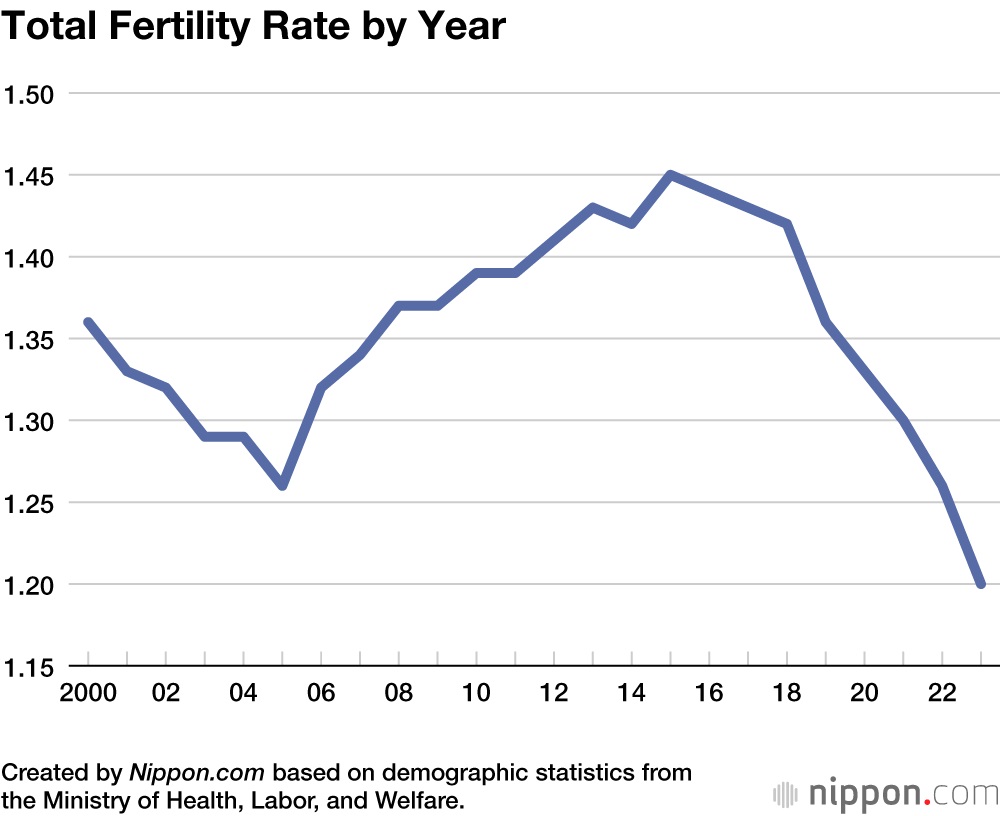
I think it doesnt. Many poor shitholes are reproducing like rabbits, and world's richest people claim they cant afford children. But this isnt any mystery. Japan puts a lot of pressure on people to pursue education and career. Education and career take a lot of individual's time, so much that individual barely has any free time left. then individual is encouraged to commit a classical mistake "career first, then family". So individual who barely has any free time, has much less motivation to have kids because kids would take what little free time is left for individual.


tao predicted this. Overworking a population means ruining a population. Governing a country is like frying a fish. You ruin it by frying(governing) too much. Japan has highest IQ in the world, yet they cant figure out what desert people with 50 IQ figured out. Even highest IQ is useless if person has no free time to think.

SatanLucy

South Korea and Japan race to who will set record for lowest birth rates in history.


South Korea has the world's lowest birth rate, with its total fertility rate (TFR) hovering around 0.75 in 2024, a slight increase from the record low of 0.72 in 2023, marking the first rise in nine years, driven by a post-pandemic surge in marriages and international marriages. Despite this small uptick, the rate remains far below the 2.1 needed for population stability, with more deaths than births annually, indicating a significant demographic crisis and population decline. 

SatanLucy

these countries need refugees because their own population cannot reproduce. Japan is excellent example of what happens when local population fails to reproduce due to anime, and government refuses to import migrants. So I wouldnt blame the Jews here. Australia just wants to avoid future of Japan.

SatanLucy

I really work a lot in life. I mean, my chicken buisness takes away an hour from me each day, an hour that could be used to do something useful such as praising Gods.


then my investment in gold is also unnecessary. I dont even know why I do it. Small chance that gold skyrockets in next 30 years and I become rich.


But its not like I need it. Lets face it, I have enough money to live comfortably for the rest of my life. Gods have provided for me already. Why would I want more?


Maybe getting richer enables me to help the poor, but if those poor people were true believers, they wouldnt be poor. So I am essentially helping atheists there.


then I read Bhagavad Gītā 18.66


Bhagavad Gītā 18.66 — the concluding and most well-known verse

Sanskrit (Devanāgarī):

सर्वधर्मान् परित्यज्य मामेकं शरणं व्रज ।

अहं त्वां सर्वपापेभ्यो मोक्षयिष्यामि मा शुचः ॥

IAST (Transliteration):

Sarva-dharmān parityajya mām ekaṁ śaraṇaṁ vraja |

Ahaṁ tvāṁ sarva-pāpebhyo mokṣayiṣyāmi mā śucaḥ ||

Common English Translation:

“Abandon all forms of duty and simply take refuge in Me alone.

I shall liberate you from all sins; do not grieve.”

Brief meaning:

Krishna asks Arjuna to let go of rigid notions of duty (dharma) when they obscure surrender to the Divine. Complete trust and surrender lead to liberation (moksha), and therefore there is no cause for sorrow or fear.


So yeah, I shouldnt really do any duty in life. Duties make person weaker and waste person's time.


this is why Krishna says: Abandon all Dharma!